





Long Life Tact Switch Guide: Lifespan, Cycles & Reliability
When engineers and procurement managers search for a long life tact switch, they are not just looking for a button that clicks — they are looking for a component that will still perform reliably at cycle one million the same way it did at cycle one. Choosing the wrong switch means field failures, product recalls, and replacement costs that dwarf the original savings. This guide walks you through everything you need to evaluate, specify, and select a long-life tact switch with confidence.
If you are still exploring the full range of tactile switch types and want to understand how long-life switches fit into the broader category, start with our complete tact switch guide before diving into the specifics here.
What Is a Long Life Tact Switch?
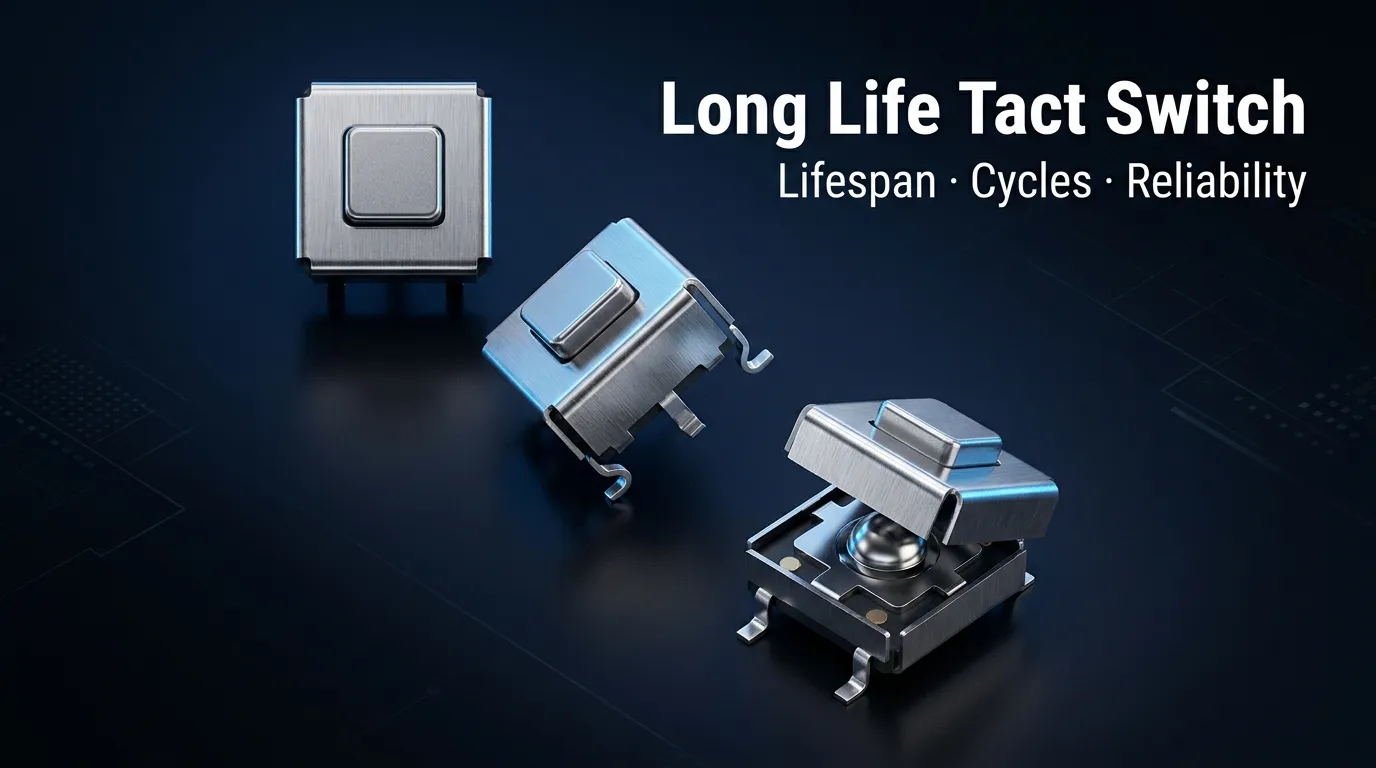
A long life tact switch is a momentary tactile push switch specifically engineered to sustain reliable electrical and mechanical performance across a high number of actuation cycles — typically one million cycles or more. This is the threshold that separates long-life switches from standard-grade components.
To understand this properly, you need to know what one actuation cycle means. One cycle = one complete press and release. The switch is pressed until the dome collapses and makes contact, then released until the dome returns to its resting position. That full motion counts as one cycle.
Here is where most buyers get confused. Standard tact switches are rated at 100,000 to 300,000 cycles. That sounds like a lot until you realize that a control panel button pressed 50 times per day reaches 300,000 cycles in under 17 years — but a gaming controller button pressed 5 times per minute during active play reaches the same count in roughly 41 days of use. Context determines whether a standard switch is enough or whether a long-life switch is non-negotiable.
| Grade | Cycle Rating | Typical Application |
|---|---|---|
| Standard | 100,000 – 300,000 | Remote controls, basic consumer electronics |
| Long Life | 1,000,000 – 2,000,000 | Industrial controls, medical interfaces |
| Extended Life | 2,000,000 – 10,000,000+ | Automotive, gaming, safety-critical systems |
How Cycle Life Is Measured and Tested
Understanding how a manufacturer arrives at their cycle life rating is one of the most important things a design engineer can know. It tells you whether you are looking at a validated specification or a marketing claim.
Cycle life testing is conducted using automated pneumatic test rigs. The switch is mounted in a fixture, and a pneumatic actuator presses it repeatedly at a controlled rate — typically between 3 and 12 cycles per second. Throughout the test, contact resistance is continuously monitored. The switch is tested under specified load conditions, ambient temperature, and humidity to replicate realistic deployment environments.
The switch is considered to have failed when one of two conditions is met: contact resistance spikes beyond the defined threshold (commonly a rise above 50 mΩ or a specified multiple of the initial value), or the tactile ratio drops by 30 to 50 percent from its baseline — meaning the dome no longer provides the intended tactile feedback to the user.
Electrical Life vs. Mechanical Life
This distinction is one that datasheets list but few articles explain clearly. Mechanical life refers to the number of cycles before the physical dome structure degrades — the switch may still click, but the force required or the travel distance has shifted outside spec. Electrical life refers to the number of cycles before the contact resistance becomes unreliable — the switch may still feel fine to the finger, but it is intermittently failing to pass a clean signal.
In most quality long-life tact switches, electrical life and mechanical life are close together. In cheap switches, electrical life ends significantly before mechanical life — the switch still clicks, but your device starts behaving erratically. This is why datasheets from reputable suppliers list both figures separately. If a datasheet only mentions one, ask the supplier for the other before committing to an order.
What Drives Tact Switch Lifespan — Key Material Factors
Two material decisions govern more than 80 percent of a tact switch's real-world lifespan: the dome material and the contact plating. Everything else is secondary. Engineers who understand these two factors can evaluate any switch datasheet in under two minutes.
Stainless Steel Dome vs. Phosphor Bronze — Why It Matters
The dome is the heart of the tactile switch. It is the metal disc that collapses under finger pressure, makes the electrical contact, and springs back. Every cycle puts it under mechanical stress. Over time, metal fatigue causes the dome to deform permanently, reducing tactile ratio and increasing actuation force variability.
Phosphor bronze domes are the standard material in budget and mid-range tact switches. They offer good conductivity and acceptable spring-back characteristics, but they fatigue faster under repeated compression. Phosphor bronze domes typically support 100,000 to 500,000 cycles before measurable degradation begins.
Stainless steel domes are the material of choice for long-life applications. Stainless steel has a significantly higher fatigue resistance than phosphor bronze — it retains its dome geometry and tactile ratio across 1 million to 10 million cycles far more reliably. When you see a switch advertised as long-life, the first thing to check on the datasheet is whether it uses a stainless steel (SUS) dome. If the dome material is not specified, treat the cycle claim with skepticism.
Gold vs. Silver Contact Plating for High-Cycle Applications
The contact plating determines how reliably the electrical connection is made at every cycle. This matters more than most buyers realize, especially in low-voltage, low-current circuits.
Silver-plated contacts are standard in most tact switches. Silver is an excellent conductor, handles standard signal-level currents well, and is cost-effective. For most applications running at 12V or higher with currents above 100 mA, silver contacts are entirely adequate even in long-life switches.
Gold-plated contacts are essential when your circuit operates in dry circuit conditions — meaning very low voltage (under 5V) and very low current (under 1 mA to 10 mA). At these signal levels, even microscopic surface oxidation on silver contacts creates enough resistance to cause intermittent failures or missed signals. Gold does not oxidize. In medical devices, precision instruments, automotive sensor interfaces, and communication equipment running at TTL or CMOS logic levels, gold plating is not a luxury — it is a reliability requirement. Specifying gold plating for a standard 12V indicator circuit is over-engineering that adds unnecessary cost. Specifying silver plating for a 3.3V microcontroller input is a field failure waiting to happen.
Operating Force and Its Impact on Longevity
Here is a trade-off that almost no competitor articles address: the relationship between operating force and dome lifespan.
Every time you press a tact switch, you are deforming the metal dome. Higher operating force means more stress is applied to the dome metal on every single actuation. More stress per cycle means the metal reaches its fatigue limit sooner. A switch rated for 1 million cycles at 160 gf operating force may only reliably deliver 600,000 to 700,000 cycles if deployed in an application where it is consistently pressed with more force than specified — for example, in a ruggedized device where operators press firmly or where a mechanical linkage amplifies the force.
This is particularly relevant in industrial environments where gloved operators, high-vibration conditions, or spring-loaded mechanical actuators are involved. When specifying a long-life tact switch for any application where force consistency cannot be guaranteed, select a switch rated at a force level below your worst-case expected actuation force, and add a cycle life safety margin of at least 30 percent above your calculated lifetime requirement.
Lighter operating force (100 to 160 gf) switches sustain the longest dome life. Heavier force switches (300 to 500 gf) trade off cycle life for a more positive tactile response in high-vibration environments where accidental actuation is a concern.
The Role of IP Rating in Reaching Rated Cycle Life
One of the most persistent misconceptions about tact switch specifications is that IP rating and mechanical cycle life are separate, unrelated parameters. They are not.
A long-life tact switch achieves its rated mechanical cycle count only when tested under clean, controlled conditions. In the real world, deployment environments introduce dust particles, moisture vapor, cleaning chemicals, and metal shavings — any of which can enter an unsealed switch housing and cause premature electrical failure, physical dome corrosion, or contact fouling. The switch may be mechanically capable of 2 million cycles, but if contaminants reach the contact surface at cycle 50,000, the electrical life ends there.
This is where IP rating becomes a lifespan protection mechanism, not just an environmental feature. An IP67-rated tact switch maintains a complete seal against dust ingress and temporary submersion in water, physically preventing the contaminants that cause early failure from reaching the dome and contacts. In other words, the IP rating does not increase the mechanical life — it ensures the switch actually reaches its rated mechanical life under realistic deployment conditions.
For detailed guidance on selecting the right sealing level for your environment, our IP67 tactile switch guide covers the full IP rating system and its application to tactile switches. If you are also evaluating sealing options more broadly, the waterproof tact switch selection guide walks through the complete range of waterproofing approaches and their trade-offs.
Long Life Tact Switch Specifications — What to Look for on a Datasheet
Most buyers scan a datasheet for cycle count and stop there. A properly specified long-life switch requires you to evaluate at least six parameters together. Here is a practical checklist.
| Specification | What to Look For | Red Flag Signs |
|---|---|---|
| Rated Mechanical Life | ≥1,000,000 cycles | No separate mechanical and electrical life figures |
| Rated Electrical Life | ≥1,000,000 cycles | Only mechanical life listed |
| Initial Contact Resistance | <100 mΩ (ideally <50 mΩ) | No resistance value listed |
| Contact Resistance Stability | Stable through rated life (no spike threshold stated) | No end-of-life resistance criteria |
| Operating Force | Listed in gf with ±tolerance | Only nominal value, no tolerance range |
| Dome Material | SUS (stainless steel) specified | "Metal dome" without material specified |
| Contact Plating | Gold or silver explicitly stated | Plating material unspecified |
| Test Load Conditions | Voltage and current listed for life test | Cycle count claimed with no test conditions |
| Operating Temperature | -20°C to +70°C minimum for industrial | Only room temperature specified |
Any supplier who cannot provide answers to all of these parameters from their datasheet is not in a position to guarantee the long-life performance they are claiming.
Application-Specific Cycle Life Requirements
Cycle life requirements vary enormously by industry and use case. Selecting a switch with far more cycles than you need adds unnecessary cost. Selecting one with too few guarantees field failure. Here is how to align your specification to your actual application.
| Application | Minimum Recommended Cycles | Key Concerns |
|---|---|---|
| Remote controls, basic consumer devices | 100,000 – 300,000 | Cost sensitivity, light use patterns |
| Gaming controllers, wearables | 1,000,000 – 2,000,000 | High use frequency, tactile consistency |
| Industrial control panels | 2,000,000 – 5,000,000 | Harsh environments, operator reliability |
| Medical devices | 5,000,000+ | Regulatory compliance, contact reliability |
| Automotive infotainment / EV controls | 2,000,000 – 10,000,000 | Vibration, temperature cycling, lifespan of vehicle |
| Safety-critical switches | 5,000,000+ | Zero tolerance for intermittent failure |
For automotive and medical applications, cycle life claims must be supported by test data aligned to standards such as AEC-Q200 (automotive components) or the applicable IEC standards for medical-grade components. Ask your supplier for test reports, not just datasheet numbers.
Standard Tact Switch vs. Long Life Tact Switch — When to Upgrade
The decision to upgrade from a standard tact switch to a long-life variant is fundamentally a total cost of ownership calculation, not a component cost comparison.
| Feature | Standard Tact Switch | Long Life Tact Switch |
|---|---|---|
| Typical Cycle Rating | 100,000 – 300,000 | 1,000,000 – 10,000,000+ |
| Dome Material | Phosphor bronze | Stainless steel |
| Contact Plating | Silver | Silver or gold |
| Sealing Options | Usually open/unsealed | Often available with IP54–IP67 sealing |
| Unit Cost | Lower | 20–80% higher depending on spec |
| Field Replacement Cost | High if product is deployed at scale | Avoided with correct upfront specification |
| Best For | Low-use consumer applications | Industrial, automotive, medical, high-use consumer |
The true cost of a standard switch in a high-cycle application includes the warranty claims, product recalls, technician time, customer satisfaction impact, and brand reputation damage that come with premature switch failure. A switch that costs $0.15 more per unit at the time of manufacture can save several hundred dollars per unit in field service costs over the product's lifetime.
When you are comparing sealing options as part of this upgrade decision, our sealed vs. waterproof tact switch comparison explains the practical differences between sealed, gasketed, and fully waterproof constructions and helps you match the right protection level to your environment.
For certain high-visibility applications — particularly in gaming, consumer electronics, and infotainment systems — long-life switches are also available with integrated LED illumination. Our LED tactile switch guide covers how illuminated long-life switches are constructed and what additional specifications apply when combining LEDs with high-cycle tactile mechanisms.
Common Mistakes When Selecting a Long Life Tact Switch
Even experienced engineers make specification errors that lead to premature switch failure. These are the most common mistakes — and how to avoid them.
Selecting by cycle count alone without considering environmental conditions. A 2 million cycle switch deployed in a dusty factory environment without a sealed housing will likely fail at 200,000 cycles due to contact fouling. Always pair cycle count with appropriate IP rating.
Assuming a higher IP rating automatically means a longer mechanical lifespan. IP rating protects against the conditions that cause early failure. It does not change the underlying mechanical cycle capability of the dome and contact structure. Both parameters must be specified correctly and independently.
Ignoring operating force in the lifespan calculation. If your application uses a mechanical actuator or spring-loaded linkage that applies force beyond the switch's nominal rating on every cycle, you are reducing dome life on every press. Always verify that your actuator force profile matches the switch specification.
Trusting cycle claims from datasheets that do not state test conditions. A cycle life rating is meaningless without knowing the test load (voltage and current), temperature, humidity, and rate of actuation used during testing. A switch tested at 5V/1mA may perform differently than one tested at 12V/100mA, even if the cycle count is identical.
Specifying gold plating unnecessarily for standard-voltage circuits. Gold plating adds measurable cost. In circuits running at 12V with currents above 50 mA, silver contacts perform equally well and last the full rated cycle life without oxidation issues. Save gold plating for the applications that genuinely require it.
Choosing the lightest available operating force simply to reduce finger fatigue without checking the force-life relationship. Extremely light switches (below 80 gf) may have reduced dome stability in high-vibration environments, leading to unintended actuations and effectively higher cycle consumption over time.
Frequently Asked Questions
What is considered a long life tact switch?
A tact switch rated for 1 million actuation cycles or more is generally classified as long-life. Standard switches are rated at 100,000 to 300,000 cycles. The specific threshold matters less than the match between the switch's rated life and your application's expected lifetime cycle count with an appropriate safety margin.
How many cycles does a tact switch last?
It depends entirely on the grade. Standard consumer switches last 100,000 to 300,000 cycles. Industrial long-life switches are rated at 1 million to 5 million cycles. High-end automotive and medical-grade switches can be rated at 10 million cycles or more. The dome material, contact plating, operating force, and environmental sealing all influence whether the switch reaches its rated cycle count in real deployment.
Does a higher IP rating make a tact switch last longer?
Not in the mechanical sense. An IP67 switch has the same dome fatigue characteristics as an unsealed switch of the same construction. What the IP rating does is prevent dust, moisture, and contaminants from causing early electrical failure — meaning the switch is far more likely to actually reach its rated mechanical life cycle count in real-world environments.
How is tact switch cycle life tested?
Automated pneumatic rigs press the switch at a controlled rate of 3 to 12 cycles per second under a specified electrical load. Contact resistance is monitored throughout the test. The switch is declared failed when contact resistance exceeds the defined threshold or when the tactile ratio drops by 30 to 50 percent from its initial measurement.
What causes a tact switch to fail before its rated cycle count?
The three main causes are: environmental contamination entering an unsealed housing and fouling the contacts; contact surface oxidation on dry circuit applications where silver plating was used instead of gold; and mechanical dome fatigue accelerated by operating forces higher than the switch's nominal rated force.
Should I choose gold or silver contact plating for a long-life switch?
Use gold plating when your circuit operates at low voltage (under 5V) and low current (under 10 mA) — these are dry circuit conditions where silver oxidation creates intermittent signal failures. Use silver plating for standard signal and power circuits at 12V or above with currents over 50 mA. Silver performs reliably at these levels and is significantly more cost-effective.
Does operating force affect how long a tact switch lasts?
Yes, directly. Higher operating force applies more mechanical stress to the metal dome on every actuation cycle. More stress per cycle means the dome reaches its fatigue limit sooner. For maximum dome longevity, select a switch with an operating force as low as your application allows, and always verify that your actuator or finger force profile stays within the switch's rated force tolerance.
Choosing a Tact Switch That Lasts
Selecting a long life tact switch comes down to three factors working together: the right dome material for your cycle target, the right contact plating for your circuit voltage and current level, and the right IP sealing to ensure the switch reaches its rated life in your actual deployment environment. No single factor is sufficient on its own.
The most reliable approach is to start with your application's lifetime cycle requirement, add a 30 to 50 percent safety margin, select the dome material and contact plating accordingly, then match the IP rating to the harshest environmental condition the switch will face in service. Use the datasheet checklist in this guide to validate any supplier's claims before committing to a specification.
For a broader view of the full tactile switch range — including all switch types, mounting options, and product categories — explore our complete tact switch catalog to find the right switch for every position in your design.
