





Automotive Tact Switch: Dashboards, Controls & Sensors
If you are engineering a vehicle dashboard, specifying components for a steering wheel control unit, or sourcing switches for an ADAS module, the tact switch you choose matters more than most buyers expect. A standard consumer-grade tact switch will not survive the thermal cycling, vibration loads, and moisture exposure that automotive environments routinely deliver. Automotive-grade tact switches are specifically designed to meet these demands — and selecting the right one for your application requires understanding what makes them different, where they are used inside vehicles, and which specifications to prioritize.
This guide covers everything a design engineer or procurement professional needs to know about automotive tact switches: where they fit inside a vehicle, what environmental conditions they must handle, how to read and apply the key specifications, and how to avoid the common selection errors that lead to premature field failures.
For a broader overview of tact switch types across all industries and applications, see our complete tact switch guide.
What Is an Automotive Tact Switch?
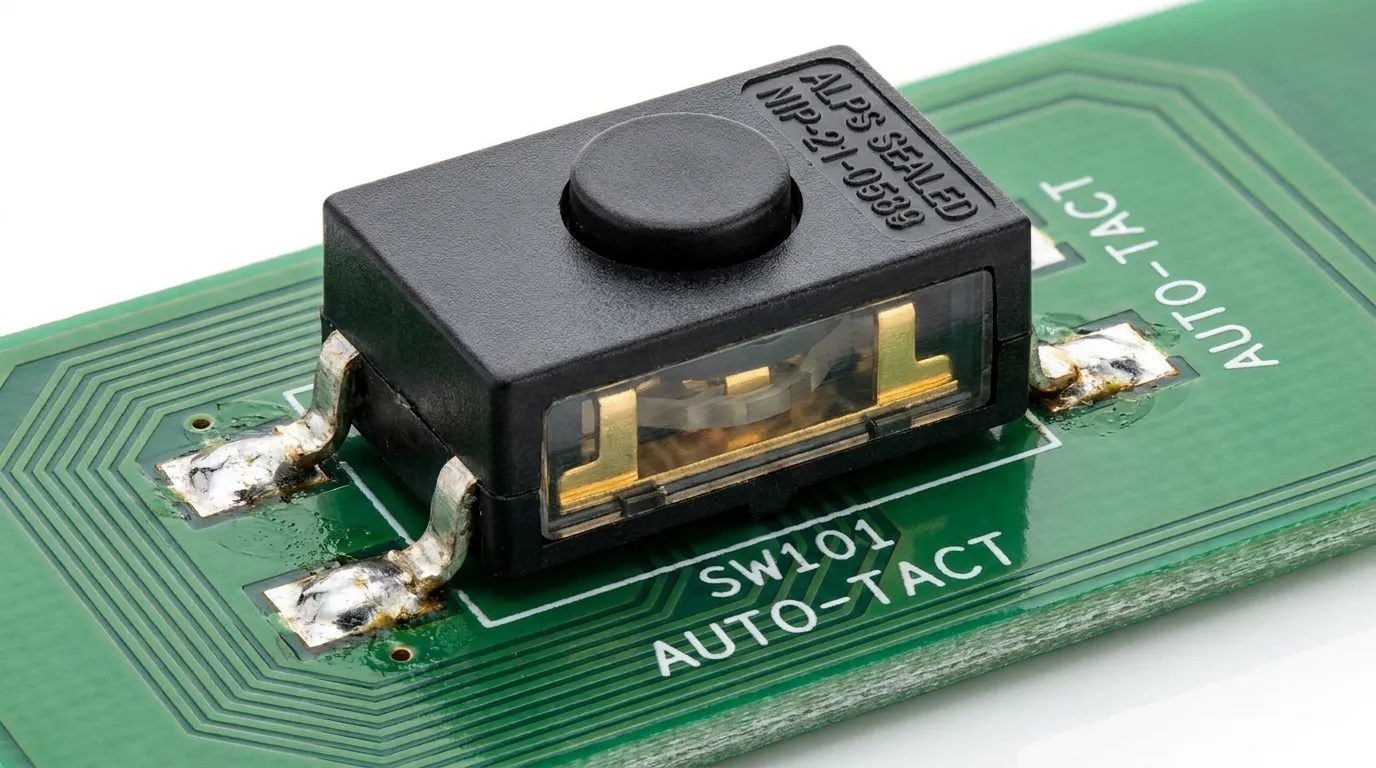
An automotive tact switch is a momentary push button switch engineered to operate reliably within the demanding conditions found inside and around vehicles. Like all tact switches, it is a normally-open device: pressing the actuator closes the circuit momentarily, delivers tactile feedback to the user confirming the input was registered, and releases the circuit when pressure is removed.
What separates an automotive-grade tact switch from a standard consumer-electronics variant is not the basic operating principle — it is the specification envelope. Automotive applications impose temperature extremes, vibration, mechanical shock, humidity, and long service life requirements that exceed what a typical tact switch is designed to handle. An automotive-grade tact switch is built from materials, sealed to protection ratings, and tested to cycle life thresholds that reflect the actual operating conditions of a vehicle across its entire service life.
In simple terms: if a standard tact switch is built for a keyboard or remote control, an automotive tact switch is built to survive ten or more years of engine heat, road vibration, cold starts, and thousands of button presses without contact degradation or mechanical failure.
Why Automotive Environments Demand More From Tact Switches
Every mounting location inside a vehicle presents a different combination of environmental stresses. A switch installed near the engine compartment faces fundamentally different conditions than one embedded in a steering wheel or a door panel, and the specification gap between "automotive-grade" and "consumer-grade" exists precisely because these conditions are unforgiving.
Temperature extremes are among the most significant challenges. Interior dashboard switches typically operate from around -20°C to +85°C, accounting for cold winter starts and the heat buildup inside a parked vehicle in summer. For switches mounted near the engine bay, near ECUs, or in underhood modules, the required operating range extends to -40°C to +125°C. Thermal cycling — the repeated expansion and contraction caused by cold starts followed by sustained operation — creates mechanical stress on solder joints, contact surfaces, and housing materials. Switches that are not rated for this range can suffer contact oxidation, housing warping, or solder joint fatigue. For applications in these areas, you need a switch rated for these temperatures from the outset. Our high-temperature tact switch guide covers the specific engineering and material requirements in detail.
Vibration and mechanical shock are continuous factors in any vehicle application. Road vibration is transmitted through the chassis and into every mounted component; engine vibration adds high-frequency stress in powertrain-adjacent locations. For tact switches, this creates two risks: mechanical fatigue of the switch body and solder connections, and false actuation — where road vibration registers as a button press. Automotive tact switches address this with higher specified actuation forces and more robust housing designs than their consumer counterparts.
Moisture and contamination are location-dependent but must be considered in every vehicle zone. Door panels, center console areas near cup holders, and any exterior-adjacent location are exposed to humidity, condensation, and liquid ingress. Even sealed cabin interiors experience humidity cycling. Unsealed tact switches are adequate only where moisture exposure is genuinely negligible — and in automotive design, that list is shorter than it appears.
Signal-level electrical conditions also matter. Most tact switches in automotive applications operate at low voltage and very low current — they are signal-switching devices, not power-switching devices. Contact materials and surface finish must maintain reliable low-resistance connections at these signal levels, especially after years of environmental exposure.
Where Automotive Tact Switches Are Used in Vehicles
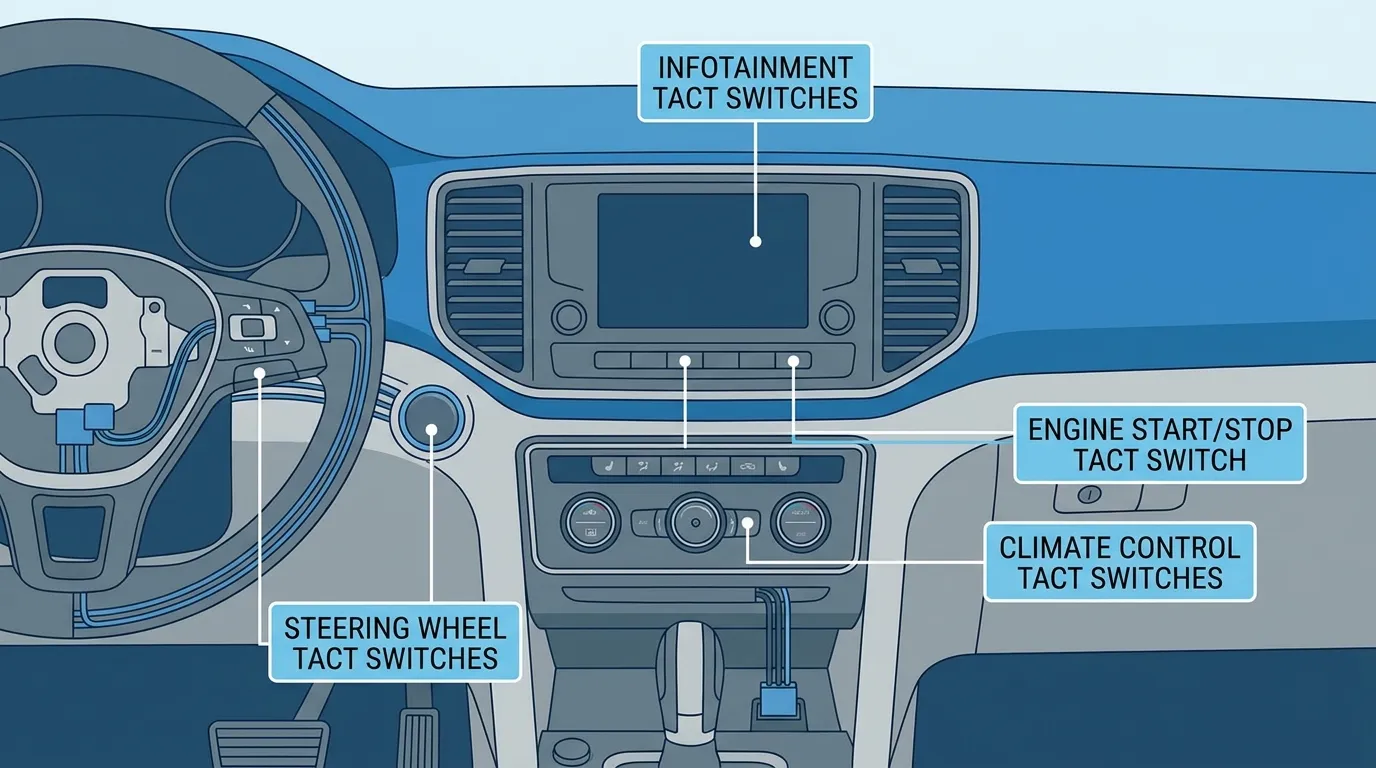
The range of applications is broad and continues to expand as vehicles become more electronically complex. Understanding the specific function and environment of each location is the foundation of correct switch selection.
Dashboard and Center Console Controls
Dashboard and center console panels represent the highest concentration of tact switches in most vehicles. Climate control panels, audio system interfaces, rear defrost activation, hazard light buttons, and infotainment navigation controls all rely on tact switches to translate driver input into electronic commands. These switches operate in a relatively controlled thermal environment but must endure millions of cumulative presses across a vehicle's lifespan, deliver consistent tactile feedback regardless of aging, and withstand the slow accumulation of humidity and fine dust that is normal in cabin interiors.
Steering Wheel Controls
Steering wheel-mounted switches — audio volume and track controls, cruise control activation, phone call management, and voice command triggers — are among the highest-cycle tact switch applications in a vehicle. A driver who uses audio controls several times per trip accumulates hundreds of thousands of actuation cycles over a vehicle's lifetime. Steering wheels also transmit both engine vibration and road vibration directly, making vibration resistance and false-actuation prevention especially important here. Long-life rated switches are not optional for this location. Our long-life tact switch guide explains the engineering behind extended cycle life and which factors most affect contact durability.
Door and Window Controls
Power window controls, door lock buttons, and mirror adjustment switches occupy a moisture-exposed zone. Door seals provide some protection, but temperature cycling causes condensation, and door panels in many vehicles do not fully exclude humidity. IP-rated sealed switches are the appropriate baseline for door panel applications.
ADAS and Safety System Buttons
Advanced Driver Assistance Systems increasingly include physical tact switch inputs — emergency stop buttons, lane assistance activation, driver alert controls, and parking system commands. These are safety-critical inputs where contact reliability is non-negotiable. A missed registration or false actuation in an ADAS context carries consequences that go beyond user inconvenience. Automotive tact switches for ADAS applications are specified with gold or gold-plated contacts to ensure reliable signal-level switching even after extended periods without actuation.
Engine Start/Stop and Ignition Controls
Engine start/stop buttons are high-visibility, premium-feel switches that must also meet serious engineering requirements. Their location near the dashboard area exposed to solar heat loading, combined with the expectation that the button will operate reliably every day for the life of the vehicle, means that cycle life, temperature rating, and tactile feel consistency all need to meet automotive-grade standards. The haptic character of the button — the crispness and resistance of the click — also factors directly into perceived vehicle quality.
Keyless Entry and Remote Fob Systems
Key fobs are one of the most cycle-intensive tact switch applications in any vehicle owner's daily experience. The small SMD tact switches inside remote entry fobs must deliver consistent tactile feedback, operate at very low power levels to preserve battery life, and survive the physical abuse of being dropped, compressed in pockets, and exposed to temperature extremes daily. For detailed guidance on SMD vs. through-hole and sealed vs. unsealed considerations in these applications, our sealed vs. waterproof tact switch guide provides a practical comparison.
Sensor and Navigation Interfaces
Navigation system controls, sensor calibration buttons on ADAS ECUs, and human-machine interface (HMI) inputs on driver assistance modules use compact, signal-level tact switches integrated directly into PCBs. These applications often require SMD mounting for board-space efficiency and precise actuation force to accommodate use-case contexts where control precision matters.
Key Specifications for Automotive Tact Switches
Specifying an automotive tact switch correctly begins with matching the switch specification to the actual operating conditions of the mounting location. The following table provides a practical reference for the most critical parameters by vehicle zone.
| Vehicle Zone | Temperature Range | Min. IP Rating | Cycle Life Guideline | Mounting Style |
|---|---|---|---|---|
| Dashboard / Center Console | -20°C to +85°C | IP54–IP65 | 500,000+ cycles | SMD or Through-Hole |
| Steering Wheel Controls | -20°C to +85°C | IP54 | 500,000–1,000,000 cycles | SMD |
| Door / Window Controls | -20°C to +85°C | IP67 | 300,000+ cycles | Through-Hole or SMD |
| Engine Bay / ECU Adjacent | -40°C to +125°C | IP67 | 100,000–500,000 cycles | SMD |
| Keyless Entry / Key Fob | -40°C to +85°C | IP67 | 300,000+ cycles | SMD |
| ADAS / Safety Controls | -40°C to +125°C | IP67 | 100,000+ cycles | SMD |
Actuation Force is measured in grams-force (gf). Consumer electronics tact switches often specify 100–160 gf, which is adequate for a keyboard or handheld remote where vibration is not a factor. In automotive applications, higher actuation forces — typically 200–400 gf depending on the location — are used to prevent road or engine vibration from generating false actuation events. Steering wheel controls and engine bay-adjacent switches particularly benefit from higher actuation force specifications.
Contact Material affects reliability at signal-level switching conditions. Gold contacts offer the best oxidation resistance and lowest contact resistance after extended service, making them the preferred choice for ADAS, ECU, and safety-critical applications where the switch may sit inactive for extended periods. Silver contacts perform well in higher-cycle, regular-use applications like dashboard and audio controls.
Cycle Life must be calculated against real use patterns, not just assumed from a product category. A steering wheel audio button pressed ten times per journey over 20,000 journeys demands 200,000 cycles minimum — and the engineering margin for a durable design pushes that to 500,000 cycles or more. For IP rating selection beyond the table above, our IP67 tactile switch guide explains exactly what the IP67 and IP68 ratings mean in practice and how to verify compliance.
Types of Automotive Tact Switches
Not every automotive application calls for the same switch type. The following comparison maps switch types to their primary automotive use cases.
| Switch Type | Key Feature | Best Automotive Applications | Notes |
|---|---|---|---|
| Standard Tact Switch | Basic momentary action, no sealing | Dry interior locations, ECU boards | Adequate only where moisture is genuinely absent |
| Sealed / Waterproof Tact Switch | IP67/IP68 ingress protection | Door panels, exterior controls, fob internals | Essential for any moisture-risk location |
| Illuminated (LED) Tact Switch | Integrated LED, visual feedback | Dashboard controls, low-light cabin use | Improves driver usability without distraction |
| High-Temperature Tact Switch | Rated to +125°C or higher | Engine bay, underhood modules, ECU proximity | Required where thermal exposure is severe |
| Long-Life Tact Switch | 500,000–1,000,000+ cycle rating | Steering wheel controls, high-frequency dashboard buttons | Prevents premature wear in high-use locations |
| SMD Tact Switch | Surface-mount PCB integration | Remote fobs, compact ADAS PCBs, modern automotive PCBs | Enables space-efficient board design |
| Through-Hole Tact Switch | Stronger solder joint attachment | High-vibration locations, legacy automotive designs | Preferred where mechanical robustness is critical |
Why Physical Controls Are Returning to Vehicle Dashboards
For several years, the automotive industry moved aggressively toward touchscreen-dominated interiors, relocating climate controls, audio settings, and safety functions behind menu layers on large displays. The rationale was partly economic — screens reduced wiring complexity and allowed software to manage many functions — and partly aesthetic, fitting a minimalist design trend.
The reversal is now well underway. Euro NCAP, Europe's primary vehicle safety assessment body, introduced updated assessment guidelines starting in January 2026 that require vehicles to have physical controls for critical functions in order to qualify for a five-star safety rating. Compliance thresholds rise from 60% in 2026 to 80% by 2028. ANCAP in Australia and New Zealand announced parallel requirements. The driver safety concern behind this shift is clearly established: research published in the UK found that touchscreen interaction while driving can slow reaction times by up to 57 percent compared to physical switch use. Studies consistently show that drivers can operate physical tact switches using muscle memory without diverting visual attention from the road — a capability that touchscreens fundamentally cannot replicate for driving-speed interactions.
Major automakers including Volkswagen, Hyundai, Mercedes-Benz, Audi, and Porsche have publicly committed to reintroducing physical controls. Mercedes-Benz engineering leadership stated directly: "The data shows us that physical buttons are better, and that's why we put them back in." This "re-buttonization" trend creates sustained and growing demand for automotive-grade tact switches designed to meet both the functional requirements and the premium haptic expectations of modern vehicle interiors.
For tact switch suppliers and automotive engineers, this means that the quality bar for physical switch selection is rising — switches must deliver a satisfying, consistent click feel across hundreds of thousands of actuations, not just basic momentary switching.
How to Select the Right Automotive Tact Switch
The selection process should follow a structured evaluation of the application's actual conditions rather than defaulting to the cheapest available part.
Step 1 — Map the mounting location. Identify the vehicle zone: cabin interior, door panel, engine-adjacent, or external. This immediately constrains your temperature range and IP rating requirements.
Step 2 — Define the cycle life requirement. Estimate the average number of actuations per journey and multiply by expected vehicle lifetime journeys. Build in a safety margin of at least 1.5–2× to account for variation across users and usage patterns.
Step 3 — Set the IP rating minimum. Any location with potential moisture exposure — including door panels, console areas near beverage zones, and all exterior-adjacent positions — requires IP67 as the minimum. Dry cabin locations with no moisture risk can accept IP54 to IP65.
Step 4 — Select actuation force to match the vibration environment. For locations that transmit road or engine vibration to the switch, specify 250 gf or higher to prevent false actuation. For low-vibration cabin positions where precise, light interaction is desirable (navigation, infotainment), 160–200 gf is appropriate.
Step 5 — Choose the mounting style. Modern automotive PCBs predominantly use SMD tact switches for board-space efficiency and automated assembly compatibility. Through-hole switches remain valid for high-vibration locations where the stronger mechanical solder joint is a meaningful advantage.
Step 6 — Decide on illumination. Illuminated tact switches with integrated LEDs are highly practical for dashboard and center console positions where low-light cabin use is common. They improve driver usability without requiring eyes-down attention to locate the switch.
Step 7 — Verify contact material and electrical rating. For ADAS, ECU, and safety-critical signal-level inputs, specify gold contacts. Confirm the rated voltage and current match your signal levels — automotive tact switches typically operate at 12V DC or lower at very low current.
Step 8 — Request supplier documentation. Ask for temperature cycling test data, IP rating certification, cycle life test reports, and RoHS compliance documentation. A supplier with genuine automotive experience should provide these without hesitation.
Common Mistakes in Automotive Tact Switch Specification
Specification errors in automotive tact switches are almost always the result of applying consumer-electronics thinking to automotive-grade requirements. The following table covers the most common mistakes and how to avoid them.
| Mistake | Why It Happens | How to Avoid It |
|---|---|---|
| Using consumer-grade switches in temperature-sensitive locations | Defaulting to the cheapest catalog option without checking the operating range | Always map the vehicle zone temperature and verify the switch datasheet rating |
| Underspecifying cycle life for steering wheel or dashboard controls | Cycle life calculations are skipped or underestimated | Calculate estimated lifetime cycles per application; specify with a 1.5–2× margin |
| Selecting too-low actuation force for vibration-exposed locations | Force is not considered in the context of vehicle dynamics | Specify 250 gf or higher for any location that transmits road or engine vibration |
| Ignoring IP rating for "indoor" dashboard locations | Assuming sealed cabin equals dry environment | Consider humidity cycling, condensation near vents, and liquid spill proximity |
| Specifying SMD switches without checking thermal reflow compatibility | Assuming all SMD switches are equivalent for automotive PCB processes | Verify the switch is rated for automotive-grade reflow temperature profiles |
| Choosing silver contacts for low-signal, low-use safety buttons | Silver is the default contact material at lower price points | Specify gold contacts where switches may sit inactive for extended periods at signal level |
| Prioritizing aesthetics over actuation force for safety buttons | Low-force switches feel lighter and more "premium" | For safety-critical inputs, function takes priority over haptic lightness |
Related Guides
Understanding automotive tact switch selection in full depth often requires reviewing the specific sub-topics that different vehicle locations raise. Our IP67 tactile switch guide covers what IP67 actually means in practice, how ingress protection is tested, and when IP67 is sufficient versus when IP68 is required — particularly relevant for door panel, exterior, and key fob applications.
For engineers evaluating whether a sealed or waterproof switch is the right choice for a given location, the sealed vs. waterproof tact switch guide explains the practical difference between these two categories and the correct terminology to use when specifying to a supplier.
High-cycle applications such as steering wheel audio controls and frequently used infotainment buttons benefit from purpose-engineered long-life switches. The long-life tact switch guide explains the mechanical and material factors that extend actuation life beyond standard ratings.
For engine-adjacent and underhood applications where temperature ratings are the primary constraint, the high-temperature tact switch guide covers the specific design and material requirements for operating at +125°C and above.
FAQs
What is an automotive tact switch?
An automotive tact switch is a momentary push button switch designed and rated to operate reliably under the temperature extremes, vibration, moisture, and long-service-life demands of vehicle applications. It provides tactile feedback to confirm user input and is used across dashboards, steering wheel controls, ADAS systems, door panels, and keyless entry modules.
What temperature rating do I need for an automotive tact switch?
For standard cabin and dashboard locations, a rating of -20°C to +85°C is typically sufficient. For switches installed near the engine, in underhood modules, or in ECU-adjacent positions, a -40°C to +125°C rating is required to survive thermal cycling across the vehicle's lifespan.
What IP rating should a dashboard tact switch have?
For dry interior positions with no direct moisture exposure, IP54 to IP65 is generally adequate. For door panels, exterior-adjacent locations, key fobs, or any area with potential liquid exposure, IP67 is the recommended minimum. When in doubt, specifying IP67 adds protection without significant cost impact.
What actuation force should I specify for an automotive tact switch?
For vibration-exposed locations — including steering wheel controls, engine bay areas, and door panels — specify 250 gf or higher to prevent false actuation from road or engine vibration. For low-vibration interior positions where a lighter touch is preferable (infotainment, navigation), 160–200 gf is appropriate.
How many cycles should an automotive tact switch last?
The answer depends on the application. High-use steering wheel controls may require 500,000 to 1,000,000 cycles. Standard dashboard buttons used several times per journey typically require 300,000–500,000 cycles over a vehicle's lifetime. Low-use safety buttons may be adequately served by 100,000-cycle ratings. Always calculate based on estimated use patterns and add a safety margin.
Can I use a standard SMD tact switch on an automotive PCB?
Consumer-grade SMD tact switches may not be rated for the higher reflow temperatures, thermal cycling stress, and extended temperature ranges of automotive PCB assembly processes. For automotive PCBs, verify that the SMD tact switch is explicitly rated for automotive operating temperature ranges and that the solder terminal design is compatible with your PCB reflow profile.
Why are physical buttons returning to car dashboards?
Euro NCAP updated its safety assessment guidelines in January 2026 to require physical controls for critical vehicle functions, linking touchscreen-heavy interiors to increased driver distraction and slower reaction times. Major automakers including Volkswagen, Hyundai, and Mercedes-Benz are actively reintroducing physical tact switch controls in response to both safety regulation and consumer preference. A UK study found touchscreen use while driving can slow reaction times by up to 57 percent compared to physical switch operation.
What is the difference between a tact switch and a dome switch in automotive applications?
Tact switches use a discrete mechanical contact mechanism integrated into a PCB-mounted housing, providing a defined actuation force and click ratio. Metal dome switches use a flexible dome-shaped membrane that collapses under pressure, often used in membrane keypads and overlay panels. Tact switches offer more precisely defined actuation force specifications and are better suited to through-hole or SMD PCB integration, making them the predominant choice for automotive control modules and dashboards.
Conclusion
Selecting the right automotive tact switch is a specification engineering task, not a commodity purchasing decision. The difference between a switch that delivers consistent, reliable operation across a vehicle's full service life and one that fails ahead of schedule comes down to matching the switch specification to the actual environmental demands of the mounting location — temperature zone, moisture exposure, vibration profile, expected cycle count, and signal-level requirements.
With Euro NCAP safety standards driving a return to physical controls in vehicle interiors and automakers actively redesigning dashboards around high-quality tactile input devices, the engineering expectations for automotive tact switches are rising rather than falling. Getting the specification right from the start is both a functional and a commercial imperative.
If you are evaluating automotive tact switches for a specific vehicle application, explore our full tact switch product range and selection guide or contact our team directly to discuss your specification requirements.
Looking for switches rated for the most demanding automotive environments? Browse our sealed, high-temperature, and long-life tact switch options, or contact us with your application details for a tailored recommendation.
