





ALPS Tact Switch Replacement: How to Match Specs Correctly
You have an ALPS tact switch on a PCB — and it is discontinued, on long lead time, or out of your budget. The natural next step is to find a replacement. But here is where most engineers make their first mistake: they match the footprint, order 10,000 units, and only discover during assembly that the height is 0.5mm too tall, or during field testing that the actuation force is off enough to cause accidental presses.
Replacing an ALPS tact switch correctly is not just about finding something that fits the pad layout. It requires matching a specific set of parameters, in a specific priority order, before you commit to any alternative. This guide walks you through exactly that — how to decode your original ALPS part, which specs are non-negotiable, and how to evaluate replacement options from brands like Omron, C&K, and OEM-grade manufacturers.
For a broader overview of tact switch types, sizes, and mounting options, see the complete tact switch guide.
Why Footprint Alone Is Never Enough
When engineers search for a tact switch replacement, the first thing they check is whether the pad layout matches. That is a necessary start — but it covers only one dimension of compatibility. The body footprint tells you whether the component will physically land on the PCB pads. It says nothing about whether the assembly will fit inside the enclosure, whether the button will feel right to the user, or whether the switch will survive the product's operating environment.
Consider a 6×6mm ALPS SKHH Series switch at 5.0mm total height. Swap it with a 6×6mm alternative at 5.8mm and you have a height overshoot of 0.8mm. In a tightly toleranced enclosure, that is enough to crack the housing or prevent the PCB from seating correctly. Alternatively, select a replacement with a 3.53N actuation force instead of the original 1.57N, and suddenly every button press on an industrial HMI requires noticeably more pressure than the product was designed for.
These are not edge cases. They are recurring failures in real production environments. The spec-matching process exists to prevent them.
How to Decode an ALPS Tact Switch Part Number
Before you can match a replacement, you need to extract the specification data from your original ALPS part number. Alps Alpine uses a structured part numbering convention across their TACT Switch™ lineup.
The ALPS Part Number Structure
Take the part number SKHHAMA010 as an example:
| Field | Code | Meaning |
|---|---|---|
| Series prefix | SKH | SKH-family snap-in type |
| Sub-series | H | SKHH — 6×6mm standard series |
| Height code | A | 4.3mm total height variant |
| Force code | M | 1.57N actuation force |
| Actuator type | A | Standard top-push actuator |
| Terminal code | 010 | Standard terminal style |
The middle characters encode the physical height and the actuation force — two of the most critical replacement parameters. If you cannot decode these, you risk selecting an alternative that matches the series name but delivers a completely different feel and physical profile.
Alps Alpine publishes complete series catalogs through their official distributor listings on Mouser and DigiKey, and their TACT Switch™ Selection Guide documents are publicly available through authorized distributors. When your ALPS part number is unfamiliar, run a parametric search on Mouser or DigiKey, input the exact part number, and read the datasheet before proceeding.
For a detailed walkthrough of how to read component datasheets and extract the right parameters, refer to this tact switch datasheet guide.
Most Common ALPS Tact Switch Series
Before looking for alternatives, confirm which ALPS series you are working with. Here is a quick reference for the most frequently replaced series:
| Series | Body Size (mm) | Height Range (mm) | Mounting | IP Rating | Typical Use Case |
|---|---|---|---|---|---|
| SKHH | 6.0 × 6.0 | 4.3 – 17.0 | Through-hole | None | Industrial, automotive, audio |
| SKTH | 3.5 × 3.2 | 2.5 | SMD | Dustproof (IP6X equiv.) | Consumer electronics, wearables |
| SKTR | 3.5 × 2.9 | 2.5 | SMD | Dustproof | Compact handheld devices |
| SKPM | 5.9 × 6.0 | 5.0 | SMD | None | Long-stroke automotive |
| SKPS | 5.9 × 6.0 | 5.0 | SMD | None | Low contact resistance, soft feel |
| SKSU | Compact | Varies | SMD | Dustproof | Automotive, middle-stroke |
The 7 Specs You Must Match Before Selecting a Replacement
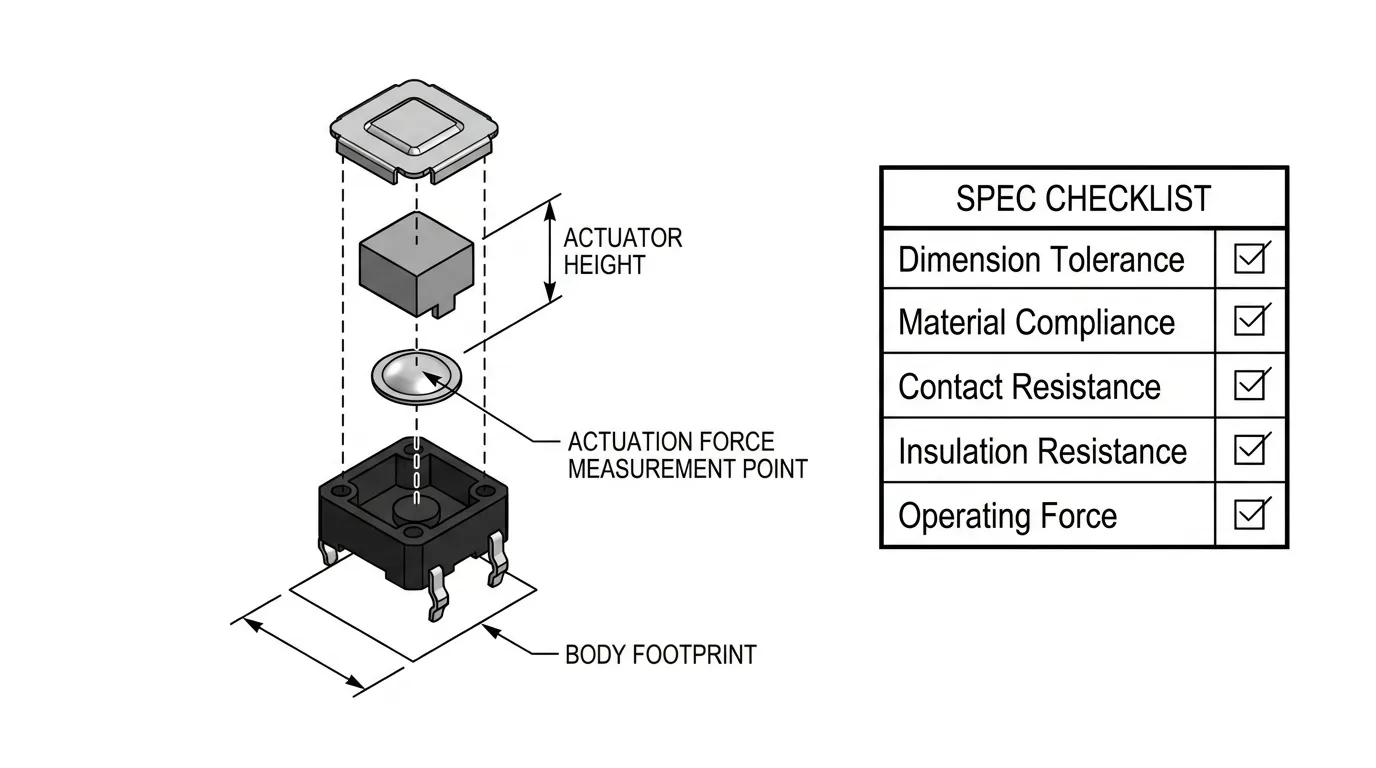
This is the core of the replacement decision. Below are the seven parameters that determine whether an alternative switch will work correctly in your PCB and application.
Spec 1 — PCB Footprint (Body Size and Pad Layout)
The body dimensions and PCB pad layout must match exactly for a true drop-in replacement. A 6×6mm body is not interchangeable with a 6×3.5mm body, even if both are "6mm" switches. Verify the exact pad pitch, pad size, and pin assignment from the datasheet.
Spec 2 — Total Height and Actuator Profile
Total switch height — from PCB surface to top of actuator — is a mechanical constraint set by the enclosure design. Even a 0.3mm deviation can interfere with the button cap travel or create clearance problems inside the housing. This spec is non-negotiable for drop-in replacement.
Spec 3 — Actuation Force
Actuation force (measured in Newtons or gram-force) controls how much pressure is needed to activate the switch. For consumer electronics, a ±15% variation from the original is generally acceptable. For automotive HMI, industrial control panels, or medical devices where haptic consistency is regulated or user-critical, keep the actuation force within ±5% of the original specification.
Spec 4 — Operating Travel Distance
Travel distance is the distance the actuator moves from the rest position to the actuation point. Mismatching travel changes the button feel and can affect mechanical compatibility with the key cap or button housing above the switch. Most ALPS SKHH models travel 0.25mm; always confirm this matches before substituting.
Spec 5 — Electrical Rating (Voltage and Current)
Your replacement must meet or exceed the original switch's rated voltage and current. Most standard ALPS tact switches are rated at 50mA / 12V DC, with a minimum rating of 10μA / 1V DC for low-signal applications. Never substitute a switch with lower ratings than the original circuit demands.
Spec 6 — Mounting Type (SMD vs. Through-Hole)
Surface mount and through-hole switches are not interchangeable without PCB rework. Confirm whether the original is a surface mount (SMD/SMT) or through-hole (DIP/THT) type before sourcing an alternative. Some series exist in both mounting configurations with identical body footprints but different pad geometries.
Spec 7 — IP Rating and Sealing Level
If your original ALPS switch is a dustproof or waterproof variant (SKTH, SKTR, or automotive SKSU series), the replacement must provide an equivalent sealing level. Substituting an unsealed switch into an application that sees moisture, dust, or contaminants is a common cause of field failures that only appear weeks or months after deployment.
Quick Reference: Which Specs Are Non-Negotiable vs. Flexible
| Specification | Non-Negotiable | Allows Some Tolerance |
|---|---|---|
| PCB footprint / pad layout | ✔ | |
| Total height | ✔ | |
| Mounting type (SMD/THT) | ✔ | |
| IP / sealing rating (if required) | ✔ | |
| Actuation force | ±15% for consumer use | |
| Operating travel | ±0.05mm typically acceptable | |
| Electrical rating | Replacement must meet or exceed | |
| Operating life | Upgrading is acceptable |
ALPS Tact Switch Replacement Options by Brand
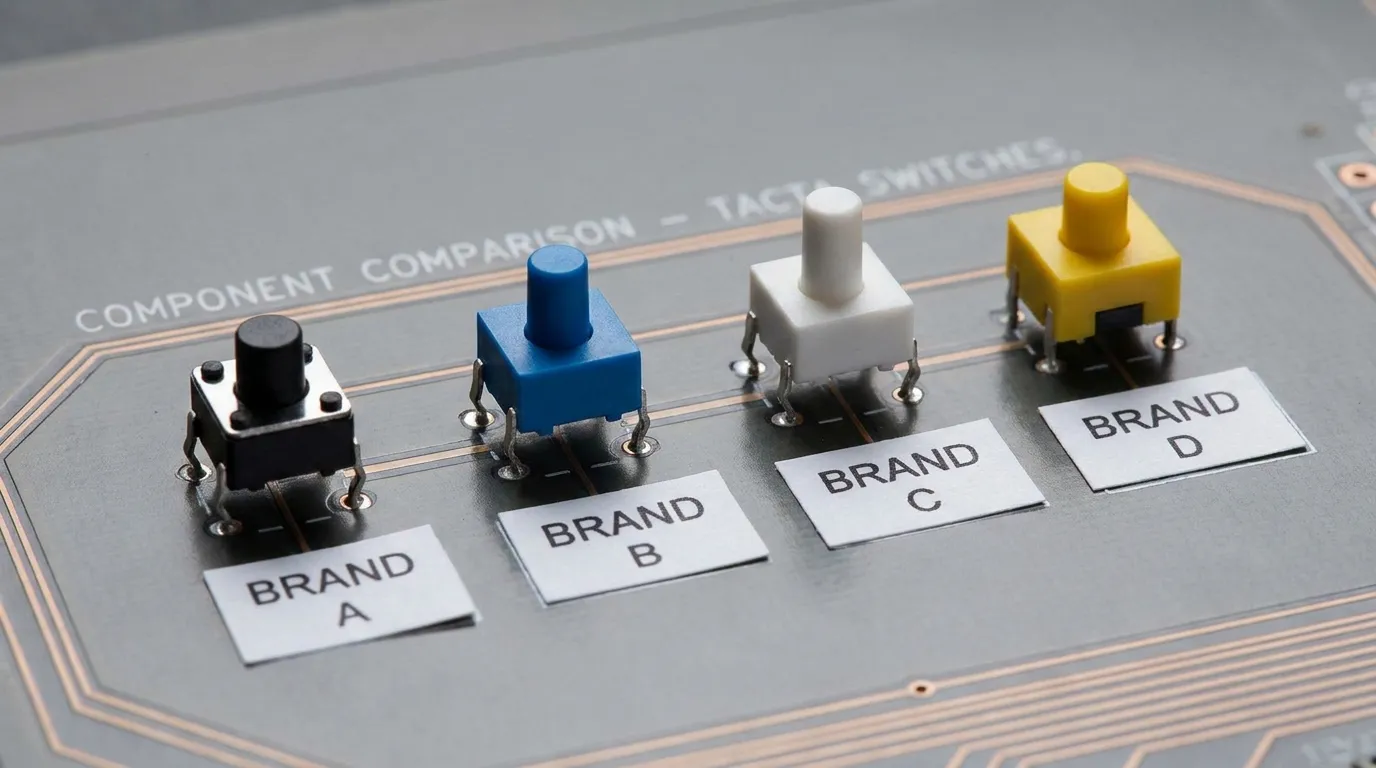
Omron — The Most Common ALPS Alternative
Omron's B3F (through-hole) and B3FS (SMD) series are the most widely used direct alternatives to ALPS SKHH switches. Both share the 6×6mm footprint and are available in multiple actuator heights and actuation forces. The B3F-1002, for example, is a well-known substitute for mid-range SKHH models. Omron switches use a sharp-click mechanism that provides a feel comparable to standard ALPS models.
One practical note: Omron's sealing options differ from ALPS. If your original ALPS switch is a dustproof or sealed variant, verify the Omron model's IP designation individually — not all B3F variants include the same protection level.
C&K and Panasonic — Premium Alternatives for Specific Applications
C&K's PTS645 and KMR series offer 6×6mm and smaller footprint options with actuation forces ranging from 130gf to 260gf, and a 100,000-cycle rated life. These are a good choice when you need a well-documented Western-brand alternative for use in safety-regulated applications.
Panasonic's EVQ series covers similar ground, particularly in ultra-compact SMD formats. However, note that some Panasonic EVQ models have reached end-of-life status in recent years, so always verify current availability before specifying them into a new design.
HX-Switch — OEM-Grade Alternative for Volume Procurement
For procurement teams sourcing at volume, HX-Switch (Hanxia) offers tact switch models that match the mechanical footprints, height variants, and electrical ratings of common ALPS series — including sealed and unsealed options across SMD and through-hole mounting configurations. Their product line covers standard 6×6mm through-hole types, compact SMD formats, and IP67-rated waterproof models with actuation force options from 100gf through 250gf and cycle lives up to 2 million actuations.
The key advantage of an OEM-grade manufacturer at this level is the ability to specify exact parameters — force, height, travel, sealing — and receive a confirmed datasheet before bulk production commitment. If you are procuring ALPS replacements at scale and need cost predictability alongside documented quality, see this guide to buying ALPS-equivalent tact switches in bulk.
Direct Spec Comparison: ALPS vs. Replacement Alternatives
The table below compares common ALPS SKHH series specifications against frequently used replacement options across major brands, using the 6×6mm through-hole configuration as the reference point.
| Parameter | ALPS SKHH | Omron B3F | C&K PTS645 | HX-Switch TS-6636 |
|---|---|---|---|---|
| Body size (mm) | 6.0 × 6.0 | 6.0 × 6.0 | 6.0 × 6.0 | 6.0 × 6.0 |
| Height options (mm) | 4.3 / 5.0 / 7.0 / 9.5+ | 4.3 / 5.0 / 7.0 | 4.3 / 5.0 | 4.3 / 5.0 / 7.0 |
| Actuation force range | 0.98N – 5.10N | 0.98N – 3.43N | 1.27N – 2.55N | 1.57N / 2.55N typical |
| Operating travel | 0.25mm | 0.25mm | 0.25mm | 0.25mm |
| Electrical rating | 50mA / 12V DC | 50mA / 24V DC | 50mA / 12V DC | 50mA / 12V DC |
| Operating life | 200K – 1M cycles | 1M cycles | 100K cycles | 1M cycles |
| IP / sealing | None (standard) | None (standard) | None (standard) | Options available |
| Mounting | Through-hole | Through-hole | Through-hole | Through-hole |
For most 6×6mm through-hole replacements: Omron B3F is the closest branded drop-in. For sealed applications or volume procurement, verify the specific sub-series or contact an OEM manufacturer with your full spec requirement.
How to Verify a Replacement Before Mass Production
Never commit to a bulk order based on spec sheet matching alone. The correct validation process has three steps, and skipping any one of them is how production-level failures happen.
Step 1 — Request samples and verify PCB fit. Before ordering volume, install the candidate switch on the actual PCB and confirm that the body seats flush, the pins align with the pads, and the total height clears the enclosure. A 0.2mm mismatch that looks insignificant on paper can prevent an enclosure from closing.
Step 2 — Test actuation feel against the original. If possible, actuate both the original ALPS switch and the proposed replacement side-by-side on the same board. Tactile feel is partly subjective, but noticeable force differences will be flagged immediately by anyone who uses the product.
Step 3 — Verify IP rating in a real environment. If your application exposes the switch to moisture or dust, do not rely on the IP classification on the datasheet alone. Test under realistic conditions — condensation, splash, vibration — before signing off on the replacement.
For a structured approach to requesting validation samples from manufacturers, refer to this tact switch sample guide.
Common Mistakes When Replacing ALPS Tact Switches
Matching footprint but ignoring height. This is the most frequent error. Engineers verify the 6×6mm pad layout and order 5,000 units without checking whether the 5.8mm height replacement clears their 5.0mm enclosure recess. The result is a mechanical interference failure found at the assembly stage.
Selecting the wrong actuation force without user testing. A 0.98N switch replaced with a 3.53N switch may seem like a simple number difference. In practice, it changes every button interaction in the product. Always test with real users or operator reference standards before approving.
Ignoring IP rating in outdoor or industrial products. Standard SKHH switches have no IP protection. If your product is used in a vehicle cabin, a food processing environment, or a handheld outdoor device, and the original ALPS part was a sealed variant, an unsealed replacement will fail in the field — often in ways that are difficult to diagnose.
Using uncertified generic components in regulated applications. In medical devices or automotive safety systems, component substitutions may require re-validation under applicable standards. Always consult your quality engineering team before replacing a component in a regulated product.
Ordering from a single datasheet parameter without a full cross-reference. Many engineers find a part that lists "6×6mm, 160gf" and assumes it matches. Contact configuration, pad dimensions, pin pitch, and height must all be verified against the original — not just body size and force.
When a Custom Tact Switch Is the Better Answer
Standard replacement options work well when your original ALPS part maps cleanly to existing alternatives. But some applications require a combination of parameters — a specific body size, a sealing rating, a particular actuation force, and a long cycle life — that no off-the-shelf brand covers simultaneously.
In those cases, the practical answer is not to compromise on specs. It is to work with a manufacturer that can build to your requirement. Custom tact switch production allows you to specify the exact footprint, height, force, travel, IP rating, and contact material — and receive a documented datasheet against those parameters. This is particularly valuable in automotive, medical, and industrial applications where deviation from a design spec carries regulatory or liability implications.
To understand what custom tact switch design involves and whether it fits your project, see this custom tactile switch guide.
Frequently Asked Questions
Can I replace an ALPS tact switch with an Omron switch?
In most cases, yes. Omron's B3F (through-hole) and B3FS (SMD) series share the 6×6mm footprint with ALPS SKHH switches and are available in matching height and force variants. Before finalizing, confirm total height, actuation force, and IP rating — standard Omron B3F models are unsealed, so they are not suitable replacements for dustproof ALPS variants.
What happens if I select a replacement with the wrong actuation force?
The button feel changes noticeably for end users. In consumer electronics this typically causes user experience complaints. In industrial or automotive HMI it can create accidental activations (too light) or operator fatigue (too heavy). Match actuation force within ±15% for general applications, and tighter for regulated or precision environments.
How do I find a replacement for a discontinued ALPS part number?
Run the original ALPS part number through the parametric cross-reference tool on DigiKey or Mouser. These tools return alternatives based on matched specifications. Alternatively, download the ALPS Alpine TACT Switch™ Selection Guide from their official distributor pages — it documents all active series with full spec tables. For help reading the datasheet output, refer to this tact switch datasheet guide.
What is the difference between a drop-in replacement and a functional equivalent?
A drop-in replacement fits the exact PCB pad layout, height, and mounting configuration with no rework required. A functional equivalent performs similarly — same force range, same electrical rating — but may require minor pad adaptation or mechanical adjustment. For established production lines, always target a drop-in replacement first to avoid re-validation costs.
Does IP rating matter when replacing a tact switch?
Only if the original switch was rated. If your ALPS part was an unsealed standard model (such as most SKHH variants), an unsealed replacement is acceptable for the same environment. If the original was a dustproof or waterproof variant (SKTH, SKTR, or sealed SKSU), you must source a replacement with an equivalent or higher IP rating. Substituting an unsealed switch into a sealed application will result in field failures.
Are generic Chinese tact switches reliable replacements for ALPS?
Quality varies significantly by manufacturer. Generic commodity switches from unknown sources carry unpredictable risks in terms of actuation force consistency, contact plating quality, and cycle life accuracy. OEM-grade manufacturers with published datasheets, 100% factory inspection, and documented production standards are a different category — they can provide verifiable equivalents. The key is always to request samples, verify specs, and test before committing to volume.
How many actuation cycles does an ALPS tact switch last?
It depends on the series and model. ALPS SKHH models range from 200,000 cycles (high-force variants) up to 1,000,000 cycles (low-force variants). The SKUB Series, Alps Alpine's smallest SMD model, is rated for 500,000 cycles. When selecting a replacement, matching or exceeding the original cycle life specification is always acceptable — downgrading the cycle life is not recommended unless the application load is known to be significantly below the original rating.
Related Guides
If you are evaluating tact switch replacements as part of a broader procurement or design project, these guides cover the next steps in detail.
The complete tact switch selection guide covers all tact switch types, mounting configurations, series comparisons, and application contexts — useful if you are working across multiple switch specifications or selecting from scratch rather than replacing a specific part.
Before you finalize a replacement specification, knowing how to read and validate a component datasheet saves time and prevents errors at the sample stage. The tact switch datasheet guide walks through the key parameters and what they mean in a real selection context.
For teams procuring replacements at volume, the bulk tact switches buying guide covers how to structure an RFQ, evaluate suppliers, and manage quality assurance for large orders.
And if the standard replacement options do not cover your combination of specs, the custom tactile switch guide explains when and how to commission a custom design instead.
Conclusion
Replacing an ALPS tact switch correctly comes down to a clear priority order: confirm the footprint, verify the height, match the actuation force, and check the IP rating if the original was sealed. Everything else — cycle life, electrical rating, contact plating — follows from there. Engineers who work through these parameters in sequence, request physical samples before bulk orders, and test in real conditions avoid the failures that come from treating a tact switch replacement as a simple part lookup.
The right replacement exists. It just requires the right process to find it.
