





Medical Grade Tactile Switch for Reliable Device Design
When you are designing a medical device — whether it is a ventilator control panel, a bedside patient monitor, or a handheld diagnostic instrument — the tactile switch is one of the smallest components with one of the largest impacts on overall device reliability. Choose the wrong switch and you face oxidized contacts causing signal dropout, liquid ingress triggering false inputs, or premature wear that shortens device service life well before regulatory projections. Choose correctly, and you have a component that performs consistently across millions of actuations, survives clinical cleaning routines, and holds up through every regulatory audit.
This guide explains exactly what makes a tactile switch "medical grade," which specifications matter most in clinical environments, how to match switch parameters to your device type, and how to avoid the most common specification errors that create downstream compliance and reliability problems.
What Is a Medical Grade Tactile Switch?
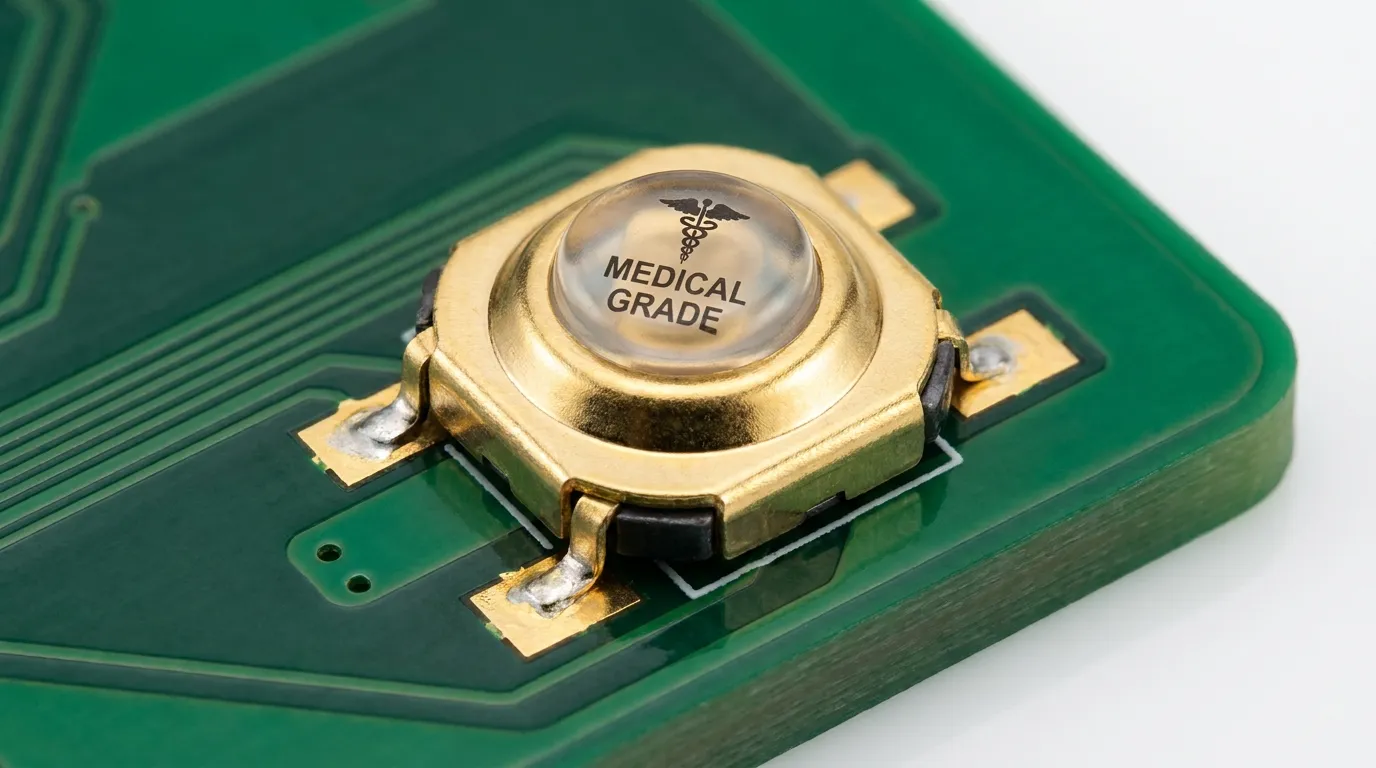
A medical grade tactile switch is a momentary push-button switch engineered to meet the safety, reliability, environmental, and compliance requirements of medical electrical equipment. The term "medical grade" is not a single certification mark — it describes a combination of specification thresholds, material requirements, documentation standards, and manufacturing quality controls that collectively make a switch suitable for use in regulated healthcare environments.
In practical terms, a medical grade tactile switch differs from a standard consumer or industrial switch in four key ways: it meets defined IP sealing levels compatible with IEC 60601-1, it uses contact materials (typically gold-plated) that maintain reliable signal integrity at the low voltages and currents common in medical electronics, it is rated for the cycle life required by the device's expected service duration, and it is manufactured with traceability documentation — material certificates, lot records, and compliance declarations — that support ISO 13485-aligned design history files.
For engineers who want a broader understanding of tact switch types, mounting configurations, and general selection principles, the complete guide to tact switches provides a useful starting point before narrowing down to medical-specific requirements.
Why Standard Switches Fail in Medical Environments
The gap between a standard industrial tactile switch and a medical grade one is not always visible to the eye, but it becomes very visible in the field. Clinical environments impose a combination of stresses that quickly expose weaknesses in components not designed for them.
Liquid exposure is constant in healthcare settings. Devices are cleaned with isopropyl alcohol, quaternary ammonium compounds, and bleach solutions on a daily basis. An unsealed switch with no IP rating will allow these fluids to penetrate the housing, corrode the contact dome, and increase contact resistance over time — eventually producing intermittent actuation that neither the device nor the user can detect reliably.
Low-voltage signal circuits are the standard in modern medical electronics. Microcontroller inputs, sensor interfaces, and logic-level signals typically operate below 5V and draw less than 100mA through the switch contact. Silver contacts, which perform well in higher-current industrial applications, form oxide and sulfide films at these low voltage levels. Those films increase contact resistance enough to block reliable signal conduction — a failure mode that can manifest as missed button presses or erratic device behavior without any visible physical damage.
High actuation frequency in devices like ventilators, infusion pumps, and patient monitors means switches are pressed thousands of times per day. A switch rated for 250,000 cycles — common in consumer-grade components — can exhaust its service life in a matter of months in these environments. Medical applications require switches rated for 1 million to 5 million cycles depending on the device type.
Regulatory documentation requirements are another hard stop. ISO 13485-compliant design processes require full component traceability: material certificates, test data, and conformity declarations. Standard off-the-shelf switches from general industrial catalogs rarely carry this documentation level, creating gaps in design history files that can delay regulatory submissions.
Critical Specifications for Medical Grade Tactile Switches
IP Rating Requirements
IP (Ingress Protection) ratings for medical devices are governed by IEC 60529, referenced within the framework of IEC 60601-1 Section 6.3, which requires device enclosures to be classified for protection against the ingress of liquids and solids. IEC 60601-1-11, which covers medical electrical equipment for use in home healthcare environments, establishes IP21 as the minimum baseline for portable or handheld devices used outside of clinical settings.
In practice, IP21 is rarely sufficient for a switch specification in clinical use. The following table maps common medical device classes to appropriate IP rating targets for their tactile switch components:
| Device Type | Typical Use Environment | Recommended Minimum IP | Key Reason |
|---|---|---|---|
| Home healthcare device (glucose meter, CPAP) | Home, low liquid exposure | IP21–IP44 | IEC 60601-1-11 baseline; limited cleaning |
| Handheld diagnostic instrument | Clinical, hand-carried | IP54–IP65 | Regular disinfection with liquid wipes |
| Bedside patient monitor | Hospital ward | IP54–IP65 | Routine spray or wipe disinfection |
| Infusion pump / ventilator | ICU / critical care | IP65–IP67 | Frequent wet cleaning, high-use environment |
| Surgical or procedural device | OR / sterile field proximity | IP67–IP68 | Potential fluid immersion during cleaning |
For applications where cleaning routines include fluid spray or submersion, refer to the detailed analysis in the sealed vs. waterproof tact switch guide to understand the distinction between IP-rated sealing methods and their practical performance differences.
Contact Material: Gold vs. Silver
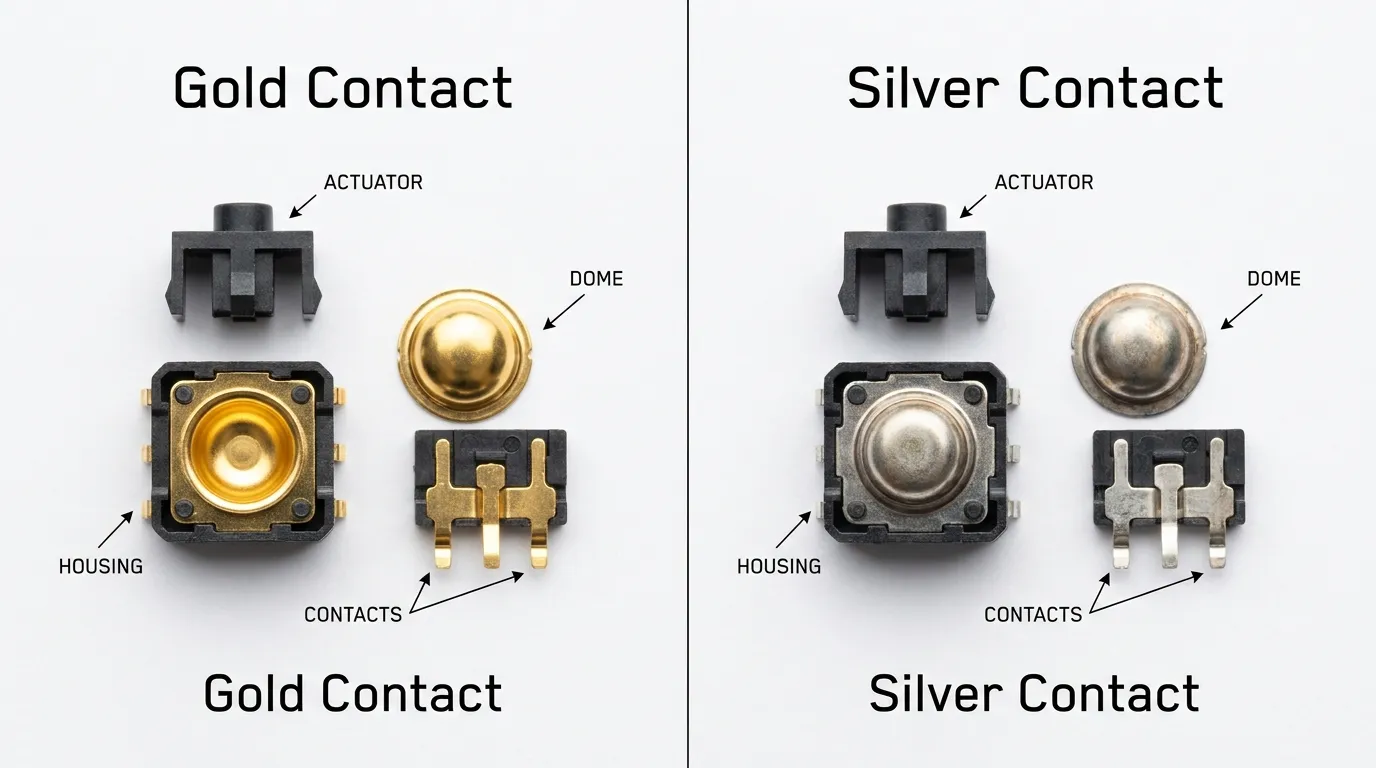
Contact material is the single most important specification decision for medical tactile switches, and it is the one most commonly handled incorrectly by engineers sourcing switches from general industrial distributors.
Silver contacts deliver excellent conductivity and handle a wide range of voltages and currents efficiently. They are appropriate for power switching applications where currents exceed 200mA and where the higher contact voltage can reliably break through any surface oxide film that forms. The problem in medical electronics is that most signal-level switch contacts operate in dry circuit conditions — below 100mA, often as low as single-digit milliampere logic inputs. At these levels, silver tarnishes through exposure to humidity and airborne sulfur compounds, forming silver sulfide films on contact surfaces. These films are electrically resistive and, at low voltages, the circuit does not carry enough energy to burn through them. The result is intermittent contact — missed actuations, erratic logic inputs, or degraded signal quality that compounds over time.
Gold contacts are chemically inert under normal conditions. They do not oxidize, do not form sulfide compounds, and maintain stable, low contact resistance — typically in the 10 to 50mΩ range — throughout the switch's service life, even at microampere-level currents. In a patient monitoring device where the switch feeds a microcontroller input reading millivolt-level logic transitions, a transient contact resistance increase of even a few ohms can cause false triggers or missed inputs. Gold eliminates this failure mode entirely.
The practical decision guideline is straightforward: use gold-plated contacts when switching below 100mA in signal-level circuits, which describes the vast majority of control panel and user interface functions on medical devices. Silver contacts remain appropriate for power functions above 200mA where higher current levels prevent oxide film buildup.
One additional advantage of gold in medical environments: gold-plated contacts maintain stable performance across a temperature range from −40°C to +125°C and resist degradation through repeated exposure to cleaning agents and sterilization cycles — conditions that accelerate silver tarnishing significantly.
Cycle Life Requirements
Cycle life — the number of actuations a switch is rated to perform before its mechanical or electrical performance degrades beyond specification — must be matched to the device's actual usage pattern with a meaningful safety margin.
A blood glucose meter used several times daily by a home user accumulates perhaps 1,000 to 5,000 actuations per year. A switch rated for 500,000 cycles provides decades of service in that application. A ventilator control panel in an ICU, where buttons may be pressed hundreds of times per shift across continuous 24/7 operation, can accumulate millions of cycles within the device's intended service life. Specifying a 500,000-cycle switch in that context means planning for switch replacement or device failure well before the device's design life expires.
As a practical planning framework, apply a minimum 2× safety margin over the worst-case estimated actuation count across the full device service life:
| Device Application | Estimated Annual Actuations | Recommended Minimum Cycle Rating |
|---|---|---|
| Home diagnostic (glucose, oximeter) | 1,000–10,000 | 500K cycles |
| Portable clinical instrument | 10,000–100,000 | 1M cycles |
| Bedside monitor / infusion pump | 100,000–500,000 | 3M cycles |
| Ventilator / high-use ICU device | 500,000–2M+ | 5M cycles |
For devices where cycle life is a primary concern, a dedicated long-life tact switch guide covers construction methods, dome materials, and ratings for high-endurance applications in detail.
Actuation Force for Clinical Use
Actuation force — the force in grams required to register a button press — directly affects both user experience and safety in medical devices. Too light, and accidental activation becomes a risk during transport, cleaning, or incidental contact with bed rails, gloves, or equipment. Too heavy, and fatigued clinical staff or gloved operators may fail to register deliberate inputs reliably.
Standard tactile switches are typically specified in the 160–300gf range for consumer electronics. Medical device design applies different considerations:
- General navigation and menu controls: 200–300gf provides sufficient resistance to accidental actuation while remaining comfortable for bare-hand or gloved operation
- Critical control functions (ventilator mode changes, drug delivery confirmation, alarm acknowledgment): 350–450gf is recommended to ensure deliberate, unambiguous actuation — particularly when the device is operated with latex or nitrile surgical gloves that reduce tactile sensitivity
The tactile ratio — the ratio of the peak force at the snap point to the actuation force — also matters in medical UI design. A high tactile ratio provides unmistakable feedback that the switch has been actuated, which is important in environments where auditory feedback is masked by ambient noise and visual feedback may be delayed by system response time.
Operating Temperature Considerations
Medical devices deployed in proximity to autoclaving equipment, surgical warming environments, or outdoor emergency settings face elevated temperature conditions that standard switches are not rated to handle. Medical grade tactile switches should be evaluated for both the continuous operating temperature and the storage temperature range appropriate to their deployment environment.
For applications where elevated ambient temperatures are a concern — such as switches mounted in equipment bays near heat-generating components, or devices used in tropical clinical environments — refer to the high-temperature tact switch guide for specifications and selection criteria specific to high-thermal-load environments.
Compliance Standards for Medical Tactile Switches
The compliance framework for a medical device incorporates several standards that directly affect switch specification and supplier qualification.
IEC 60601-1 is the foundational safety standard for medical electrical equipment. Section 6.3 requires enclosures to be classified with a defined IP rating, and Section 11.6 addresses liquid ingress protection requirements under normal use conditions. The switch, as a component of the device enclosure or panel, must be specified to support — not compromise — the device's overall IP classification.
IEC 60601-1-11 is the collateral standard specifically addressing medical electrical equipment for use in home healthcare environments. It establishes an IP21 baseline for devices intended for use outside of controlled hospital settings, which applies to a broad range of portable diagnostic and therapeutic devices.
ISO 13485 is the quality management system standard for medical device manufacturing. It does not specify switch performance parameters, but it requires complete documentation traceability for components used in regulated devices. This means the switch supplier must be able to provide material certificates, lot traceability records, conformity declarations, and test data that can be included in or referenced from the device's Design History File. Sourcing a switch that performs well technically but lacks this documentation chain is a compliance risk that surfaces during audits and regulatory submissions.
RoHS and REACH directives restrict hazardous substance content in electronic components. All switch components used in medical devices sold in the EU must comply with these restrictions, and compliance declarations must be available from the supplier.
ISO 10993 governs biocompatibility testing for materials that contact patients or are used in proximity to patient contact areas. For tactile switches on devices where patient hands or skin may directly contact the switch housing — such as patient-operated home monitoring devices — the housing material should be evaluated or confirmed against biocompatibility requirements appropriate to the intended contact classification.
Medical Grade Tactile Switch: Application Guide by Device Type
The following table maps common medical device types to the most relevant switch specification priorities. Use it as a first filter when defining your component requirements:
| Device Type | IP Priority | Contact Material | Min. Cycle Life | Actuation Force | Additional Notes |
|---|---|---|---|---|---|
| Ventilator control panel | IP65+ | Gold | 5M cycles | 350–450gf (critical keys) | Sealed housing; high-contrast actuation feedback |
| Infusion pump | IP65+ | Gold | 3M–5M cycles | 350–400gf | Anti-false-actuation design critical |
| Patient monitor | IP54–IP65 | Gold | 3M cycles | 200–300gf | Frequent disinfection; ESD protection valuable |
| Blood glucose meter | IP44 | Gold | 500K–1M cycles | 200–250gf | Compact SMT; glove-compatible sizing |
| Pulse oximeter | IP44 | Gold | 500K cycles | 200–250gf | Low profile; portable design |
| CPAP / home healthcare | IP21–IP44 | Gold | 500K–1M cycles | 200–300gf | IEC 60601-1-11 applies |
| Handheld diagnostic tool | IP54–IP65 | Gold | 1M–3M cycles | 250–350gf | Drop resistance; compact footprint |
| Surgical instrument control | IP67+ | Gold | 1M–3M cycles | 350–450gf | Sterilization-resistant housing material |
Medical Grade vs. Standard Industrial Tactile Switch
Engineers specifying components under time and cost pressure sometimes consider whether an industrial-grade or automotive-rated switch could substitute for a purpose-specified medical grade component. The following comparison clarifies where those options fall short.
| Specification Attribute | Medical Grade Tactile Switch | Standard Industrial Switch | Consumer Grade Switch |
|---|---|---|---|
| IP Rating | IP54–IP68 (device-class dependent) | IP40–IP65 typical | IP20 or unrated |
| Contact Material | Gold-plated (recommended for signal circuits) | Silver or tin | Tin or carbon |
| Cycle Life | 1M–5M cycles (application dependent) | 500K–1M cycles typical | 50K–250K cycles |
| Operating Temperature | −40°C to +125°C (gold contact variants) | −25°C to +85°C typical | 0°C to +70°C typical |
| RoHS / REACH Compliance | Required; documented | Often available | Varies |
| ISO 13485 Documentation | Required from qualified suppliers | Not typically available | Not available |
| Biocompatibility Consideration | Assessed for patient-contact applications | Not evaluated | Not evaluated |
| Actuation Force Options | Broad range including glove-compatible | Limited range | Standard consumer range |
Automotive-grade tactile switches share some characteristics with medical grade — including extended temperature range and robust sealing — but are qualified to different stress profiles (vibration, EMC for automotive environments) and typically lack the documentation traceability required for medical regulatory submissions. For a direct comparison of automotive and medical switching requirements, the automotive tact switch guide explains where those specifications converge and where they diverge.
How to Select the Right Medical Grade Tactile Switch
Selection should follow a structured decision process rather than defaulting to the first available component that meets the basic voltage and current ratings. Work through the following steps in order:
Step 1 — Define your device class and IP requirement. Identify whether your device is home-use (IEC 60601-1-11 applies), portable clinical, bedside, or fixed installation. Map that classification to the appropriate minimum IP rating using the table in the IP section above. The switch must match or exceed the target IP rating for the panel location where it is mounted.
Step 2 — Confirm your circuit's voltage and current at the switch contact. If the switch is feeding a microcontroller input, logic circuit, or sensor interface operating below 100mA — which is true of the vast majority of medical UI controls — specify gold-plated contacts. If the switch is handling a power function above 200mA, silver contacts are technically appropriate and more cost-effective.
Step 3 — Calculate required cycle life. Estimate the maximum number of daily actuations for the specific switch location across the full device service life. Multiply by a 2× safety margin and specify a switch rated to meet or exceed that number.
Step 4 — Set actuation force based on operator context. Determine whether the switch will be operated with bare hands, surgical gloves, or in an environment where accidental actuation is a safety concern. Select actuation force accordingly — 200–300gf for general navigation, 350–450gf for critical control functions.
Step 5 — Verify temperature rating against operating environment. Confirm that the switch's rated operating temperature range covers both the ambient and localized PCB thermal conditions in your device design. If elevated temperatures are a consideration, evaluate high-temperature rated variants before finalizing.
Step 6 — Qualify the supplier's documentation capability. Request material certificates, lot traceability records, RoHS/REACH compliance declarations, and cycle life test data. If the supplier cannot provide documentation that supports an ISO 13485-aligned DHF, the component may not survive a regulatory audit regardless of its physical performance.
Common Mistakes When Specifying Tactile Switches for Medical Devices
Specifying silver contacts in low-voltage signal circuits. This is the most common and consequential specification error. Engineers familiar with industrial equipment — where switches handle 24VDC control circuits — default to silver contacts without considering that medical signal circuits operate at voltages too low to burn through oxide films. The result is intermittent actuation that appears months after initial qualification testing passes.
Under-specifying IP rating until late in the design cycle. IP rating requirements are often treated as a system-level concern and not translated to component-level specifications early enough. When the device-level IP target is established late in development, the switch may already be committed and a swap to a sealed variant requires PCB layout changes, re-qualification testing, and schedule delays.
Ignoring documentation requirements during early component selection. A switch that performs perfectly technically but cannot supply ISO 13485-compatible documentation will force a component change during the regulatory submission phase — one of the most expensive possible points in a development program to discover a sourcing problem.
Assuming automotive-rated switches meet medical requirements. Automotive qualification and medical qualification are different frameworks. A switch qualified to AEC-Q200 automotive reliability standards has been tested for vibration, thermal shock, and EMC profiles relevant to vehicle environments. That qualification does not address the IP sealing levels, biocompatibility considerations, or documentation traceability requirements of medical device standards. For more on the distinction, the automotive tact switch guide outlines where automotive specifications diverge from medical requirements.
Under-estimating cycle life for high-use applications. Design teams sometimes use a single conservative cycle life estimate across all switch positions on a device, without distinguishing between primary function buttons that are pressed continuously and secondary menu navigation buttons that are rarely used. Applying the low-use specification to a high-frequency switch position creates a reliability time bomb.
Failing to account for gloved-hand operation. Actuation force specifications are validated during benchtop testing with bare hands. In clinical reality, surgical gloves reduce tactile sensitivity, alter finger contact geometry, and require higher intentional force for confident operation. A switch that registers cleanly in bare-hand lab testing may feel ambiguous or require excessive force concentration in gloved clinical use.
Related Guides
Understanding medical grade tactile switch requirements is one part of a broader component selection process for medical devices. Several related topics are covered in depth in dedicated guides:
For decisions involving sealing levels — specifically when your application requires confirmed protection against fluid ingress during cleaning routines — the sealed vs. waterproof tact switch guide explains the technical and practical differences between IP-rated sealed construction and waterproof-rated designs.
If long service life in a high-actuation device is a primary concern, the long-life tact switch guide covers construction choices and ratings for switches designed to exceed standard cycle life specifications in demanding applications.
For devices operating in elevated temperature environments — including equipment bays, clinical storage environments, or industrial medical applications — the high-temperature tact switch guide covers temperature-rated material selection and performance characteristics.
For a complete overview of tact switch types, configurations, and general selection principles that apply across all industries and applications, the full tact switch product overview provides a comprehensive category reference.
Frequently Asked Questions
What is a medical grade tactile switch?
A medical grade tactile switch is a momentary push-button switch that meets the specific reliability, sealing, contact material, cycle life, and documentation requirements of medical electrical equipment — including alignment with IEC 60601-1, ISO 13485 quality management requirements, and RoHS/REACH compliance. The designation reflects a combination of technical specifications and manufacturing quality standards rather than a single certification mark.
What IP rating does a medical tactile switch need?
The required IP rating depends on the device class and use environment. IEC 60601-1-11 establishes IP21 as the minimum for home healthcare devices. Clinical bedside equipment typically requires IP54 to IP65. High-use devices in ICU or surgical environments are often specified at IP67 or higher to withstand direct fluid exposure during routine cleaning. The switch must meet or exceed the target IP rating of the panel location where it is installed.
Do medical tactile switches need gold contacts?
Gold-plated contacts are strongly recommended — and effectively required — for any switch operating in signal-level circuits below 100mA, which describes the majority of control and UI functions in medical devices. Silver contacts form oxide and sulfide films that block reliable conduction at low voltages, leading to intermittent actuation failures. Gold contacts maintain stable, low contact resistance throughout the switch service life, even under microampere-level currents.
How many cycles should a medical grade tactile switch be rated for?
This depends entirely on the device type and the specific switch position's actuation frequency. Home healthcare device controls may need only 500,000 cycles. Patient monitors and infusion pump controls typically require 3 million cycles. Ventilator control panels and other high-frequency clinical devices should be specified at 5 million cycles with a 2× safety margin applied to the worst-case actuation estimate across the device's full service life.
What actuation force is recommended for switches operated with surgical gloves?
For critical control functions operated with latex or nitrile surgical gloves, an actuation force of 350–450gf provides sufficient resistance to accidental activation while remaining deliberately actuable. General navigation controls can use 200–300gf, which balances ease of use with adequate protection against incidental contact. Always validate actuation force with glove-wearing operators during usability testing, not only during bare-hand benchtop evaluation.
Can an industrial or automotive-grade tactile switch be used in a medical device?
In most cases, no — or not without additional qualification and documentation work. Industrial switches typically lack the IP ratings, cycle life, contact material specifications, and documentation traceability required for medical regulatory submissions. Automotive-grade switches are qualified to a different test framework (AEC-Q200) that does not map to medical compliance requirements and does not include the documentation outputs needed for ISO 13485-aligned design history files.
What documentation should a medical switch supplier provide?
At minimum: material certificates confirming housing and contact materials, RoHS and REACH compliance declarations, lot traceability records, cycle life test data, IP rating test certificates, and a product conformity declaration. This documentation must be available in formats that can be incorporated into or referenced from your device's Design History File for ISO 13485 and regulatory submission purposes.
Conclusion
A medical grade tactile switch is not a marketing category — it is a defined set of specification thresholds that collectively determine whether a switch can perform reliably, comply with regulatory requirements, and survive the physical realities of clinical environments. The decisions that matter most are IP rating selection matched to your device class, gold contact specification for signal-level circuits, cycle life rated to your actual usage pattern with a safety margin, and supplier documentation that supports your regulatory submissions from the start.
Getting these decisions right during the component selection phase prevents far more costly corrections during design validation, regulatory review, or — worst case — in the field. If you are defining switch specifications for a medical device design and need guidance on sealing levels, contact materials, or long-life ratings specific to your application, reach out to discuss your requirements. The right switch specification is a precision decision, and it is worth getting right the first time.
