





Industrial Tactile Switch for Control Panels & Automation: Complete Selection Guide
When a control panel is installed on a factory floor, a production machine, or an outdoor automation cabinet, every component inside it faces a harder life than the equivalent part in a consumer device. Dust accumulates. Coolants splash. Operators in heavy gloves punch buttons hundreds of times a day. Temperatures swing from cold-start mornings to peak operating heat. In this environment, a standard tact switch that works perfectly in a TV remote will fail within weeks.
Industrial tactile switches are designed from the ground up for exactly these conditions. This guide explains what separates them from standard switches, which specifications matter most, how to match a switch to your specific application, and what mistakes to avoid before committing to a design.
What Is an Industrial Tactile Switch?
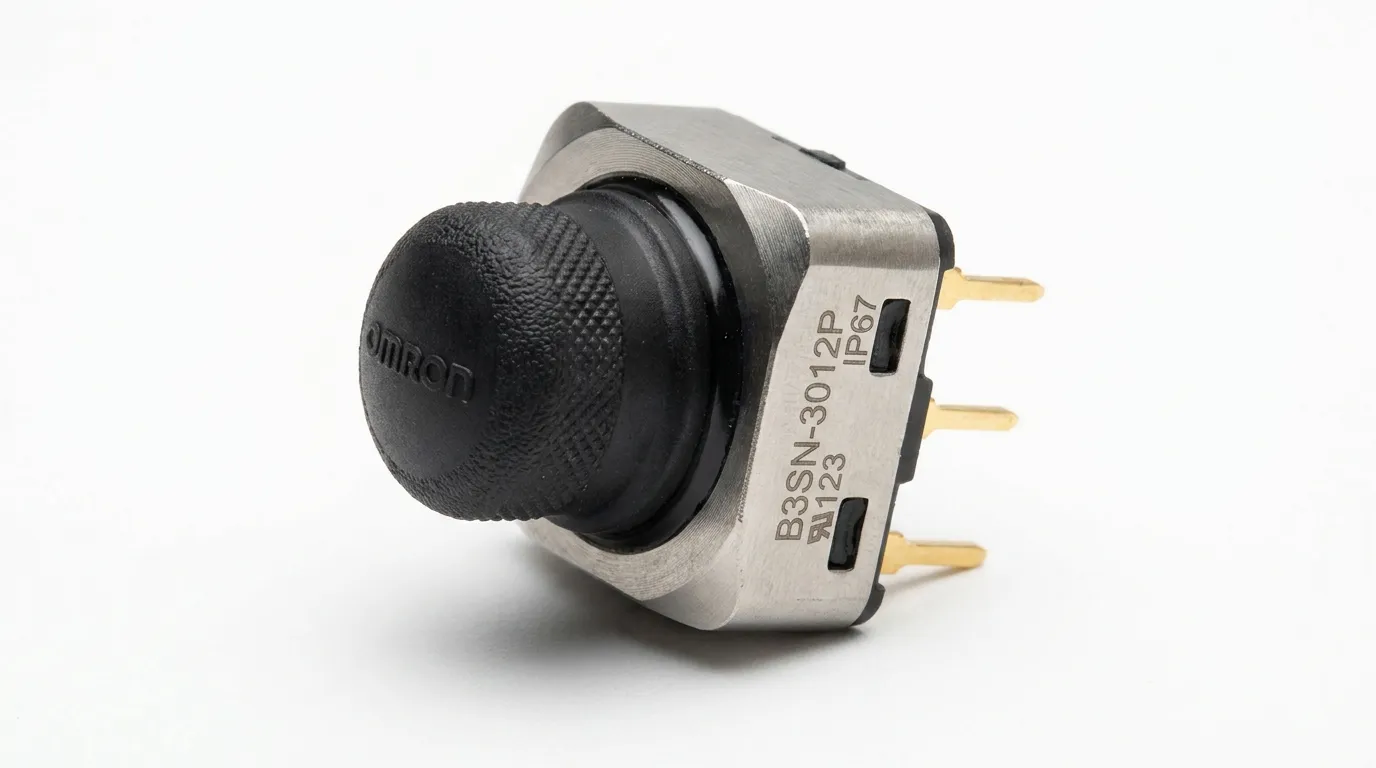
An industrial tactile switch is a momentary push-button switch built to operate reliably in harsh, high-demand environments such as factory automation systems, machine control interfaces, PLC panels, and HMI enclosures. Like all tact switches, it activates an electrical circuit only while pressed and returns to its open state immediately on release, providing a physical click or tactile bump that confirms the input to the operator.
What makes it industrial-grade is not a single feature but a combination of environmental protection, mechanical durability, and specification headroom that standard switches simply do not offer. An industrial tactile switch typically carries an IP67 or IP68 dust and water ingress rating, a cycle life of 300,000 operations or more, a wider operating temperature range, reinforced mounting for vibration resistance, and contact materials that resist oxidation in chemically active environments.
For a broader overview of all tact switch types — including consumer, automotive, and medical variants — see the complete guide to tact switches.
Why Standard Tactile Switches Fail in Industrial Environments
A standard tact switch is optimized for light-duty, controlled environments. It uses unsealed housing, relatively low cycle life ratings (typically 100,000 to 250,000 cycles), a narrow operating temperature range, and minimal mechanical anchoring to the PCB. Any one of these limitations becomes a failure point once the switch is placed inside an industrial control panel.
Dust and metallic particles — common in machining, welding, and assembly environments — enter unsealed housings and contaminate the contact surface, increasing resistance and causing intermittent operation. Liquid ingress from coolants, cleaning sprays, or condensation causes short circuits or accelerated corrosion of unprotected silver contacts. Vibration from nearby machinery loosens PCB-mounted switches over time, especially SMD types without mechanical anchor pins.
High-frequency operation is another killer. A factory operator confirming production steps or acknowledging system alerts may actuate a switch 500 to 1,000 times per shift. At that rate, a 100,000-cycle consumer switch reaches its rated life in under six months. An industrial switch rated at 1,000,000 cycles at the same usage pattern lasts years without degradation.
The bottom line: specifying a consumer-grade tact switch for an industrial panel is not a cost saving — it is a scheduled maintenance problem.
Key Specifications for Industrial Tactile Switches
Understanding which parameters define industrial suitability is the foundation of correct switch selection. These are not abstract data sheet numbers — each one maps to a specific real-world failure mode.
IP Rating — Ingress Protection
The IP (Ingress Protection) rating defines how well a switch's housing resists solid particles and liquids. For industrial control panels, this is often the first specification to check.
| IP Rating | Dust Protection | Liquid Protection | Typical Industrial Application |
|---|---|---|---|
| IP40 | Protected against objects >1mm | No liquid protection | Indoor, clean control rooms |
| IP54 | Dust resistant | Splash from any direction | Light manufacturing, packaging |
| IP65 | Fully dust-tight | Low-pressure water jets | Outdoor panels, light washdown |
| IP67 | Fully dust-tight | Temporary immersion up to 1m | Factory floor, food processing |
| IP68 | Fully dust-tight | Continuous immersion (depth per spec) | Subsea, heavy washdown environments |
For most general industrial control panel applications, IP67 is the practical minimum. Environments with regular high-pressure washdown — food processing, pharmaceutical manufacturing, beverage bottling — may require IP68-rated switches or fully sealed enclosure designs.
Cycle Life and Operating Durability
Cycle life measures how many full actuations a switch is rated to perform before contact resistance or mechanical performance degrades beyond specification. Industrial switches are available in three practical tiers.
- 300,000 cycles — Suitable for low-frequency applications such as alarm acknowledgment panels or configuration interfaces used a few dozen times daily
- 1,000,000 cycles — The standard choice for most factory HMI panels and machine control interfaces with moderate operator use
- 2,000,000 cycles or more — Required for high-frequency automation lines, production confirmation panels, and safety-critical interfaces actuated many times per hour
For applications where cycle life is a critical design parameter, Hanxia's long-life tact switch guide covers reinforced actuator design, contact material choices, and life extension strategies in greater detail.
Actuation Force for Industrial Operators
Actuation force — measured in grams-force (gf) or Newtons (N) — determines how much pressure is required to trigger the switch. In industrial settings, this specification carries ergonomic and operational consequences that are often ignored during design.
An operator wearing standard work gloves loses tactile sensitivity and fine motor precision. A switch with 100gf actuation force can be triggered by accidental brush contact in a gloved-hand environment, causing false inputs on automated lines. The practical range for gloved industrial operation is 250gf to 600gf, depending on glove thickness and the criticality of the action.
For precision instrument panels or laboratory-style control interfaces where operators work bare-handed, 100gf to 180gf provides the best balance between effortless operation and accidental press prevention.
Safety-critical inputs — emergency confirmations, process lockout controls — warrant higher actuation forces (400gf+) and may benefit from protective guards regardless of the switch's own force rating.
Operating Temperature Range
Standard consumer tact switches typically operate within 0°C to +70°C, a range that covers office and home environments comfortably. Industrial environments rarely stay within those bounds.
Cold storage facilities, outdoor winter installations, and refrigeration plant panels can see operating temperatures below −20°C. Foundries, heat treatment areas, engine test cells, and control cabinets near hot processes regularly reach +85°C or above. Industrial tactile switches address this with rated operating ranges of −40°C to +85°C as a standard floor, with specialized high-temperature variants going beyond that.
For automation environments where sustained high temperatures are a design constraint, Hanxia's high-temperature tact switch guide covers material selection, contact behavior under thermal stress, and appropriate models for extreme conditions.
Mounting Type: SMD vs. Through-Hole in Industrial PCBs
The choice between surface mount (SMD) and through-hole (DIP/THT) mounting affects mechanical stability, vibration resistance, and repairability — all important in industrial contexts.
| Mounting Type | Mechanical Strength | PCB Assembly | Best For | Limitation |
|---|---|---|---|---|
| Through-Hole (THT) | High — leads pass through PCB | Manual or selective soldering | Vibration-heavy panels, heavy-duty industrial | Larger footprint, lower board density |
| Surface Mount (SMD) | Moderate — solder pads only | Automated reflow soldering | High-density PCBs, controlled environments | Can crack solder joints under sustained vibration |
For control panels mounted directly on machines with mechanical vibration — conveyor systems, machining centers, packaging lines — through-hole mounting provides measurably better long-term reliability. SMD industrial switches with extended solder pads or anchor pins close this gap, but through-hole remains the conservative choice for high-vibration environments.
Types of Industrial Tactile Switches
Not all industrial tact switches are identical. Several distinct types address different combinations of environmental and functional requirements.
Sealed / Waterproof Tact Switches are the most common industrial choice. Their housings are sealed against dust and liquid ingress to IP65, IP67, or IP68, protecting internal contacts from contamination. Silicone rubber actuators are common, providing both the sealing function and a comfortable, slightly soft actuation feel.
Illuminated Industrial Tact Switches integrate an LED indicator directly into the switch body. In HMI control panels, these serve a dual function: the switch accepts operator input and simultaneously displays system status — active, standby, fault, confirmed. This eliminates the need for a separate indicator light alongside each switch, saving panel space and wiring complexity.
Long-Life Tact Switches use reinforced actuators, high-durability contact materials, and precision spring geometry to reach 1,000,000 to 2,000,000 cycle ratings. These are the appropriate choice wherever a control panel sees intensive, repetitive operator use.
High-Temperature Tact Switches use heat-resistant housing materials and specialized contact alloys capable of maintaining specification at sustained temperatures above +85°C. Standard industrial switches degrade mechanically and electrically when operated continuously near their maximum temperature rating.
Through-Hole Industrial Tact Switches prioritize mechanical anchoring. Their lead-through-PCB construction distributes mechanical stress across the board rather than concentrating it at surface solder joints, making them significantly more resistant to shock and vibration.
Industrial Tactile Switch Applications
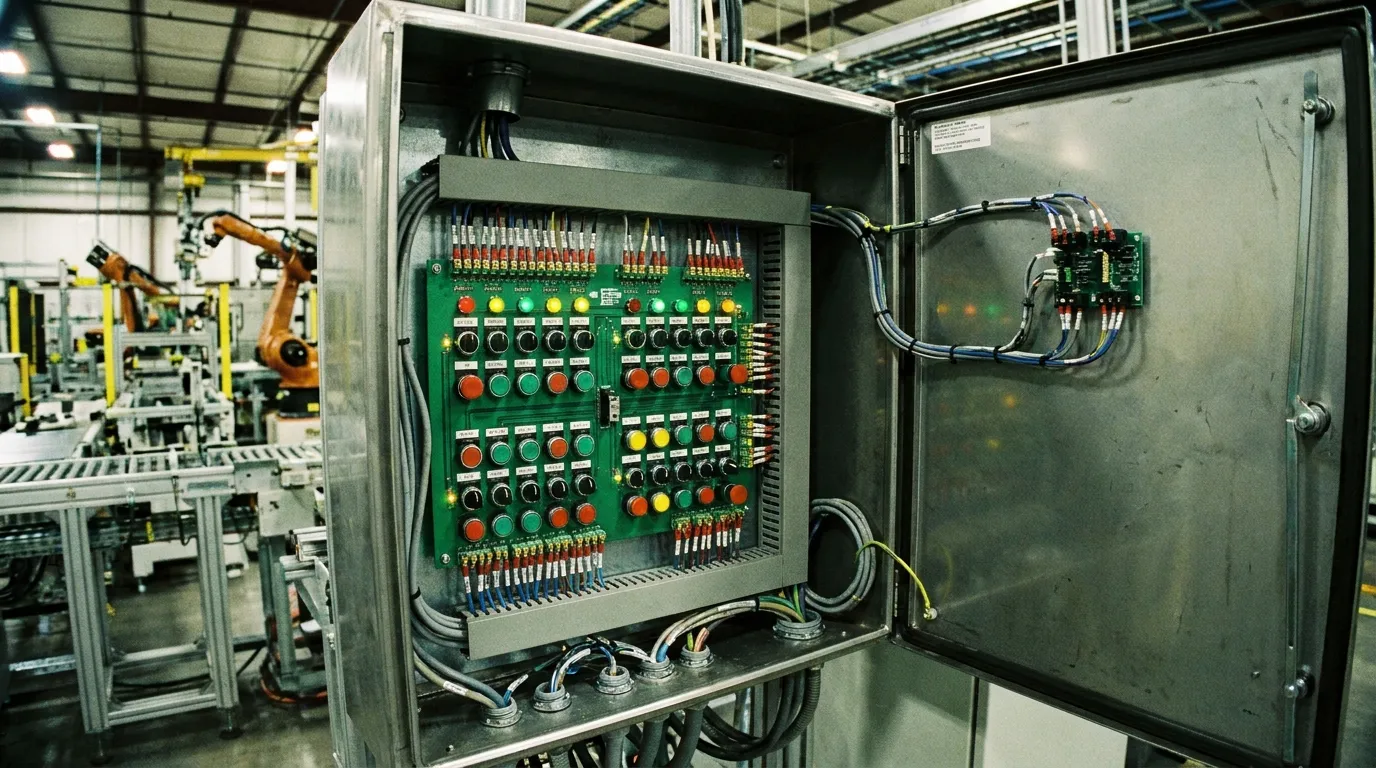
Industrial tactile switches appear across nearly every segment of manufacturing and process automation, but the demands they face vary significantly by application vertical.
PLC and HMI Control Panels
In PLC-controlled systems, operators interact with HMI panels to acknowledge alarms, select operating modes, confirm production steps, and trigger manual overrides. Tactile switches in these panels need reliable cycle life (1M+), clear tactile feedback that confirms input without visual confirmation, and IP protection appropriate to the installation environment. Illuminated variants are particularly valuable here — the LED state reflects PLC output status, giving the operator immediate visual feedback without additional indicator components.
Factory Automation and Machine Control Interfaces
Machine tool panels, conveyor control stations, robotic cell interfaces, and assembly line control points are high-frequency use environments. Switches may be actuated hundreds of times per shift across multiple operators. Cycle life and IP rating are the primary selection drivers, with actuation force chosen to prevent false inputs in the vibration-heavy conditions typical of these installations.
Process Control and Industrial Instrumentation
Flow meters, pressure calibrators, industrial analyzers, and process controllers use compact tactile switches for configuration and mode selection. These applications typically involve less frequent actuation but require long-term reliability over the device's service life — often 10 to 15 years. Sealed construction protects against cleaning solvents and chemical splashes common in process industries.
Safety-Critical Control Interfaces
E-stop confirmation panels, safety relay reset switches, and interlock bypass controls require switches that actuate deliberately and positively — never accidentally. Higher actuation force (300gf to 600gf), guarded actuators, and sealed construction are all relevant here. For vehicle-mounted safety control applications, the considerations differ — Hanxia's automotive tact switch guide covers the specific vibration, temperature, and compliance requirements of mobile platform control interfaces.
Industrial Tactile Switch vs. Standard Tactile Switch
The functional difference between an industrial tact switch and a standard one is not visible from the outside. It lives in the specifications.
| Feature | Standard Tactile Switch | Industrial Tactile Switch |
|---|---|---|
| IP Rating | IP40 or none | IP65 / IP67 / IP68 |
| Cycle Life | 100,000 – 250,000 | 300,000 – 2,000,000+ |
| Operating Temperature | 0°C to +70°C | −40°C to +85°C |
| Mounting Stability | SMD or light THT | Reinforced THT or anchored SMD |
| Contact Material | Silver-plated (standard) | Gold-plated or protected silver |
| Actuator Material | Standard plastic | Silicone rubber or sealed plastic |
| Illuminated Option | Rarely | Yes — common in HMI variants |
| Typical Application | Consumer electronics, remotes | Control panels, automation HMI, safety interfaces |
The main difference is not just durability — it is the consistency of performance over time in an environment that actively works to degrade the switch. An industrial switch maintains its actuation force, contact resistance, and sealing integrity across its rated cycle life and temperature range. A standard switch does not carry that commitment.
How to Select the Right Industrial Tactile Switch
The correct industrial tactile switch is the one that matches the specific demands of your application — not the one with the highest spec sheet numbers. Over-specifying adds unnecessary cost; under-specifying creates field failures.
Follow this selection sequence:
Step 1 — Define the environment. Is the panel located in a clean control room, a factory floor, an outdoor enclosure, or a washdown zone? The environment determines the minimum IP rating.
Step 2 — Estimate actuation frequency. How many times per day will the switch be pressed? Multiply by your expected panel service life in years to determine the total cycle demand. Select a switch rated for at least 30% above that number to account for use variation.
Step 3 — Specify actuation force. Will operators wear gloves? Is accidental actuation a safety concern? Match actuation force to operator conditions — 100–180gf for bare-hand precision use, 250–600gf for gloved or safety-critical applications.
Step 4 — Choose mounting type. Is vibration present? Use through-hole. Is the PCB assembled on an automated line in a controlled environment? SMD is acceptable.
Step 5 — Determine if illumination is needed. HMI panels and machine interfaces benefit from illuminated switches that indicate state. Process control panels often do not require this.
Step 6 — Check temperature requirements. Does the installation location exceed +70°C or drop below −25°C during operation? Step up to high-temperature rated models if so.
Quick Selection Reference
| Application Type | Minimum IP | Cycle Life | Actuation Force | Mounting |
|---|---|---|---|---|
| Indoor control room panel | IP40–IP54 | 300K | 100–250gf | SMD or THT |
| Factory floor HMI | IP67 | 1M | 250–400gf | THT preferred |
| Outdoor automation cabinet | IP67–IP68 | 1M | 250–400gf | THT |
| Washdown / food processing | IP68 | 1M+ | 300–500gf | THT sealed |
| Safety interlock interface | IP67 | 1M+ | 400–600gf | THT |
| Process instrument panel | IP65 | 300K–1M | 100–250gf | SMD or THT |
Common Mistakes When Specifying Industrial Panel Switches
These are real errors that appear in industrial control panel designs — and all of them are avoidable.
Using consumer-grade switches in industrial enclosures. The most common and costly mistake. A standard tact switch with no IP rating and a 100,000-cycle life will fail in a factory environment, sometimes within months of installation.
Under-specifying the IP rating. Specifying IP54 for a panel that gets cleaned with high-pressure wash daily. The water will find its way in. Always verify actual cleaning procedures and environmental exposure against the switch's IP rating, not just the enclosure's rating.
Ignoring actuation force for gloved use. A 100gf switch feels precise to a bare-hand operator in a design lab. On the factory floor, where operators wear gloves, it triggers on incidental contact and creates false inputs.
Choosing SMD mounting in vibration-heavy panels. Vibration causes fatigue cracking in SMD solder joints over months or years. Through-hole mounting costs slightly more and requires more PCB space but eliminates this failure mode.
Over-specifying cycle life. A 2,000,000-cycle switch in a panel actuated 10 times per day is over-specified by a factor of 20. It adds cost without meaningful reliability benefit. Match the specification to the actual use case.
Skipping illuminated options where they add value. Designers sometimes avoid illuminated switches for cost reasons in HMI panels, then add separate LED indicators for each switch. The combined cost of the extra LEDs, routing, and wiring often exceeds the price difference of the illuminated switch.
Related Guides
If your application has requirements beyond general industrial control panels, these related resources cover the specific specifications and selection criteria in greater depth.
For applications with sustained elevated operating temperatures — furnace controls, engine test cells, or industrial ovens — the high-temperature tact switch guide explains the material differences and thermal performance data that matter in those environments.
Where extremely high cycle life is the primary design driver — production line confirmation switches, high-frequency machine interfaces — the long-life tact switch guide covers reinforced actuator design and contact material strategies that extend service intervals.
For vehicle-mounted control panels, mobile machinery, and transportation applications, the automotive tact switch guide addresses the vibration profiles, temperature cycling, and standards compliance unique to that context.
For a full overview of all tact switch types, specifications, and product categories, the complete tact switch overview covers the entire Hanxia range from standard to specialized variants.
FAQs
What is an industrial tactile switch?
An industrial tactile switch is a sealed, momentary push-button switch designed for harsh environments — including factory floors, automation panels, and outdoor control cabinets. It differs from standard tact switches through higher IP ingress protection ratings, extended cycle life (300,000 to 2,000,000+ operations), wider operating temperature ranges, and reinforced mounting construction.
What IP rating do I need for a factory floor control panel?
IP67 is the practical minimum for most factory floor installations. It provides full dust-tightness and protection against temporary water immersion — sufficient for splash exposure, regular cleaning, and high-humidity environments. Washdown applications requiring pressure cleaning should use IP68.
How many cycles does an industrial tactile switch last?
Industrial tact switches are rated from 300,000 cycles (light-duty panel use) up to 2,000,000 cycles or more for high-frequency automation applications. To size correctly, estimate your daily actuation count, multiply by the expected panel service life in years, and select a switch rated at least 30% above that figure.
Can industrial tactile switches work with gloves?
Yes, but only if actuation force is correctly specified. For operators wearing standard work gloves, a minimum actuation force of 250gf is recommended to prevent accidental activation. Heavy industrial gloves warrant 400gf or more. Switches below 180gf are best reserved for bare-hand precision operation.
What is the difference between SMD and through-hole industrial tact switches?
Through-hole tact switches anchor through the PCB, providing superior mechanical stability under vibration — the preferred choice for most industrial panel environments. SMD switches suit high-density boards in lower-vibration settings and support automated PCB assembly. For vibration-heavy installations, through-hole is the more reliable long-term choice.
Are illuminated tactile switches available for industrial use?
Yes. Illuminated industrial tact switches integrate an LED into the switch body, providing both operator input and status indication from a single component. They are widely used in HMI panels, machine control interfaces, and automation systems where visual state feedback improves operator efficiency and reduces panel complexity.
What operating temperature range do industrial tact switches support?
Standard industrial tact switches operate reliably from −40°C to +85°C. Applications with sustained temperatures above this range — near heating elements, furnaces, or hot-process machinery — require high-temperature rated variants with specialized housing materials and contact alloys.
Conclusion
The right industrial tactile switch is not the one with the most impressive spec sheet — it is the one correctly matched to the actual demands of the installation. Start with the environment (IP rating), then address cycle frequency, operator conditions (actuation force), PCB assembly method (mounting type), temperature exposure, and illumination requirements in that order.
Getting this selection right the first time avoids field failures, unplanned maintenance shutdowns, and panel redesigns. Getting it wrong is rarely obvious during design review — it shows up six months after commissioning when switches begin degrading under conditions they were never built to handle.
If you are sourcing industrial tactile switches for a control panel or automation application, Hanxia manufactures a full range of sealed, illuminated, long-life, and high-temperature industrial tact switches built to perform in demanding environments. Contact us to discuss specifications, custom actuation force options, or OEM requirements for your project.
