





Tactile Switch Factory: Quality, Capacity & Testing Guide
Ordering tact switches from the wrong factory is an expensive mistake. A batch of 500,000 switches with inconsistent actuation force, poor contact plating, or undocumented IP ratings can ground an entire product line — long after the components have been soldered to your PCBs.
The problem most procurement managers face is straightforward: factory websites all look credible. They all list certifications, claim automated lines, and promise strict quality control. But the difference between a reliable tactile switch factory and an unvetted supplier becomes clear only when you know what specific questions to ask, what documentation to request, and what testing protocols to verify.
This guide covers exactly that — the quality systems, production capacity metrics, and testing standards that separate trustworthy tact switch manufacturers from those that simply look the part. If you are still deciding which type of tact switch fits your application, start with the complete guide to tact switches before returning here for supplier evaluation.
What Makes a Tactile Switch Factory Reliable?
A reliable tactile switch factory is not defined by its marketing language. It is defined by documented systems: a certified quality management process, measurable production capacity, validated testing protocols, and traceable materials from incoming goods to finished product.
In simple terms, reliability means the factory can produce the same switch performance — same actuation force, same contact resistance, same IP integrity — across every unit in every production batch, at scale, and over time.
Three pillars determine this:
- Quality systems: ISO certifications, internal QC procedures, and documented inspection stages
- Production capacity: Line automation level, units per shift, MOQ flexibility, and lead time consistency
- Testing protocols: Specific mechanical, electrical, and environmental tests run on each production batch
Understanding each pillar gives buyers a concrete framework for factory evaluation — one that goes well beyond supplier claims.
Core Certifications Every Tactile Switch Factory Should Hold
Certifications are not just compliance boxes. For a B2B buyer, they are the first objective filter when qualifying a supplier, because they confirm that an independent third party has audited the factory's management systems.
ISO 9001 is the foundational certification for any serious tact switch manufacturer. It confirms that the factory operates a documented quality management system (QMS) with processes for design control, production consistency, corrective action, and continuous improvement. For most electronics procurement, ISO 9001 is the minimum acceptable standard.
IATF 16949 extends ISO 9001 specifically for automotive supply chains. It requires additional controls around production part approval processes (PPAP), first article inspection (FAI), and defect prevention methods like FMEA (Failure Mode and Effects Analysis). If your tact switches are destined for dashboard controls, infotainment systems, or any in-vehicle application, IATF 16949 certification at the factory level is non-negotiable. See our dedicated automotive tact switch guide for the full specification requirements in that context.
RoHS and REACH compliance confirm that the switch materials — contact alloys, housing resins, plating chemicals — meet European Union restrictions on hazardous substances. These are mandatory for any product sold in EU markets and should be supported by material declarations, not just a logo on a product page.
| Certification | Scope | When It's Required |
|---|---|---|
| ISO 9001 | Quality management system | All B2B procurement |
| IATF 16949 | Automotive quality management | Automotive applications |
| RoHS | Hazardous substance restriction | EU market products |
| REACH | Chemical safety compliance | EU market products |
| CE Marking | Product safety (EU) | Consumer/industrial EU sales |
| UL Recognition | Component safety (North America) | North American market sales |
Always request the actual certificate document with its issue date and expiry. A credible factory will supply this without hesitation. A factory that responds with a scanned image of an expired certificate or redirects to a general "certifications page" with no downloadable documents is showing you a red flag immediately.
Production Line Setup — What Capacity Really Means
Production capacity is one of the most misunderstood data points in tact switch procurement. A factory quoting "millions of units per month" is not useful information unless you understand what supports that number.
The most important variable is line automation level. A fully automated production line uses robotics and precision machinery throughout stamping, assembly, contact plating, and inspection — with minimal human handling between stages. This directly translates to tighter dimensional tolerances, more consistent actuation force curves, and lower defect rates across high-volume runs. A semi-manual line introduces human variability at assembly and inspection stages, which typically results in wider performance distribution across a batch.
Hanxia operates 38 fully automated production lines — a configuration that allows both high-volume standard production and efficient changeover for custom specifications.
Beyond automation, capacity assessment requires understanding:
- Units per shift: A concrete daily output figure, not a monthly marketing estimate
- MOQ flexibility: Whether the factory can handle development-stage orders at lower volumes before scaling
- Lead time at peak loading: Stated lead times often assume 60–70% line utilisation; understand what happens at full capacity
- Surge capacity: Can the factory absorb an urgent 20% increase in order volume without quality impact?
How to Verify a Factory's Stated Capacity
Ask the factory for production schedule records from the previous quarter — not projections. Ask specifically about their changeover time between product variants and whether automated optical inspection (AOI) is part of every production line or only applied to specific models. A factory that answers these questions with data, not generalities, is one with real systems behind its claims.
Manufacturing Stages Inside a Tactile Switch Factory
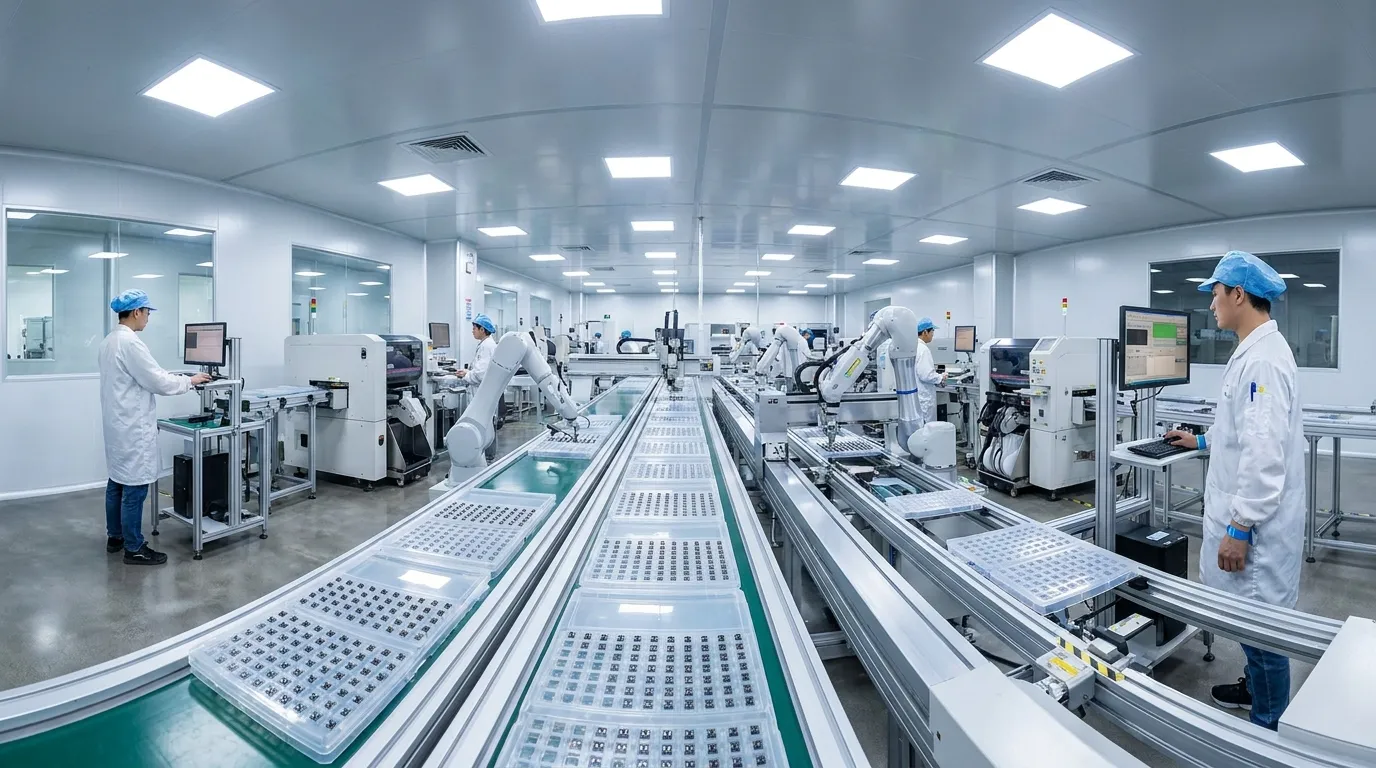
Understanding how a tact switch is made gives buyers a clearer picture of where quality is built in — and where corners get cut.
Stage 1 — Contact dome stamping: The metal dome, which creates the tactile snap feel, is stamped from stainless steel or beryllium copper sheet stock. Dimensional precision at this stage determines actuation force consistency. Variation in dome geometry translates directly into variation in tactile feel across units.
Stage 2 — Housing moulding: The thermoplastic housing (typically LCP or PA resin) is injection moulded. Material grade matters here: cheap housing resins can creep under heat, which compromises switch height tolerances over time. For applications requiring stability at elevated temperatures, this is especially critical — see the high-temperature tact switch manufacturing guide for detailed material requirements in thermal-demanding environments.
Stage 3 — Contact plating: The contact surfaces are plated with gold or silver. Gold plating (typically 3–30 µin) provides the lowest contact resistance and highest corrosion resistance; silver plating is a cost-effective alternative for standard environments. Plating thickness and uniformity directly affect contact resistance stability over the switch's service life.
Stage 4 — Assembly: Dome, housing, actuator, and cover tape are assembled, typically by automated pick-and-place machinery on reliable production lines. This is the stage where contamination risks are highest — a factory with proper clean room practices and ESD controls at the assembly stage prevents two common failure modes: contact contamination and ESD-induced latent damage.
Stage 5 — Sealing (for IP-rated models): Waterproof and sealed tact switches undergo laser welding or resin sealing to achieve their IP rating. The integrity of this seal determines whether the switch actually meets IP67 or IP68 — a detail that only water submersion testing can validate.
Stage 6 — Final inspection and packaging: Finished switches go through final quality control before tape-and-reel or bulk packaging. In a mature factory, this stage includes automated force-travel testing and visual inspection — not just random sampling.
Tactile Switch Testing Protocols — What Factories Must Run
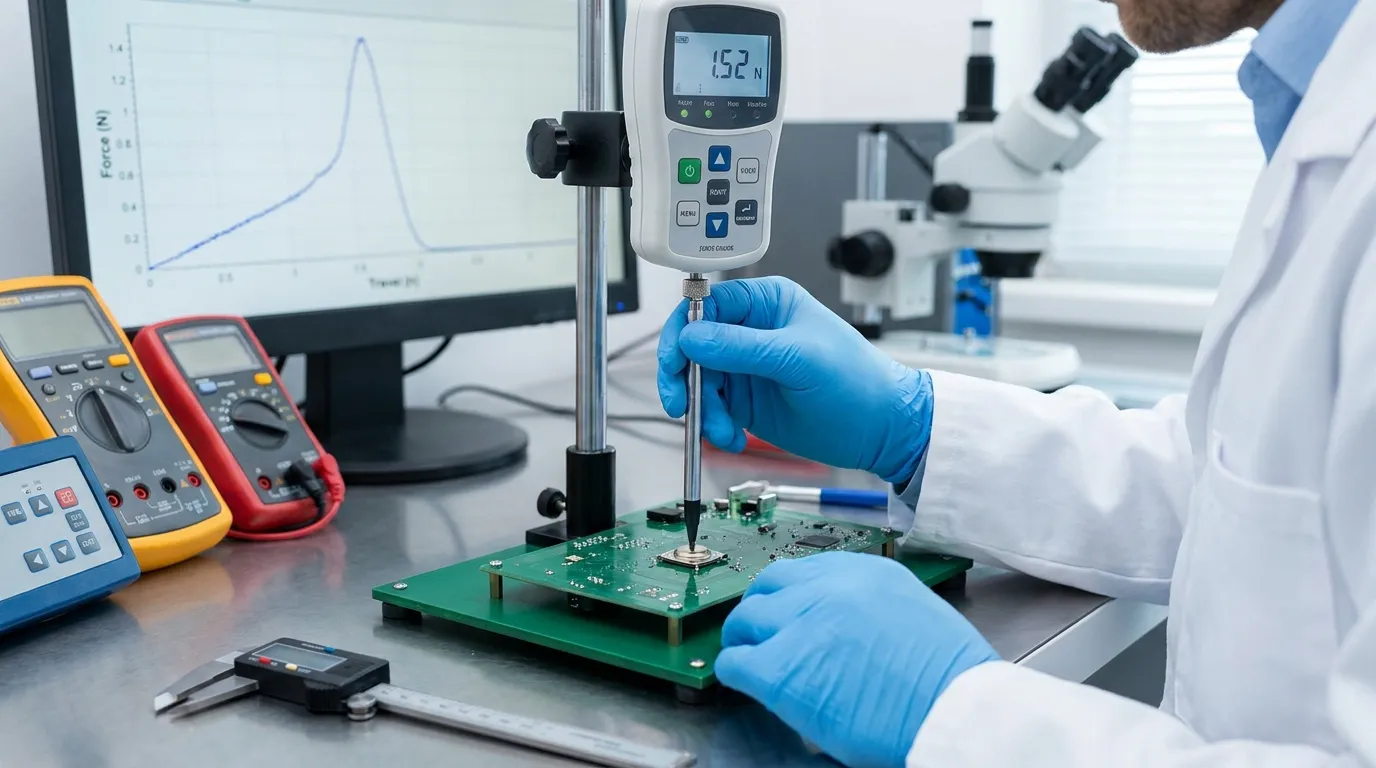
Test documentation is the single most underutilised buyer tool in tact switch procurement. A credible factory does not just perform tests — it provides batch-specific test reports that buyers can review before approving shipment.
Here is what those tests should cover and what acceptable thresholds look like.
Mechanical Testing
Actuation force / force-travel curve test measures the force required to actuate the switch at the defined travel distance. For a switch rated at 160 gf, the factory should be testing that every batch falls within an acceptable tolerance band — typically ±15–20% for standard applications, tighter for precision-use cases. A force-travel curve (graphing force against displacement) reveals snap ratio behaviour, which determines how "crisp" the tactile feel is.
Cycle life (mechanical fatigue) test validates that the switch meets its rated operational lifespan. Standard tact switches are typically rated at 100,000–500,000 cycles; long-life and industrial models at 1–2 million cycles. The factory should provide accelerated life test data, not just a stated rating.
Electrical Testing
Contact resistance is measured in milliohms (mΩ) at initial contact and after a defined number of cycles. A new, quality-plated tact switch should show contact resistance below 100 mΩ — most premium models test at 30–50 mΩ. Rising contact resistance over cycle life indicates plating degradation and is a direct predictor of contact failure in service.
Insulation resistance confirms that no current leaks between open contacts. Acceptable values are typically above 100 MΩ at 500 VDC. Dielectric voltage withstand (hi-pot test) verifies that the switch can handle voltage stress without breakdown — typically tested at 250 VAC or 500 VDC for standard tact switches.
Environmental Testing
High and low temperature storage: Switches are exposed to operating and storage temperature extremes (typically −40°C to +85°C for standard models, higher for industrial-grade variants) and then tested for mechanical and electrical performance. Housing creep, contact corrosion, and seal failure are the main failure modes detected here.
Humidity resistance: 85°C / 85% relative humidity over 96–500 hours (per IEC 68-2-3 or similar). Particularly relevant for switches used in outdoor or industrial environments.
Salt spray / corrosion resistance: Relevant for switches used in coastal, automotive, or industrial environments. A factory with marine or automotive customers should have this test in its standard qualification process.
IP Rating Validation
For IP67-rated sealed tact switches, the factory must verify:
- Dust ingress: Zero contact with internal components (IP6X)
- Water submersion: No ingress after 30 minutes at 1 metre depth (IPX7)
This validation requires physical submersion testing of production samples. Laser weld integrity is typically verified by pull testing and visual microscopy before the submersion test. A factory that claims IP67 without this test data is making an unverified specification claim.
| Test Type | What It Measures | Acceptable Threshold |
|---|---|---|
| Actuation force | Force to actuate at rated travel | Rated value ±15–20% |
| Contact resistance (initial) | Ohmic resistance at contact | < 100 mΩ (premium: < 50 mΩ) |
| Insulation resistance | Leakage between open contacts | > 100 MΩ at 500 VDC |
| Dielectric withstand | Breakdown voltage | 250 VAC or 500 VDC |
| Cycle life | Mechanical fatigue | Rated cycles without spec deviation |
| IP67 water submersion | Seal integrity | No ingress at 1m / 30 min |
| Temperature storage | Performance post thermal stress | No spec deviation after exposure |
Factory Audit Checklist for Tact Switch Buyers
Whether you are auditing a factory in person or evaluating a supplier remotely using documentation, the following checklist covers the most critical checkpoints.
| Audit Area | What to Check | Acceptable Standard |
|---|---|---|
| Quality certifications | ISO 9001 certificate (valid, current issue) | Valid document with no expiry gap |
| Automation level | Confirmation of automated vs. manual line ratio | Full or majority automation for high-volume orders |
| ESD controls | ESD flooring, wrist straps, equipment grounding documentation | Documented ESD control plan in place |
| Incoming inspection (IQC) | Materials tested on arrival: contact alloy purity, resin grade | Documented IQC procedure with rejection criteria |
| In-process inspection (IPQC) | Force-travel checks during production, AOI on assembly | Per-batch IPQC records available |
| Outgoing inspection (OQC) | 100% inspection or AQL sampling plan | 100% for critical specs; AQL Level II minimum for bulk |
| Traceability | Batch codes, material lot records, production date tracking | Full traceability from material lot to finished batch |
| Test reports | Batch-specific electrical and mechanical test records | Reports dated per production batch, not generic |
| PPAP / FAI (automotive/medical) | First Article Inspection documents for custom parts | Required for any regulated application |
| Sample policy | Pre-shipment samples with matching test reports | Available within stated lead time |
For buyers targeting automotive applications, the audit checklist extends further — including FMEA documentation, control plans, and measurement system analysis (MSA). The automotive tact switch guide covers these supply chain requirements in detail.
Quality Control Stages — IQC, IPQC, and OQC Explained
A mature tact switch factory does not rely on end-of-line inspection alone. Quality is controlled at three distinct stages, and buyers should verify all three are in place.
Incoming Quality Control (IQC) covers the materials before production begins. This means testing incoming contact alloy sheet stock for dimensional and metallurgical compliance, verifying housing resin grade certifications from raw material suppliers, and checking plating chemical bath concentrations. A factory with no IQC procedure is effectively building quality on an unverified foundation.
In-Process Quality Control (IPQC) runs throughout production. On automated lines, this typically includes camera-based optical inspection at the assembly stage, in-line force measurement on a statistical sample of units per hour, and dimensional verification of dome geometry. IPQC catches process drift early — before an entire shift's production becomes non-conforming.
Outgoing Quality Control (OQC) is the final gate before shipment. For critical specifications like actuation force and contact resistance, a reliable factory performs 100% testing on finished units. For cosmetic and dimensional checks, AQL (Acceptance Quality Level) sampling plans — typically AQL 1.0 or AQL 0.65 for precision components — are used. Ask any prospective factory what their OQC method is for electrical testing: 100% or sampling. The answer tells you a great deal about their quality commitment.
For industrial-grade tact switches, where switch failure can cause equipment downtime, 100% electrical testing at OQC is the recommended standard. Learn more about the specific production standards relevant to industrial applications in the industrial tact switch guide.
Red Flags When Evaluating a Tactile Switch Supplier
Most quality failures in component procurement are predictable if buyers know what signals to look for during the sourcing process.
Pricing significantly below market rate is the most consistent early indicator of a problem. Tact switch pricing reflects material costs (contact alloy, plating thickness, housing resin grade) and process costs (automation level, testing scope). A price 20–30% below comparable alternatives usually indicates thinner plating, lower-grade resins, reduced testing scope, or counterfeit base materials.
No batch-specific test reports. A credible factory holds test data per production batch. A supplier that can only provide a single generic test report — undated or clearly not matched to your order — does not have the quality traceability system buyers should expect.
Expired or unverifiable certifications. Always check the issue date and expiry of any ISO or IATF certificate. Legitimate certification bodies maintain public registers — cross-check the certificate number if you have doubts.
No sample policy or excessive sample lead time. A factory confident in its quality provides pre-production samples on a reasonable timeline. Resistance to sampling, excessive minimum orders before any sample is available, or samples that perform differently from the production batch all indicate quality consistency problems.
Vague answers to specific technical questions. Ask a factory what their contact resistance target is and how it is tested. A competent factory answers immediately with a number and a method. Vague answers like "our switches are tested to industry standards" without specifics indicate that the technical substance is missing behind the marketing surface.
Medical and Automotive Factories — When Standard Quality Isn't Enough
Standard ISO 9001 certification is the right foundation for most tact switch procurement. But buyers sourcing switches for medical devices or automotive systems need factories whose quality management systems go deeper.
Medical-grade tact switches require stricter traceability, biocompatibility considerations for certain actuator materials, and production environments that minimise contamination risk. Factories supplying into ISO 13485-certified medical device manufacturers typically need to align their processes accordingly. The full specification and selection requirements for this use case are covered in the medical-grade tact switch guide.
Automotive tact switches place demands on the factory process that standard QMS frameworks do not address: PPAP submission, FMEA-based process controls, and production consistency at the level IATF 16949 requires. A factory serving automotive OEMs will be able to demonstrate these systems with documentation — not just claim them.
The key takeaway: always match the factory's certified quality system to your application's regulatory and performance requirements, not just its product catalogue.
Related Guides
If you are at the product selection stage rather than the factory evaluation stage, the complete tact switch buying guide covers the full range of switch types, mounting options, size options, and selection parameters across Hanxia's product line.
For application-specific factory and product requirements, these guides cover each sector in detail:
- Automotive Tact Switch Guide — IATF 16949 supply chain requirements, automotive-grade specs, and vibration resistance considerations
- Medical-Grade Tact Switch Guide — Cleanroom production standards, material traceability, and reliability requirements for medical devices
- Industrial Tact Switch Guide — Heavy-duty cycling, panel mount requirements, and OQC standards for industrial-grade switches
- High-Temperature Tact Switch Guide — Housing material selection and seal integrity for elevated temperature environments
Frequently Asked Questions
What certifications should a tactile switch factory have?
At minimum, ISO 9001 for quality management. For automotive applications, IATF 16949 is required. For EU market sales, RoHS and REACH compliance with supporting material declarations are mandatory. Always verify certificates are current and issued by an accredited body.
How do I verify a tact switch factory's production capacity?
Ask for production schedule records from the previous quarter and confirm the automation level of the lines producing your specific part number. Stated capacity figures are only meaningful when you understand whether they reflect automated or semi-manual lines and what happens at peak loading.
What tests should a factory run before shipping tact switches?
Outgoing quality control should include actuation force testing, contact resistance measurement, and IP rating validation for sealed models. Factories should provide batch-specific test reports — not generic documents — with each shipment.
What is an acceptable contact resistance for a tact switch?
Below 100 mΩ is the standard threshold for quality tact switches. Premium gold-plated models typically test at 30–50 mΩ. Contact resistance that rises significantly over cycle life indicates plating degradation and is a predictor of premature contact failure.
What is the typical cycle life of a tact switch?
Standard models are rated at 100,000–500,000 cycles. Long-life and industrial-grade models typically achieve 1–2 million cycles. Hanxia's TS-1288 model, for example, is rated at 2 million cycles. Always confirm that cycle life ratings are supported by accelerated life test data, not just specification sheet claims.
What documents should I request from a tact switch factory before placing a bulk order?
Request the current ISO certificate, batch-specific test reports (electrical and mechanical), material traceability records, and a sample with a matching data sheet. For first orders or custom specifications, request a First Article Inspection (FAI) report before approving production.
What is the difference between 100% inspection and AQL sampling in a tact switch factory?
100% inspection means every unit is tested against defined electrical or mechanical criteria before shipment. AQL sampling tests a statistically representative sample and accepts or rejects the batch based on the defect rate found. For critical electrical specifications, 100% testing at the factory significantly reduces the risk of out-of-spec units reaching your assembly line.
Conclusion
Choosing the right tactile switch factory is a structured decision, not a matter of taking a supplier at their word. The combination of verified certifications, documented production capacity, and batch-specific test reports gives procurement teams an objective basis for qualification — before samples are ordered and well before bulk production begins.
The practical framework is straightforward: confirm the factory holds the certifications your application requires, verify production automation at the line level, review their testing scope against the thresholds in this guide, and request batch-specific documentation before committing to volume orders. Red flags — suspiciously low pricing, generic test reports, unverifiable certifications — are consistent across suppliers and reliably predictive of quality problems downstream.
Hanxia operates 38 fully automated production lines with 100% factory inspection on finished units, backed by 10+ years of precision tact switch manufacturing experience. To explore the full product range and selection parameters, visit the Hanxia tact switch product page — or contact the team directly to request samples, test reports, or a formal supplier qualification package for your application.
