





Tact Switch Supplier in China: Compare & Choose Wisely
China supplies the majority of the world's tact switches. From consumer electronics to industrial control panels, the components in your product almost certainly originate from one of China's manufacturing clusters — whether you planned it that way or not. The question is not whether to source from China, but how to choose the right supplier, avoid the wrong ones, and build a procurement relationship that holds up under real production conditions.
This guide is built specifically for procurement managers, hardware engineers, and OEM buyers who are actively evaluating Chinese tact switch suppliers. It covers supplier types, manufacturing regions, certification requirements, evaluation criteria, red flags, and the questions you should ask before placing a first order. If you are still researching tact switch types, specifications, and product categories, start with our complete tact switch guide before returning here for the sourcing layer.
Why China Dominates Global Tact Switch Supply
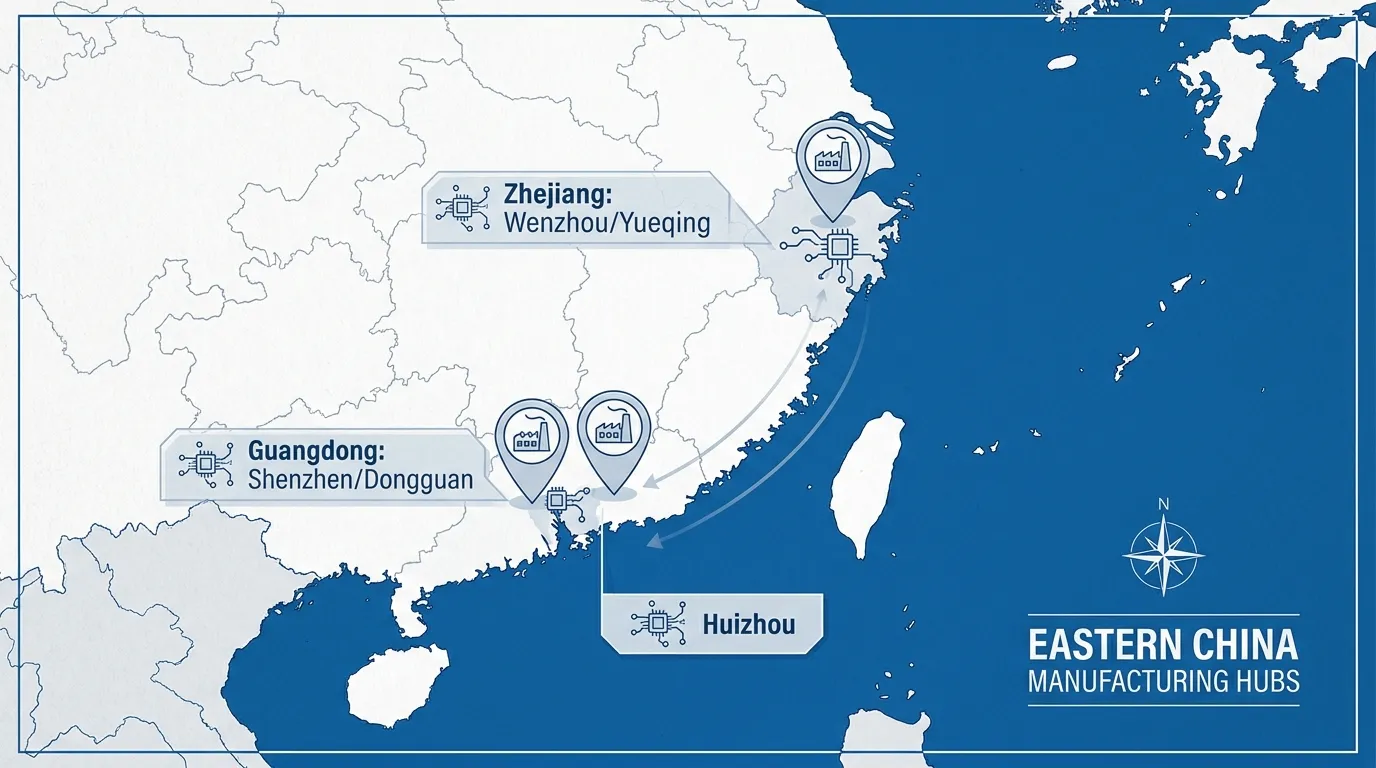
China's position in the tact switch market is not accidental — it is the product of decades of specialized industrial clustering. Three provinces account for the overwhelming majority of global tact switch output.
Zhejiang Province (Wenzhou / Yueqing) is the precision tooling heartland. The Yueqing cluster, in particular, has specialized in electromechanical switch manufacturing since the early 1980s. Factories here typically offer deep DFM (Design for Manufacturability) expertise, in-house tooling for custom stems and housings, and strong quality documentation capability. This is where you will find manufacturers best suited for industrial, medical, and custom OEM projects.
Guangdong Province (Shenzhen / Dongguan) offers a different kind of advantage. Shenzhen's electronics ecosystem — dense with EMS companies, PCB assemblers, and R&D teams — makes it ideal for fast prototyping, custom design work, and sampling. Dongguan is more production-focused, with large-volume facilities suited to consumer electronics and high-run SMD tact switch supply.
Huizhou (also in Guangdong) hosts factories with stronger automotive and industrial orientation, where tighter quality systems and PPAP documentation support are more commonly available.
Understanding this geography matters because a supplier's physical location within China is a meaningful indicator of their specialization — and knowing which region fits your application is the first filter worth applying.
Know Who You Are Actually Talking To: Supplier Types in China
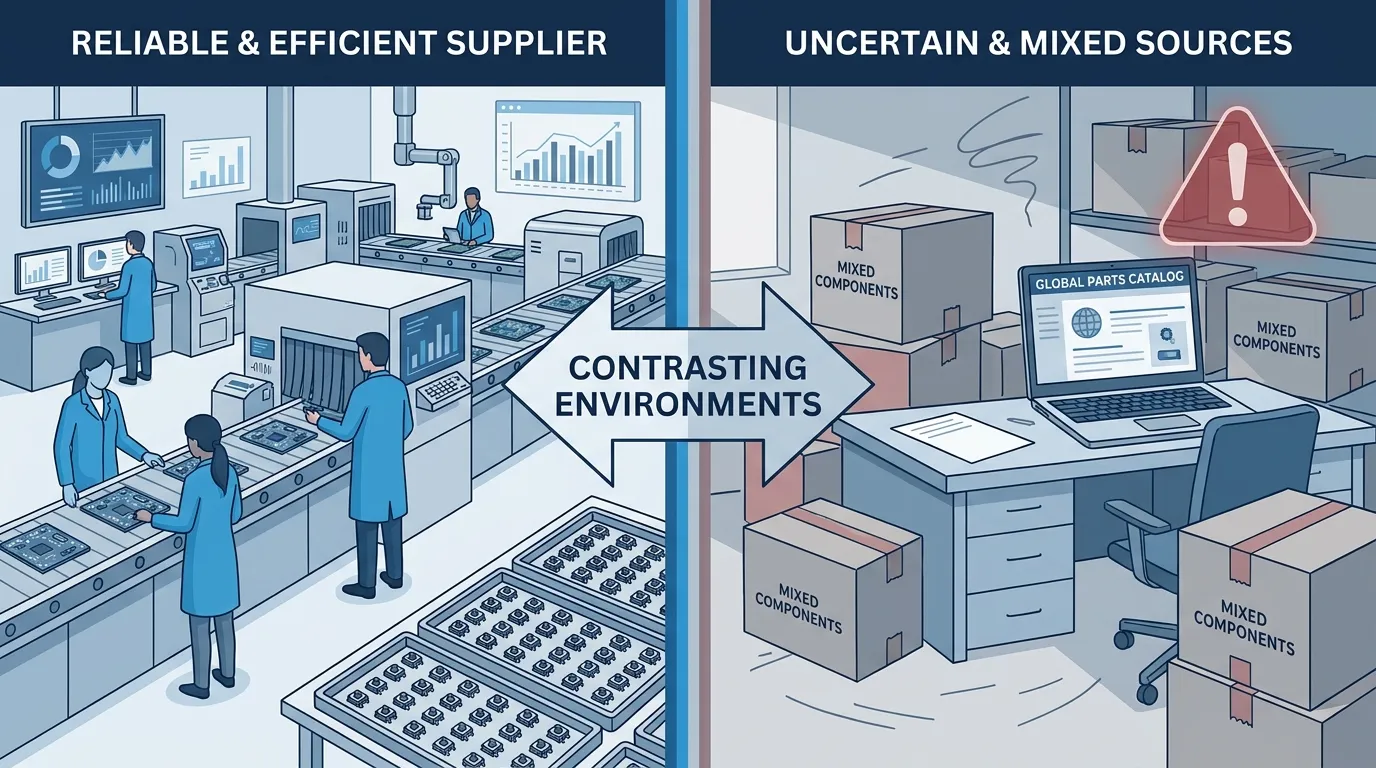
Before evaluating any Chinese tact switch supplier on quality, price, or lead time, you first need to understand what kind of entity you are dealing with. This distinction is the most consistently missed step in OEM sourcing — and the most costly when it goes wrong.
There are three primary supplier types in China's tact switch market:
Direct Factory (Manufacturer): The company designs, tools, and manufactures their own components. They have an in-house production line, their own quality inspection systems, and engineering staff who can answer technical questions. Factory-direct sourcing typically offers the best pricing floor, the most customization control, and the clearest accountability for quality.
OEM/ODM Factory: These manufacturers make components — sometimes under their own brand, sometimes under yours. An OEM factory manufactures to your design and specifications. An OEM/ODM factory offers existing designs that you can modify, rebrand, and adapt for your product. ODM is faster to market and carries lower tooling cost. OEM gives you tighter IP control and full specification ownership.
Trading Company: A trading company buys from factories and resells. They are not manufacturers. Some trading companies add legitimate value — managing logistics, consolidating small orders across multiple product types, or handling English-language documentation for factories that lack export infrastructure. The risk is not the model itself; the risk is a trading company that actively misrepresents itself as a manufacturer.
| Supplier Type | Ownership | Typical MOQ | Customization | IP Control | Best For |
|---|---|---|---|---|---|
| Direct Factory | Manufacturer | 500–5,000 pcs | High | Full | Mid-to-large OEM runs, custom specs |
| OEM/ODM Factory | Manufacturer (with own designs) | 1,000–10,000 pcs | Medium–High | Shared/Negotiable | Faster NPI, rebrand projects |
| Trading Company | Reseller | Flexible (100+) | Low | None | Small orders, multi-SKU sourcing |
How to Tell If You Are Talking to a Factory or a Trading Company
The claim "we are the manufacturer" is nearly universal on Alibaba, Made-in-China, and direct inquiry responses. Here is how to verify it:
- Business license scope: A genuine manufacturer's Chinese business license (营业执照) lists "manufacturing" (制造) in its business scope. A trading company lists "trade" (贸易) or "wholesale" (批发). Request the document and verify the scope.
- Product catalog breadth: A factory with genuine tooling expertise will have a focused product range — tact switches, perhaps related micro switches or push buttons. If a supplier quotes you tact switches, LED strips, connectors, plastic housings, and motors with equal confidence, you are almost certainly talking to a trader.
- Engineering access: When you ask a technical question — pin material grade, actuation force tolerance, contact resistance specification — does the person you are talking to actually know the answer, or do they disappear for 24 hours and return with a vague response? Real factories have engineering staff.
- Factory visit response: A real factory welcomes or at least accommodates audit visits. A trading company will find reasons to delay, redirect, or refuse.
- Sample documentation: Request that samples arrive with factory-issued test reports. Factories produce these internally. Trading companies often forward documents from the actual factory — if those documents show a different company name, the signal is clear.
Use our tactile switch factory checklist to run a structured evaluation against any supplier before shortlisting them.
What Certifications Should a Chinese Tact Switch Supplier Hold?
Certifications are not bureaucratic checkboxes — they define whether your finished product can be legally sold in your target market, and whether your supplier's quality system can be audited and verified by a third party.
Baseline certifications every supplier should hold:
- ISO 9001 — Quality management system standard. This is the minimum credible quality framework. Any supplier unable to provide a current ISO 9001 certificate should be treated with caution.
- RoHS — EU Directive on restriction of hazardous substances. Mandatory for any component entering the EU or UK market. Confirms the switch is free from lead, mercury, cadmium, and other restricted materials.
- REACH — EU chemical safety regulation. Required alongside RoHS for full EU market compliance.
Market-specific certifications:
- CE marking — Required for EU market placement. Confirm it is self-declared or third-party assessed, and request the Declaration of Conformity.
- UL / cUL — Required for North American market. Relevant for switches used in AC-powered devices.
- CQC — China domestic market quality certification. Relevant if you are selling into China or if your assembler is Chinese.
Application-specific certifications — do not skip these:
- IATF 16949:2016 — The automotive quality management standard. This is non-negotiable if your tact switch will be used in a vehicle. The supplier's entire production and documentation system must comply. See our automotive tact switch guide for the full specification context.
- ISO 13485:2016 — Medical device quality management. Required if your switch enters any medical device. Traceability, process validation, and change control requirements are significantly stricter than ISO 9001. See our medical-grade tactile switch guide for what this means at the component level.
- IEC 61058 / IP ratings — For switches used in industrial environments, confirm the IP rating (IP67 or IP68 for sealed applications) and compliance with relevant IEC standards.
| Application | Minimum Certifications Required |
|---|---|
| Consumer electronics | ISO 9001, RoHS, REACH, CE |
| EU/UK market (any) | RoHS, REACH, CE + relevant safety standard |
| North American market | UL/cUL, RoHS |
| Automotive | IATF 16949, RoHS, REACH, AEC-Q200 grade parts |
| Medical devices | ISO 13485, RoHS, REACH, full traceability |
| Industrial / harsh environments | ISO 9001, IP67/IP68 rated, IEC 61058, RoHS |
Key Criteria for Comparing Tact Switch Suppliers
Once you have confirmed supplier type and baseline certifications, the comparison shifts to operational fit. These are the criteria that determine whether a supplier can sustain quality at production volume, not just impress you with samples.
Minimum Order Quantity (MOQ): Standard catalog tact switches (6×6mm THT, common SMD variants) typically carry MOQs between 500 and 5,000 pieces from direct factories. Custom OEM/ODM designs requiring new tooling will have higher minimums, often 5,000–20,000 pieces depending on tooling investment. Ask for the MOQ on your specific configuration — not the lowest advertised figure.
Sample lead time: A reliable factory can provide engineering samples in 3–7 business days for standard configurations. Custom tooling samples typically require 3–5 weeks. If a supplier promises custom samples in 5 days without explaining how, probe further.
Customization capability: Confirm whether the factory can accommodate your specific requirements — actuation force (gf), stem height, housing color, surface finish, LED illumination, sealing level, and private-label or custom packaging. Ask whether customization is handled in-house or subcontracted. Subcontracted tooling is a risk factor for both lead time reliability and quality consistency.
Documentation support: For serious procurement, you should be able to receive a complete documentation package: ISO certificate, RoHS declaration, REACH declaration, product test report (incoming and outgoing), FMEA (Failure Mode and Effects Analysis), and PPAP (Production Part Approval Process) for automotive-grade projects. If a supplier cannot produce these documents, they are not equipped for professional OEM supply.
Communication quality: This is underweighted in most sourcing evaluations. A supplier's ability to answer technical questions accurately, respond within a reasonable time, and escalate to engineering staff when needed is a direct indicator of how the relationship will function when production problems arise.
Red Flags to Recognize Before Committing
The majority of sourcing problems become visible before the first order — if you know what to look for.
1. Price significantly below market average. If four suppliers quote you $0.08–$0.12 per unit for a standard SMD tact switch and one quotes $0.03, the likely explanations are inferior contact materials, a bait-and-switch pricing strategy, or a trading company forwarding a workshop price it cannot actually guarantee.
2. Excessively wide product catalog. A supplier that lists tact switches, HDMI cables, LED drivers, rubber keypads, and power supplies is almost certainly a trading company. Real switch factories have deep specialization in a narrow product range.
3. Factory visit refused or endlessly delayed. This is one of the clearest signals that a factory does not exist as presented. A genuine manufacturer has nothing to hide from a buyer doing due diligence.
4. Fabricated or copy-paste inspection records. If you receive inspection reports that look identical across multiple batches — same values, same date format, no process variation — they were either generated from a template or fabricated entirely. Real inspection records show natural statistical variation.
5. No technical staff access. If your only point of contact is a sales representative who cannot answer questions about pin base material (brass vs. phosphor bronze), contact resistance, or cycle life ratings, you do not have access to the engineering capability you will need when specification issues arise.
6. Payment to a third-party bank account. If the supplier asks you to pay a company with a different name from the one you've been communicating with — especially a Hong Kong trading entity — this is a serious red flag for supply chain transparency and legal recourse.
Before approving any supplier, work through our tactile switch factory checklist, which covers factory verification, documentation review, sample evaluation, and quality system assessment in a structured format.
How to Evaluate Samples Before Committing to Production
Samples are your last verifiable window into the supplier's production quality before committing to a full order. Treat them as a qualification test, not a formality.
What to measure and verify:
- Actuation force consistency: Test 5–10 samples with a digital force gauge. Variation greater than ±15% across the batch suggests tooling or spring inconsistency. For precision applications, acceptable tolerance is tighter.
- Travel distance: Verify pre-travel and total travel against the supplier's datasheet. A discrepancy here often indicates tooling wear or an incorrect spring specification.
- Contact resistance: Should typically be below 100mΩ at rated current for standard tact switches. Higher resistance causes unreliable signal transmission, especially in low-voltage logic circuits.
- Sealing integrity (IP-rated variants): For IP67/IP68 variants, request a third-party or factory water immersion test record. Do not rely solely on verbal claims.
- Haptic consistency: For end-user-facing applications, tactile feedback quality should feel uniform across samples. Inconsistent haptics usually trace back to inconsistent dome or spring manufacture.
- Cycle life documentation: Request test reports for rated mechanical life (typically 50,000 to 300,000 actuations depending on grade). For industrial and automotive applications, see our industrial tactile switch guide for the cycle-life benchmarks relevant to demanding environments.
Also check that the physical samples match the supplied datasheet in every dimension — pin pitch, body height, footprint — before approving for PCB layout.
Questions to Ask a Tact Switch Supplier Before Your First Order
A direct list you can use in your first supplier qualification call or email:
- Are you the manufacturer or a trading company? Request a copy of your business license and confirm its scope.
- Where is your factory located, and can we schedule an audit visit?
- What certifications do you currently hold? Request copies of each certificate with validity dates.
- What is your MOQ for our specific configuration? (Specify exact dimensions, actuation force, sealing, pin type.)
- Can you provide engineering samples, and what is the lead time?
- Is tooling for custom designs done in-house or subcontracted?
- What quality control steps occur during and after production? (Incoming inspection, in-process, outgoing)
- Can you provide PPAP documentation? (Relevant for automotive supply chains)
- What is your policy for batch quality failures after delivery?
- Who is our engineering contact for technical issues during production?
The quality and specificity of the answers you receive will tell you more about a supplier's real capability than their website ever will.
Matching Supplier Type to Your Application
Not every application requires the same type of supplier or the same level of documentation rigor. Matching your sourcing strategy to your end-use context saves both cost and negotiating friction.
| Application | Priority Criteria | Certification Needed | Ideal Supplier Profile |
|---|---|---|---|
| Consumer electronics | Cost, MOQ flexibility, fast sampling | ISO 9001, RoHS, REACH | Mid-size OEM/ODM factory with strong export experience |
| Automotive HMI | Zero-defect quality system, PPAP, traceability | IATF 16949, RoHS, REACH | Specialized factory with automotive supply chain experience |
| Medical devices | Traceability, validated process, change control | ISO 13485, RoHS, REACH | Factory with dedicated medical quality system |
| Industrial control | High cycle life, IP-rated, wide temp range | ISO 9001, IEC 61058, IP67/IP68 | Factory with industrial-grade tooling and sealing capability |
| IoT / smart home | SMD profile, low-profile, cost-sensitive | RoHS, REACH, CE | High-volume SMD-focused factory (Shenzhen/Dongguan) |
For automotive-specific sourcing criteria, our automotive tact switch guide covers what IATF 16949 compliance means in practice at the component level. For medical device procurement, the medical-grade tactile switch guide explains the ISO 13485 requirements that directly affect your supplier selection.
Common Mistakes Buyers Make When Sourcing From China
Choosing on price alone. The lowest per-unit cost rarely accounts for rework cost, re-inspection, delayed shipments, or the cost of a product recall. Evaluate total cost of ownership, not unit price.
Skipping the factory type verification. Assuming a supplier is a manufacturer without checking their business license or requesting an audit is the most common sourcing error in this market.
Using sample approval as full quality sign-off. Samples are hand-selected and sometimes hand-finished. The first production batch may not match them. Always specify that production approval requires an in-process inspection or pre-shipment inspection, especially on first orders.
Ignoring the engineering contact gap. Having a sales-only relationship with your supplier means you have no direct line to the people who can actually solve a quality problem when one arises.
Not specifying all requirements in writing. Verbal agreements about actuation force, housing color, packaging, and labeling are not enforceable. Every specification that matters to your product should appear in a written purchase agreement or approved drawing before production starts.
Assuming certifications are current. ISO 9001 certificates expire. RoHS declarations may reference a previous product version. Request certificates with expiry dates and cross-check them.
FAQs About Tact Switch Suppliers in China
How do I know if a Chinese tact switch supplier is a real factory or a trading company?
Request their Chinese business license and verify that "manufacturing" (制造) appears in the registered business scope. Ask whether you can arrange a factory audit. Request that samples arrive with factory-issued inspection documents. If the factory resists all three, treat it as a trading company at minimum.
What certifications should a tact switch supplier in China hold?
At a minimum: ISO 9001, RoHS, and REACH. For EU/UK market supply, CE marking is required. For North American supply, UL or cUL. For automotive applications, IATF 16949:2016. For medical device use, ISO 13485:2016. Always request the actual certificate document, not a logo on a webpage.
What is the typical MOQ for tact switches from a Chinese manufacturer?
For standard catalog configurations (common 6×6mm, 12×12mm SMD or THT variants), MOQs typically range from 500 to 5,000 pieces. Custom OEM designs requiring new tooling usually carry higher minimums. Sampling is generally available in 5–20 pieces depending on the supplier.
What is the difference between OEM and OEM/ODM for tact switches?
OEM (Original Equipment Manufacturer) means the factory manufactures to your design and specification — you own the design. OEM/ODM means the factory has its own existing design platform that you can modify and rebrand. OEM/ODM reduces your tooling investment and speeds up NPI. OEM gives you full IP ownership and precise specification control.
Which region of China is best for tact switch sourcing?
Wenzhou/Yueqing (Zhejiang) is the strongest region for precision tooling and specialized switch manufacturing. Shenzhen (Guangdong) is preferable for R&D collaboration and fast prototyping. Dongguan suits high-volume production of standard SMD tact switches. Huizhou is well-positioned for automotive and industrial-grade supply.
What documents should I request before approving a tact switch supplier?
Request: ISO certificate, RoHS and REACH Declaration of Conformity, CE Declaration (if applicable), product test report (incoming/outgoing), FMEA, PPAP (for automotive), factory business license, and at minimum one reference customer contact for verification.
How do I evaluate tact switch samples from a Chinese supplier?
Measure actuation force across multiple samples with a force gauge, verify travel distance against the datasheet, check contact resistance, confirm dimensional accuracy against your PCB footprint, and request third-party or factory-issued cycle life test records. Do not approve samples based on visual inspection alone.
Related Guides
Understanding which supplier to work with is one layer of the tact switch sourcing decision. For a complete picture of what to look for during a factory assessment, the tactile switch factory checklist provides a structured evaluation framework covering quality systems, documentation, and production capability.
If your application is in automotive, the component requirements go significantly beyond standard consumer-grade switches — the automotive tact switch guide covers IATF 16949, AEC-Q200 alignment, and what durability benchmarks to demand from a supplier.
For industrial environments where IP protection, wide temperature ranges, and high mechanical life define the selection, the industrial tactile switch guide explains the specifications that matter and how to evaluate them.
For a broader overview of tact switch types, form factors, and full category specifications, the complete tact switch guide on our main page covers everything from basic working principles to application-specific selection.
Conclusion
China's tact switch supply chain offers genuine capability across every application level — consumer, industrial, automotive, and medical — but accessing that capability reliably requires more than finding the lowest quote. The buyers who build stable, long-term component supply chains in China are the ones who know the difference between a factory and a trading company, verify certifications before they are needed, ask technical questions early, and treat the first order as a qualification run rather than a routine transaction.
The decision framework is straightforward once you apply it: confirm supplier type, verify certifications against your target market and application, evaluate documentation capability, test samples systematically, and ask the questions that expose engineering depth. If a supplier passes all of these, you have a procurement relationship worth building. If they resist, that resistance is itself the answer.
