





Tactile Switch Wholesale Guide for OEM & Distributor Buyers
Sourcing tactile switches for mass production is a fundamentally different challenge from selecting a component for a prototype. When you are placing orders in the tens of thousands of units, a single specification mismatch, an unverified supplier, or a poorly negotiated MOQ structure can delay production, inflate costs, or trigger batch-wide quality failures.
This guide is written specifically for OEM hardware designers, electronics procurement managers, and regional distributors who are ready to move beyond sampling and need a clear, practical framework for wholesale tactile switch procurement. It covers pricing structures, critical specifications, OEM customization options, supplier qualification, and the most common wholesale sourcing mistakes — so you can source with confidence rather than guesswork.
If you are still at the stage of understanding what types of tact switches exist, start with the complete Hanxia tact switch overview before returning here.
What "Tactile Switch Wholesale" Actually Means for OEM Buyers
In simple terms, wholesale tactile switch procurement means sourcing switches in volume — typically starting from 1,000 units upward — directly from a manufacturer or authorized distributor, rather than buying from a retail component marketplace.
For OEM buyers, this goes further than simply ordering more units. Wholesale procurement involves locking specifications to your design, negotiating pricing tiers, selecting the right mounting and packaging format for your assembly line, arranging sample validation before production approval, and establishing a consistent supply pipeline across multiple production runs.
The distinction matters because a wholesale order without proper specification control is not a cost saving — it is a cost risk. A 1% defect rate across 100,000 units means 1,000 failed switches reaching your assembly line or, worse, your end customers.
Understanding Wholesale Pricing Structure
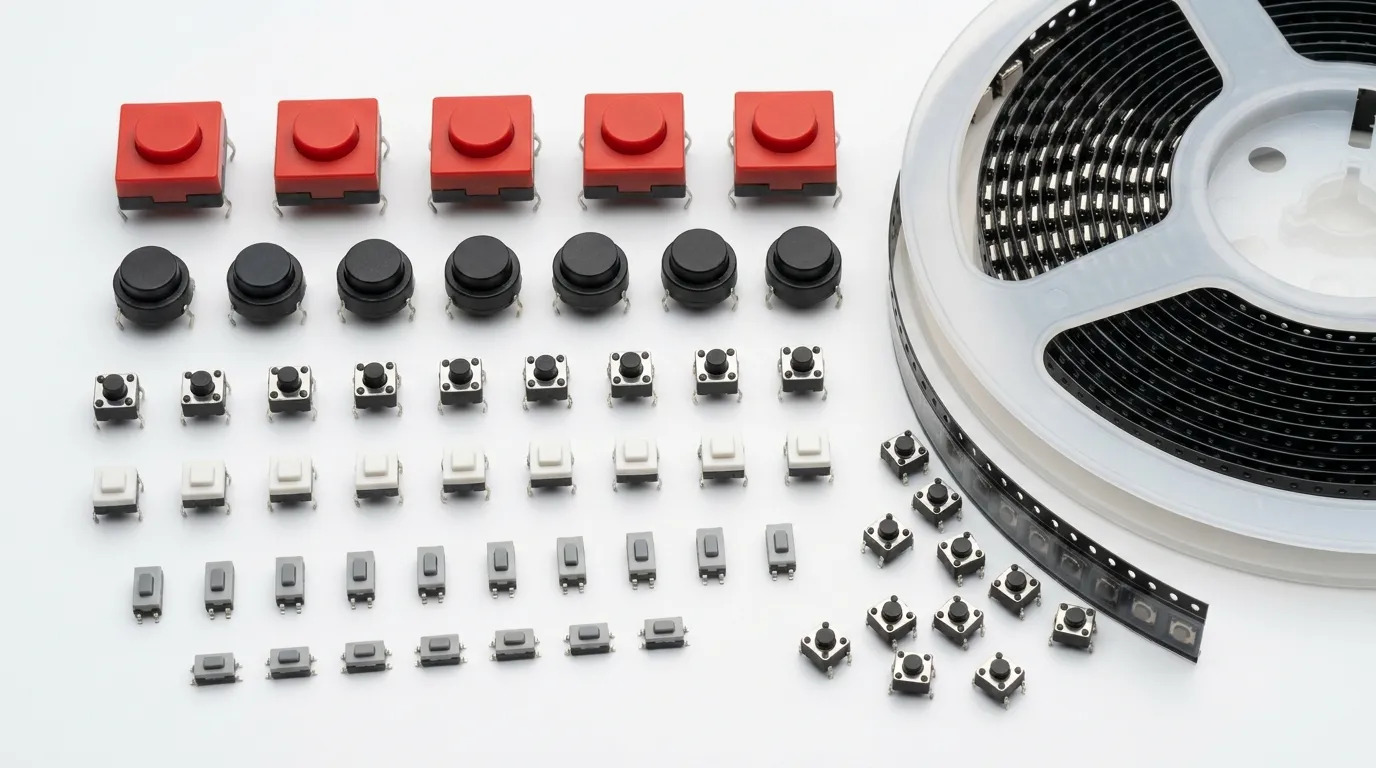
Tactile switch pricing at wholesale level is not a fixed number — it is a tiered structure that shifts significantly with order volume, product type, contact plating, and customization requirements.
At the standard catalog level, per-unit pricing follows a predictable pattern. Small batches of 1,000 to 5,000 pieces typically carry a higher unit cost. Orders from 10,000 to 50,000 pieces see meaningful price reductions. At 100,000 pieces and above, per-unit costs for standard models can be substantially lower, making the total landed cost economics very different from small-batch buying.
| Order Quantity | Pricing Tier | Customization Availability | Typical Lead Time |
|---|---|---|---|
| 1,000 – 4,999 pcs | Standard (higher unit price) | Packaging options only | 2 – 4 weeks |
| 5,000 – 49,999 pcs | Mid-volume discount | Partial (reel format, markings) | 3 – 5 weeks |
| 50,000 – 99,999 pcs | High-volume pricing | Full OEM customization available | 5 – 8 weeks |
| 100,000+ pcs | Best unit rate | Full ODM (housing, actuator, part number) | 6 – 12 weeks |
Beyond unit price, buyers often underestimate the cost layers that determine real landed cost. Tooling fees apply when requesting a custom actuator height or housing design that does not match an existing mold. Reel and tape packaging typically carries a premium over bulk bag delivery. Freight terms — whether FOB, CIF, or DDP — significantly affect the final cost per unit, particularly for European buyers sourcing from China.
MOQ Negotiation Is Often Possible
Standard MOQ figures from factory price sheets are not always fixed. If you are placing a first order with a manufacturer and demonstrating clear repeat-order intent, MOQs for standard catalog models are often negotiable. Custom OEM specifications, however, carry higher MOQ floors because they require dedicated tooling or production line changeovers.
Critical Specifications to Confirm Before Any Bulk Order
The most expensive mistake in wholesale procurement is discovering a specification mismatch after production has started. These are the parameters to lock down in writing before issuing a purchase order.
| Specification | What to Confirm | Why It Matters |
|---|---|---|
| Actuation Force | Grams-force (gf): 100gf, 160gf, 250gf | Wrong force causes poor user experience or accidental actuation |
| Rated Voltage / Current | e.g., 12V DC, 50mA | Ensures compatibility with your PCB circuit design |
| Contact Resistance | Should be ≤100mΩ initially | High resistance causes signal issues in low-current circuits |
| Mechanical Life | Cycles: 500K, 1M, 2M | Mismatching life rating to application increases field failure rate |
| Mounting Type | SMD (reflow) or THT (through-hole / wave soldering) | Must match your assembly process — not interchangeable |
| Actuator Height | mm from PCB surface | Mechanical interference in housing if wrong height specified |
| Footprint / Body Size | 3×3mm, 6×6mm, 12×12mm | PCB land pattern must match datasheet footprint exactly |
| IP Rating | IP67 (splash), IP68 (submersion) | Required for outdoor, industrial, or medical deployments |
| Contact Plating | Gold, silver, nickel | Gold plating required for low-current signal and long-life applications |
| Operating Temperature | e.g., –40°C to +85°C | Critical for automotive, outdoor, and industrial environments |
| RoHS / REACH Compliance | Confirm with documentation | Mandatory for EU market entry; required for most OEM customers |
Request the manufacturer's official datasheet and a signed RoHS conformance declaration for every model before purchase. Do not accept verbal assurances — compliance documents should be lot-specific and traceable.
Tactile Switch Types That Drive Wholesale Buying Decisions
You do not need to choose across every category at the wholesale stage, but you do need to align the switch type to your assembly process and application environment from the start.
SMD (Surface Mount) Tactile Switches are the default for high-volume automated PCB assembly. They are compatible with reflow soldering processes, space-efficient, and available in reel packaging ready for pick-and-place machines. If your production line uses SMT assembly, SMD tact switches are the correct baseline specification for most consumer electronics, wearables, and compact industrial devices.
Through-Hole (DIP/THT) Tactile Switches provide superior mechanical anchoring, making them the correct choice for applications where the switch experiences repeated physical stress, vibration, or operator push force. Automotive control panels, professional audio equipment, and ruggedized industrial interfaces typically specify through-hole mounting for this reason.
Sealed and Waterproof Tactile Switches become mandatory — not optional — when the end application exposes the PCB to liquids, dust, or condensation. IP67-rated switches survive brief immersion; IP68-rated switches tolerate sustained submersion. Specifying the wrong IP rating in a wholesale order for outdoor or industrial products is a certification liability, not just a reliability concern. For detailed requirements across industrial environments, refer to the industrial tactile switch guide.
Long-Life Tactile Switches are engineered for applications where the switch actuates frequently over the product's service lifetime. Standard catalog switches may be rated for 500,000 to 1 million cycles. Long-life variants, with reinforced actuators and higher-grade contact materials, extend this to 2 million cycles or beyond. For medical device applications with strict reliability requirements, the medical-grade tactile switch guide covers the additional compliance and performance considerations in detail.
OEM Customization Options in Wholesale Orders
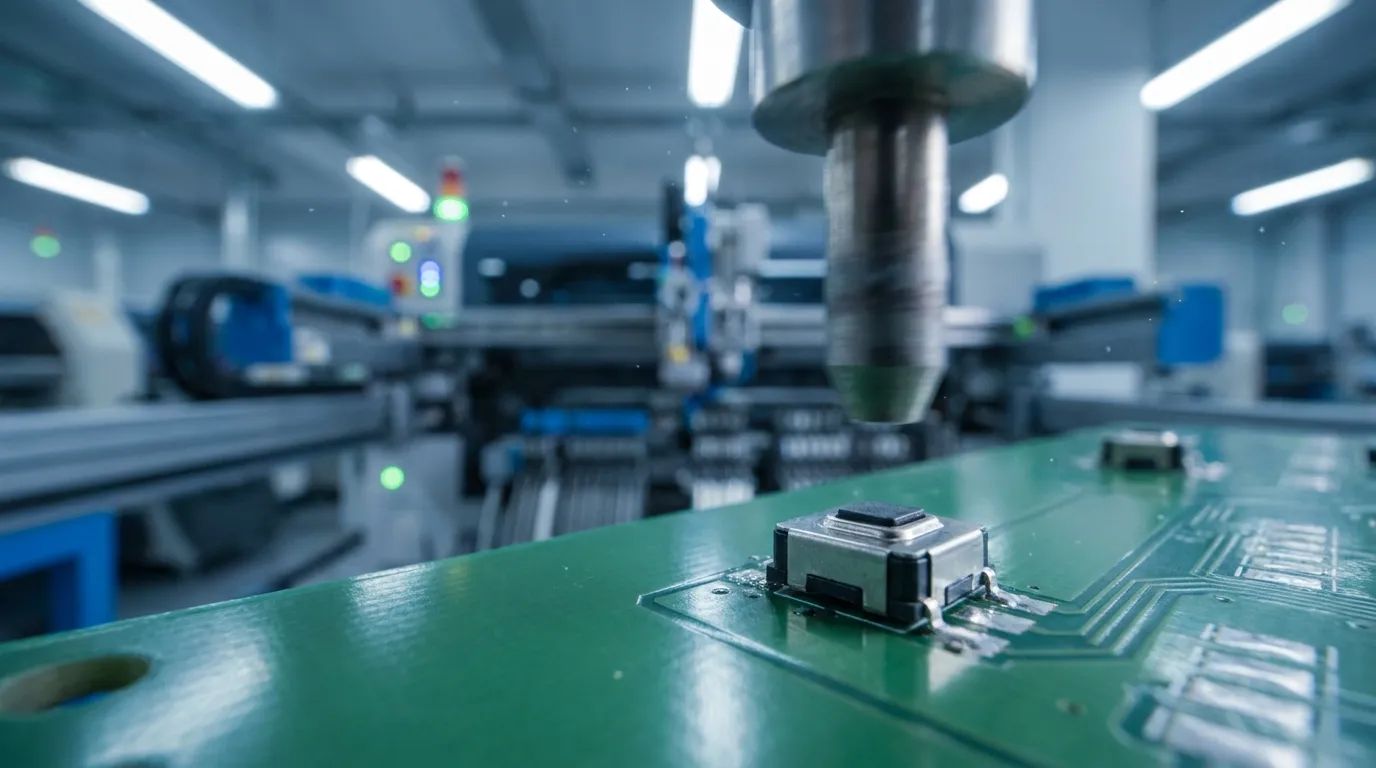
One of the most overlooked advantages of wholesale procurement is the ability to specify a switch that fits your product exactly, rather than adapting your design around a catalog component.
At volume, most reputable manufacturers offer customization across several dimensions. Actuator height and shape can be adjusted to fit recessed or exposed panel designs. Housing color can be specified for assembly line identification or branding purposes. Contact plating — gold versus silver — can be selected based on signal type and expected cycle life. Part numbers and customer-specific markings can be applied for traceability. Packaging format (reel and tape for automated assembly, tray for manual placement, bulk bag for hand assembly) can be specified per production requirement.
| Customizable Parameter | Standard Option | Custom Option | Typical MOQ for Customization |
|---|---|---|---|
| Actuator Height | Catalog standard | Custom height (mm) | 50,000+ pcs (new tooling required) |
| Housing Color | Black / Natural | Any specified color | 50,000+ pcs |
| Contact Plating | Silver | Gold, Nickel | 10,000+ pcs |
| Part Marking / Logo | None | Customer part number, logo | 10,000+ pcs |
| Reel Packaging | Bulk bag | Tape and reel (SMD), Custom tray | 5,000+ pcs |
| Custom Part Number (Datasheet) | Manufacturer PN | Customer PN with co-branded datasheet | 50,000+ pcs |
Customization that requires new injection molds or tooling carries a one-time tooling fee, which is typically amortized across the production volume. For standard catalog customizations like reel format or contact plating selection, tooling fees generally do not apply.
How to Qualify a Tactile Switch Supplier Before Ordering
Placing a large order with an unqualified supplier is one of the highest-risk actions in electronics procurement. Price-per-unit is the easiest number to compare — it is also the least reliable indicator of a supplier's ability to deliver consistent quality at production scale.
A proper supplier qualification process starts with verifying that the manufacturer has documented quality control at every stage of production, not just outgoing inspection. Ask specifically whether they operate 100% factory inspection or statistical sampling inspection (AQL). For high-stakes production runs, 100% inspection is the stronger guarantee.
Request the following documents before approving a supplier for production orders:
- RoHS Compliance Declaration (EU Directive 2011/65/EU) — lot-specific, not just a general company statement
- REACH Declaration — confirming absence of SVHCs (Substances of Very High Concern)
- Product Datasheet — with rated voltage, current, actuation force, mechanical life, and environmental specifications
- Quality Conformance Certificate — test results for the specific product model
- IEC 60529 IP Rating Test Report — for waterproof or sealed variants
For a comprehensive factory-level evaluation framework, the tactile switch factory checklist provides a structured audit approach you can apply before committing to a production order.
Red Flags When Evaluating a Wholesale Supplier
- Cannot provide model-specific datasheets on request
- Offers RoHS certificates that are not dated or lot-referenced
- Cannot confirm whether the facility operates automated or manual production
- Quotes are dramatically lower than comparable suppliers without explanation
- MOQ and lead time change significantly after initial pricing discussion
The Sample-to-Production Pipeline
Skipping the sample validation stage is the single most common cause of costly batch rejection in wholesale tactile switch procurement. Even when a supplier provides a matching datasheet, real-world performance must be verified under your specific application conditions before production approval.
A structured sample-to-production process typically follows five stages:
- Specification Lock — Agree on all parameters in writing (footprint, actuation force, IP rating, plating, life rating, packaging format) before requesting samples
- Sample Request — Obtain a minimum of 20–50 pieces per model for evaluation
- Application Testing — Test samples against your actual PCB design, housing tolerances, and environmental conditions; measure actuation force, contact resistance, and switch travel
- Feedback and Revision — If deviations are found, revise the specification with the supplier and request a second sample run before approving
- First-Article Inspection (FAI) — On the first production batch, inspect a statistical sample against the approved specification before accepting the full order
This process adds two to four weeks to the procurement timeline. It also eliminates the far greater cost of a full batch rejection or product recall.
Factory-Direct vs. Trading Company vs. Distribution Platform
Understanding your sourcing channel is as important as selecting the right switch specification. Each channel has different trade-offs across price, quality control, customization capability, and supply risk.
| Factor | Factory-Direct | Trading Company | B2B Distribution Platform |
|---|---|---|---|
| Unit Price | Lowest at high volume | Mid-range | Highest |
| MOQ | Higher (typically 5,000+ pcs) | Lower (sometimes 500–1,000 pcs) | No MOQ / per-unit |
| OEM Customization | Full capability | Limited (dependent on factory relationship) | Not available |
| Quality Control | Direct factory QC | Indirect — depends on trading co. | Platform guarantee only |
| Traceability | High — direct audit access | Medium | Low |
| Lead Time | Longer (production-scheduled) | Variable | Fastest (from stock) |
| Certification Documentation | Full documentation available | Often incomplete | Varies by listing |
| Best For | High-volume OEM production | First-order trial batches | Urgent small replenishments |
For large-volume OEM production, factory-direct sourcing consistently delivers better specification control, stronger certification documentation, and full OEM customization — at the cost of higher MOQ requirements and longer lead times. For a detailed assessment of Chinese tact switch manufacturers and what to look for in factory partnerships, refer to the tact switch supplier China guide.
Common Wholesale Buying Mistakes to Avoid
Most costly sourcing errors are predictable and preventable. These are the mistakes that appear most frequently in wholesale tactile switch procurement.
| Mistake | Consequence | How to Avoid |
|---|---|---|
| Selecting a supplier based on unit price alone | Inconsistent quality, missing certifications, specification deviations | Evaluate quality system, documentation, and production capacity alongside price |
| Skipping the sample validation stage | Batch rejection, PCB rework, production delay | Always complete the 5-stage sample-to-production process before ordering at scale |
| Not specifying packaging format | SMD switches delivered in bulk bag, incompatible with pick-and-place machines | Specify reel pitch, orientation, and packaging type in the PO |
| Single-sourcing without a backup supplier | Production halt if the primary supplier has stock or capacity issues | Qualify at least two suppliers for critical components |
| Accepting verbal RoHS/REACH compliance | Regulatory non-compliance in EU or US markets | Request signed, dated, lot-referenced compliance documentation |
| Ignoring operating temperature range | Field failures in automotive or outdoor deployments | Match the switch's temperature specification to the application environment |
| Not confirming actuator height against housing | Mechanical interference, incomplete switch travel, poor tactile feel | Test assembled switch in final housing with samples before production |
Related Guides
Understanding wholesale procurement is one layer of a broader sourcing decision. If your application requires switches for environments with specific certification demands, these resources provide deeper specification guidance:
For medical device applications, where switch reliability and material compliance requirements go beyond standard RoHS, the medical-grade tactile switch guide covers biocompatibility, IEC 60601 considerations, and long-life specifications.
For industrial applications involving vibration, high-cycle operation, or environmental exposure, the industrial tactile switch guide explains the IP rating, sealing, and actuation force requirements specific to industrial deployments.
If you are evaluating a new factory supplier and need a structured audit framework, the tactile switch factory checklist provides a step-by-step process for qualifying a manufacturer before committing to production orders.
For a broader view of the full product range — types, mounting configurations, standard specifications, and application categories — the complete Hanxia tact switch overview is the right starting point.
Frequently Asked Questions
What is the standard MOQ for wholesale tactile switches?
For standard catalog tactile switches, most manufacturers set a minimum order quantity between 1,000 and 5,000 pieces. Custom OEM specifications — particularly those requiring new actuator tooling or housing molds — typically carry MOQ requirements of 50,000 pieces or more to recover tooling investment.
What certifications should wholesale tactile switches carry for EU markets?
At minimum, switches sold into EU markets should carry RoHS compliance (EU Directive 2011/65/EU) and REACH compliance documentation. For industrial or outdoor applications, IP rating certification per IEC 60529 is required. Medical device applications require additional compliance with IEC 60601 standards.
How do I verify if a RoHS certificate is genuine?
Genuine RoHS certificates should reference a specific product model number, include a test date, identify the testing laboratory or issuing authority, and list the restricted substances tested. A generic, undated company declaration without model or lot specificity is not sufficient for regulatory purposes.
What is the price difference between SMD and through-hole tactile switches at wholesale?
At comparable specifications, SMD and through-hole tactile switches are often similarly priced at catalog level. Price differences arise from contact plating (gold-plated contacts cost more than silver), body size (larger footprints use more material), and IP-rated sealing (waterproof variants carry a premium due to gasket or sealing membrane components).
Should I use SMD or through-hole tactile switches for high-volume production?
For automated SMT assembly lines, SMD tactile switches are the correct choice — they are compatible with reflow soldering and pick-and-place machinery, and they arrive in reel packaging ready for automated handling. Through-hole switches are appropriate when the application requires stronger mechanical anchoring or when the assembly process uses wave soldering.
What is the typical lead time for a wholesale tactile switch order?
Standard catalog items from an active production manufacturer typically ship within two to four weeks. Custom OEM specifications requiring new tooling or housing designs may require six to twelve weeks, including tooling fabrication, sample approval, and production scheduling.
Can I request samples before committing to a production order?
Yes — any reputable manufacturer will provide pre-production samples for specification validation. Request a minimum of twenty to fifty pieces per model for application testing. Skipping this step on large-volume orders is one of the most common sources of costly batch rejection.
What is the difference between gold-plated and silver-plated contacts in wholesale orders?
Gold-plated contacts provide superior oxidation resistance, making them the correct choice for low-current signal switching (below 10mA) and long-life applications. Silver-plated contacts are suitable for higher-current applications and offer lower initial contact resistance, but are more susceptible to sulfidation over time in certain environments.
Conclusion
Sourcing tactile switches at wholesale scale is a procurement discipline as much as it is a product selection exercise. The switches that serve your production well are not necessarily the cheapest per unit — they are the ones whose specifications are locked to your design, validated through a proper sample process, supplied by a manufacturer with documented quality systems, and delivered in the correct format for your assembly line.
Establish your specification checklist before you request quotes. Qualify your supplier against documentation and quality process criteria, not price alone. Build the sample-to-production pipeline into your procurement timeline. And where your application demands domain-specific compliance — medical, industrial, automotive — ensure that your switch specification meets those requirements before you place a production order.
For OEM buyers ready to discuss specific volume requirements, packaging formats, and customization options, Hanxia's manufacturing team supports the full process from specification consultation through production delivery.
