





Bulk Tact Switches Buying Guide: MOQ, Packaging & Lead Time
You have confirmed your tact switch specification. You know the footprint, the actuation force, the mounting type. Now the real procurement questions begin: How many do you have to order? How will the parts arrive? How long will production actually take?
These are the questions that determine whether your production schedule runs smoothly or gets delayed by three weeks. This guide answers all three — clearly, specifically, and from a buyer's perspective — so you can walk into your first RFQ conversation fully prepared.
If you are still evaluating product types and specifications before committing to a bulk order, start with the complete tact switch product guide to compare switch types, mounting options, and key technical parameters first.
What "Bulk" Means in a Tact Switch Order Context
In the component industry, "bulk" does not mean loosely dumped into a box. It refers to a structured factory-direct order placed at volume — typically above the factory's minimum order quantity — where pricing, packaging format, and lead time are negotiated directly with the manufacturer, not drawn from a distributor's shelf stock.
Bulk orders differ from spot purchases in three important ways. First, the unit price drops significantly at volume, often by 30–60% compared to distributor pricing. Second, you control the packaging format, which directly affects how parts feed into your assembly process. Third, you are working on a production timeline, not pulling from existing inventory, which means lead time planning becomes a critical part of your order.
Understanding these three dimensions — MOQ, packaging, and lead time — before contacting a supplier will save you significant back-and-forth and prevent costly surprises during production ramp-up.
Understanding MOQ for Bulk Tact Switches
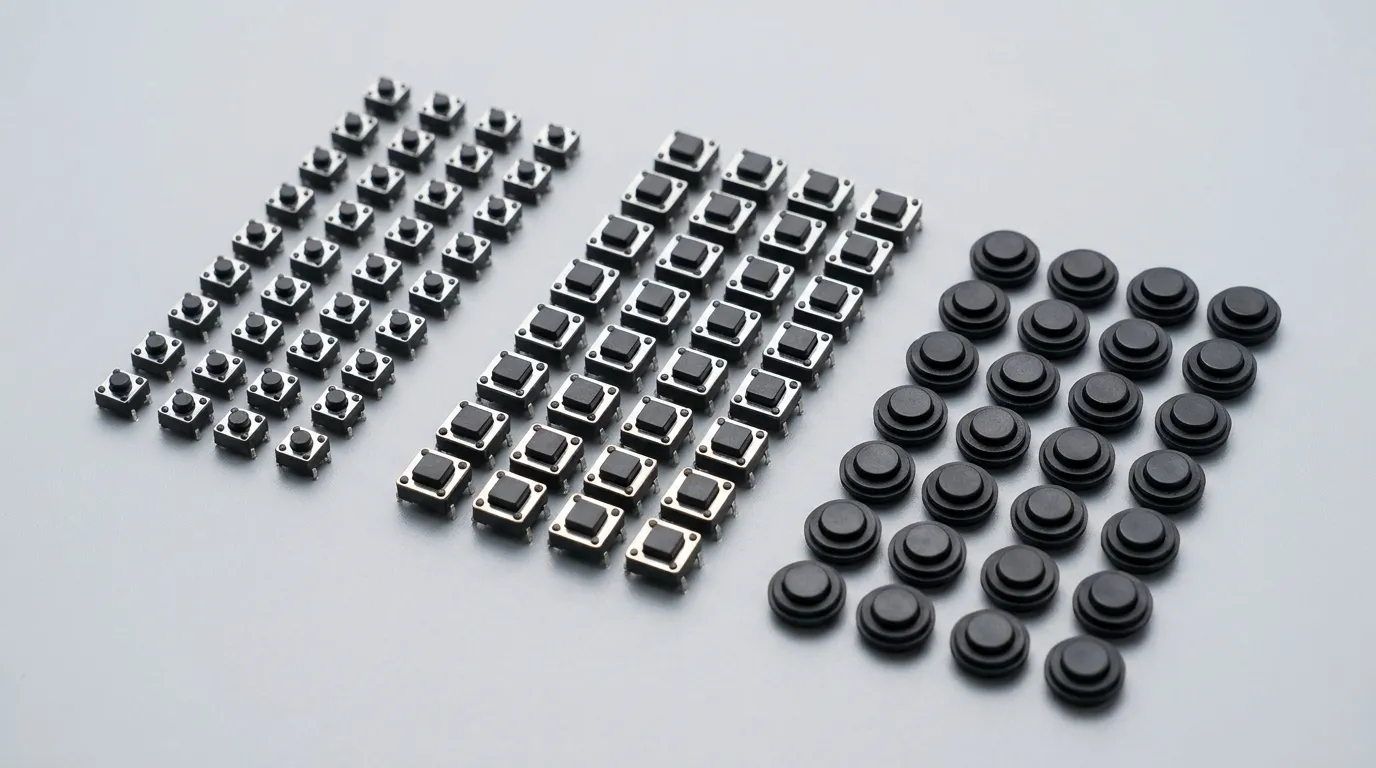
MOQ stands for Minimum Order Quantity, and in the tact switch world, it is not a fixed industry standard — it varies by switch type, construction complexity, and factory capacity. Knowing the realistic MOQ ranges before your first conversation prevents wasted time on both sides.
Typical MOQ Ranges by Switch Type
| Tact Switch Type | Typical MOQ Range | Notes |
|---|---|---|
| Standard SMD/SMT tact switch | 2,000 – 5,000 pcs | Higher MOQ due to tape & reel setup cost |
| Standard DIP through-hole tact switch | 500 – 2,000 pcs | Lower setup cost, more flexible MOQ |
| 6×6 or 12×12 general-purpose tact switch | 1,000 – 3,000 pcs | Most common; widely stocked mold tooling |
| Waterproof / sealed tact switch | 2,000 – 10,000 pcs | Specialized sealing process increases MOQ |
| Illuminated / LED tact switch | 1,000 – 5,000 pcs | LED integration adds assembly complexity |
| Right-angle / low-profile tact switch | 1,000 – 3,000 pcs | Depends on existing tooling at factory |
| Custom dimensions or actuator shape | 5,000 – 20,000 pcs | New tooling required; higher commitment |
These are directional ranges based on typical factory terms. Your actual MOQ will depend on the specific factory's production setup, whether mold tooling already exists for your switch type, and your relationship with the supplier.
MOQ Per SKU vs. MOQ Per Order
One of the most common points of confusion for first-time OEM buyers is the difference between MOQ per SKU and MOQ per order. Some factories set MOQ at the order level — meaning your total order across all switch variants must meet a minimum value or piece count. Others apply MOQ per individual product code, which means each switch size, color, or actuation force variant must independently meet the threshold.
Always confirm in writing whether the quoted MOQ applies per SKU or per total order. This distinction significantly affects how you consolidate your initial purchase.
Negotiating Below MOQ as a New Buyer
Most Chinese tact switch factories will accommodate below-MOQ sample orders, typically at 50–200 pieces, with the buyer covering express freight costs. This is a standard part of the qualification process and does not commit either party to a production run.
For your first production order, factories sometimes allow a 30–50% MOQ reduction if you agree to a slightly higher unit price to offset the setup cost difference. Frame the conversation as a long-term relationship with a confirmed second order — most experienced sales engineers will work with you. To understand which factory terms are fair before entering that negotiation, review this tact switch factory qualification checklist before your first contact.
Tact Switch Packaging Formats Explained
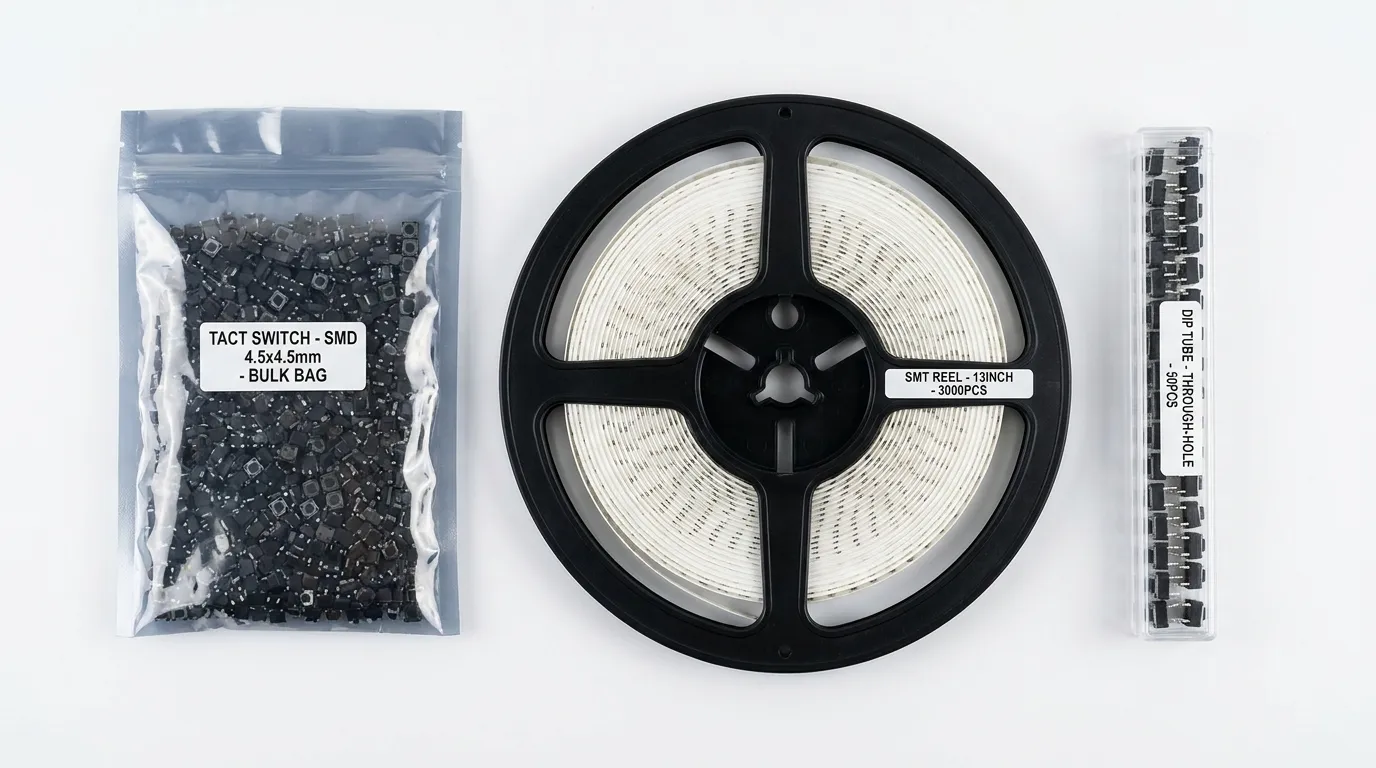
Packaging format is not a minor shipping detail. It directly determines whether your parts can feed into your assembly process automatically or require manual handling. Choosing the wrong packaging at the order stage means either repacking parts before production or running manual soldering on a line designed for automation.
There are three standard packaging formats for bulk tact switches, and each one matches a specific assembly method.
SMT Tape and Reel — For Automated Pick-and-Place Lines
Tape and reel is the standard packaging format for SMD (surface-mount) tact switches used on automated PCB assembly lines. The switches are placed at consistent intervals in individual pockets along a continuous carrier tape, sealed with a cover tape, and wound onto a reel — typically 7-inch or 13-inch diameter.
The reel feeds directly into your pick-and-place machine, enabling high-speed, consistent component placement with no manual intervention. A standard 13-inch reel holds approximately 2,000–4,000 pieces depending on switch body size. Tape pitch (the spacing between pockets) must match your machine's feeder specification — confirm this with your assembly team before ordering.
This format adds a setup cost compared to bulk bag, but the labor and cycle time savings on an automated line typically justify the premium for orders above 5,000 pieces.
Choose SMT tape and reel when: your PCB assembly line uses automated pick-and-place equipment and your switch is an SMD footprint.
Bulk Bag / Loose Pack — For Manual Assembly and Low-Volume Runs
Bulk bag (also called loose pack) is the most straightforward packaging format. Switches are placed together in anti-static bags or plastic bags, counted to a standard quantity per bag (commonly 100, 500, or 1,000 pieces per bag), and boxed for shipment.
This format is appropriate for through-hole DIP switches used in manual soldering, prototype and small-batch runs, hand-assembly operations, or situations where your assembly team feeds parts manually into wave soldering fixtures. Bulk bag has no tape setup fee and is the cheapest format per unit at low volumes. The trade-off is that it requires manual picking and placement on the line, which slows throughput at higher volumes.
Choose bulk bag when: your assembly is manual or semi-automated, your volumes are under 5,000 pieces per run, or you are ordering samples and low-volume prototypes.
DIP Radial Tape and Tube — For Through-Hole Auto-Insertion
Through-hole tact switches designed for auto-insertion machines are typically available in two sub-formats: radial tape (also called paper tape or ammo pack) and DIP tube. In radial tape, switches are taped at fixed intervals on a paper carrier and wound on a reel or packed in a box (ammo pack style), compatible with automatic insertion equipment. In tube packaging, switches are stacked vertically inside rigid plastic tubes, compatible with manual or semi-automatic insertion machines.
Choose DIP radial tape when: your production line uses automatic through-hole insertion equipment. Choose DIP tube when: your line uses manual or semi-automatic through-hole placement.
Packaging Format Comparison Table
| Format | Best For | Assembly Method | Unit Cost Impact | Anti-Static Option |
|---|---|---|---|---|
| SMT Tape & Reel | SMD switches | Pick-and-place machine | Slightly higher (setup fee) | Standard |
| Bulk Bag / Loose Pack | DIP/THT switches | Manual soldering | Lowest | Available on request |
| DIP Radial Tape | Through-hole switches | Auto-insertion machine | Moderate | Available |
| DIP Tube | Through-hole switches | Manual / semi-auto | Low to moderate | Standard |
For switches being placed in industrial environments or medical-grade assemblies, confirm anti-static (ESD-safe) packaging with your supplier. See the industrial tactile switch guide for assembly-line packaging standards specific to industrial PCB production.
Tact Switch Lead Time Breakdown
Lead time is the number that most buyers underestimate. When a factory quotes "15–20 working days," that figure typically covers only the production stage — it does not include material procurement, QC hold time, or shipping transit. Your actual calendar lead time from order confirmation to parts-in-hand can be significantly longer.
Understanding lead time as a multi-stage process allows you to build a realistic production schedule.
Lead Time by Stage
| Stage | Typical Duration | Notes |
|---|---|---|
| Material procurement | 3 – 7 days | Longer if raw materials are not in stock |
| Production / assembly | 7 – 20 days | Depends on order volume and line capacity |
| Quality control & inspection | 2 – 5 days | IQC, IPQC, OQC standard for OEM orders |
| Packaging & export documentation | 1 – 3 days | Includes labeling, carton prep, COA |
| Shipping transit | 3 – 35 days | Air: 3–7 days; Sea: 20–35 days to Europe |
| Total: standard small batch (<100k units) | 15 – 35 working days | Air freight to Europe |
| Total: large volume (>200k units) | 25 – 50 working days | Sea freight typical |
Sample Lead Time
Sample orders of 50–200 pieces typically carry a 5–10 working day lead time, with the option of DHL/FedEx express delivery at additional cost. Samples are usually produced from existing tooling and stock material, so the material procurement stage is compressed or eliminated.
Factors That Extend Lead Time
Several variables can push your lead time beyond the standard range:
- Custom specifications: Non-standard actuator height, body color, or contact plating requires additional setup time or material sourcing.
- New mold tooling: If your switch dimensions require a new mold, add 15–30 days for tooling fabrication before production can begin.
- Factory workload: Q4 and Q1 are peak seasons for electronics component factories. Orders placed in November or December, or in January–February (around Chinese New Year), routinely face 2–4 week delays.
- Material shortages: Raw copper, phosphor bronze, and specific resin compounds occasionally face supply chain pressure. Confirm material availability before locking in your delivery date.
- Large tape & reel setups: Setting up automated taping lines for a new switch SKU adds 1–3 days to the production timeline.
How to Reduce Lead Time on Your Bulk Order
The most effective way to compress lead time is to finalize your switch specification completely before placing the order. Every revision after order confirmation resets at least part of the production stage. Second, book production capacity in advance — especially for Q4 delivery deadlines. Third, for repeat orders, establish a blanket order arrangement where the factory maintains a pre-production buffer of your most-used SKUs.
For a deeper breakdown of how Chinese tact switch factories structure their production cycles and capacity planning, see this guide on working with tact switch suppliers in China.
Trade Terms and Payment Conditions for OEM Tact Switch Orders
When you receive a bulk tact switch quotation, it will include an Incoterm that defines where the factory's responsibility ends and yours begins. This term directly affects your total lead time calculation because it determines when shipping time starts adding to your calendar.
| Incoterm | Factory Responsibility Ends | Buyer Responsible For | Best For |
|---|---|---|---|
| EXW (Ex Works) | At factory gate | All freight, insurance, customs | Buyers with freight forwarder |
| FOB (Free on Board) | At port of origin | Ocean/air freight + import costs | Most common for Asia–Europe orders |
| CIF (Cost, Insurance, Freight) | At destination port | Import duties, local delivery | Buyers preferring door-to-port quotes |
| DAP (Delivered At Place) | At buyer's premises | Import duties only | Buyers wanting simplified logistics |
For most European OEM buyers ordering tact switches from China, FOB pricing is the standard starting point. Always confirm which Incoterm is included in the quoted unit price — EXW quotes can look cheaper per piece until you add freight.
Payment terms for first-time bulk orders typically follow a T/T structure: 30% deposit upon order confirmation, 70% balance before shipment. Established long-term buyers sometimes negotiate 30/70 with extended balance payment windows. Letter of Credit (L/C at sight) is available for very large orders (typically USD 20,000+) where both parties prefer bank-secured payment.
For a full breakdown of pricing tiers and wholesale payment structures, the tactile switch wholesale guide covers volume pricing in detail.
How Packaging Format Affects Your Unit Price
The packaging format you choose is not cost-neutral. Each format carries a different cost structure, and understanding the trade-off helps you choose the format that delivers the best total assembly cost — not just the cheapest per-piece price at the invoice stage.
Bulk bag is the lowest-cost packaging format at the invoice level. There is no carrier tape, no reel, and no taping machine setup fee. For manual assembly or low-volume prototyping runs, this is the most economical choice.
Tape and reel carries a one-time setup fee (typically USD 50–150 depending on factory) plus a per-piece taping cost added to the base unit price. At low volumes (under 2,000 pieces), the setup fee makes tape and reel significantly more expensive per unit. At high volumes (10,000+ pieces), the setup fee is amortized and the difference becomes negligible — while your assembly line cycle time improves substantially.
DIP radial tape sits between the two in cost. The taping is simpler than SMT embossed taping, and reel setup fees are lower, but you still pay a premium over loose bulk bag.
The correct framework: Do not choose packaging based on unit price alone. Calculate total cost per assembled board, including manual picking labor, cycle time, and rework rate. For any run above 5,000 SMD switches, tape and reel almost always wins on total cost.
Pre-Order Checklist: What to Confirm Before Placing a Bulk Tact Switch Order
Before you send your purchase order or sign off on a proforma invoice, confirm the following in writing with your supplier:
- ☐ Switch type and mounting: SMD, DIP through-hole, or right-angle confirmed
- ☐ Part number / product code: Exact SKU, including body size, actuator height, and contact rating
- ☐ MOQ clarification: Per SKU or per total order — confirmed in writing
- ☐ Packaging format: Tape & reel (reel size + tape pitch), bulk bag, or DIP tube/radial tape
- ☐ Quantity per reel or bag: Confirmed to match your assembly line feeder requirements
- ☐ Anti-static packaging: Required or not — confirm for sensitive applications
- ☐ Lead time by stage: Not just "X days" — production + QC + packaging confirmed separately
- ☐ Incoterm: EXW, FOB, CIF, or DAP — confirmed and included in quoted price
- ☐ Payment terms: Deposit percentage, balance trigger, bank details
- ☐ QC documentation: Certificate of Conformance (COA), inspection reports available on request
- ☐ Sample stage: Confirm whether pre-production samples are included before mass production begins
- ☐ Seasonal production notes: Confirm if order window overlaps with Chinese New Year or factory peak seasons
This checklist should be your standard pre-order verification template for any bulk electronic component order, not just tact switches.
Common Mistakes When Ordering Tact Switches in Bulk
| Mistake | Why It Happens | How to Avoid It |
|---|---|---|
| Choosing wrong packaging format | Buyer focuses on unit price, ignores assembly method compatibility | Confirm assembly line type (manual, pick-and-place, auto-insertion) before specifying packaging |
| Treating lead time as a single number | Factory quotes production time only; buyer assumes it includes shipping | Ask for lead time broken down by stage; add shipping transit separately |
| Ignoring MOQ per SKU distinction | Buyer assumes one MOQ for the whole order | Confirm in writing whether MOQ applies per SKU or per total order value |
| Skipping the sample stage | Buyer wants to save time and cost; mass production reveals issues | Always run a pre-production sample confirmation before authorizing mass production |
| Ordering during Chinese New Year window | Buyer unaware of factory closure periods | Plan orders to avoid January–February; book production slots in November |
| Not confirming tape pitch for SMT reel | Buyer assumes standard pitch fits all pick-and-place feeders | Confirm tape pitch and pocket dimensions with your assembly team before ordering |
| Accepting vague payment terms | First-time buyer doesn't push for written T/T structure | Request a proforma invoice with full payment terms before paying any deposit |
Related Guides
If you are at an earlier stage of your procurement process — still comparing switch types, evaluating technical specifications, or shortlisting suppliers — these resources will help you build the foundation before you get to bulk order terms:
The complete tact switch buying guide covers the full product category: switch types, technical specifications, mounting options, and application matching. This is where to start if you have not yet finalized your switch specification.
If you are evaluating factories rather than just terms, the tactile switch factory checklist walks through the supplier qualification process — what certifications to verify, what production capabilities to confirm, and what red flags to watch for before committing to a production relationship.
FAQs — Bulk Tact Switch Orders
What is the minimum order quantity for bulk tact switches?
For most standard tact switch types, MOQ ranges from 500 to 5,000 pieces depending on switch complexity and factory setup. DIP through-hole switches typically have lower MOQ (500–2,000 pcs) than SMD switches (2,000–5,000 pcs) because SMT tape and reel setup carries a higher fixed cost. Custom or waterproof variants generally require 2,000–10,000 pieces minimum.
What packaging options are available for bulk tact switch orders?
The three standard options are: SMT tape and reel (for automated pick-and-place assembly), bulk bag / loose pack (for manual soldering and low-volume runs), and DIP radial tape or tube (for through-hole auto-insertion or manual through-hole assembly). The right choice depends on your PCB assembly method, not personal preference.
How long does a bulk tact switch order take from order to delivery?
A standard small-batch order (under 100,000 units) takes approximately 15–35 working days from order confirmation to delivery in Europe, including production, QC, and air freight. Large-volume orders via sea freight can take 35–50 working days total. Sample orders typically take 5–10 working days.
Can I order a sample before committing to a bulk run?
Yes. Most tact switch manufacturers accept sample orders of 50–200 pieces, usually at a higher per-piece price to offset the setup cost, with express shipping billed separately. Always request pre-production samples before approving mass production, especially for custom specifications.
What is tape and reel packaging for SMT tact switches?
Tape and reel is a packaging system where surface-mount tact switches are loaded into individual pockets in a continuous carrier tape, sealed with cover tape, and wound onto a plastic reel. The reel feeds directly into pick-and-place machine feeders for high-speed automated PCB assembly. A 13-inch reel typically holds 2,000–4,000 SMD tact switches depending on body size.
Does packaging format affect the unit price?
Yes. Bulk bag is the lowest-cost format at invoice level. Tape and reel adds a one-time setup fee (typically USD 50–150) plus a per-piece taping charge. At high volumes, the cost difference is marginal, but the assembly labor savings from automation typically justify tape and reel for any run above 5,000 pieces on an automated line.
What payment terms should I expect for a first bulk order?
Standard payment terms for new OEM buyers are T/T with 30% deposit upon order confirmation and 70% balance before shipment. Some factories accept Letter of Credit (L/C at sight) for orders above USD 20,000. Avoid any arrangement requiring 100% upfront payment before sample approval.
How does Chinese New Year affect tact switch lead times?
Chinese electronics component factories typically close for 1–3 weeks around Chinese New Year (late January to mid-February). Orders placed in December that require delivery before mid-February often face significant delays. Plan bulk orders with January–April deadlines by placing them no later than early to mid-November.
Can I request custom packaging for an OEM bulk order?
Yes. Most factories accommodate OEM-branded packaging for sufficient order volumes, including custom reel labels, branded carton printing, and specific bag labeling. Confirm custom packaging requirements at the RFQ stage, as these requests may add 1–3 days to the packaging and documentation stage.
What is the difference between EXW and FOB pricing for tact switches?
EXW (Ex Works) means the factory price ends at their gate — you arrange and pay for all freight, insurance, and customs clearance from the factory forward. FOB (Free on Board) means the factory handles delivery to the port of origin and loads the goods onto the vessel. For European buyers sourcing from China, FOB is the standard basis for comparison because it eliminates the variable of domestic Chinese freight.
Ready to Place Your Bulk Tact Switch Order?
Ordering tact switches in bulk is straightforward once you understand the three commercial variables that govern every factory-direct order: the MOQ that determines your minimum commitment, the packaging format that must match your assembly method, and the lead time structure that governs your production schedule.
The decisions you make at the inquiry stage — packaging format, quantity tier, Incoterm — determine your total cost and assembly efficiency more than the per-piece price on the quote sheet. Go into your RFQ with a confirmed spec, a clear packaging requirement, and a realistic timeline built around the full lead time stages outlined above.
For product-level guidance on switch types, technical specifications, and application matching before you reach the ordering stage, the full tact switch product range and buying guide covers everything you need to finalize your specification with confidence.
