





How Do I Choose an OEM Tactile Switch Supplier?
Choosing the right OEM tactile switch supplier is an important decision for companies developing electronic products. A reliable supplier can provide customized solutions, stable quality, and long-term manufacturing support, while the wrong supplier may create production delays, quality issues, and increased costs.
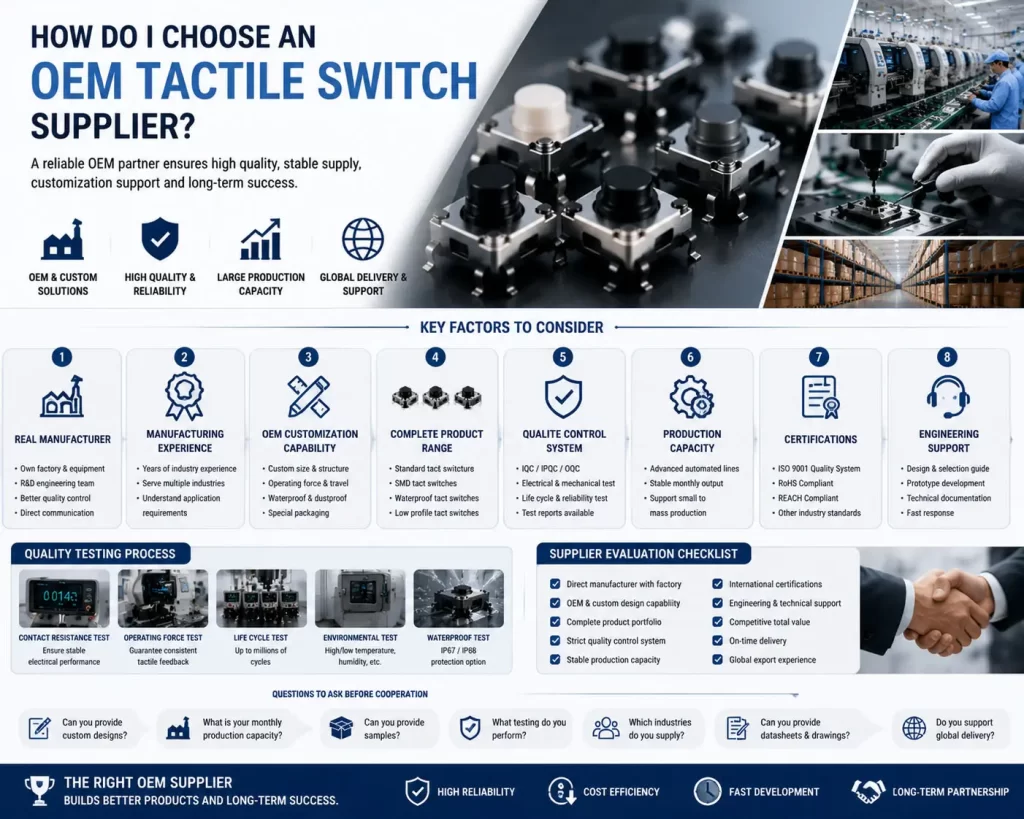
Tactile switches are small components, but they directly affect product reliability and user experience. Whether used in consumer electronics, automotive systems, industrial equipment, or medical devices, selecting the right OEM partner is essential.
This guide explains the most important factors to consider when choosing an OEM tactile switch supplier.
1. Verify the Supplier Is a Real Manufacturer
The first step when selecting an OEM tactile switch supplier is confirming that the company is a direct manufacturer rather than only a trading company.
A real manufacturer should have:
- Production facilities
- Manufacturing equipment
- Engineering teams
- Quality control departments
- Product development capabilities
Working directly with a manufacturer provides better control over:
- Product quality
- Customization
- Production schedules
- Technical communication
A supplier with its own factory can respond faster to design changes and production requirements.
2. Evaluate Manufacturing Experience
Experience is one of the strongest indicators of supplier reliability.
An experienced tactile switch manufacturer understands:
- Switch structure design
- Material selection
- Mechanical performance
- Electrical requirements
- Industry applications
Manufacturers with experience in different industries can provide better technical recommendations.
Important questions to ask:
- How many years have you manufactured tactile switches?
- Which industries do you supply?
- Do you support international customers?
- Can you provide engineering assistance?
3. Check OEM Customization Capability
Every electronic product has different requirements. A good OEM tactile switch supplier should offer customized solutions.
Customization options may include:
Mechanical Design
- Custom dimensions
- Button height
- Terminal structure
- Mounting style
Performance Specifications
- Operating force
- Travel distance
- Tactile feedback
- Operating lifespan
Environmental Requirements
- Waterproof protection
- Dust resistance
- Temperature resistance
OEM capability allows companies to develop switches specifically designed for their products.
4. Review Product Range
A professional tactile switch supplier should provide different solutions for various applications.
Common product categories include:
Standard Tactile Switches
Suitable for:
- Consumer electronics
- Remote controls
- General devices
SMD Tactile Switches
Designed for:
- Compact PCB designs
- Automated assembly
- Portable electronics
Waterproof Tactile Switches
Used for:
- Automotive electronics
- Outdoor equipment
- Industrial applications
Low Profile Tactile Switches
Ideal for:
- Wearable devices
- Space-limited products
A wide product range indicates stronger technical capability.
5. Analyze Quality Control Systems
Quality control is one of the most important factors when choosing an OEM supplier.
A reliable manufacturer should have testing procedures covering:
Electrical Performance
Including:
- Contact resistance
- Insulation resistance
- Voltage rating
- Current rating
Mechanical Performance
Including:
- Operating force testing
- Travel measurement
- Life cycle testing
Environmental Testing
Including:
- Temperature resistance
- Humidity testing
- Waterproof testing
Ask suppliers for:
- Test reports
- Product specifications
- Quality certificates
6. Evaluate Production Capacity
For companies planning mass production, supplier capacity is critical.
A reliable OEM tactile switch supplier should be able to support:
- Prototype production
- Small batches
- Large-scale manufacturing
Important factors include:
- Number of production lines
- Automation level
- Monthly output capacity
- Inventory management
A supplier with strong production capability reduces the risk of supply interruptions.
7. Check Certifications and Compliance
Professional electronic component manufacturers follow international standards.
Common certifications include:
- ISO quality management systems
- RoHS compliance
- REACH compliance
For automotive applications, additional quality requirements may be necessary.
Certifications demonstrate that the manufacturer follows controlled production processes.
8. Evaluate Engineering Support
A strong OEM partner provides technical support throughout product development.
Engineering services may include:
- Product selection advice
- Design optimization
- Prototype development
- Technical documentation
- Testing support
Good communication between engineers helps prevent problems before mass production.
9. Compare Total Value, Not Only Price
Price is important, but it should not be the only selection factor.
The lowest-cost supplier may create additional expenses through:
- Product failures
- Delayed shipments
- Quality problems
- Redesign costs
A reliable OEM supplier provides better long-term value through:
- Stable quality
- Faster development
- Consistent production
- Technical support
OEM Tactile Switch Supplier Evaluation Checklist
Before choosing a supplier, review the following:
✓ Direct manufacturer with factory capability
✓ Experience producing tactile switches
✓ OEM customization support
✓ Complete product portfolio
✓ Quality testing procedures
✓ Stable production capacity
✓ International certifications
✓ Engineering support
✓ Reliable communication
✓ Global shipping experience
Questions to Ask Before Cooperation
Before placing an order, ask:
- Can you provide custom tactile switch designs?
- What is your production capacity?
- Can you provide samples before mass production?
- What testing procedures do you perform?
- Which industries do you currently supply?
- Can you provide technical drawings and datasheets?
- What certifications do you have?
These questions help identify professional manufacturers.
Conclusion
Choosing an OEM tactile switch supplier requires careful evaluation of manufacturing capability, customization options, quality systems, and technical support.
The best supplier is not simply the one offering the lowest price. It is the manufacturer that can provide reliable products, consistent quality, engineering expertise, and long-term supply stability.
By selecting the right OEM tactile switch partner, companies can improve product reliability, reduce manufacturing risks, and create better electronic products for global markets.
