





High-Temp Tact Switch Guide for Industrial Electronics
When your PCB operates near heat-generating components — motor drivers, power modules, or inside a sealed automotive enclosure — a standard tact switch rated to +70°C is not enough. The housing will warp, contact resistance will drift, and the switch will fail well before its rated lifecycle ends.
This guide is for engineers and procurement specialists who need to select, specify, or source high temperature tact switches for demanding industrial and commercial applications. You will learn what defines a high-temp tact switch, which specifications actually matter, how to compare options, and how to avoid the mistakes that cause early failure in thermal environments.
What Is a High Temperature Tact Switch?
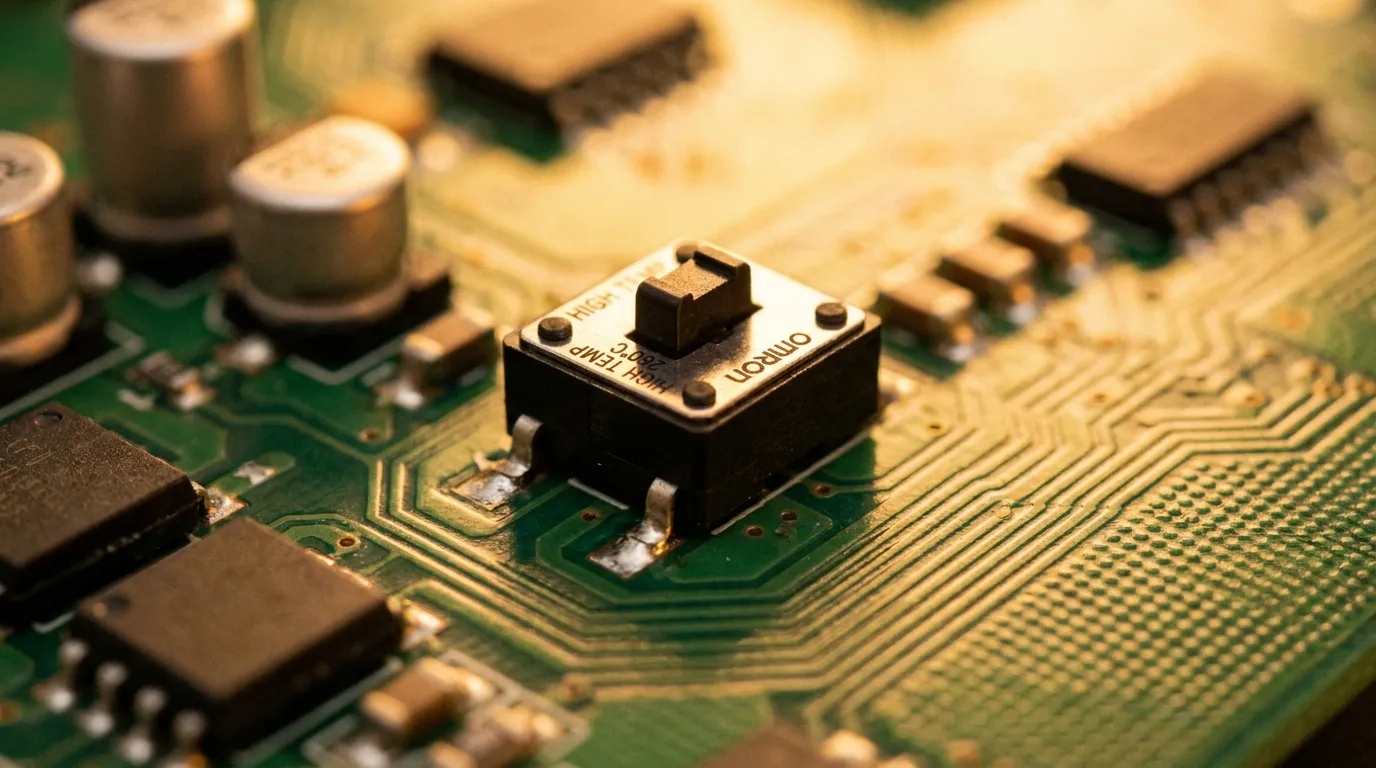
A high temperature tact switch is a momentary pushbutton switch designed to maintain reliable mechanical and electrical performance at elevated operating temperatures — typically rated from +85°C up to +125°C or higher, compared to the +70°C upper limit of standard tact switches.
In simple terms, it is a tact switch built with heat-resistant housing materials, stable contact metals, and thermally robust internal construction that allows it to survive reflow soldering, sustained high-ambient conditions, and repeated thermal cycling without degradation.
The key difference from a standard tact switch is not only the temperature rating on the datasheet, but the combination of housing material, contact plating, and internal spring geometry that together determine real-world thermal reliability over time.
How a High Temp Tact Switch Works
The working principle is the same as any standard tact switch. When the actuator is pressed, it deflects a metal dome or spring disc, completing the circuit between two contacts. When pressure is released, the dome snaps back, breaking the circuit.
What changes in high-temperature designs is the material engineering behind that mechanism. The housing — normally nylon or PBT in standard switches — is replaced with high-performance thermoplastics such as LCP (Liquid Crystal Polymer), PPS (Polyphenylene Sulfide), or glass-fiber reinforced PA66. These materials resist thermal deformation at temperatures where standard housings would soften, warp, or lose dimensional stability.
The metal dome and contact terminals must also maintain consistent spring force and low contact resistance across wide temperature swings. Gold-plated contacts are common in high-temp variants because gold maintains stable electrical conductivity even as temperatures rise, unlike silver, which can oxidize and show resistance drift under thermal stress.
Why High Temperature Rating Matters in Industrial Design
Most standard tact switches carry an operating range of -25°C to +70°C. That is adequate for consumer electronics at normal room temperatures, but it is not sufficient for industrial applications where ambient heat, enclosed housings, or proximity to power components push local PCB temperatures well above that limit.
In automotive applications, cabin temperatures in summer regularly reach 85°C to 100°C. Switches mounted near HVAC controllers, dashboard electronics, or seat control modules must perform reliably at those sustained temperatures. In industrial automation, switches installed on power distribution panels or near servo drives can see continuous ambient temperatures of 70°C to 120°C.
Using a standard tact switch in these environments leads to housing warpage, inconsistent actuation force, rising contact resistance, and eventual switch failure. Selecting the correct high temperature tact switch from the start eliminates these failure modes and reduces field replacement costs significantly.
Key Specifications to Check
Operating temperature is the headline specification, but it is not the only one that matters. The combination of thermal rating, housing material, contact type, and solderability defines whether a switch will perform reliably over its full service life.
| Specification | Standard Tact Switch | High Temp Tact Switch |
|---|---|---|
| Operating Temperature | -25°C to +70°C | -40°C to +125°C (up to +150°C) |
| Housing Material | Nylon, PBT | LCP, PPS, GF-PA66, PEEK |
| Contact Plating | Silver | Gold or Gold over Silver |
| Reflow Solder Compatible | Not always | Yes (260°C peak capable) |
| Contact Resistance | ≤500 mΩ | ≤100–500 mΩ |
| Typical Lifecycle | 100k–500k cycles | 100k–1M cycles |
| Environmental Sealing | Open or basic | Optional IP67 rated |
Operating Temperature Range — Verify both the minimum and maximum. Industrial applications often involve cold starts and high-temperature operation within the same duty cycle.
Housing Material — LCP offers excellent dimensional stability up to 180–200°C and is the most common choice for high-temp SMT variants. PPS offers similar thermal resistance at slightly higher cost. PEEK is reserved for military, aerospace, and medical sterilization applications where temperatures can reach 250°C.
Contact Plating — Gold contacts maintain stable resistance through thermal cycles. If your application involves frequent actuation in high-ambient conditions, gold variants are worth the cost premium.
Reflow Solder Compatibility — SMT high-temp tact switches must survive the reflow soldering process, where peak PCB surface temperature can reach 240–260°C. Confirm reflow compatibility in the datasheet before committing to a PCB assembly process.
Sealing — If your application also involves moisture or particulate exposure, consider whether an IP67-rated high-temp switch is appropriate. Our IP67 tactile switch guide covers ingress protection ratings and sealed switch construction in detail.
High Temperature Tact Switch vs Standard Tact Switch
The practical difference between a standard and high temperature tact switch is not always visible from the outside. Both share similar footprints and actuation profiles. The distinction is internal — material grade, contact type, and validated operating envelope.
| Factor | Standard Tact Switch | High Temp Tact Switch |
|---|---|---|
| Cost | Lower | Moderate to higher |
| Max Operating Temp | +70°C | +125°C to +150°C |
| Housing Stability at Heat | Prone to warpage above 80°C | Dimensionally stable |
| Contact Reliability | Adequate at room temperature | Stable under sustained thermal stress |
| Reflow Process Suitability | Not always guaranteed | Designed for reflow compatibility |
| Best Applications | Consumer electronics, general use | Industrial, automotive, medical |
For most B2B buyers, the cost difference between standard and high-temp variants is small relative to the cost of field failure, PCB rework, or product recall. If your PCB environment consistently exceeds 60–70°C, a high-temp variant is the correct specification — not an optional upgrade.
For a broader overview of tact switch types and how they compare, the complete tact switch guide covers the full product category in detail.
Common Applications
Industrial Automation and Control Panels — PLCs, motor controllers, and industrial HMIs often operate in enclosed cabinets with limited airflow. High-temp tact switches are used on control boards and operator interface panels where ambient temperature regularly exceeds 70°C during production cycles.
Automotive Electronics — Switches used in dashboard controls, climate management systems, seat adjustment modules, and body control units must withstand interior temperatures that regularly exceed 85°C. High-temp variants with gold contacts and LCP housing are standard in automotive-grade PCB designs.
Power Supply and Power Management Boards — On boards with switching regulators, MOSFET drivers, and transformer components, the local temperature near switch positions can far exceed room ambient temperature. High-temp tact switches prevent localized thermal failure in these positions.
LED Lighting and Heating Appliance Controls — High-lumen LED drivers and electric heating appliances generate sustained heat near their control boards. Switches rated to +125°C are common specifications in these product categories.
Medical Equipment — Devices that undergo autoclave steam sterilization at 121°C require switches that maintain dimensional and electrical stability through repeated thermal exposure. PEEK-housing variants are often specified for these applications.
Outdoor and Rugged Electronics — Equipment in enclosed metal enclosures, direct sun exposure, or high ambient outdoor environments benefits from high-temp switch ratings combined with environmental sealing. For more on combining heat resistance with moisture protection, see our waterproof tact switch guide.
How to Choose the Right High Temperature Tact Switch
Selecting the right switch starts with understanding your application's actual thermal environment — not just the rated ambient temperature of the room.
Step 1: Determine local PCB temperature — The PCB surface temperature near your switch position can be 20–40°C higher than the room ambient. Measure or simulate the local thermal environment using thermal imaging or board-level simulation before finalizing your specification.
Step 2: Confirm reflow compatibility — If using an SMT assembly process, confirm the switch is rated for peak reflow temperatures of 245–260°C on the PCB copper surface. Not all high-temp switches are automatically compatible with lead-free reflow profiles.
Step 3: Select housing material by temperature class — For industrial and automotive applications up to +125°C, LCP or PPS housing is sufficient and cost-effective. For medical sterilization or extreme-environment applications above +150°C, specify PEEK.
Step 4: Decide on contact plating — Gold contacts provide the most stable contact resistance over thermal cycling and extended lifecycles. For applications where long-term reliability outweighs initial cost, specify gold-plated contacts.
Step 5: Assess sealing requirements — If your application combines high temperature with moisture, dust, or chemical exposure, specify a switch that is both thermally rated and environmentally sealed. Our sealed vs waterproof tact switch comparison clarifies which construction is appropriate for your conditions.
Step 6: Verify lifecycle at operating temperature — A switch rated for 500,000 cycles at room temperature may have a shorter effective lifecycle under continuous high-temperature operation. Confirm lifecycle data at temperature, not just standard conditions. The long life tact switch guide provides detailed guidance on lifecycle ratings and what affects them in practice.
Common Mistakes to Avoid
| Mistake | Why It Matters | What to Do Instead |
|---|---|---|
| Specifying by ambient room temperature only | PCB local temperature can be 20–40°C higher than ambient | Measure or simulate the actual PCB surface temperature near the switch |
| Assuming all SMT switches handle reflow | Standard housings can warp or fail at 260°C peak reflow | Confirm reflow solder compatibility in the datasheet |
| Using silver contacts in high-temp cycling applications | Silver oxidizes under thermal stress, increasing contact resistance over time | Specify gold contacts for thermally cycled environments |
| Ignoring housing material specifications | Standard nylon or PBT will warp or soften above 80–90°C | Confirm LCP, PPS, or equivalent housing for applications above +85°C |
| Treating temperature rating as the only specification | A high-temp rating alone does not guarantee lifecycle or contact stability | Evaluate housing, contact plating, lifecycle, and sealing together |
| Over-specifying PEEK for standard industrial use | PEEK adds significant cost without benefit below +150°C | Use PEEK only for sterilization, aerospace, or extreme thermal applications |
Related Guides
Selecting a switch for a high-temperature environment often involves additional challenges beyond thermal performance alone.
If moisture and heat coexist in your application, the waterproof tact switch guide explains protection ratings, sealing methods, and the material requirements for combined heat and moisture resistance.
For IP67-rated switch construction and ingress protection standards, the IP67 tactile switch guide covers the specific sealing requirements and how they interact with thermal ratings.
If you need to understand whether a sealed or fully waterproof switch is the right specification for your environment, the sealed vs waterproof tact switch comparison explains the practical differences and when each construction is appropriate.
For applications where extended operational lifecycle is a priority alongside temperature performance, the long life tact switch guide explains how lifecycle ratings are measured and what affects them under real operating conditions.
For the full range of tact switch types and selection criteria across all categories, the complete tact switch guide is the best reference point.
FAQs
What temperature is considered high temperature for a tact switch?
A tact switch is generally classified as high temperature when its operating rating exceeds the standard +70°C upper limit. Most high-temp variants are rated to +85°C, +105°C, or +125°C. Specialist switches for medical sterilization or aerospace applications can reach +150°C to +250°C depending on housing material.
Can a standard tact switch be used in reflow soldering?
Many standard tact switches are not rated for lead-free reflow peak temperatures of 245–260°C. High-temperature tact switches designed for SMT reflow use LCP or PPS housings and validated terminal materials that withstand the solder profile without dimensional or electrical degradation. Always confirm reflow compatibility in the datasheet before PCB assembly.
What is the best housing material for a high temperature tact switch?
For most industrial and automotive applications rated to +125°C, LCP is the most widely used and cost-effective option. PPS offers similar performance at slightly higher cost. PEEK is reserved for applications above +150°C, including autoclave sterilization and aerospace environments.
Do high-temp tact switches cost significantly more than standard switches?
The cost premium varies by specification level. LCP-housing switches are only moderately more expensive than standard variants. Gold contact and PEEK-housing switches carry a larger premium. In B2B industrial applications, the cost difference is typically minor compared to the cost of field failure, rework, or product redesign caused by an under-specified switch.
What is the difference between a high temperature and a sealed tact switch?
High-temperature tact switches are rated for elevated thermal environments but may or may not have environmental sealing. Sealed tact switches protect against dust and liquid ingress but may not carry a high-temperature rating. For applications requiring both properties, specify a switch that is thermally rated and environmentally sealed. The sealed vs waterproof tact switch guide covers this in detail.
Can high temperature tact switches be used in automotive applications?
Yes. High-temp tact switches rated to +125°C with gold contacts and LCP housing are widely used in automotive electronics, including body control modules, HVAC panels, seat controls, and dashboard interfaces where sustained cabin heat and thermal cycling are normal operating conditions.
Conclusion
Selecting a high temperature tact switch is straightforward once you know what to measure and what to specify. Assess your actual PCB-level thermal environment, confirm reflow compatibility for SMT assembly, choose the housing material that matches your temperature class, and determine whether contact plating or sealing requirements apply to your specific application.
For most industrial and automotive designs, a high-temp tact switch with LCP housing, gold contacts, and a +125°C rating provides the right balance of performance and cost. If you face additional challenges — moisture exposure, extended lifecycle demands, or environmental sealing — the related guides linked throughout this article will help you complete the specification.
For a full overview of the tact switch category before finalizing your decision, the complete tact switch guide is the right starting point.
