





Sealed vs Waterproof Tact Switch: Key Differences
If you have ever searched for a tact switch for an outdoor product, a marine panel, or any application exposed to moisture, you have almost certainly run into both terms: sealed and waterproof. Suppliers use them interchangeably. Datasheets label the same product with both descriptions. And yet, for an engineer writing a component specification, the difference between the two is not just a matter of vocabulary — it directly determines whether your switch survives in the field or fails.
This article clarifies the distinction once and for all. You will learn exactly what each term means technically, how IP ratings define the boundary between them, how the sealing construction differs, and how to match the right switch type to your specific application.
What Is a Sealed Tact Switch?
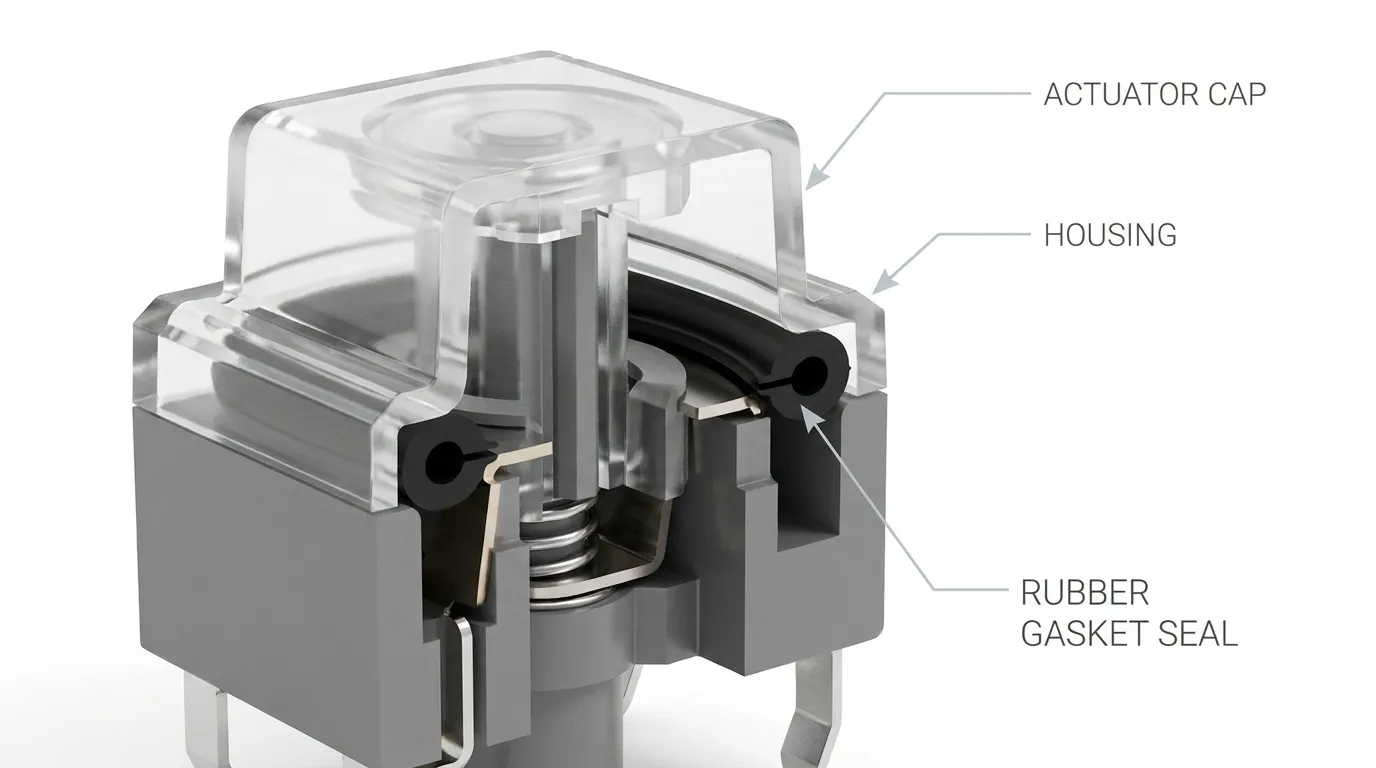
A sealed tact switch is a momentary tactile push button switch designed with mechanical protection to prevent the ingress of dust, moisture, and environmental contaminants into its internal contact mechanism. The "sealing" refers to a physical barrier — typically a rubber gasket, closed housing, or elastomeric cap — that closes off the switch body from outside elements.
The term "sealed" covers a broad protection range. A sealed tact switch can carry any IP rating from IP54 (splash and dust resistant) up to IP67 or higher depending on its construction. Not every sealed switch, however, is built to withstand water immersion. Many sealed tact switches are designed purely to block dust, resist light moisture exposure, or survive board-wash processes during PCB assembly — not to operate submerged in water.
In simple terms: sealing is a design feature. The level of protection that sealing provides is defined by the switch's IP rating, not the word "sealed" alone.
What Is a Waterproof Tact Switch?
A waterproof tact switch is a sealed tact switch that meets or exceeds IP67 under the IEC 60529 standard — meaning it is completely dust-tight and capable of withstanding temporary water immersion at a depth of up to 1 metre for 30 minutes without allowing harmful water ingress.
Waterproof tact switches achieve this level of protection through more robust sealing construction: full silicone boots over the actuator, o-ring seals around the housing perimeter, and in some designs, sealed terminal legs to prevent moisture from wicking into the PCB interface. IP68-rated variants extend this capability further, protecting against continuous submersion under specified pressure conditions — typically used in marine electronics, underwater instrumentation, and demanding industrial environments.
The key distinction: every waterproof tact switch is sealed, but not every sealed tact switch is waterproof.
Sealed vs Waterproof: Are They the Same Thing?
The direct answer is no. The term "sealed" describes any switch with environmental protection built into its construction. The term "waterproof" specifically indicates a switch rated at IP67 or above, validated for water immersion under IEC 60529 test conditions. A sealed switch at IP54 or IP65 resists rain and splashes — but it is not designed for submersion. Calling it "waterproof" in that context is technically inaccurate, even though the industry often does exactly that.
The confusion originates in loose commercial language. Some manufacturers label their IP65-sealed products as "waterproof" because they resist water jets. Others use "sealed" to describe switches that are only process-sealed for PCB washing, offering almost no real-world water resistance beyond that. When specifying components, always verify the actual IP rating on the datasheet rather than relying on the product name or category label alone.
For buyers evaluating a waterproof tact switch, understanding this distinction is the most important first step before writing any component specification.
IP Rating Breakdown for Tact Switches
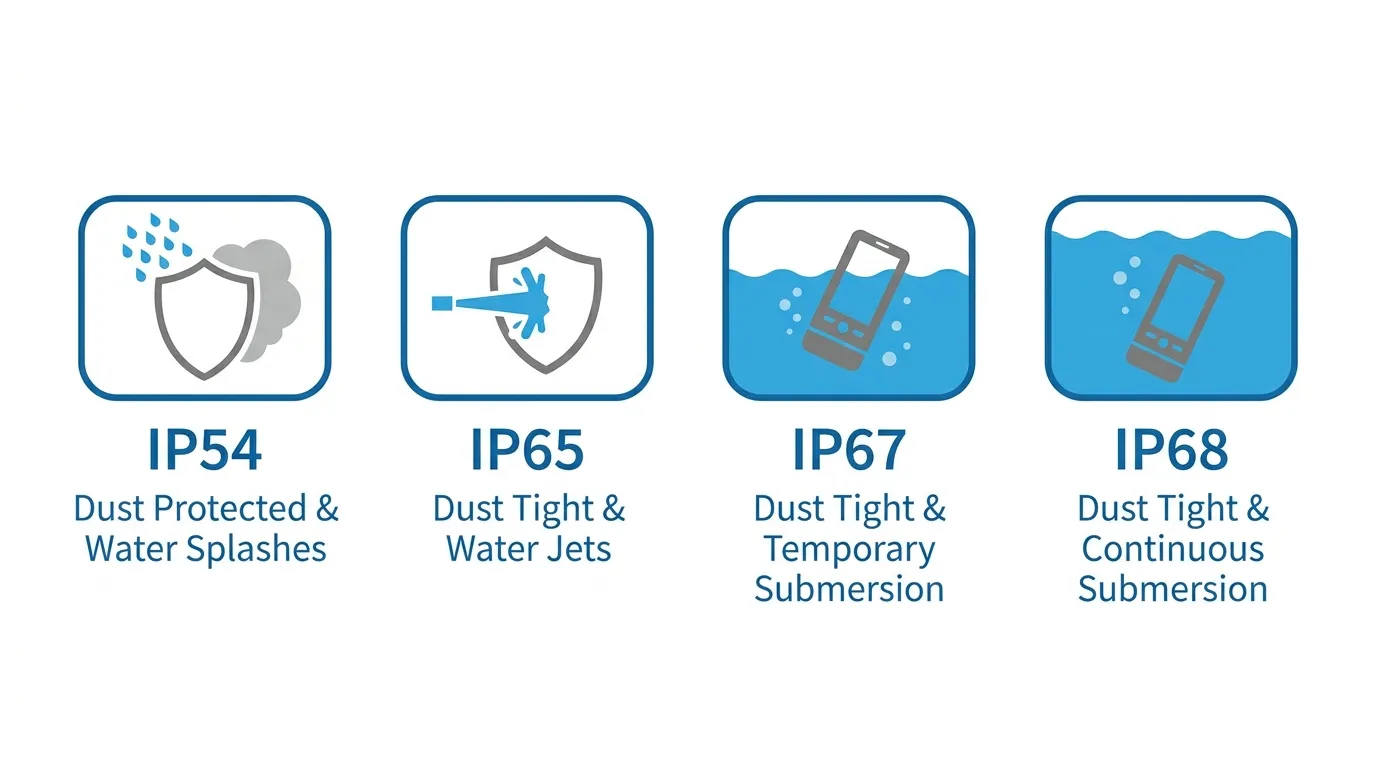
IP (Ingress Protection) ratings, defined under IEC 60529, use a two-digit code to describe protection levels. The first digit indicates protection against solid particles; the second indicates protection against water ingress. For tact switches, the second digit is the most relevant factor when comparing sealed and waterproof variants.
| IP Rating | Dust Protection | Water Protection | Typical Application |
|---|---|---|---|
| IP40 | Objects >1mm | No water protection | Indoor dry environments |
| IP54 | Dust limited | Splashing from any direction | Light-duty outdoor, rain-resistant panels |
| IP65 | Dust-tight | Low-pressure water jets from any direction | Outdoor controls, industrial panels |
| IP66 | Dust-tight | High-pressure water jets | Ship decks, washdown equipment |
| IP67 | Dust-tight | Temporary immersion: 1m for 30 min | Handheld outdoor devices, automotive, marine |
| IP68 | Dust-tight | Continuous immersion under pressure | Underwater equipment, marine instrumentation |
IP54 and IP65 — Splash and Dust Protection
Tact switches at IP54 and IP65 are sealed against dust and are suitable for environments with rain exposure or occasional water spray. These are appropriate for outdoor control panels, industrial keypads, and consumer devices that may see moisture but will never be submerged. IP65 adds protection against directional water jets, making it more robust for environments like factory floors or outdoor enclosures.
IP67 — The Industry Standard for Waterproof Tact Switches
IP67 is where sealed transitions to genuinely waterproof. A tact switch rated IP67 has been tested to survive complete submersion at 1 metre depth for 30 minutes without water infiltrating the contact mechanism. This is the most common standard for waterproof tact switches used in automotive applications, handheld outdoor instruments, drones, and similar products.
If your application calls for a waterproof tact switch and you need guidance on IP67-specific selection criteria, our IP67 tactile switch guide covers the topic in full detail.
IP68 — Extended Submersion Protection
IP68 exceeds IP67 by covering continuous submersion at depths and durations agreed between the manufacturer and buyer. This rating is required for marine navigation equipment, underwater sensors, and devices that operate in permanently wet environments. IP68 tact switches typically use more advanced sealing construction — often fully potted terminals or dual-layer o-rings — and carry a higher unit cost as a result.
How Sealed and Waterproof Tact Switches Are Built Differently
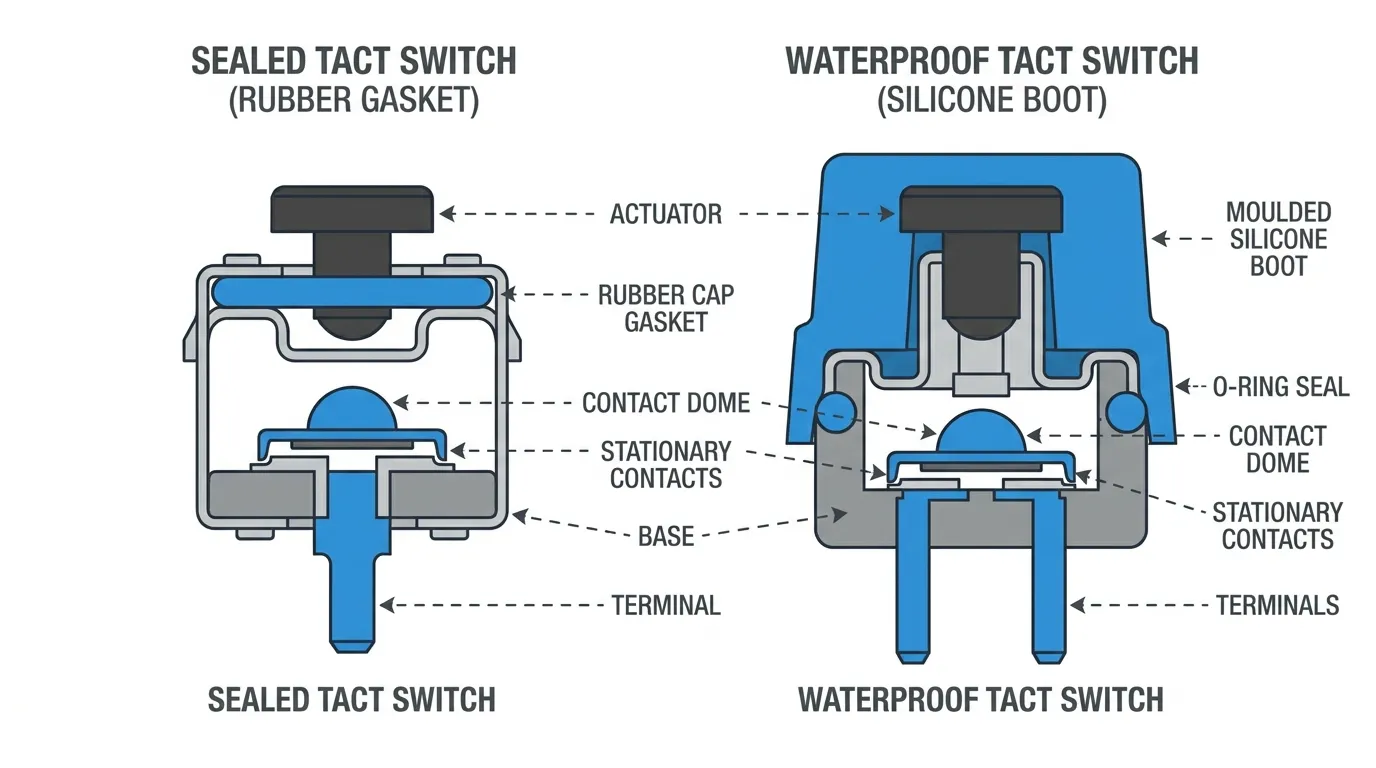
The physical sealing construction is what actually separates a standard sealed switch from a true waterproof variant. Understanding the construction difference helps you evaluate whether a switch will perform as required, not just whether it carries the right label.
A basic sealed tact switch typically uses a rubber gasket or a closed-top actuator cap that keeps dust and light moisture out of the housing during normal use. This is often sufficient for PCB wash-down processes and light environmental exposure.
A waterproof tact switch, rated IP67 or above, uses a more integrated sealing approach: a moulded silicone boot that covers the actuator and bonds to the housing perimeter, an o-ring seal at the base or terminal interface, and in through-hole designs, sealed through-hole legs to prevent water from travelling along the solder joint into the board. Some waterproof designs use a single-piece elastomeric over-mould that eliminates any joint where water could enter under pressure.
The result is a switch that can be pushed, released, submerged, and returned to normal function without any water reaching the contact dome.
Performance Trade-offs of Sealing
Sealing improves environmental protection, but it introduces trade-offs that matter in precision product design.
Actuation force increases. The rubber boot or silicone seal adds mechanical resistance to the actuator's downward travel. A standard open-frame tact switch may require 160–200 gN of actuation force, while a sealed or waterproof version of the same footprint can require 250 gN or more, depending on the sealing material and thickness. If your product requires a very light, sensitive touch, verify the sealed variant's actuation force specification before finalising the design.
Travel distance can change. The elastomeric seal compresses as the actuator is depressed, which can slightly affect the tactile click point and total travel distance. This is rarely a problem for most applications but may matter in precision input devices.
Thermal range is generally maintained. Most sealed and waterproof tact switches maintain the same operating temperature range as their standard counterparts — typically -40°C to +85°C — since the sealing material is chosen to remain flexible across that range.
Cost increases with sealing level. An IP65-sealed tact switch costs more than an open-frame equivalent, and an IP67-rated waterproof switch costs more still. IP68 variants command the highest unit price. For high-volume OEM production, this cost gradient is a meaningful specification decision.
Sealed vs Waterproof Tact Switch: Side-by-Side Comparison
| Feature | Sealed Tact Switch | Waterproof Tact Switch |
|---|---|---|
| IP Rating Range | IP40–IP66 (typically IP54–IP65) | IP67 or IP68 |
| Sealing Method | Rubber gasket, closed housing cap | Silicone boot, o-ring, moulded elastomeric seal |
| Submersion Capable | No | Yes (IP67: 1m / 30 min; IP68: defined by spec) |
| Actuation Force Impact | Low to moderate increase | Moderate to noticeable increase |
| Dust Protection | Partial to full (IP5x/6x) | Full (IP6x) |
| Operating Temperature | -40°C to +85°C | -40°C to +85°C |
| Relative Cost | Moderate | Higher |
| PCB Wash Compatible | Often yes (process-sealed) | Yes |
| Typical Applications | Industrial panels, light outdoor, consumer electronics | Marine, automotive, outdoor handhelds, medical |
Application Selection Guide
Matching the right switch to the right environment prevents premature failure and avoids over-specifying (and overpaying) for protection that is not needed.
| Environment | Exposure Risk | Minimum IP Rating | Recommended Switch Type |
|---|---|---|---|
| Indoor electronics, climate-controlled | Low — dust only | IP40–IP54 | Standard or lightly sealed |
| Indoor industrial, light moisture | Moderate — occasional splash | IP54–IP65 | Sealed tact switch |
| Outdoor enclosures, rain exposure | High — direct water contact | IP65 | Sealed tact switch (IP65) |
| Handheld outdoor devices, automotive | High — rain + possible immersion | IP67 | Waterproof tact switch |
| Marine, boat instruments | Very high — spray + immersion | IP67–IP68 | Waterproof tact switch |
| Underwater or continuously wet | Extreme | IP68 | Waterproof tact switch (IP68) |
For a broader view of the tact switch product family and which variant fits your overall design, the complete tact switch guide covers all types, mounting options, and application categories in one place.
Common Mistakes When Selecting Tact Switches for Wet Environments
Assuming "sealed" always means waterproof. This is the most common specification error. A switch described only as "sealed" without a confirmed IP67 or IP68 rating is not cleared for submersion. Always verify the IP code on the datasheet.
Choosing IP65 for submersion applications. IP65 is resistant to water jets but has no immersion rating. If there is any chance your product will be submerged — even accidentally — IP65 is insufficient.
Ignoring actuation force changes. A designer who specifies a waterproof switch based solely on IP rating without checking actuation force may end up with a product that feels stiff and unresponsive. Compare the force specification between sealed and standard variants during prototype testing.
Not confirming the seal integrity under actuation. A switch is most vulnerable to water ingress at the moment the actuator is depressed. Some lower-cost sealed designs lose their seal momentarily under pressure. For critical applications, request test data or use a switch with a moulded one-piece elastomeric seal rather than a simple cap gasket.
Selecting by price alone. Upgrading from IP65 to IP67 adds cost, but specifying the wrong IP level for a safety-critical or field-deployed product creates far greater costs — in warranty returns, product recalls, and customer trust. Match the IP rating to the application, not the budget.
Related Guides
If you are working on a design that requires sealed or waterproof switching, these focused guides will help you go deeper on specific variants:
The waterproof tact switch guide covers IP67 and IP68 product selection in detail, including construction types, mounting configurations, and what to request from a supplier when sourcing in volume.
For applications that need both environmental sealing and visual feedback, explore the illuminated tact switch guide — sealed and waterproof illuminated variants are used extensively in automotive dashboards and outdoor control panels where both visibility and protection matter.
If your design uses surface-mount LED tactile switches, the LED tactile switch guide covers sealing considerations specific to SMD LED switch designs.
And for a full category overview covering all tact switch types, mounting options, specifications, and application guidance, the complete tact switch guide is the right starting point.
Frequently Asked Questions
Is a sealed tact switch the same as a waterproof tact switch?
Not always. All waterproof tact switches are sealed, but not all sealed tact switches are waterproof. The difference lies in the IP rating. A waterproof tact switch is specifically rated at IP67 or IP68 and has been tested for water immersion under IEC 60529 conditions. A sealed switch may only carry an IP54 or IP65 rating, which covers splash and water jets but not submersion.
What IP rating do I need for a waterproof tact switch?
IP67 is the industry-standard minimum for a tact switch to be genuinely classified as waterproof — covering complete dust protection and temporary immersion at 1 metre depth for 30 minutes. IP68 is required for applications involving continuous or deeper submersion.
Does sealing affect the actuation force of a tact switch?
Yes. The rubber boot or silicone seal adds mechanical resistance during actuation, increasing the force required to trigger the switch. The degree of increase depends on the sealing material and construction. Always verify the actuation force specification — listed in grams-force (gN) or millinewtons (mN) on the datasheet — before finalising your design.
Can I use a sealed tact switch outdoors?
It depends on the IP rating and the nature of the outdoor exposure. An IP65-sealed switch handles rain and water jets and is suitable for most outdoor enclosures. However, if your product might be submerged, even temporarily, you need an IP67-rated waterproof tact switch.
What materials are used to seal waterproof tact switches?
The most common sealing materials are silicone rubber, thermoplastic elastomers (TPE), and nitrile or EPDM o-rings. Silicone is preferred in most applications because of its flexibility, temperature resistance (-40°C to +85°C), and durability across millions of actuation cycles.
Are there waterproof illuminated tact switches?
Yes. Sealed and waterproof variants of illuminated tact switches exist and are used in automotive and outdoor control applications where both visual feedback and environmental protection are required. The sealing design must account for the LED optical path, which adds complexity to the manufacturing process. See the illuminated tact switch guide for detailed coverage of this variant.
What is a process-sealed tact switch?
A process-sealed switch — sometimes called a wash-sealed switch — is sealed specifically to survive PCB cleaning and soldering processes, including water-wash or solvent-wash operations. This type typically meets the minimum requirements of IP67 for the purpose of surviving the manufacturing process, but it may not be rated for field-level water immersion in the final product. Always check whether the IP67 rating is for process use only or for full environmental use.
Conclusion
The line between a sealed tact switch and a waterproof tact switch is not just semantic — it is a specification boundary defined by IP rating and validated through standardised testing. A sealed switch offers valuable protection against dust and moisture in many common environments, but it is not a substitute for a true waterproof switch when immersion is a real possibility in your application.
Use the IP rating — not the product label — as your primary selection criterion. For environments with rain or spray exposure, a sealed switch at IP65 is often sufficient. For any environment where submersion is possible, specify IP67 as the minimum. For continuous or deep-water applications, require IP68.
When in doubt, over-specify protection rather than under-specify it. A switch failure in the field costs far more than the incremental cost of a higher IP rating during the design phase.
For sourcing support or technical guidance on sealed and waterproof tact switch options, explore the full product range in the complete tact switch guide.
