





IP67 Tactile Switch: Meaning, Uses & Selection Tips
You're reviewing a component datasheet and you see it: IP67. You know it means something about water resistance, but you're not sure exactly what test it passed, whether it's enough for your product, or how to compare it against IP65 or IP68 before you commit to a design.
This article decodes IP67 specifically for tactile switches. You'll learn what the rating actually means at the test level, how IP67 sealing is physically built into a tact switch, where the rating is appropriate, and what to check before selecting one for your PCB.
What Does IP67 Mean on a Tactile Switch?
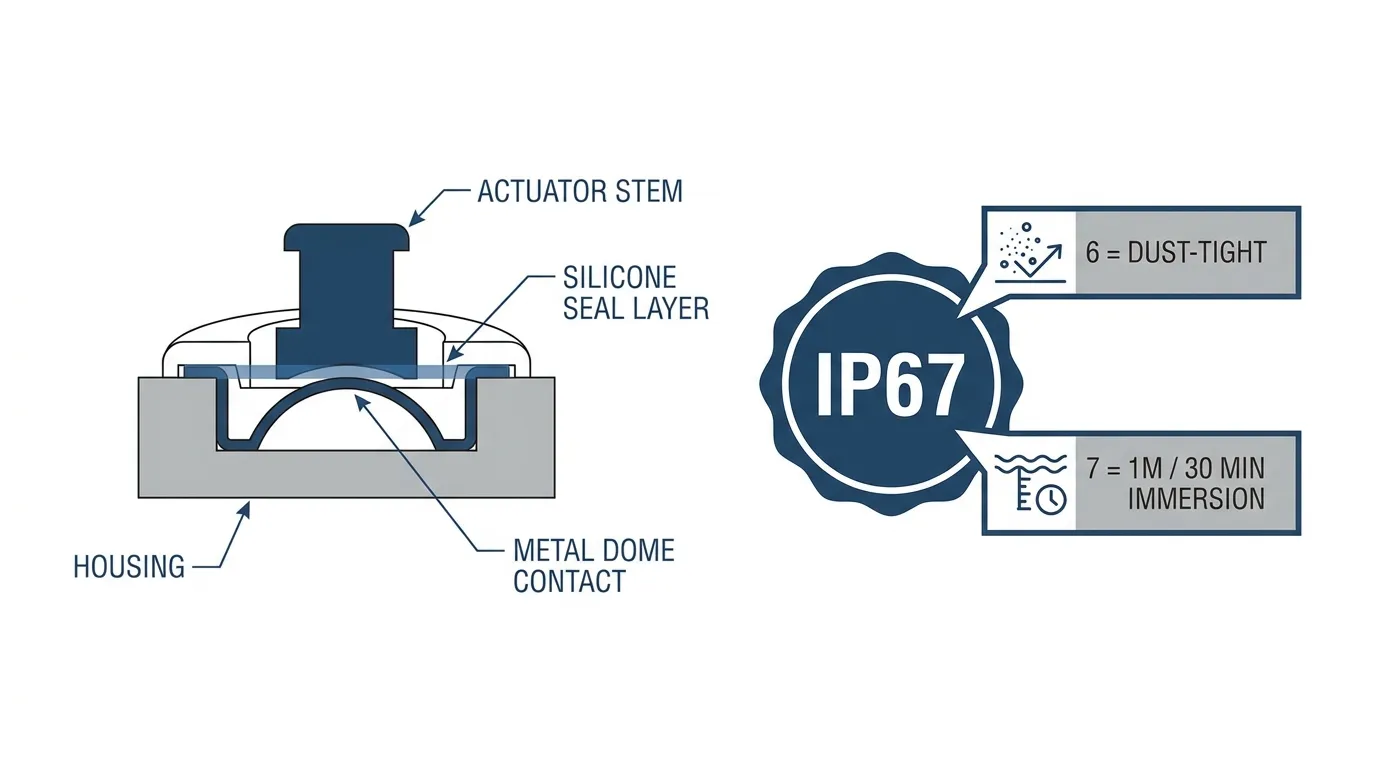
IP67 is an ingress protection rating defined by the international standard IEC 60529. On a tactile switch, it tells you exactly how well the switch resists two things: solid particle intrusion and liquid ingress. The two digits after "IP" each carry a specific meaning.
The first digit — 6 — means the switch is completely dust-tight. No solid particles, regardless of size, can enter the housing under test conditions. This is the maximum dust protection level defined in IEC 60529.
The second digit — 7 — means the switch can withstand temporary immersion in water up to 1 metre deep for 30 minutes without the water causing harmful effects to the internal components. The test is conducted in still water at approximately 0.1 bar of pressure at the 1-metre depth mark.
In simple terms: an IP67 tactile switch will survive a dusty factory floor and won't fail if briefly submerged — for example, if a handheld device is accidentally dropped in a sink or exposed to a sudden flood of water on a production line.
What IP67 does not mean is that the switch is permanently waterproof. It does not protect against continuous immersion, high-pressure water jets, or ongoing submersion at depths greater than 1 metre. If those conditions apply, a higher rating is needed.
| IP Code | Digit | Protection Level | Test Condition |
|---|---|---|---|
| IP67 | First digit (6) | Dust-tight — complete protection against solid particles | No dust ingress under vacuum test |
| IP67 | Second digit (7) | Temporary immersion — protected against water at 1m depth | Submerged at 1m for 30 minutes (still water) |
How IP67 Sealing Works Inside a Tactile Switch
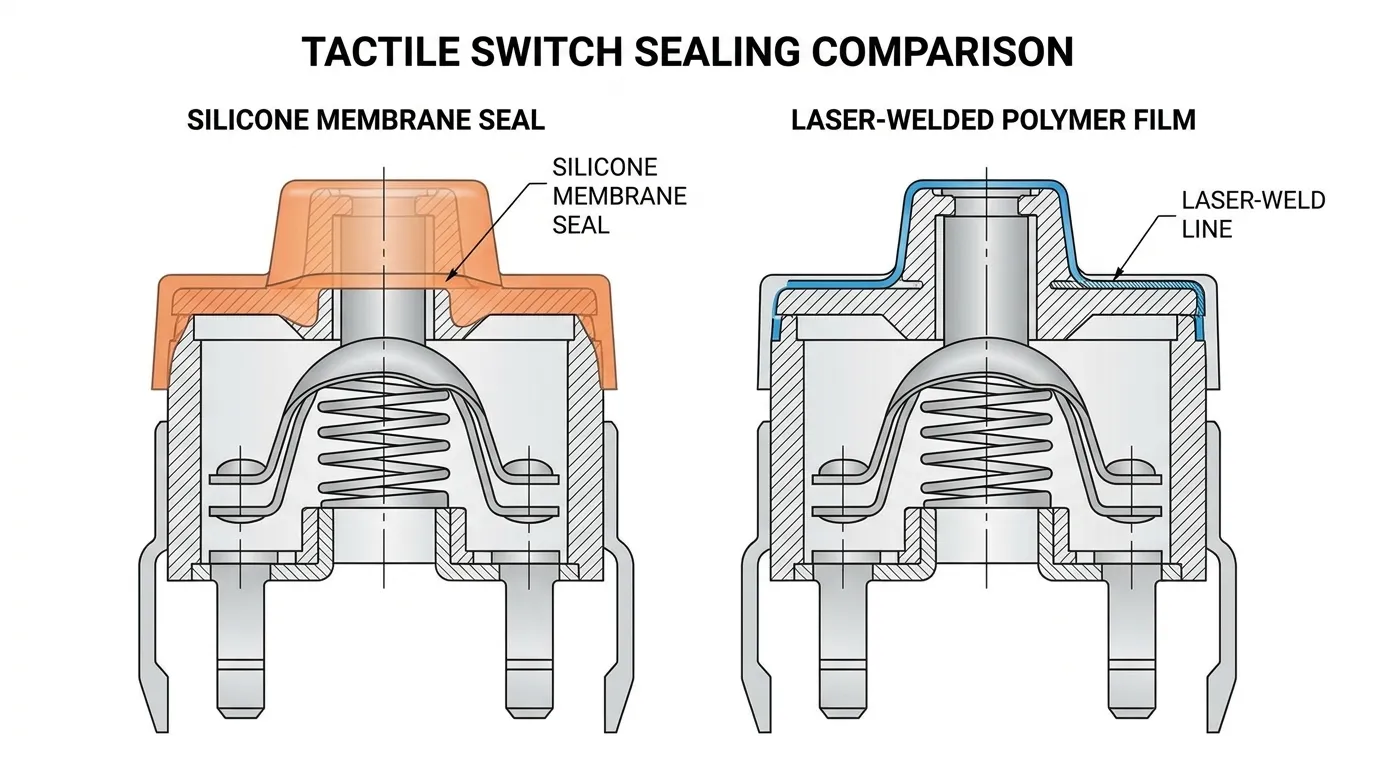
Standard tactile switches leave the actuator stem and contact area exposed. That's fine for dry, controlled PCB environments — but it's a failure risk the moment moisture or contamination enters the picture. IP67-rated tact switches solve this through a sealed internal construction that protects the metal dome contact while still delivering clean tactile feedback on every press.
Silicone Membrane Sealing
The traditional approach uses a silicone rubber membrane over the actuator. The membrane wraps around the contact area, creating a flexible seal that compresses when the button is pressed and springs back to position on release. This method is reliable and cost-effective, but the silicone layer can slightly dampen the crispness of the tactile click — something engineers designing for precision user interfaces should account for during prototyping.
Laser-Welded Film Sealing
More advanced IP67 tact switches use a laser-welded nylon or polymer film that is bonded directly to the switch housing. This process creates a hermetic seal with tighter tolerances than silicone membrane designs. The result is better long-term sealing consistency, improved resistance to side-load pressure on the actuator, and — critically — a preserved tactile response that feels much closer to an unsealed switch. For products where both IP67 protection and sharp tactile feedback matter, laser-welded variants are typically the better choice.
Both sealing methods must survive reflow soldering temperatures if the switch is surface-mount type, which is why material selection (housing, membrane, adhesive) matters as much as the seal design itself. For a deeper look at how waterproof sealing is applied across tactile switch types, the waterproof tact switch guide covers the full mechanics in detail.
IP67 vs IP65 vs IP68 — Which Rating Do You Actually Need?
This is where most specification errors happen. Engineers default to IP67 without checking whether IP65 was sufficient or IP68 was necessary. The difference is not just a number — it reflects a real difference in test conditions and real-world protection capability.
IP65 protects against water jets at 12.5 litres per minute. It handles spray, splashing, and high-humidity environments well. It does not protect against any form of submersion — even brief. If your product will only be splashed or wiped down, IP65 may be entirely adequate and often cheaper to source.
IP67 adds temporary immersion protection. It covers accidental drops into water, brief flooding, PCB washdown during assembly, and outdoor environments where standing water is a realistic risk. For most industrial, medical, and outdoor consumer applications, IP67 is the right balance of protection and cost.
IP68 goes further — it defines continuous immersion protection at manufacturer-specified depths that exceed 1 metre and durations that exceed 30 minutes. IP68 switches typically use double-layer sealing with resin potting or full encapsulation internally. They're the right choice only when submersion is a regular or prolonged part of the product's operating environment.
| Rating | Dust Protection | Water Protection | Test Condition | Best For |
|---|---|---|---|---|
| IP65 | Dust-tight | Water jets | 12.5 L/min nozzle | Spray, splash, wash-down environments |
| IP67 | Dust-tight | Temporary immersion | 1m depth, 30 minutes | Outdoor, industrial, medical, occasional submersion |
| IP68 | Dust-tight | Continuous immersion | Manufacturer-defined (>1m, >30min) | Marine, underwater, permanently wet environments |
A useful rule: if your device could end up in water but won't live in water, IP67 is your standard. If water is a permanent operating condition, step up to IP68.
Where IP67 Tactile Switches Are Used
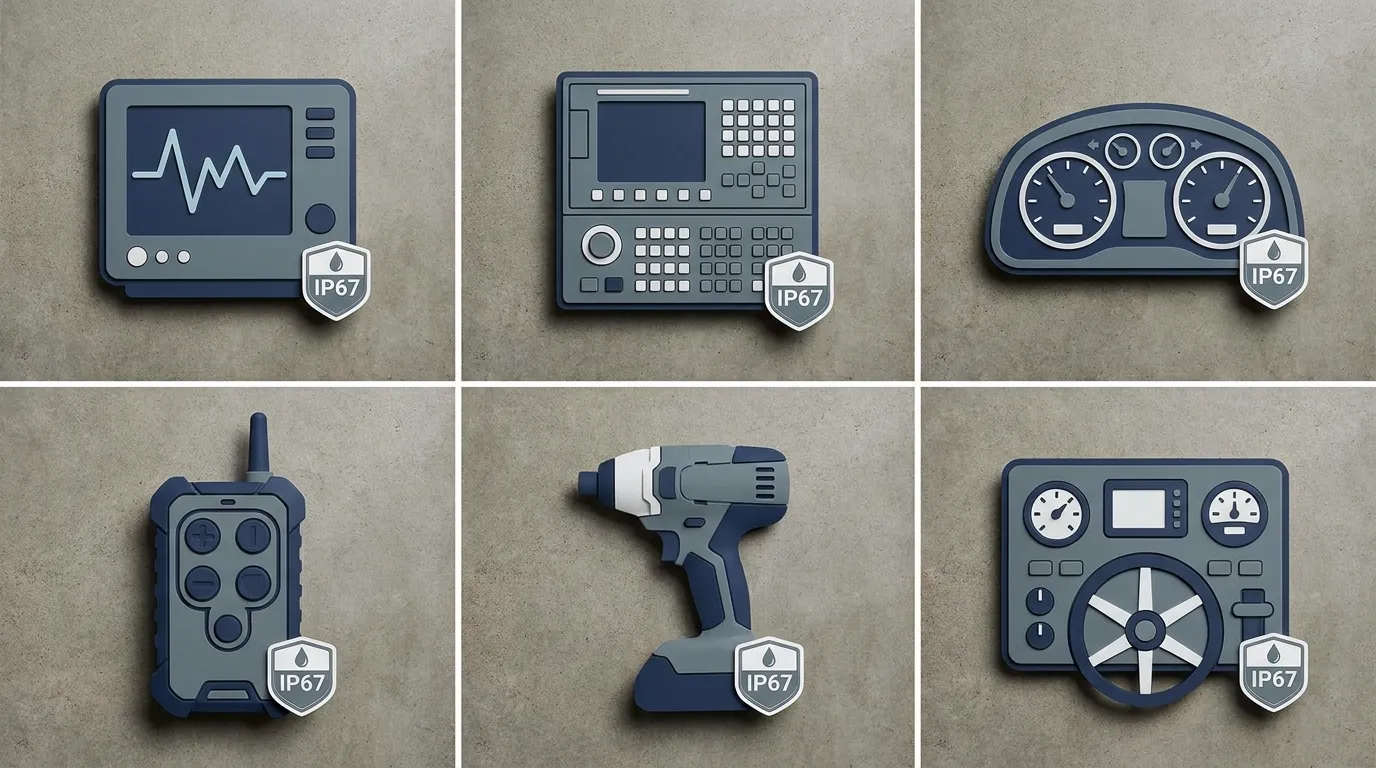
IP67 tact switches appear across a wide range of industries precisely because temporary water and dust exposure is common in real-world product environments, even when it isn't the primary operating condition.
Medical devices are one of the most common application areas. Equipment like portable patient monitors, infusion pumps, and ultrasound handsets must survive regular disinfectant wipe-downs and, in some cases, autoclave-adjacent processes. IP67 sealing ensures that cleaning cycles don't degrade switch reliability over time.
Industrial automation and CNC machinery frequently expose control panels to coolant spray, metal swarf, and periodic washdown. An IP67 tact switch on a CNC machine's control interface will outlast an unsealed switch by a significant margin in that environment — and reduce unplanned maintenance.
Automotive electronics use IP67 tact switches in dashboard controls, steering wheel buttons, and key fobs, where exposure to rain, humidity, and temperature cycling is unavoidable. The dust-tight rating also protects against fine particulate contamination in cabin environments.
Consumer electronics and wearables — outdoor remote controls, fitness trackers, smart meters, and rugged handheld devices — regularly use IP67 tact switches as the standard sealing tier for any product that might be used outdoors or near water.
Power tools and marine controls round out the common applications. In these environments, both the submersion protection and the dust-tight rating serve a practical purpose: tools get dropped and marine panels get waves.
| Industry | Application | Why IP67 Fits |
|---|---|---|
| Medical | Patient monitors, infusion pumps | Withstands disinfectant wipe-downs and splash exposure |
| Industrial / CNC | Control panels, conveyor interfaces | Survives coolant spray and production line washdown |
| Automotive | Dashboard controls, key fobs | Handles rain, humidity, and temperature variation |
| Consumer Electronics | Outdoor remotes, wearables | Protects against incidental water exposure |
| Power Tools | Trigger controls, mode buttons | Dusty and wet working environments |
| Marine | Helm controls, deck panels | Water splash and spray in constant use |
SMT vs THT: Which Mounting Type Is Right?
IP67 tactile switches are available in both surface mount (SMT) and through-hole (THT) configurations, and the choice between them affects more than just PCB layout.
SMT IP67 tact switches are designed for automated pick-and-place assembly and reflow soldering. They have a smaller footprint, support higher-density PCB designs, and are compatible with PCB water-wash processes during manufacturing. Most modern compact electronics — wearables, handheld medical devices, consumer products — use SMT IP67 switches for this reason. The key technical consideration is that the seal must withstand reflow temperatures (typically up to 260°C peak) without degradation. Look for switches rated for reflow soldering in the datasheet before specifying.
THT IP67 tact switches use through-board pins that are soldered from the underside of the PCB. They offer a stronger mechanical bond to the board, which matters in applications that experience vibration, shock, or frequent physical actuation — think CNC control panels or power tool interfaces. The through-hole design also makes rework easier in low-volume industrial production runs.
If your design is compact and automated, SMT is the practical choice. If the switch will face mechanical stress or high-cycle industrial use, THT is more robust. For engineers working with very compact form factors, low-profile SMT tact switches offer IP67 protection in board heights as low as 1–2mm.
Key Specifications to Check When Selecting an IP67 Tact Switch
IP67 is the protection rating — but it's not the only spec that determines whether a switch will perform correctly in your design. These are the parameters you should verify on every datasheet before committing to a part.
Operating Force: IP67 tact switches typically range from 120gf to 450gf actuation force. Lower forces (120–200gf) suit user interfaces that need light, frequent tapping. Higher forces (300–450gf) are appropriate where accidental actuation must be prevented — industrial controls, outdoor panels.
Electrical Rating: Most IP67 tact switches are rated for low-signal applications: typically 1mA to 50mA at 1VDC to 12VDC (some up to 24VDC). They are not designed for high-current switching. Verify this matches your signal circuit before specifying.
Travel Distance: The physical distance the actuator moves before the contact closes — usually 0.5mm to 2.5mm. Shorter travel creates a snappier, more precise feel. Longer travel gives more tactile depth.
Operating Temperature: Standard IP67 tact switches cover -25°C to +85°C, though some industrial-grade variants extend to -40°C to +105°C. Always cross-check the operating temperature against the worst-case thermal environment your product will encounter.
Mechanical Lifecycle: Expect 100,000 to 200,000 actuation cycles for IP67-rated switches. Because the seal prevents contamination of the contact area, sealed switches often maintain consistent contact resistance over their lifecycle longer than equivalent unsealed switches.
Compliance Flags: Verify RoHS compliance for markets where it's required, and check for UL94 HB or better flammability rating on the frame material. HTN (high-temperature nylon) is a common frame material in IP67 switches due to its thermal and chemical resistance.
| Specification | Typical Range | What to Consider |
|---|---|---|
| Operating Force | 120gf – 450gf | Match to user interaction type and accidental actuation risk |
| Electrical Rating | 1mA–50mA / 1–24VDC | Signal circuit only — not for power switching |
| Travel Distance | 0.5mm – 2.5mm | Shorter = snappier feel; longer = more tactile depth |
| Operating Temperature | -25°C to +105°C | Verify against worst-case environmental temperature |
| Mechanical Lifecycle | 100,000 – 200,000 cycles | Check against expected product usage life |
| Compliance | RoHS, UL94 HB | Confirm for your target market and material flammability requirements |
How to Select the Right IP67 Tactile Switch
Selection becomes straightforward once you work through each decision point in order rather than jumping straight to a part number.
Step 1 — Define your environment. Is the device exposed to rain, splashing, brief immersion, washdown, or continuous moisture? If the answer is occasional or accidental water contact, IP67 is the right tier. If it's continuous submersion, you need IP68.
Step 2 — Confirm your mounting type. Will your PCB be assembled via reflow (SMT) or wave/hand soldering (THT)? Does vibration or mechanical stress require stronger board attachment? Choose SMT for compact automated production; THT for mechanically demanding environments.
Step 3 — Set your actuation force. Light-touch user interfaces need lower operating forces (120–200gf). Controls that must resist accidental pressing — outdoor panels, safety-critical equipment — need higher forces (300–450gf).
Step 4 — Match the electrical spec. Confirm your circuit operates within the switch's rated current and voltage range. IP67 tact switches are low-signal devices — typically under 50mA.
Step 5 — Check the temperature range. Review both the minimum and maximum operating temperatures against your product's operating and storage environment specs.
Step 6 — Verify lifecycle requirements. Calculate expected actuation cycles over the product's service life and confirm the switch's rated lifecycle meets or exceeds that figure.
Step 7 — Consider feedback and form factor. If your design requires illuminated confirmation of button press, check whether an IP67-rated LED variant exists for your target footprint. Illuminated IP67 tact switches combine sealing with integrated LED feedback — useful for panel interfaces where visual confirmation matters. Similarly, if LED feedback is built into your circuit design, LED tact switch options cover both sealed and standard configurations.
For a complete overview of all tact switch types and categories, the full tact switch guide covers the entire product family and helps you map the right switch type to your broader design requirements.
Common Mistakes to Avoid
Choosing IP65 when immersion is a realistic risk. IP65 is not rated for submersion. If your product can end up in standing water — even briefly — IP65 is insufficient. The cost difference between IP65 and IP67 is small; a failed switch in the field is not.
Assuming IP67 means permanently waterproof. IP67 covers temporary immersion at 1 metre for 30 minutes. It is not rated for continuous submersion, high-pressure jets, or extended time at depth. Products designed for marine or permanently wet environments need IP68.
Ignoring seal degradation over time. Seals are not permanent. Repeated thermal cycling, mechanical compression from actuation, and chemical exposure (cleaning agents, solvents) can degrade seal integrity over years of use. Specifying a switch with margin in the operating temperature range reduces this risk.
Specifying IP67 without checking the actuation force against the sealing method. Silicone membrane seals can stiffen with age or at low temperatures, which changes the perceived actuation force. If consistent tactile feedback is critical throughout the product's life, a laser-welded film seal is a more stable choice.
Overlooking the electrical rating. IP67 tact switches are low-signal components. Using them in circuits with current or voltage outside their rated range will cause contact degradation regardless of IP protection level.
Not confirming reflow compatibility for SMT variants. Not all SMT IP67 switches are rated for reflow soldering. If your assembly process uses reflow, verify the switch is explicitly rated for it — otherwise the sealing compound or membrane adhesive may be compromised during assembly before the product ever reaches a customer.
Related Guides
IP67 is one specific protection tier within the broader waterproof tact switch category. If you're evaluating sealing options more broadly or need to understand how IP-rated switches compare across design scenarios, the waterproof tact switch guide covers the full range of sealed switch construction methods and rating levels in one place.
If your design requires a sealed switch with a minimal PCB footprint, low-profile SMT tact switches are available in IP67-rated versions and offer board heights well under 3mm.
For designs where button-press feedback needs to be both tactile and visual, illuminated tact switches and LED tactile switch options extend the functionality of sealed switches without compromising protection.
Frequently Asked Questions
What does IP67 mean on a tactile switch?
IP67 means the switch has been tested and certified to IEC 60529 standards. The digit 6 confirms the switch is completely dust-tight. The digit 7 confirms it can withstand immersion in still water at 1 metre depth for up to 30 minutes without damage to internal components.
Is IP67 waterproof enough for outdoor use?
Yes — for most outdoor applications. IP67 handles rain, splashing, high humidity, and accidental submersion in standing water. It is appropriate for outdoor control panels, wearables, handheld instruments, and consumer electronics used in wet conditions.
What is the difference between IP65 and IP67 tactile switches?
IP65 protects against water jets (12.5 litres per minute) but offers no immersion protection. IP67 adds resistance to temporary submersion at 1 metre for 30 minutes. If the product can be submerged — even accidentally — IP67 is the minimum required rating.
Can IP67 tactile switches be washed on a PCB during assembly?
Yes. IP67-rated switches (often labelled "washable" or "process-sealed") are designed to survive PCB water-wash processes during manufacturing. For SMT variants, confirm that the switch is explicitly rated for reflow soldering before specifying.
Do IP67 tact switches feel different from standard switches?
Silicone membrane seals can slightly reduce the sharpness of the tactile click. Laser-welded film seals preserve tactile crispness much more closely to an unsealed switch. If tactile feedback quality is a priority, specify the sealing method, not just the IP rating.
What is the typical lifecycle of an IP67 tact switch?
Most IP67-rated tactile switches are rated for 100,000 to 200,000 actuation cycles. Because the sealed construction protects the contact area from contamination, consistent contact resistance is often maintained longer than in comparable unsealed switches.
When should I use IP68 instead of IP67?
Use IP68 when the switch will be exposed to continuous or prolonged submersion, not just brief immersion. Marine control panels, permanently wet industrial equipment, and underwater applications require IP68. For standard outdoor and industrial use, IP67 is typically sufficient and more cost-effective.
What mounting types are available for IP67 tact switches?
Both SMT (surface mount) and THT (through-hole) configurations are available in IP67 ratings. SMT suits compact PCBs with automated assembly. THT is preferred where the switch needs stronger mechanical attachment for vibration-heavy or high-cycle applications.
Conclusion
IP67 is not a vague claim of "waterproofness" — it is a precise, testable standard that tells you exactly what protection level a tactile switch delivers: complete dust exclusion and survival through temporary 1-metre immersion for 30 minutes. Understanding what the digits mean, how the sealing is constructed, and where the rating's limits lie gives you the foundation to specify correctly the first time.
For most industrial, medical, automotive, and outdoor consumer electronics applications, IP67 is the appropriate sealing tier — more protection than IP65, without the added cost and construction complexity of IP68. Choose the mounting type that matches your PCB process, verify the actuation force and electrical specs match your circuit, and confirm the lifecycle covers your product's intended service life.
If you're still comparing switch types or building out your full component specification, the complete tact switch guide covers the broader product family and helps you select the right switch type for every layer of your design.
