





Waterproof Tact Switch Guide for Outdoor Electronics
Choosing the wrong tact switch for an outdoor electronic device is one of the most avoidable engineering mistakes in hardware design. A standard tact switch will fail within weeks when exposed to rain, condensation, dust, or temperature cycling. A properly rated waterproof tact switch, selected for the right environment, will last millions of actuation cycles without a single failure.
This guide gives you a complete, practical framework for selecting waterproof tact switches for outdoor electronics. You will understand how sealing works, what IP ratings mean for outdoor use, which specifications matter most, and how to match the right switch to your specific application — whether that is a marine control panel, an outdoor IoT sensor, a rugged wearable, or a smart agriculture device.
What Is a Waterproof Tact Switch?
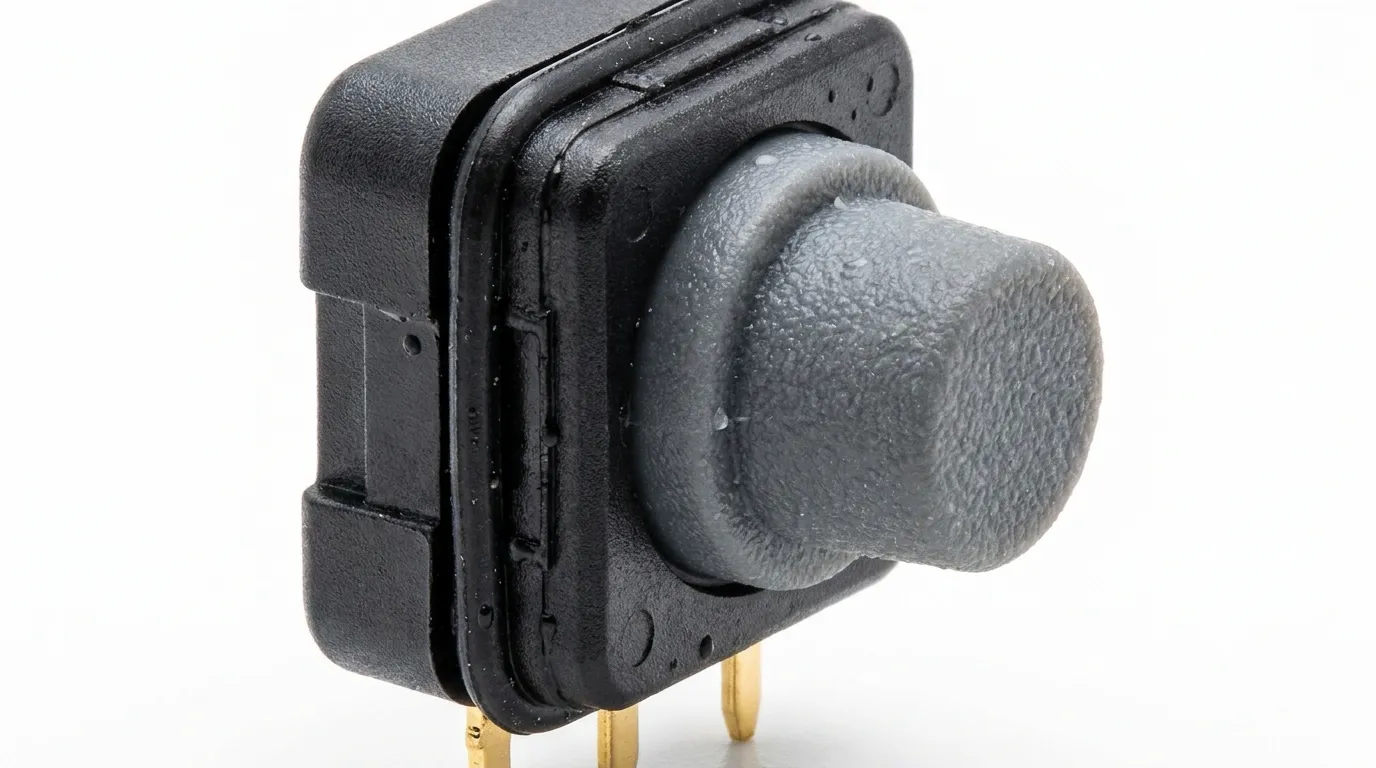
A waterproof tact switch is a sealed momentary push-button switch designed to prevent water, dust, and contaminants from entering its internal mechanism. Like a standard tact switch, it uses a metal dome contact to produce tactile feedback when pressed. The critical difference is the sealing system built around that mechanism — a combination of silicone rubber membranes, O-rings, and sealed thermoplastic housing that creates a continuous barrier against moisture ingress.
In simple terms: the switch looks and functions like a standard momentary button, but it is engineered to survive the conditions that would destroy an unsealed switch.
How the Sealing Mechanism Works
Understanding the sealing mechanism is what separates a good specification decision from a guess. Waterproof tact switches achieve their protection through three primary design elements, and each one serves a specific function.
Silicone Rubber Membrane or Actuator Cover
The most common sealing approach uses a flexible silicone rubber cover that sits over the actuator. When you press the button, the silicone membrane flexes and transfers the actuation force to the internal metal dome — without ever creating an open path for water to enter. The silicone material is chosen for its ability to remain flexible across a wide temperature range, which is critical in outdoor environments where temperatures can swing from −30°C in winter to +70°C in direct summer sun.
O-Ring and Housing Seal
Below the silicone membrane, an O-ring seated against the housing body creates a second line of defense. This prevents water from traveling laterally between the body and the PCB surface. In submersion-rated switches (IP67 and IP68), the housing itself is molded with extremely tight tolerances and sealed with epoxy or adhesive around the base to eliminate any remaining ingress path.
Corrosion-Resistant Contact Materials
Even if water enters a switch, it causes damage primarily through contact corrosion. Waterproof tact switches use gold-plated or silver-alloy contacts specifically to resist oxidation in humid or salt-air environments. Gold-plated contacts offer superior long-term corrosion resistance, making them the preferred choice for marine and industrial outdoor applications where contact degradation over years of exposure is a real failure mode.
IP Ratings Explained for Outdoor Applications
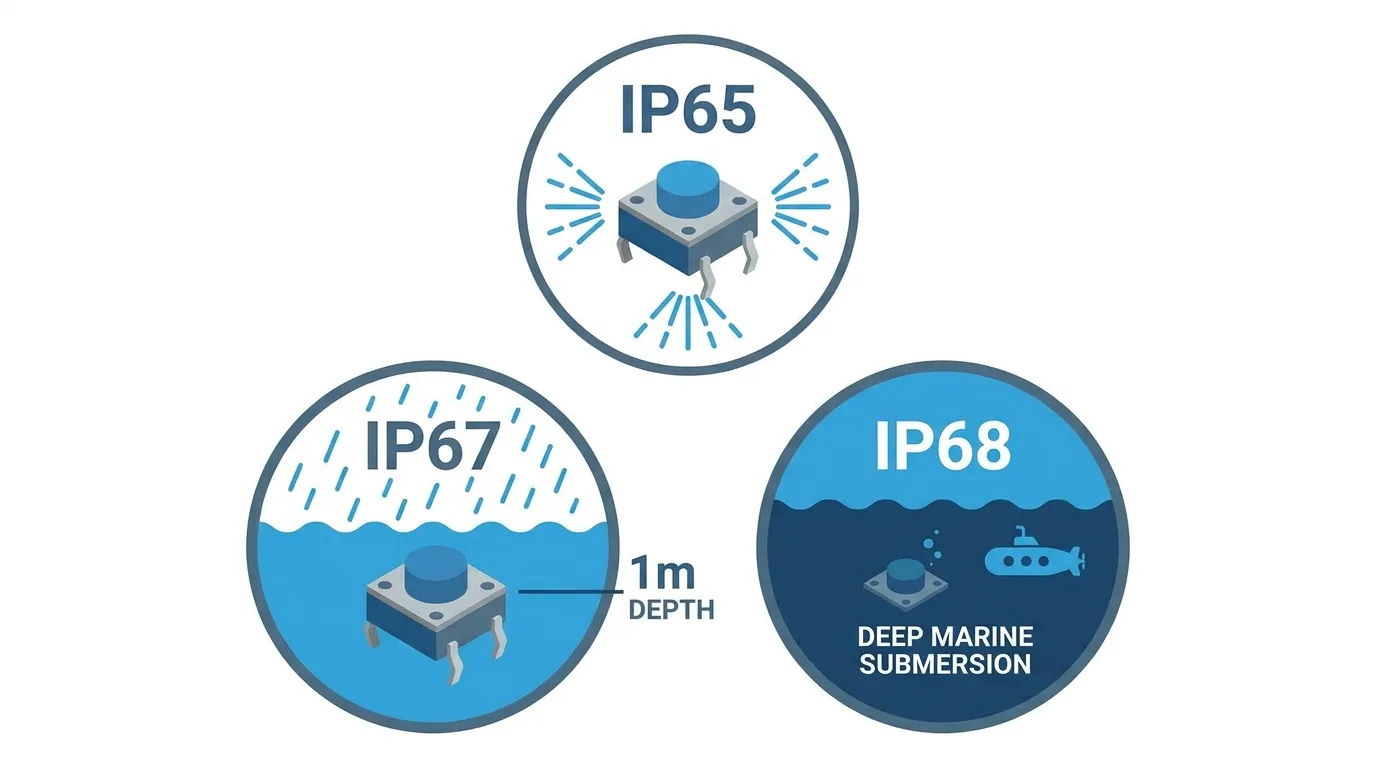
The IP code has two digits. The first digit (0–6) indicates protection against solid particles, including dust. The second digit (0–9) indicates protection against water. For outdoor electronics, you are primarily concerned with the second digit, but achieving a fully dust-tight rating (first digit: 6) is equally important for devices used in agricultural, industrial, or desert environments.
Here is how the most relevant outdoor IP ratings compare:
| IP Rating | Dust Protection | Water Protection | Max Water Exposure | Typical Outdoor Use Case |
|---|---|---|---|---|
| IP65 | Dust-tight | Water jets from any direction | Low-pressure jets | Outdoor panels, garden equipment, automotive exterior |
| IP67 | Dust-tight | Temporary immersion | 1 meter for 30 minutes | Wearables, GPS devices, smart agriculture, outdoor IoT |
| IP68 | Dust-tight | Continuous immersion | Beyond 1 meter (per manufacturer spec) | Marine electronics, diving equipment, underwater sensors |
IP65 — Splash and Jet Protection
IP65 is the entry-level rating for outdoor use. It handles rain, spray, and low-pressure water jets from any direction. For static outdoor enclosures like junction boxes, garden irrigation controllers, or automotive exterior panels, IP65 is often sufficient. However, if the device may be submerged even briefly — dropped in a puddle, mounted at deck level on a boat, or used in heavy monsoon rain — IP65 is not enough.
IP67 — Immersion and Rain Protection
IP67 is the most widely specified rating for outdoor consumer and industrial electronics. It handles everything IP65 does, plus temporary immersion in up to 1 meter of water for 30 minutes. For most outdoor wearables, handheld field devices, GPS trackers, and outdoor IoT sensors, IP67 is the practical minimum that provides real-world confidence across typical environmental exposure.
IP68 — Continuous Submersion for Marine and Extreme Use
IP68 is the highest standard for most tact switch applications. The exact depth and duration are defined by the manufacturer, but it always exceeds the IP67 requirement. Switches meeting IP68 are fully functional under water for extended periods — one documented example involves submersion at 2 meters for a minimum of 5 hours. For marine electronics, underwater sensors, and devices that may be submerged in operation, IP68 is the correct choice.
Key Specifications to Check Before Buying
IP rating is the most visible specification, but it is not the only one that determines suitability for outdoor use. Before finalizing a waterproof tact switch for your design, verify each of these parameters against your application requirements.
| Specification | What to Look For | Why It Matters for Outdoor Use |
|---|---|---|
| IP Rating | IP65 minimum; IP67 for most outdoor; IP68 for marine | Defines actual water and dust protection level |
| Operating Temperature | −40°C to +85°C for full outdoor range | Outdoor environments span extreme cold to direct sun heat |
| Actuation Force | 100–260 gf depending on application | Glove use, overlay panels, and spring-back response in cold need correct force |
| Mechanical Life | 1,000,000 cycles minimum; 3,000,000+ for high-use | Outdoor devices face hard use cycles over years |
| Contact Resistance | ≤200 mΩ initial; gold-plated preferred | Higher resistance = signal reliability issues in low-power circuits |
| Dimensions | 6×6mm standard; 5×5mm compact; 8×8mm heavy-duty | PCB footprint compatibility and enclosure fit |
| Actuator Height | 3.5mm, 4.3mm, or 5.2mm common | Determines panel overlay depth and actuation feel |
| Mounting Type | SMD or through-hole (THT) | Depends on PCB assembly process and mechanical requirements |
| Contact Material | Gold-plated or silver-alloy | Gold resists corrosion better in marine and humid environments |
| Housing Material | Nylon 6/6 or thermoplastic with UV stabilization | UV degradation of housing can compromise seal integrity over time |
The operating temperature specification deserves particular attention. A switch rated only to −20°C may function correctly in mild climates but fail in high-altitude applications, Nordic outdoor equipment, or devices shipped to cold-weather markets. If your product is designed for global deployment, a −40°C to +85°C range is the correct minimum target.
SMD vs. Through-Hole Mounting for Outdoor Enclosures
The choice between surface mount (SMD) and through-hole (THT) mounting is a practical design decision that interacts directly with how your outdoor enclosure is built.
SMD waterproof tact switches are the standard choice for compact outdoor products: wearables, GPS trackers, IoT sensors, and slim handheld devices. They are compatible with automated reflow soldering processes, and their sealed design allows PCB wash cycles after assembly without damage. However, SMD switches rely on the PCB pads for mechanical support. In applications where the button is pressed with significant force or where vibration is a concern — outdoor industrial equipment, vehicle-mounted devices — that mechanical load can stress the solder joints over time.
Through-hole (THT) waterproof tact switches are the better choice when mechanical robustness is the priority. The through-hole pins give the switch a physical anchor into the PCB, which handles lateral force and vibration significantly better than SMD mounting. For panel-mount outdoor control stations, marine control panels, or agricultural machinery interfaces where buttons are pressed firmly and frequently, THT mounting provides better long-term reliability.
One practical note: when using a THT waterproof switch in a panel-mount application, confirm that the switch body's IP rating includes the area around the panel hole. Some waterproof tact switches achieve their rating at the PCB level but are not rated for front-panel exposure — a common source of field failures.
Best Applications of Waterproof Tact Switches in Outdoor Electronics
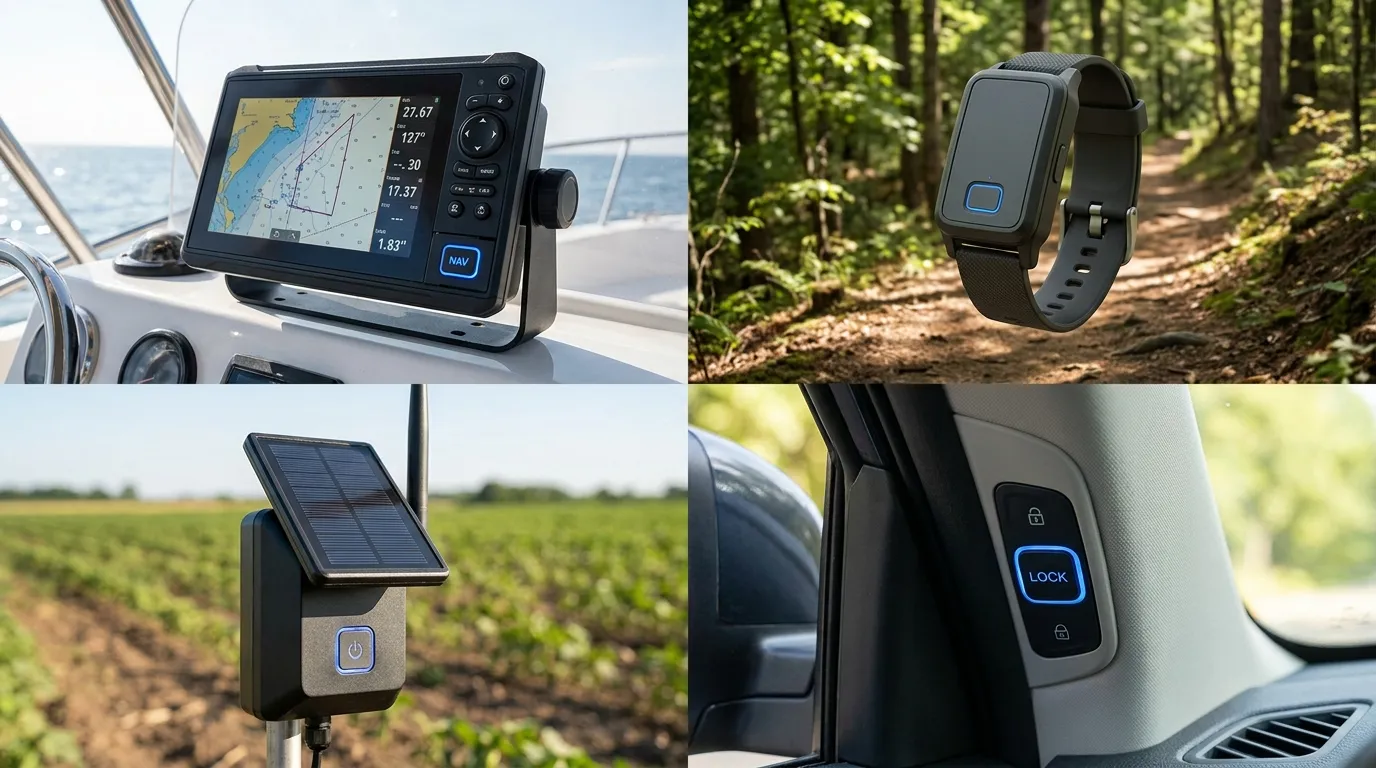
Marine and Watercraft Electronics
Marine environments are among the harshest conditions any electronic switch faces. Salt air accelerates contact corrosion, constant spray creates sustained water exposure, and humidity rarely drops below 80%. For chart plotters, VHF radios, fishfinders, autopilot control heads, and bilge pump panels, IP67 is the minimum acceptable rating and IP68 is the recommended standard. Gold-plated contacts are non-negotiable in salt-water environments, where silver contacts will oxidize and degrade within months.
Outdoor IoT and Smart Agriculture Sensors
Smart irrigation controllers, weather stations, field data loggers, and livestock monitoring devices all combine outdoor exposure with long unattended deployment cycles — sometimes years between maintenance intervals. IP67-rated tact switches in these applications provide confidence against seasonal rain, ground-level moisture, and the dust loading common in agricultural environments. The combination of a dust-tight (6) first digit with immersion resistance ensures these devices survive both dry seasons and monsoon conditions.
Wearables and Handheld Field Devices
GPS trackers, rugged handheld computers, outdoor fitness devices, and safety equipment like avalanche transceivers require waterproof switches in compact form factors. Here, IP67-rated SMD tact switches in 5×5mm or 6×6mm footprints are the typical solution. Actuation force selection is important in wearables — buttons used with gloves require a firmer actuation feel, typically 200–260 gf, while bare-hand portable devices work well at 150–180 gf. If your wearable device also needs visual feedback on the button, illuminated tact switches with sealed ratings are available and worth evaluating for panels where button visibility in daylight matters.
Automotive Exterior and Industrial Outdoor Controls
Keyless entry buttons, trunk release switches, exterior lighting controls, and outdoor industrial control panels share a common requirement: they face sustained UV exposure, temperature cycling across seasons, and direct precipitation. IP65 to IP67 covers most automotive exterior applications. The UV resistance of the housing material matters here — unstabilized plastics become brittle and crack after years of UV exposure, which compromises the O-ring seal even if the switch mechanism itself remains functional. Always confirm UV stabilization when specifying switches for external automotive or outdoor industrial use.
How to Choose the Right Waterproof Tact Switch: Step-by-Step
The right switch is always determined by your specific application environment, not by the highest available IP rating. Follow this five-step decision process:
Step 1: Define your water exposure level.
Is the device exposed to splash only (IP65), rain and possible immersion (IP67), or sustained underwater operation (IP68)? Match the IP rating to the worst-case scenario your device will realistically face — not the average case.
Step 2: Confirm your operating temperature range.
List the minimum winter temperature and maximum summer temperature (including direct sun loading) for every market where your device will be sold or deployed. The switch must operate reliably across the full range, not just at room temperature.
Step 3: Select your mounting type.
Use SMD for compact, weight-sensitive, automated-assembly designs. Use THT for mechanically demanding, panel-mount, or high-vibration applications. If unsure, THT is the more mechanically robust default for outdoor use.
Step 4: Set your actuation force and dimension requirements.
Match actuator height to your panel overlay thickness. Match actuation force to how the button will be used — bare finger, gloved hand, or through a membrane panel. Standard 6×6mm footprints are compatible with the widest range of PCB layouts.
Step 5: Verify contact material and lifecycle ratings.
For any application involving salt air, high humidity, or long deployment cycles, specify gold-plated contacts. Confirm that the mechanical lifecycle (rated number of actuations) exceeds your expected product life by a comfortable margin — a device used five times per day for ten years requires approximately 18,250 actuations; a frequently used industrial control may require millions.
| Decision Factor | IP65 | IP67 | IP68 |
|---|---|---|---|
| Outdoor panels with no immersion risk | ✓ Best fit | Works | Overspec |
| Outdoor wearables and GPS devices | Minimum | ✓ Best fit | Works |
| Marine and underwater devices | Not sufficient | Minimum | ✓ Best fit |
| Smart agriculture and outdoor IoT | Minimum | ✓ Best fit | Works |
| Automotive exterior controls | ✓ Best fit | Works | Overspec |
Common Mistakes When Specifying Waterproof Tact Switches
Specifying IP65 for Applications That Need IP67
The most common mistake is treating IP65 as "good enough for outdoor use" without accounting for immersion scenarios. A device that falls into standing water, gets submerged during a flood event, or is washed down in a marine environment will fail at IP65. Unless you can guarantee the device will never face temporary immersion, default to IP67 for outdoor products.
Ignoring Temperature Cycling Effects on Seal Integrity
A switch that passes IP67 testing at room temperature may develop seal leakage after years of thermal cycling between −30°C and +70°C. Repeated expansion and contraction stresses O-rings and silicone membranes over time. When specifying for long-lifecycle outdoor products, verify that the switch is rated for your full temperature range — not just the maximum.
Selecting the Wrong Mounting Type for the Enclosure
Using an SMD waterproof switch on a front panel that receives repeated forceful presses will eventually crack the solder joints, creating a mechanical failure independent of the IP rating. Panel-mount applications require THT switches with sufficient pin-to-board mechanical anchoring.
Overlooking UV Degradation of Housing Material
A switch housing that has not been UV-stabilized will become brittle and discolor after extended outdoor exposure. More critically, a brittle housing can crack around the O-ring groove, breaking the seal without any visible damage to the actuator. Always request UV resistance data for outdoor applications where sun exposure is continuous.
Assuming "Waterproof" Includes Operational Submersion
An IP67 rating confirms that the switch survives temporary immersion without damage — it does not guarantee the switch will function correctly while submerged. If your application requires underwater operation (a dive computer, underwater lighting controller, or submersible sensor), you need an IP68 switch specifically tested for operational performance under water, not just survival testing.
| Mistake | Root Cause | How to Avoid |
|---|---|---|
| Wrong IP rating | Not accounting for worst-case immersion | Map every environmental scenario before specifying |
| Seal failure over time | Temperature cycling degrades O-rings | Verify temp range covers full seasonal extremes |
| SMD joint failure on panel | Mechanical force on SMD pads | Use THT for panel-mount or high-force applications |
| Housing cracking | No UV stabilization specified | Confirm UV resistance data from supplier |
| Operational failure underwater | Confusing survival rating with operation rating | Use IP68 for any in-water operational use case |
Related Switch Types for Outdoor Applications
Waterproof is one critical specification, but outdoor applications often combine it with other form-factor requirements. Understanding how the waterproof variant relates to other tact switch types helps you make the right choice when your design has multiple constraints.
If your outdoor device requires a button that mounts at an angle to the PCB for a panel-mount configuration, right-angle tact switches for panel-mount outdoor applications offer that geometry while still being available with sealed ratings.
For compact wearable devices or slim handheld outdoor equipment where PCB height is tightly constrained, low-profile tact switches for slim outdoor wearable enclosures reduce the actuator footprint while maintaining the small-form-factor advantage.
When your outdoor control panel or indicator button needs to be visible in bright daylight or harsh-light environments, LED tactile switches with environmental protection ratings combine visual feedback with sealed switch mechanics — though verifying that the IP rating covers the LED sealing, not just the mechanical switch body, is essential.
For the full category context — including all tact switch types, mounting options, and product variants — the complete tact switch overview from Hanxia covers the broader selection landscape.
Frequently Asked Questions
What IP rating is needed for outdoor tact switches?
For most outdoor electronics, IP67 is the practical standard. It handles rain, humidity, and brief immersion up to 1 meter for 30 minutes. IP65 is sufficient for splash-only environments like outdoor panels or automotive exteriors. IP68 is required for marine applications or any device that may operate while submerged.
What is the difference between a waterproof and a water-resistant tact switch?
Water-resistant typically refers to IP64 or IP65 protection — the switch handles splash and low-pressure water jets but is not rated for immersion. Waterproof specifically refers to IP67 or IP68, where the switch survives defined depths and durations of submersion. The distinction is not marketing language — it maps directly to specific IEC 60529 test conditions.
Can I use a standard tact switch outdoors with a sealed enclosure?
A sealed enclosure provides housing-level protection, but it does not protect the switch during assembly washing, condensation buildup inside the enclosure, or enclosure seal failures. Using a waterproof tact switch is the more reliable engineering approach, especially for products with long deployment cycles where enclosure integrity cannot be guaranteed throughout the product's life.
How long do waterproof tact switches last outdoors?
High-quality sealed tact switches are rated for 1 million to 3 million mechanical cycles. Real-world longevity also depends on UV resistance of the housing, seal material durability across temperature cycling, and contact material — gold-plated contacts maintain reliable performance significantly longer than silver contacts in humid or salt-air environments.
What are standard dimensions for waterproof tact switches?
The most common footprints are 6×6mm and 5×5mm. Standard actuator heights range from 3.5mm to 5.2mm. For compact wearables and IoT devices, 5×5mm with low-profile actuators is typical. For control panels and industrial applications, 6×6mm and larger variants offer better mechanical stability and actuation feel.
Can waterproof tact switches be used with reflow or wave soldering?
Yes. Sealed tact switches are specifically designed to survive PCB assembly processes, including reflow soldering (SMD) and wave soldering (THT), as well as post-assembly PCB wash cycles. Always confirm the switch's rated soldering temperature and process compatibility in the manufacturer's datasheet before assembly.
Are illuminated tact switches available with waterproof ratings?
Yes, but the selection is more limited. When evaluating an illuminated waterproof switch, confirm that the IP rating covers the entire switch assembly including the LED sealing — not just the mechanical switch body. Some products are rated for the switch mechanism but not for water ingress around the LED aperture, which creates a real failure path in outdoor or marine use.
Conclusion
Selecting a waterproof tact switch for outdoor electronics comes down to three core decisions: the right IP rating for your specific environment, the right mounting type for your enclosure and mechanical load, and the right contact material for your deployment lifetime and climate. IP67 covers the majority of outdoor use cases from wearables to IoT sensors. IP68 is the correct choice for marine and submersible applications. IP65 is appropriate only when immersion is genuinely not a risk.
Beyond the IP rating, temperature range, UV resistance, actuation force, and contact material determine whether the switch performs for months or for years. Specify these parameters against your worst-case scenario, not your average one.
If you are in the process of evaluating switch options across multiple types and form factors for your next outdoor product, the full tact switch range from Hanxia covers sealed, SMD, THT, and custom variants. Contact the team with your application requirements for a specification recommendation matched to your specific outdoor use case.
