





A Practical Guide to Selecting the Right USB Panel Mount Connector
Introduction
Walk through any factory floor, server room, or industrial kitchen, and you will spot them: small, rugged ports bolted into metal or plastic panels. They look like simple, off-the-shelf components. But if you have ever dealt with a device failing in the field, you know that a cheap USB Panel Mount Connector is often the culprit behind an otherwise well-engineered product.
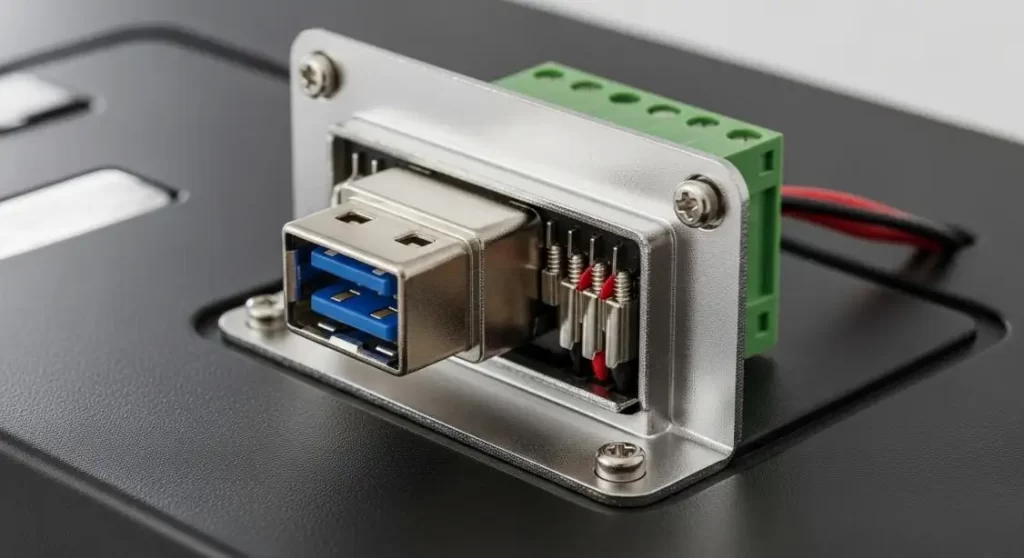
The reality is that these components live a hard life. They sit on the front lines of your device, acting as the bridge between your delicate internal circuitry and a world full of dust, angled plugs, and accidental coffee spills. When a user jams a cable in at the wrong angle or yanks on it to reach a different spot, that little port has to absorb the abuse. If it fails, the connection drops, data corrupts, and your customer support line starts ringing.
At HANXIA, we have spent over a decade building connectors that survive these conditions. We don't just design for perfect lab conditions; we design for the real world. We have seen our components rattle inside infotainment systems on bumpy roads for thousands of hours and endure the harsh sterilization chemicals used in operating rooms. We know exactly what holds up and what snaps.
This guide is a collection of lessons learned from that experience. We are going to skip the marketing fluff and focus on the practical, physical factors that separate a mediocre USB Panel Mount Connector from a truly reliable piece of hardware.
Matching the Physical Format to Your User
Before you get lost in data sheets about voltage and amperage, take a step back. Think about the person holding the cable. The physical shape of your USB Panel Mount Connector dictates whether that user can plug in their device without frustration.
We manufacture every mainstream USB format because each one solves a specific problem in the real world:
• USB Type-A: This is the classic rectangle. It is the standard for a reason. If you are building a power supply, a control panel for a machine, or a desktop computer, Type-A is your safest bet. It is universally recognized, and because there are billions of legacy cables out there, your users will never be stuck searching for a wire.
• USB Type-B: You rarely see this square connector on consumer gadgets anymore, but it is a workhorse in industrial settings. Printers, audio interfaces, and specific industrial controllers use it because the square shape offers a very secure, snap-in fit that resists accidental disconnection.
• USB Type-C: This connector solved the biggest user annoyance of all time: flipping the plug three times. But beyond convenience, the specification allows for massive power delivery and high-speed data transfer. Modern laptops, high-end automotive dashboards, and even power tools are standardizing on Type-C because it handles video, data, and power in one sleek, reversible package.
• Micro-USB & Mini-USB: Don't count these out just yet. They are still the perfect choice for ultra-compact portable equipment, certain GPS units, and legacy medical devices. When every millimeter of board space matters, these smaller footprints are invaluable.
The format you choose dictates the size of your panel cutout and the availability of cables for your end-user. Make this choice based on what they actually own, not just what looks new.
Building Robustness to Prevent Field Failures
There are few things more frustrating than an intermittent connection. It is the "sometimes it works, sometimes it doesn't" problem that drives technicians crazy. Do not underestimate how easily mechanical stress can undo a good design. A USB Panel Mount Connector that seems secure on day one can be loose and problematic by year three.
Because every interaction applies stress. Plug in a cable: mechanical force. Unplug it: more force. Let the cable dangle off the side of the device: continuous force. When the cable moves, that leverage transfers torque directly to the solder joints and the panel mount. Temperature swings cause materials to expand at different rates. Vibration slowly works things apart.
We focus on what engineers call "high-retention force." In plain English, this means the connector holds the plug tightly without requiring the user to force it. It should feel "bank vault" solid.
This performance starts with material science. We combine reinforced polymer housings with high-grade copper alloys. The gold plating on our contacts isn't just for show; it is a functional layer that resists oxidation and maintains signal integrity across thousands of mating cycles.
If you are designing for a factory floor where motors shake the building, a cheap connector will develop microscopic fretting corrosion. A properly specified USB Panel Mount Connector will maintain its death grip on the cable regardless of the environmental vibration.
Matching Data Speeds to Application Needs
It is easy to get caught up in the race for the highest specification, but faster isn't always better. Paying for USB 3.2 capabilities when your device only sends temperature readings is a waste of budget.
We offer a range of USB Panel Mount Connector options to match varying data loads:
• USB 2.0: This is more than adequate for the vast majority of industrial tasks. Sending control signals, updating configuration files, or polling sensors does not require massive bandwidth. It is a proven, stable, and cost-effective solution.
• USB 3.0 and higher: This is where you need to be if you are handling high-resolution video, moving large data logs, or running diagnostic imaging equipment. The jump in transfer speed changes the user experience from waiting minutes to waiting seconds.
The connector you install today sets the ceiling for what your hardware can do tomorrow. Swapping out a connector later means re-spinning a PCB and retooling a panel—costly steps best avoided by a little foresight now.
Leveraging Power Delivery (PD) for Smarter Design
The role of USB has evolved. It is not just a data pipe anymore; it is a power grid. Modern USB Panel Mount Connector designs can now replace bulky barrel jacks and separate power bricks.
Our advanced connectors support the Power Delivery spec, pushing up to 100W. This unlocks some elegant design solutions:
• A medical cart can charge a laptop, run a monitor, and power a small pump all from a single upstream cable.
• Point-of-sale terminals can be cleaner, with just one wire for both the credit card reader and the tablet.
When you are choosing a connector, think about future power budgets. Even if your device does not need 100W today, selecting a USB Panel Mount Connector with PD capability means you are not closing the door on future upgrades or higher-power variants of your product.
The Critical Role of Shielding in Signal Integrity
Here is a trap that catches many junior engineers: the connector itself can act as an antenna. Without proper shielding, the electromagnetic noise generated by nearby motors, switching power supplies, or even radio transmitters can bleed into your data lines.
The results can be subtle—a flickering display—or catastrophic—a medical monitor reporting a false reading. The metal shell surrounding the contacts in a quality USB Panel Mount Connector is not just structural; it is a Faraday cage.
At HANXIA, we engineer our shielding to block common-mode interference before it ever reaches your sensitive circuits. This is non-negotiable in certain environments:
• Medical Suites: Where patient monitoring equipment sits next to powerful imaging machines.
• Industrial Automation: Where Variable Frequency Drives (VFDs) fill the air with electrical hash.
• Telecom Hubs: Where high-speed signals run in dense bundles.
Specifying a fully shielded USB Panel Mount Connector from the start is cheap insurance against noise-related field failures.
Exploring Mechanical Configurations for Tight Spaces
Product designers are constantly fighting the war for space. Enclosures are shrinking, and PCBs are getting packed tighter than ever. In these scenarios, a standard, straight connector often will not fit.
If your board runs parallel to the back panel, a vertical USB Panel Mount Connector might create a clearance nightmare. This is why we offer a variety of mechanical configurations:
• Right-Angle Designs: These allow the connector to exit sideways. This lets you mount the PCB flush against the panel while the cable routes neatly along the inside wall of the enclosure. It is a lifesaver in slim, compact devices.
• Vertical Orientations: When your PCB sits at a 90-degree angle to the access panel, a vertical connector delivers three key benefits: simplified board layout, intuitive cable access, and mechanical protection for solder joints by aligning insertion force with the board's mounting hardware.
• Ultra-Slim Profiles: Gain critical clearance without compromising performance. Whether you are shrinking a product or adding features to an existing footprint, our low-profile USB Panel Mount Connectors give you the room you need.
These mechanical variations give your layout engineers the flexibility they need to optimize the board design without forcing a bulky connector into a small space.
If our catalog of standard options does not fit your exact mechanical or electrical needs, our Custom & OEM Solutions team is ready to build a USB Panel Mount Connector tailored specifically to your blueprints.
Why Engineering Teams Trust HANXIA
Choosing a connector is ultimately a risk-management decision. You are trusting a tiny component to maintain signal integrity, deliver power, and hold up to physical abuse for years. You need to trust the name on the data sheet.
• Decades of Experience: We have spent over ten years solving the specific problems that arise in harsh environments. That knowledge is baked into every design.
• Automated Precision: Consistency you can count on. Because our lines are fully automated, you eliminate the risk of performance drift, ensuring every batch of connectors arrives with the same reliable fit and finish.
• 100% Verification: Zero sampling. 100% testing. Every USB Panel Mount Connector is verified for signal integrity and mechanical durability before it reaches your hands.
• Global Logistics: Built for just-in-time. Our logistics network ensures your production line never waits, with parts arriving precisely when scheduled.
Ready to lock in the right connector for your project?
Do not leave this critical interface to chance. [Contact HANXIA today] and talk to an application engineer who speaks your language. We will help you spec the perfect USB Panel Mount Connector—whether it is a standard catalog part or a custom design engineered to your exact specifications. Let us build something that lasts.
