





How to Request Tact Switch Samples Before Bulk Orders
Placing a bulk order for tact switches without first testing a sample is one of the most preventable mistakes in electronics procurement. A wrong actuation force, an incompatible PCB footprint, or a contact resistance that drifts under load — any of these issues can render an entire shipment unusable. Yet many buyers skip sampling entirely, or they approach it without a clear process and end up with samples that don't reflect actual production quality.
This guide walks you through exactly how to request tact switch samples the right way — from preparing your technical specification to evaluating what you receive — so that your bulk order decision is based on verified data, not assumptions.
If you're still finalising which type of switch fits your project, start with our complete tact switch guide to confirm your specification requirements before proceeding with a sample request.
Why Sampling Is Non-Negotiable Before a Bulk Tact Switch Order
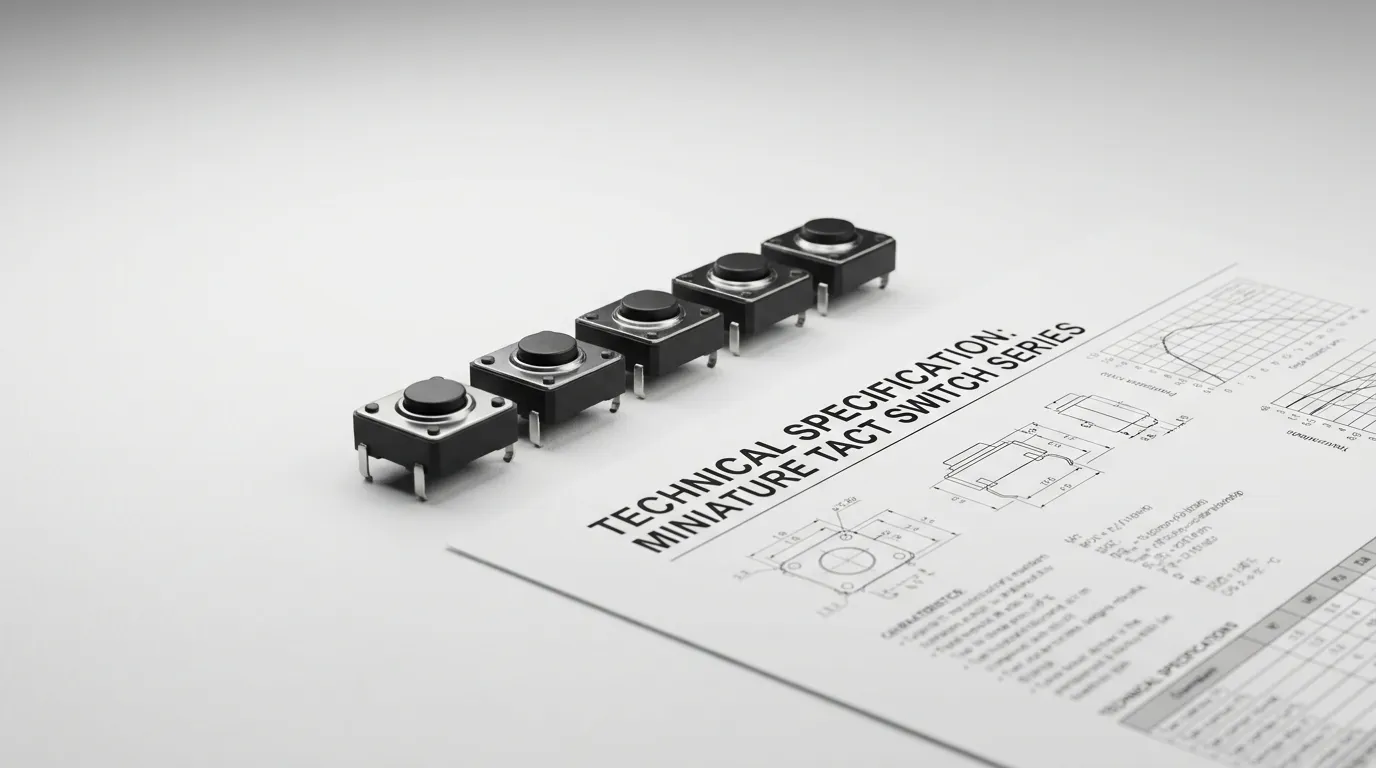
Tact switches appear simple, but the performance gap between a well-specified component and a poorly matched one is significant in practice. A switch with the wrong actuation force frustrates end users. A mounting footprint that's even 0.2mm off centre can create reflow soldering problems across an entire production batch. And a unit rated for 50,000 cycles used in a high-frequency application will fail long before the product lifecycle ends.
The cost of identifying these problems after you've received 50,000 units is orders of magnitude higher than the cost of properly evaluating five to ten samples before committing. This is especially true in product categories like medical equipment, automotive controls, and industrial machinery — where component failure has consequences beyond simple product returns.
Sampling gives you a factual baseline: the physical sample proves the supplier can produce what the datasheet claims. It also reveals how a supplier responds when you give detailed technical requirements — which itself is useful information about their quality culture.
Two Types of Tact Switch Samples: Know the Difference
Not every sample serves the same purpose. Before contacting a supplier, know which type of sample you need.
Free Standard Samples
Most tact switch manufacturers supply free samples of their standard catalogue models — common sizes like 6×6mm or 12×12mm, standard actuation forces (100gf, 160gf, 260gf), and conventional SMD or through-hole mounting configurations. These are typically shipped within three to seven business days and require only a formal request with your specification details.
Standard samples are appropriate when your design uses an off-the-shelf switch configuration. They let you verify fit, feel, and basic electrical performance before committing to a bulk purchase.
Paid Custom Prototype Samples
If your project requires a non-standard body size, a custom actuator height, a specific IP rating, or an illuminated variant with particular LED colour and intensity, you will need a custom prototype sample. These typically involve tooling or production setup costs ranging from moderate to significant depending on complexity, and lead times of two to four weeks.
Many suppliers credit the prototype fee against your first bulk order — always confirm this in writing before paying. For a detailed breakdown of what custom configurations are available, see our custom tactile switch guide.
| Sample Type | Cost | Lead Time | Best For | Key Limitation |
|---|---|---|---|---|
| Free standard sample | Free (buyer pays shipping) | 3–7 business days | Off-the-shelf specs, initial supplier evaluation | Limited to catalogue configurations |
| Paid custom prototype | Fee (often credited to bulk) | 2–4 weeks | Custom size, actuator, or IP rating requirements | Requires detailed spec sheet upfront |
What to Prepare Before Sending a Sample Request
A poorly written sample request produces a poorly matched sample. Before contacting any supplier, define and document the following:
Physical specifications:
- Body size (e.g., 6×6mm, 3×3mm, 12×12mm)
- Mounting type: SMD (surface mount) or through-hole (DIP)
- Actuator height and type (standard, low-profile, extended)
- Operating travel distance (in mm)
Electrical specifications:
- Rated voltage (e.g., 12V DC)
- Rated current (e.g., 50mA)
- Contact resistance target (typically <100mΩ)
- Insulation resistance requirement (typically >100MΩ)
Mechanical and durability specifications:
- Actuation force (in gf or N — be precise, not approximate)
- Required lifecycle: 50,000 cycles, 500,000 cycles, 1 million cycles, or more
Compliance requirements:
- RoHS compliance (mandatory in most markets)
- REACH compliance if applicable
- IP rating for waterproof or dustproof versions (e.g., IP67)
If you're not yet fully confident reading and interpreting switch datasheets, our tact switch datasheet guide explains each specification parameter and how to use it in a supplier request.
Step-by-Step: How to Request a Tact Switch Sample
Step 1: Shortlist Suppliers
Identify two or three suppliers capable of producing your target specification. Reviewing a supplier's product catalogue, manufacturing capabilities, and quality certifications before approaching them avoids wasting time on suppliers who cannot meet your requirements. Our tactile switch wholesale guide covers how to evaluate and shortlist tact switch manufacturers.
Step 2: Prepare a Specification Document
Write a one-page specification summary that includes all the parameters listed in the section above. Attach any relevant datasheet you are referencing or any existing PCB footprint file. This document becomes the binding reference for the sample — if the sample deviates from it, you have a documented basis for rejection.
Step 3: Write a Clear Sample Request
Your sample request message or email should include:
- Your full specification document or a reference part number
- The sample quantity you need (see below)
- Your expected testing timeline
- Your target bulk order volume (this signals commercial intent and improves supplier responsiveness)
- Whether you require datasheet documentation, compliance certificates, or test reports alongside the physical sample
- Your question about sample cost and whether it is credited toward the bulk order
Step 4: Confirm Sample Fee and Shipping Terms
For standard catalogue samples, most suppliers ship free of charge or ask the buyer to cover courier costs. For custom prototypes, confirm the fee, credit policy, and shipping method before proceeding. Get this in writing — either via email confirmation or a formal proforma invoice.
Step 5: Agree on Lead Time and Tracking
Request a confirmed ship date and a tracking number once the sample dispatches. A supplier who cannot provide basic logistics visibility is a risk indicator for the larger relationship.
Step 6: Document Everything
Save every communication, specification document, sample fee agreement, and tracking confirmation in a dedicated folder. When your sample arrives, this documentation becomes your acceptance or rejection benchmark.
How Many Tact Switch Samples Should You Request?
Request a minimum of three to five samples per supplier. Testing a single unit tells you nothing about batch consistency — one switch might perform perfectly while a second from the same box shows a 30% deviation in actuation force. For safety-critical applications (medical, automotive, industrial control), request ten or more samples and test each one individually against your specification criteria.
If you are evaluating multiple suppliers simultaneously — which is recommended — request samples from all shortlisted suppliers at the same time. Side-by-side comparison under the same testing conditions gives you an objective ranking rather than a sequential one distorted by timing or memory.
How to Evaluate a Tact Switch Sample: What to Test
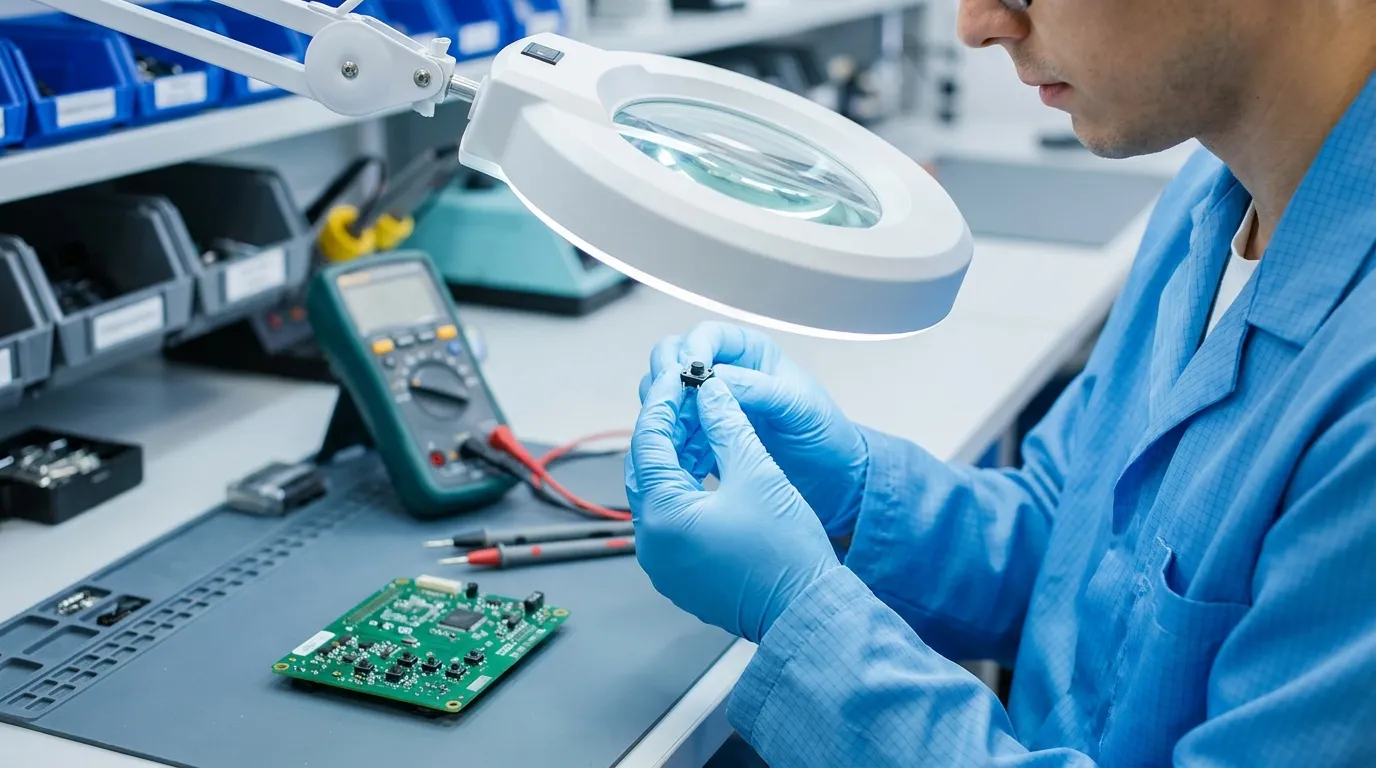
Receiving the sample is the midpoint, not the end. A thorough evaluation requires you to check performance across three dimensions: physical fit, mechanical behaviour, and electrical performance.
Physical and Mechanical Checks
Start by verifying that the sample fits your PCB footprint precisely. Place the switch on your test PCB or production board and confirm that all pins or pads land correctly within tolerance. For SMD variants, verify that the pad geometry is consistent with IPC standards for reflow soldering.
Test actuation force by feel and, where possible, with a force gauge. The force should be consistent across all samples in your set — any significant variation within the same batch is a quality consistency concern. Check operating travel: the distance from resting position to fully actuated should match the specified value.
Inspect the housing, actuator, and terminal finish visually. Housing should be free of mould flash, warping, or discolouration. Terminal plating (gold or silver contact finish) should be uniform with no oxidation or pitting.
Electrical Performance Checks
Using a multimeter or LCR meter, measure contact resistance across the switch terminals in the actuated state. The value should be consistently below 100mΩ. A reading significantly above this indicates contact surface quality issues that will worsen under real operating conditions.
Verify insulation resistance in the open (non-actuated) state. It should exceed 100MΩ — any leakage suggests contamination or material quality issues.
Confirm that rated voltage and current performance match your application requirements. If the switch is rated for 12V/50mA and your application draws more, this is the stage to identify the mismatch.
Matching Sample Specs to the Datasheet
Cross-check every measurement you take against the supplier's datasheet values. If the physical sample measures an actuation force of 210gf but the datasheet states 160gf, that is a non-conformance — and it means the production line does not consistently deliver what the specification document claims.
A good supplier welcomes this kind of scrutiny. A supplier who cannot explain spec deviations is a supplier who cannot guarantee production consistency in bulk. For guidance on reading and interpreting these specification documents, refer to our tact switch datasheet guide.
Sample Evaluation Criteria Reference Table
| Check Item | Method | Pass Threshold | Fail Indicator |
|---|---|---|---|
| PCB footprint fit | Physical placement on test PCB | All pins/pads align within ±0.1mm | Pins out of position, pads misaligned |
| Actuation force | Force gauge or tactile comparison | Within ±10% of specified gf value | >10% variation across samples in batch |
| Contact resistance (actuated) | Multimeter / LCR meter | <100mΩ | Readings consistently above 100mΩ |
| Insulation resistance (open) | Multimeter | >100MΩ | Any detectable leakage |
| Operating travel | Callipers or travel gauge | Within ±0.1mm of datasheet spec | Travel noticeably shorter or longer than specified |
| Visual inspection | Naked eye / magnification | No flash, warping, oxidation, or pitting | Surface defects, discolouration, uneven plating |
| Compliance markings | Visual + certificate check | RoHS mark + certificate present | Missing or unverifiable certification |
Free vs. Paid Samples: Setting Realistic Expectations
For standard catalogue tact switches, free samples are common industry practice. The buyer typically covers international courier costs; the supplier absorbs the component cost to build a commercial relationship. This is reasonable and expected when you are evaluating an order of meaningful volume.
For custom configurations, a paid sample process is standard and legitimate. The tooling, engineering time, and production setup required to manufacture a non-catalogue prototype have real costs. What matters is that the fee is reasonable relative to the complexity, and that the credit-toward-bulk-order policy is confirmed upfront.
Avoid suppliers who charge significant fees for standard catalogue samples with no credit policy. Equally, be cautious of suppliers who offer samples with no quality documentation — a sample with no datasheet, no compliance certificate, and no test report is not a usable engineering evaluation unit.
Common Mistakes to Avoid When Requesting Tact Switch Samples
| Mistake | Why It Happens | How to Avoid It |
|---|---|---|
| Requesting samples without a full specification document | Buyers assume suppliers will "figure it out" | Always attach a written spec sheet with your request |
| Testing only one sample per supplier | Appears sufficient but reveals nothing about consistency | Request and test at least 3–5 samples per supplier |
| Not testing on the actual target PCB | Testing in isolation misses footprint fit issues | Mount samples on a production or test board before approval |
| Accepting a sample that deviates from spec | Pressure to move quickly | Document and reject any non-conforming sample formally |
| Skipping lifecycle and endurance checks | Lifecycle testing seems excessive for a sample | Even a basic 500-cycle manual test reveals wear patterns |
| Requesting certifications after receiving samples | Certificates feel like a formality | Request RoHS certificates and test reports alongside the physical sample |
| Evaluating only one supplier's sample | Speeds up the process but removes competitive comparison | Always evaluate at least two suppliers simultaneously |
After Sample Approval: Your Path to Bulk Order
Once a sample passes all your evaluation criteria, document the approval formally. Send a written confirmation to the supplier referencing the sample lot number, the specification document it was measured against, and the parameters that were verified.
This documented approval becomes the production quality reference — meaning that your bulk order is expected to conform to the same standards as the approved sample. Make this explicit in your purchase order: "All units must conform to the approved sample specification dated [date]."
From here, the bulk order conversation shifts to pricing, minimum order quantity, lead time, and payment terms. Our bulk tact switch buying guide covers how to negotiate MOQ, structure pricing tiers, and manage quality inspection on arrival.
Related Guides
Understanding tact switch sampling is one part of a broader procurement process. The complete tact switch guide at Hanxia covers the full range of available switch types — standard, SMD, through-hole, illuminated, waterproof, and long-life variants — which is useful context when selecting which type to sample.
For buyers working with non-standard requirements, the custom tactile switch guide explains available customisation options and what information to provide when requesting a custom prototype sample.
For sourcing and supplier selection, the tactile switch wholesale guide helps you identify and evaluate qualified manufacturers before initiating your sample request.
Frequently Asked Questions
Are tact switch samples free?
Standard catalogue samples are typically free, though the buyer usually covers international shipping costs. Custom prototype samples carry a tooling or setup fee, which reputable suppliers credit toward your first bulk order. Always confirm the credit policy in writing before paying.
How many tact switch samples should I order?
Request at least three to five samples per supplier for standard evaluation. If your application is safety-critical — medical devices, automotive controls, or industrial safety systems — request ten or more samples to test batch consistency across a statistically meaningful set.
How long does it take to receive tact switch samples?
Standard off-the-shelf samples typically arrive within three to seven business days depending on shipping method and origin. Custom prototype samples require two to four weeks from order confirmation due to tooling and production setup time.
What specifications should I verify on a tact switch sample?
The most important checks are actuation force (within ±10% of specified value), contact resistance (<100mΩ actuated), insulation resistance (>100MΩ open), PCB footprint fit, operating travel distance, and visual inspection of housing and terminal plating. Cross-check each measurement against the supplier's datasheet.
What should I do if the sample does not match my specification?
Document the deviation in writing with photographs and measurement data. Send a formal non-conformance report to the supplier and request either a corrected sample or a specification explanation. Do not approve a bulk order based on a non-conforming sample.
Can I request samples from multiple suppliers at the same time?
Yes — and it is recommended practice. Requesting samples from two or three shortlisted suppliers simultaneously allows direct comparison under the same testing conditions, giving you an objective basis for supplier selection rather than a sequential evaluation distorted by timing.
Can the sample fee be applied toward my bulk order?
Most reputable suppliers credit paid sample fees (especially custom prototype fees) against the first bulk purchase order. This needs to be negotiated and confirmed before you pay — request written confirmation via email or proforma invoice.
How do I know the sample represents actual production quality?
Request that samples are drawn from a live production run or standard production tooling, not a pre-selected showroom unit. Ask the supplier to confirm the sample lot and production origin in writing. A supplier who cannot or will not confirm this is worth scrutinising further.
Final Thoughts
A structured sample request process is not bureaucratic overhead — it is the most cost-effective quality control step available to any electronics buyer. The time invested in preparing a clear specification, requesting the right sample quantity, and evaluating results against documented criteria pays for itself the first time it prevents a bulk order failure.
Keep your sample approval formal, your specification document detailed, and your supplier communication written. When the bulk order eventually arrives, you will have a documented quality baseline to hold it against.
If you are still in the process of evaluating which tact switch type and configuration suits your project, visit our complete tact switch guide to review available models, specifications, and recommended configurations before committing to a sample request.
