





Sliding Door Switch Selection Guide: Electrical, Mechanical & Environmental Parameters
Choosing the correct Sliding Door Switch is key to making sure that applications spanning industrial automation and smart homes, automotive sliding doors, and commercial lifts remain safe, reliable, and long-lasting. Selecting an inferior Switch can result in the unpleasant trifecta of operational disruption due to switch failure and, worse, creating safety concerns. The objective of this guide is to assist you in understanding the most important of the Electric, Mechanical, and Environmental parameters for you to select a Switch with the least possible obsolescence.
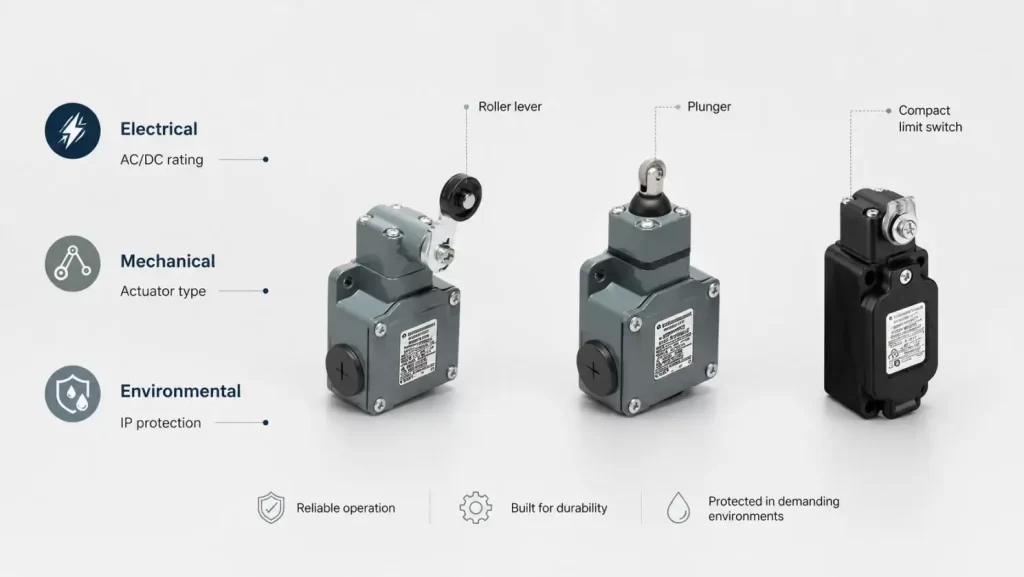
Importance of Proper Sliding Door Switch Selection
A Sliding Door Switch will identify the open and closed positions of a sliding door and provide that information to some control logic (PLC, relay, or microcontroller). The environment will dictate if that switch is a Magnetic Reed Switch as used in a smart window sensor, or a Heavy-Duty Limit Switch as used in a factory's guard door. System uptime and safety compliance are both heavily dependent on the correct Switch selection for the operating conditions.
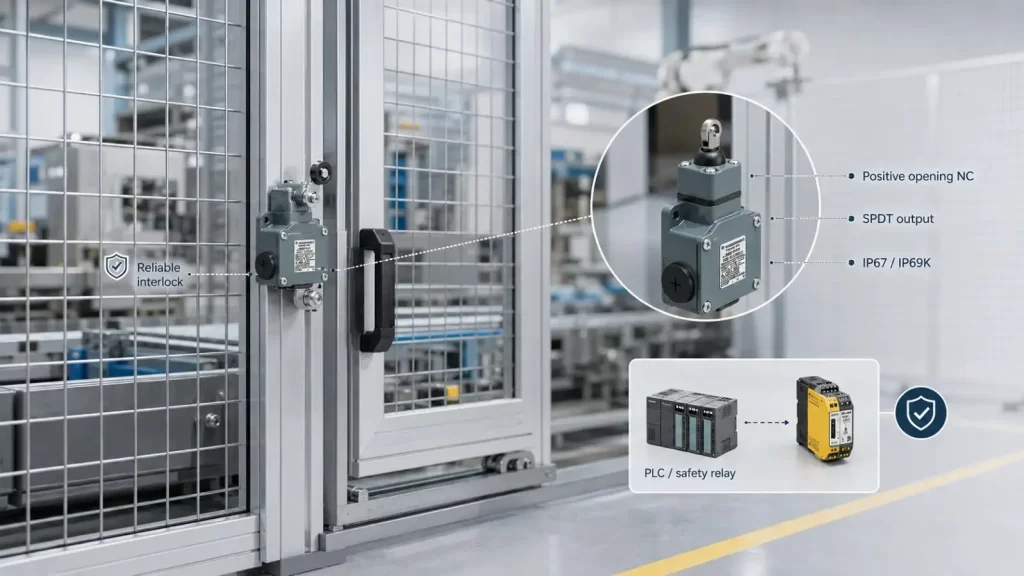
1. Electrical Parameters: The Core of Switching Reliability
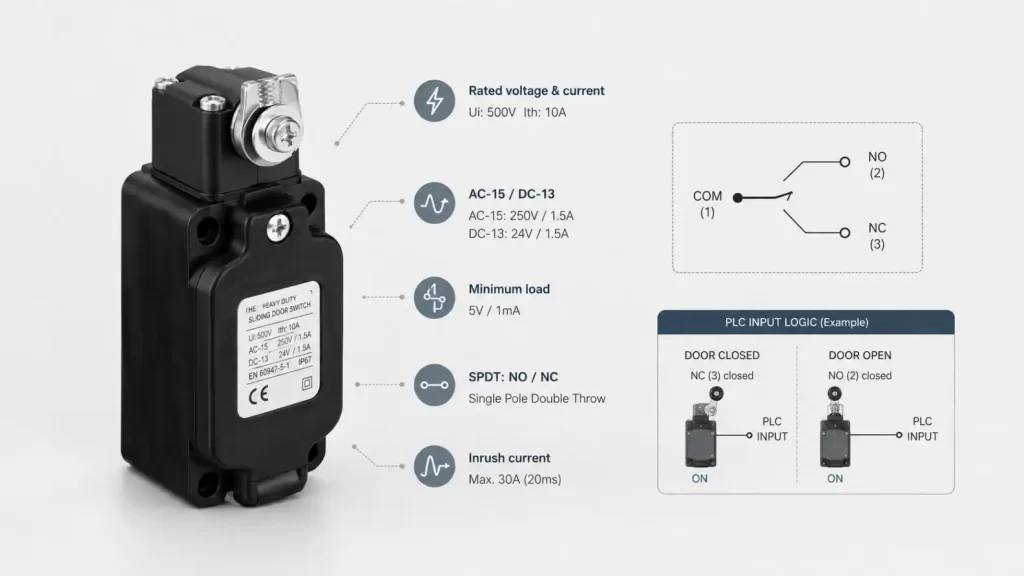
Electrical ratings determine what kind of load the Sliding Door Switch can safely handle. Overlooking these is the #1 cause of contact welding or premature failure.
•Rated voltage & current (AC/DC): Always check both the thermal current (Ith) and the switching current; for DC circuits, the same voltage rating usually requires a lower current due to arc persistence.
•AC-15 / DC-13 ratings: These utilization categories from IEC 60947-5-1 define the switch's ability to control inductive loads (contactors, solenoids); DC-13 is far more demanding than AC-15 at equal voltage.
•Minimum load (dry circuit capability): If your Sliding Door Switch interfaces with a solid-state input or PLC with very low current (<5mA), look for gold-plated contacts to ensure reliable switching even with oxidation.
•Contact configuration (SPST, SPDT, DPDT): Consider position sensing applications using an SPDT (Single Pole Double Throw) switch, which provides a normally open (NO) and a normally closed (NC) output. For safety circuits, choose the NC output, so a wire break would result in a "door open" alarm.
Inrush current: Some loads, such as motors and LEDs, and capacitive loads, may draw inrush currents of 10 to 20 times the rated steady-state normal operating current of the load. Consider the inrush current capability of the switch if these loads are connected.
2. Mechanical Parameters: Lifespan and Physical Interaction
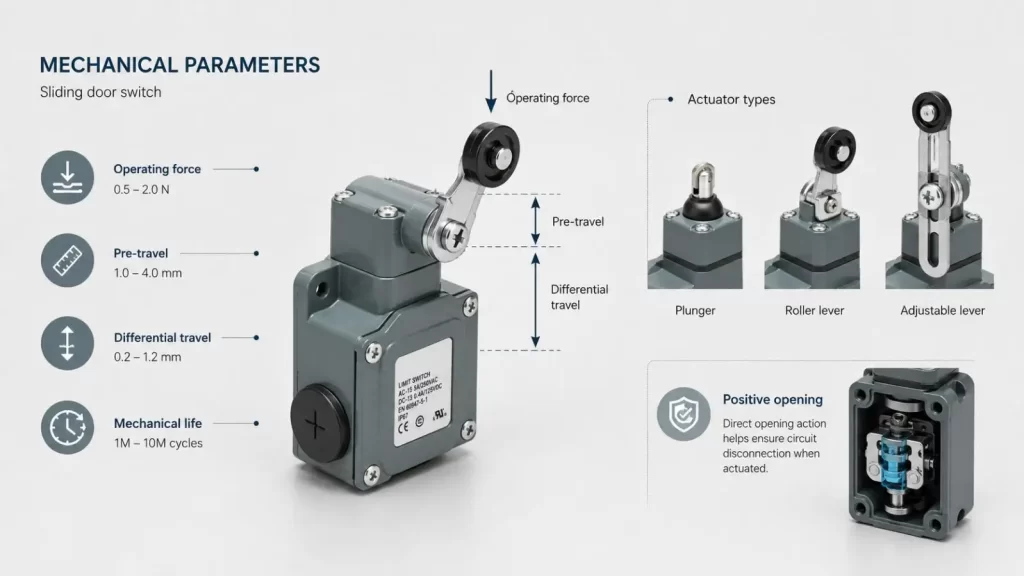
This clause refers to the physical interface of a Sliding Door Switch and the number of mechanical cycles the design will withstand.
•Operating force (OF) and pre-travel (PT) – Light weight plastic doors may require a low OF (of the order of 2N) whereas heavy industrial gates may require an OF of greater than (10N) to avoid false operation.
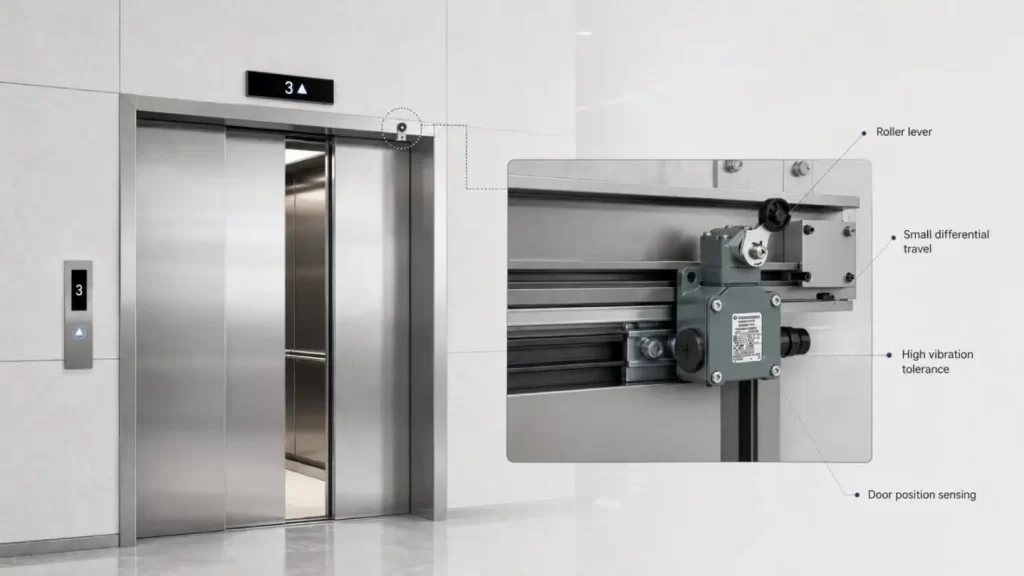
•Differential travel (DT) – Small DT (of the order of 0.5mm) facilitates position sensing, while large DT avoids false operation of a door that moves slowly.
•Mechanical life (operations) – The number of cycles for a Sliding Door Switch is normally between 1 million and 10 million. For a switch incorporated into a door that operates frequently in an automated system, select a switch with a rating of greater than (≥) 5 million operations.
•Actuator type (plunger, roller lever, adjustable lever) – Friction is minimized with the use of a roller plunger for linear motion. An adjustable lever arm facilitates.
•Positive opening (forced guide) mechanism – Safety interlock switches must incorporate this mechanism. Even if contacts weld, the mechanism will forcibly open the NC circuit, ensuring that a hazardous condition is rendered safe with the opening of the door.
3. Environmental Parameters: Surviving Real-World Conditions
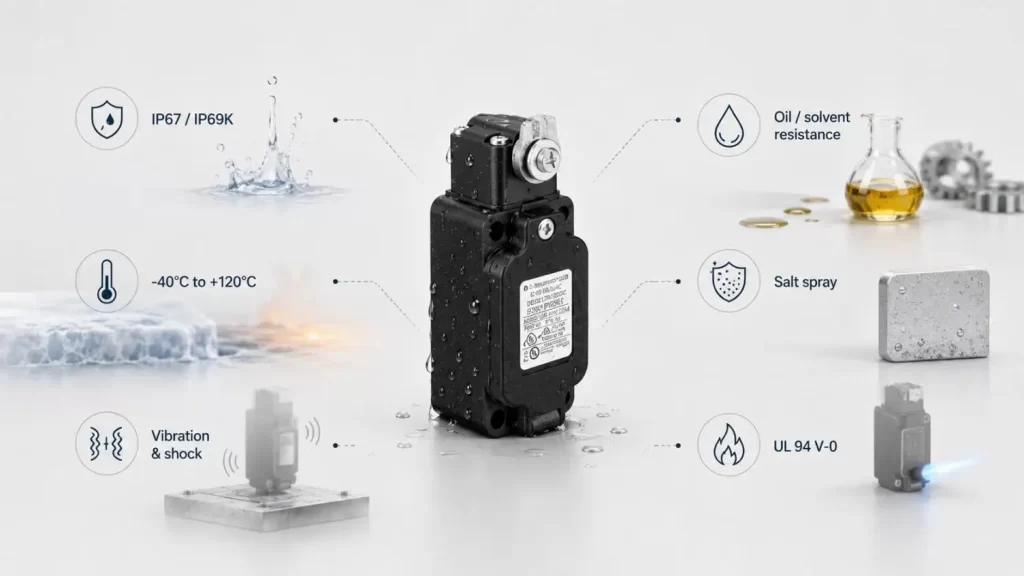
Moisture, dirt, dust, and temperature swings can all render a non-rated switch inoperable. While the electrical specifications for your Sliding Door Switch do matter, the location of your switch matters more.
1) Ingress Protection (IP) Rating
IP67 means the switch is protection rated dust-tight and can withstand immersion in 1 meter of water for 30 minutes; IP69K means the switch can withstand high-temperature and high-pressure wash downs (common in food processing).
2) Operating Temperature Range
Sliding Door Switches typical offer a range of -25°C to +85°C. For outdoor applications or switch used in freezers, look for switches with an operating temperature range of -40°C to +120°C.
3) Vibration and Shock (IEC 60068-2)
Sliding Door Switches used on heavy equipment or the doors of vehicles are subjected to 10–55 Hz vibrations of 1.5 mm amplitude. These switches should be "shock-proof" and have their internals potted.
4) Chemical Resistance (oils and solvents, salt spray)
PBT and Stainless Steel housings for switches are resistant to industrial oils and brake fluids. For marine environments, anodized 6061 Aluminum and 316 Stainless Steel housings are required.
5) UL 94 Flammability
UL 94 V-0 or V-2 rated housings are required for safe use in control panels and Sliding Door Switches used in public transportation.
How to Match Parameters to Your Application
| Application | Recommended Sliding Door Switch Features |
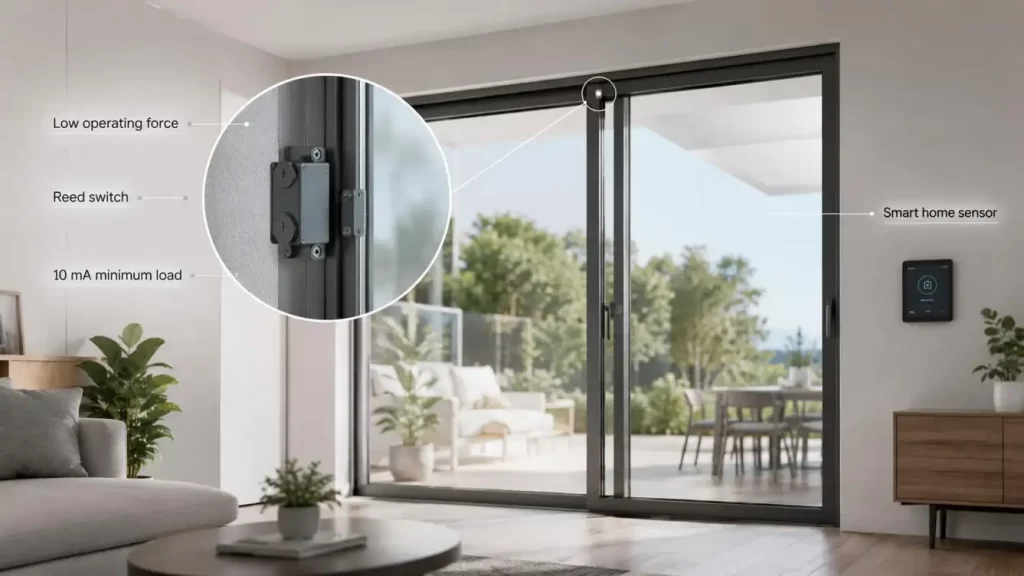
| Home smart sliding window | Low operating force, magnetically operated reed switch, 10mA minimum load, IP40 |
| Industrial safety guard door | Positive opening NC contact, IP67 or IP69K, SPDT, 5A / 250VAC, -25 to +85°C |
| Automotive power sliding door | Hall-effect non-contact, wide temp range (-40 to +105°C), sealed against moisture |
| Food & beverage washdown | IP69K, stainless steel roller plunger, chemically resistant seals, 10 million cycles |
| Elevator landing door | Roller lever type, very small differential travel, CE/EN81-20 compliant, high vibration tolerance |
Step-by-Step Selection Checklist for Engineers
- Define the load type: Inductive (coils), resistive (heaters), or capacitive (LED drivers) – this dictates the required AC/DC rating.
- Calculate the switching frequency: Over 10 cycles per minute? Select a Sliding Door Switch with gold-plated crossbar contacts for micro-arcing immunity.
- Check wiring distance: Long runs greater than 50m can result in a voltage drop. You can use a switch with a pre- amplifier or a relay interface.
- Also confirm mounting flexibility: Does the switch mount to the moving or fixed part? Adjustable actuator heads and 360° cable exit are flexible design features that simplify mounting.
- Review your safety standards: If the switch is to be used as a guard door interlock, a switch meeting ISO 14119 with a tamper-resistant design (i.e. separate actuator and switch housing) is required.
About HANXIA - Your Sliding Door Switch Manufacturing Partner
When you need a Sliding Door Switch, HANXIA is your partner for cost, performance, and guaranteed traditional support. In 2026, HANXIA have worked with over 3,600 companies, including many listed companies in automation, home appliances, and the automotive industry. Focusing on the precision sensing market, HANXIA possesses 12 years of experience.
HANXIA holds the CE, REACH, ROHS 2.0 certifications, and a utility model patent. With a production capacity of 2 million units a day and a 2 to 6 day lead time, HANXIA has you covered. Standard switches offer a 90-day no-reason return policy. Additionally, our engineers will provide assistance on-site. With our complete range from the IP67 Limit and Mini Magnetic Reed Switches, custom actuators, etc., HANXIA guarantees that our sliding doors will be operational for years to come.
FAQs
Q1: What is the expected life of a sliding door switch?
A: The range is typically from 1 to 10 million operations, but usually depends most on the model and type of actuator.
Q2. What is meant by AC-15 and DC-13 ratings?
A: AC-15 would represent an AC inductive load contactor circuit, while for DC would be solenoid circuits which are harder to switch, therefore would be DC-13.
Q3: Which is better, a magnetic Sliding Door Switch or a mechanical one?
A: Mechanical is more appropriate for high-force industrial applications, while for sensing that is low-force or non-contact, magnetic switches (reed/Hall) would be more appropriate.
Q4: How can I ensure the compatibility of my Sliding Door Switch with a PLC?
A: Look for the minimum load; for a dry PLC, the switch should have a gold-plated contact (very low current).
Q5: What is the defined operating temperature for a Sliding Door Switch?
A: The standard is from -25°C to +85°C; when the application is outside or in a freezer, the switch should be the -40°C to +120°C model.
