





USB Head Connector: The Five Families of USB Interfaces – A Complete Visual Guide
The USB connector landscape can feel overwhelming. One device has a rectangular port, another a tiny trapezoid, and your latest gadget uses a small oval that works no matter which way you flip it. Are they all just "USB"? And which USB Head Connector should you look for when buying cables or designing electronics?
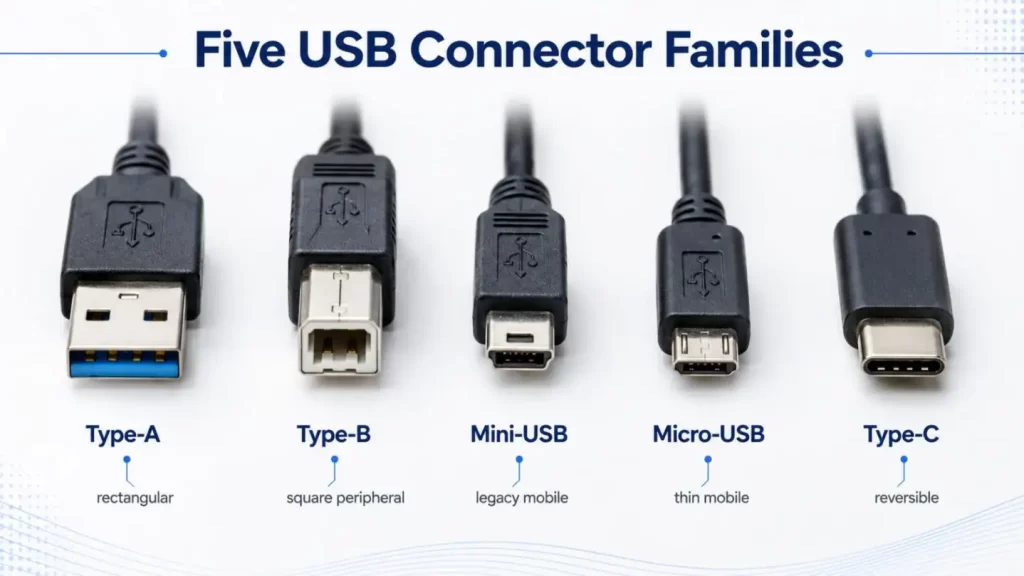
This guide breaks down the five major USB connector families—Type-A, Type-B, Type-C, Mini-USB, and Micro-USB. In the end, you'll immediately identify each type and understand both their pros and cons, and discern which USB Head Connector suits your requirements.
1. USB Type-A: The Classic Rectangle
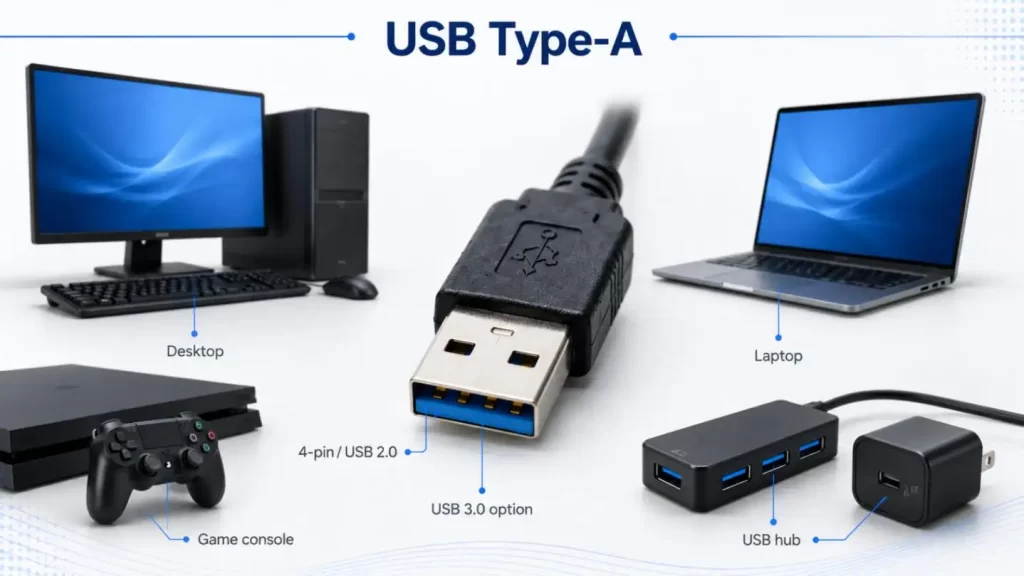
The most recognizable USB Head Connector in the world. Flat, rectangular, and impossible to insert upside down (though we all try).
• Typical applications: Desktop computers, laptops, game consoles, power adapters, USB hubs, and nearly every peripheral from the 2000s and 2010s.
• Key traits: 4-pin design for USB 2.0 (480 Mbps), with additional pins for USB 3.0 (5–10 Gbps, often blue inside).
• Version differences: USB 3.0 Type-A adds five extra pins behind the standard four, keeping backward compatibility but requiring a deeper port.
• Durability: Rated for ~1,500 insertion cycles; robust enough for daily home and office use.
• Power delivery: Maximum 2.5W for USB 2.0 (5V/0.5A), up to 4.5W for USB 3.0 (5V/0.9A) – slow by today's standards.
2. USB Type-B: The Square That Means "Peripheral"
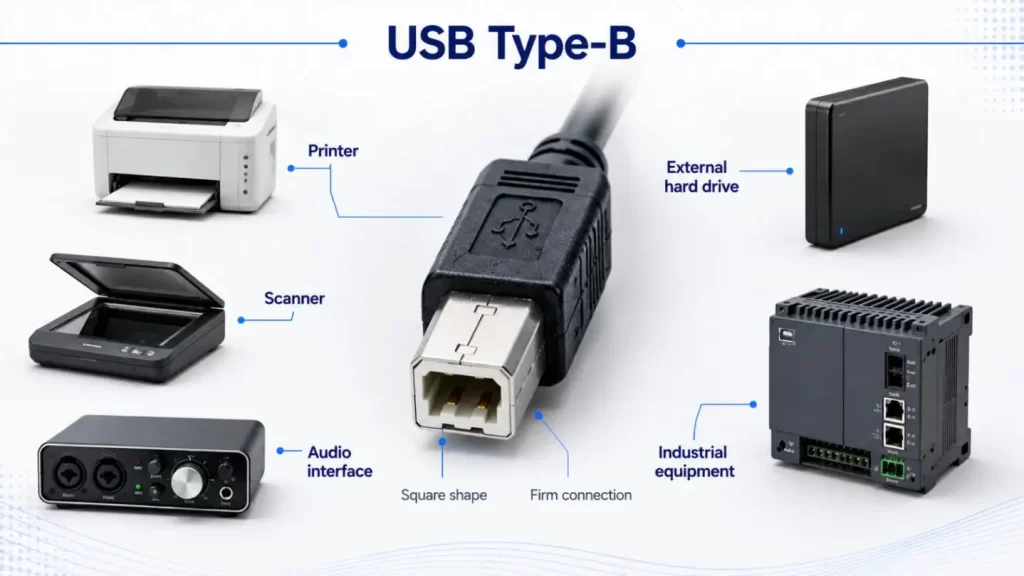
A near-square USB Head Connector with beveled corners. It was designed to make "upstream" (host) and "downstream" (device) ports physically different – so you never plug a printer into a computer's printer port.
• Typical applications: Printers, scanners, external hard drives (older models), audio interfaces, and some industrial equipment.
• Key traits: 4 pins (USB 2.0) or 9 pins (USB 3.0, a taller connector often called "Standard-B SuperSpeed").
• USB 3.0 Type-B: Adds a stacked section on top with extra pins for 5 Gbps transfer; not backward compatible with USB 2.0 Type-B ports.
• Why it's rare today: Most modern peripherals switched to Type-C or Micro-USB, but the rugged square shape is still favored in pro audio and medical devices.
• Insertion feel: Snaps in with a clear click and won't wiggle loose – great for stationary equipment.
3. USB Mini-USB: The Small Pioneer of Mobile Connectors
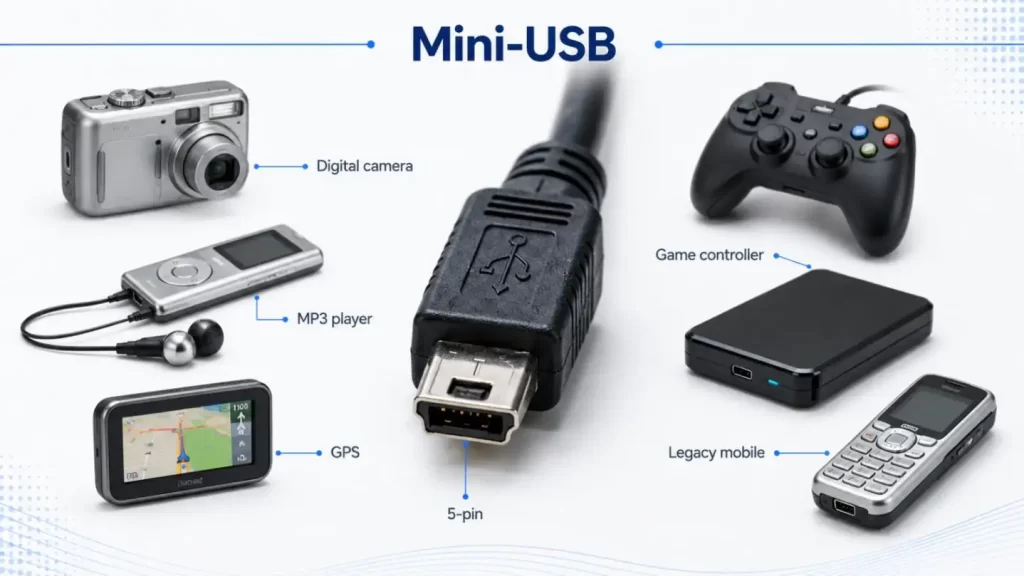
Before smartphones became ultra-thin, this small USB Head Connector was everywhere. Mini-USB (officially "Mini-B") has a rounded trapezoid shape with pinched sides.
• Typical applications: Older digital cameras, MP3 players (like early iPods), GPS devices, game controllers (PS3), and some external hard drives.
• Key traits: 5-pin design (USB 2.0, 480 Mbps), slightly taller than Micro-USB but more robust for frequent plugging.
• Durability: Rated for 5,000+ insertion cycles – better than Type-A, which is why it was used for devices like point-of-sale terminals.
• Power delivery: Up to 1.8A (9W) in early fast-charging implementations, but no official USB-BC 1.2 support.
• Why it's obsolete: Too bulky for modern slim phones; replaced by Micro-USB and then Type-C.
4. USB Micro-USB: The Ultra-Thin Champion of the 2010s
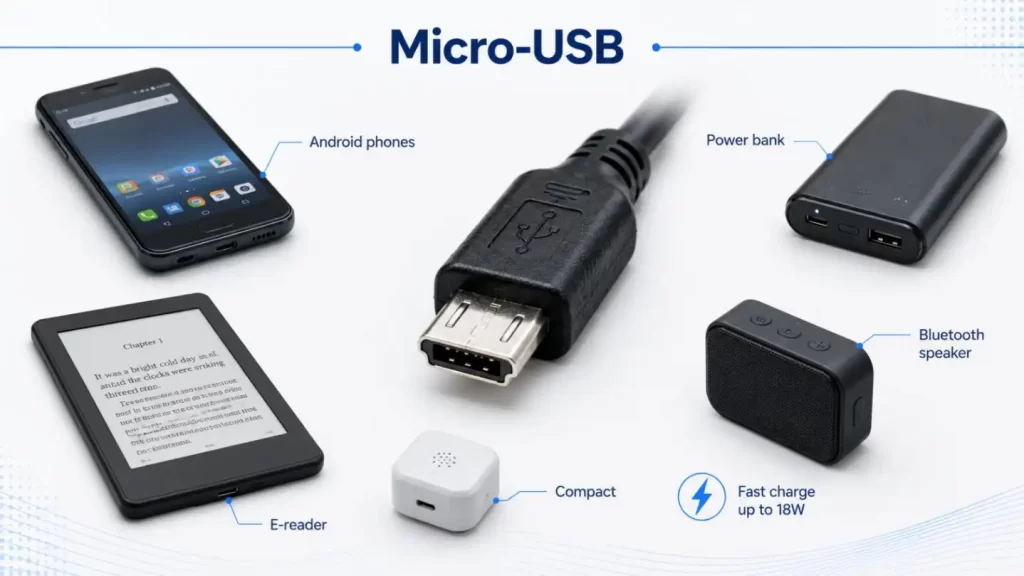
When smartphones went paper-thin, Micro-USB became the dominant USB Head Connector for mobile devices. It looks like a smaller, flatter version of Mini-USB.
• Typical applications: Android phones (pre-2016), power banks, Bluetooth speakers, e-readers (Kindle), and many IoT devices.
• Key traits: 5-pin USB 2.0 design, but with a different latching mechanism that makes it even smaller than Mini-USB.
• Durability problems: Rated for ~10,000 cycles, but the tiny latch wears out quickly – loose Micro-USB ports are a common complaint.
• Power delivery: Micro-USB can support USB-BC 1.2 (up to 1.5A/7.5W) and vendor-specific fast charging (Qualcomm Quick Charge 2.0/3.0 up to 18W).
• USB 3.0 variant: "Micro-B SuperSpeed" is a wider, two-prong connector (10 pins) for external SSDs – rare and bulky.
5. USB Type-C: The One Connector to Rule Them All
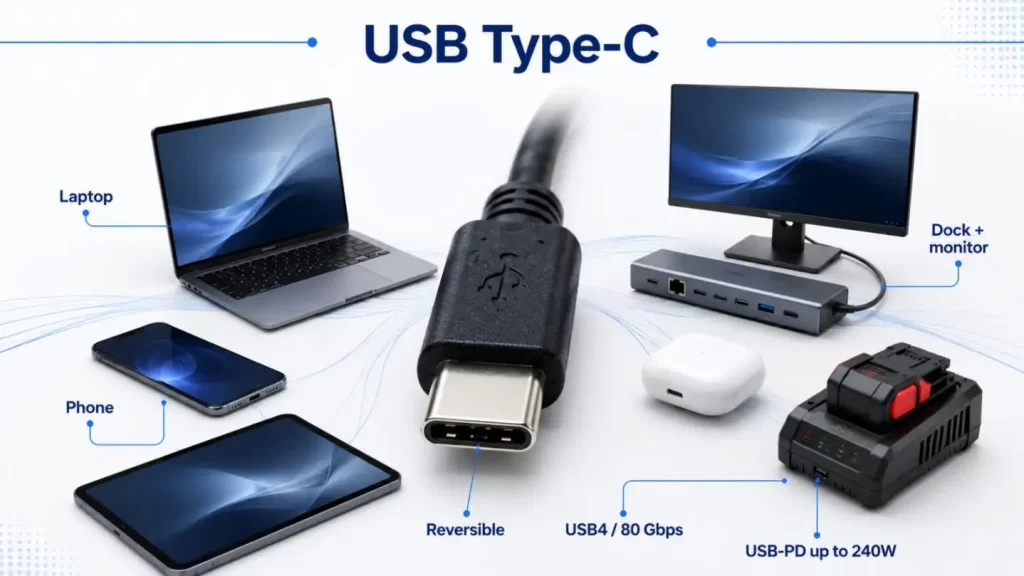
The youngest and most versatile USB Head Connector. Oval, symmetrical, and designed to end plug-orientation frustration forever.
• Typical applications: Modern laptops (MacBooks, Windows ultrabooks), smartphones (Android, iPhone 15+), tablets, docking stations, monitors, earbuds, and even power tools.
• Key traits: 24 pins (12 per side), supporting USB 2.0, USB 3.x (5–20 Gbps), USB4 (40 Gbps), Thunderbolt 3/4, DisplayPort, and PCIe over a single cable.
• Reversible design: No "wrong way" – plug it in any orientation; the connector auto-negotiates the signal path.
• Power delivery (USB-PD): From 0.5W to 240W (48V/5A) – enough to charge a gaming laptop or run a desktop monitor.
• Durability: Rated for 10,000+ insertion cycles, with reinforced versions reaching 20,000 cycles for industrial use.
• Smart features: Supports alternate modes (video output), audio adapter accessory mode (USB-C to 3.5mm), and debug access.
• Future-proof: USB4 v2.0 pushes speeds to 80 Gbps and still uses the Type-C USB Head Connector – it's the universal port for the next decade.
Quick Reference: Which USB Head Connector Should You Choose?
| Family | Best For | Data Speed | Power (Max) | Durability |
| Type-A | Host devices (computers, chargers) | 480 Mbps – 10 Gbps | 4.5W | 1,500 cycles |
| Type-B | Peripherals (printers, pro audio) | 480 Mbps – 5 Gbps | 4.5W | 2,000+ cycles |
| Mini-USB | Legacy handheld devices | 480 Mbps | 9W | 5,000 cycles |
| Micro-USB | Old phones, small gadgets | 480 Mbps | 18W (QC) | 10,000 cycles (weak latch) |
| Type-C | Everything modern (laptops, phones, docks) | 480 Mbps – 80 Gbps (USB4 v2) | Up to 240W | 10,000–20,000 cycles |
Why Choose HANXIA? Reliable USB Head Connector Solutions for Any Application
Whether you're sourcing USB Head Connector components for a consumer gadget or an industrial control system, the quality of the physical interface determines long-term reliability. HANXIA brings over a decade of precision manufacturing to every connector we produce.
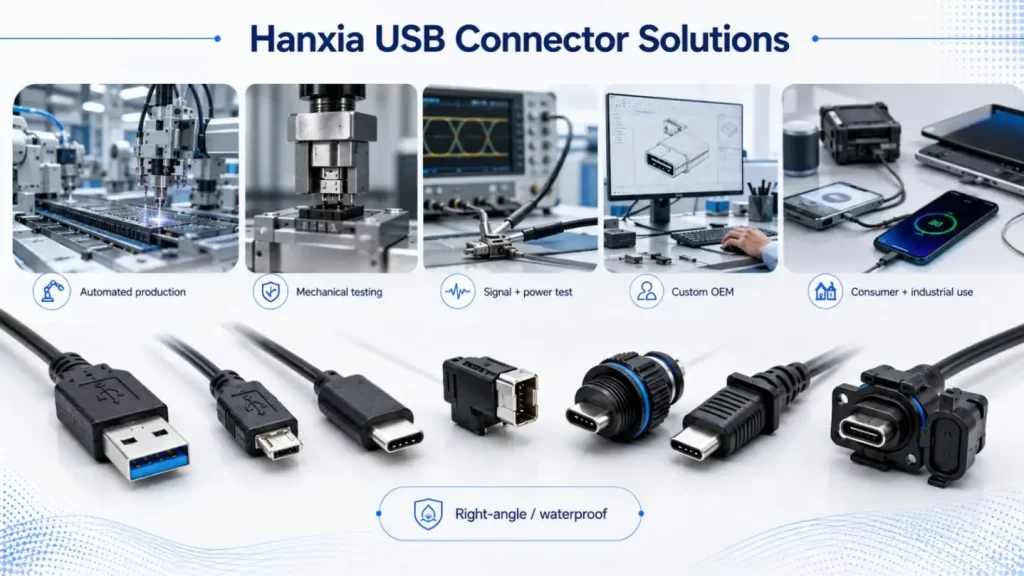
• Leading the Industry: 10+ years manufacturing precision USB connectors from Type-A to USB-C Connectors.
• Cutting Edge Manufacturing: Automated production of our USB Head Connectors results in precise uniformity and completely flawless connectors.
• Thorough Assessment of Quality: We test every connector for reliability. We also check the connectors' mechanical integrity as well as the integrity of the power and signal. This is part of our commitment to providing highly durable connectors and offering products that are free from lapses in performance.
• Flexible Design: We deal in USB 2.0, USB 3.x, USB4, USB-PD, and also accommodate requests for design with consideration for user-defined voltage, current, and data specifications.
• Custom and OEM Services: We design not only for connectors of various sizes and configurations, but also for different performance specifications including right angle, waterproof (IP67), and latching reinforced connectors.
• Fast & Safe International Shipping: Our shipping is safe and fully compliant for large and custom connector orders placed anywhere in the world.
HANXIA gives you the manufacturing capability and engineering support needed to upgrade from obsolete Micro-USB ports to ready to use Type-C USB Head Connectors. Reach out to our team to discuss your connector needs or for a sample.
FAQs
Q1: Which USB Head Connectors are the most prevalent today?
USB Type-C is used in all modern tablets, smartphones, docks, and laptops.
Q2 What do the blue, colored USB 3.0 Type A ports signify?
If a Type A port is colored blue, 5-10 Gbps can be transferred. Black and white colored USB ports are of the 2.0 variety and are slower.
Q3: Which USB Head Connectors support the fastest charging?
USB Type-C connectors with USB PD support fast charging up to 240W.
Q4: Are Mini-USB and Micro-USB the same?
No. Micro-USB is smaller, flatter, and has a different latch design; Mini-USB is older, thicker, and more rugged.
Q5: How many times can a USB Head Connector be plugged in before failing?
It varies by type: Type-A ~1,500 cycles, Micro-USB ~10,000 cycles, Type-C ~10,000–20,000 cycles.
