





8 Key Application Scenarios & Selection Cases for 4 Pin Tact Switch: A Practical Guide
The tiny 4 Pin Tact Switch is everywhere: from your TV remote to industrial control panels. Unlike standard 2-pin versions, the four-pin design provides superior mechanical stability, prevents rotation during soldering, and ensures reliable long-term performance. This guide will help you understand these eight potential real-life applications of the 4 Pin Tact Switch and help you understand how to select the right 4 Pin Tact Switch for each situation.
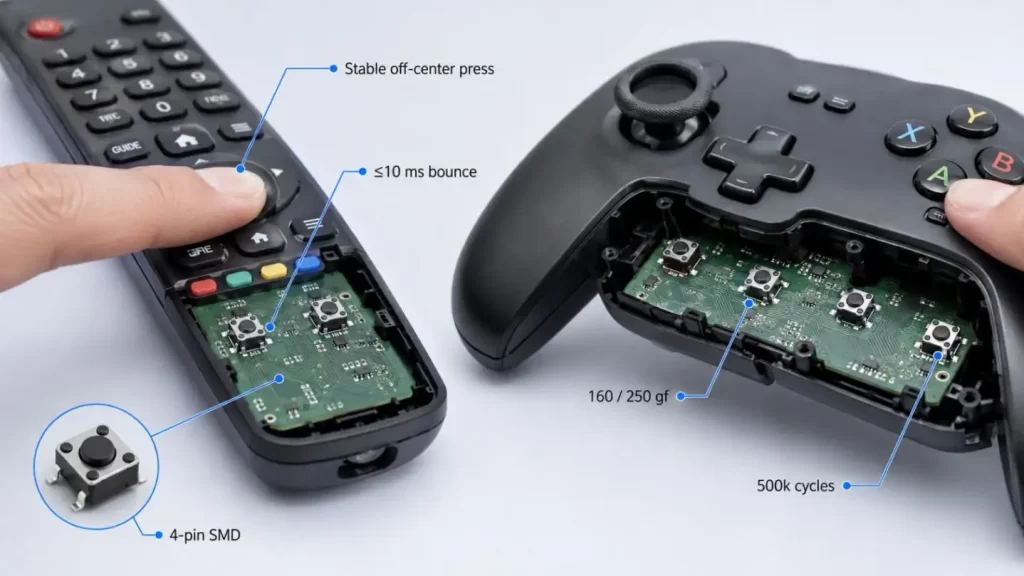
1. Consumer Electronics: remote controls and game controllers
Handheld devices are defined partly by their buttons. Using the right 4 Pin Tact Switch will help you design portable devices that are easy to operate and maintain.
• Low bounce time (<10 ms): gaming requires that the switches only trigger once.
• Operating force options (160 gf / 250 gf): the lower the force the button requires to be pressed, the less fatigued the user will be.
• 4 Pin SMD: prevents lifting at the corners of the switch; this is common in remote controls because users often press off-center.
• Long lifespan (up to 500,000 cycles): long-lasting switches are ideal for devices that will be used daily, like set top boxes.
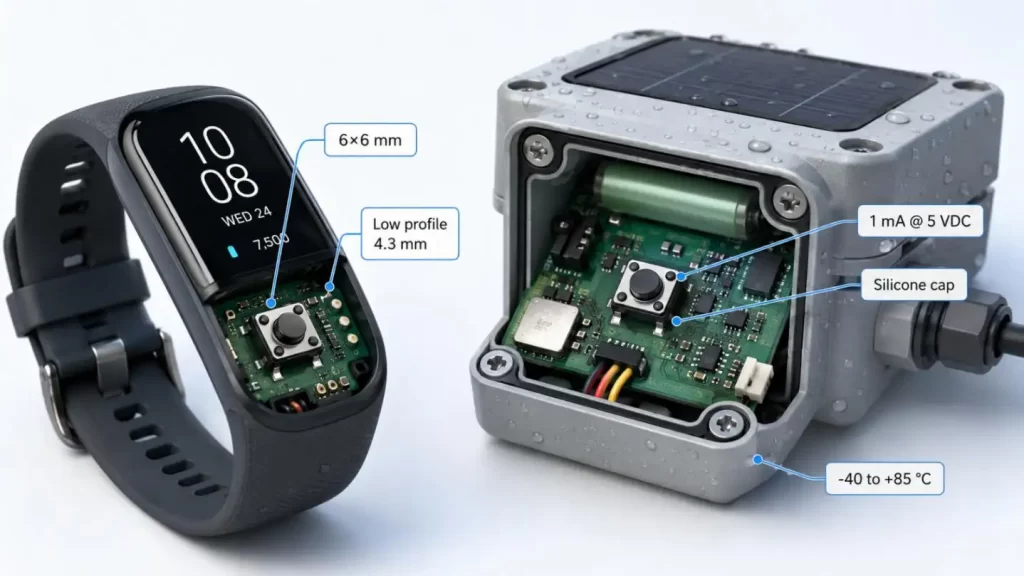
2. Wearables & IoT Nodes
Wearables demand ultra-compact components that survive sweat, movement, and tight enclosures. A 4 Pin Tact Switch in a 6×6 mm package fits perfectly.
• Low-profile height (≥4.3 mm): enables slim watch-like designs without compromising tactile response.
• Low-level capability down to 1 mA @ 5 VDC: works directly with coin-cell powered MCUs, preserving battery life.
• Optional silicone rubber button cap: adds brand color and improves customization along with dust and splash resistance.
• Operating temperature range (−40 to +85 °C): suitable for outdoor wearables and industrial IoT gateways.
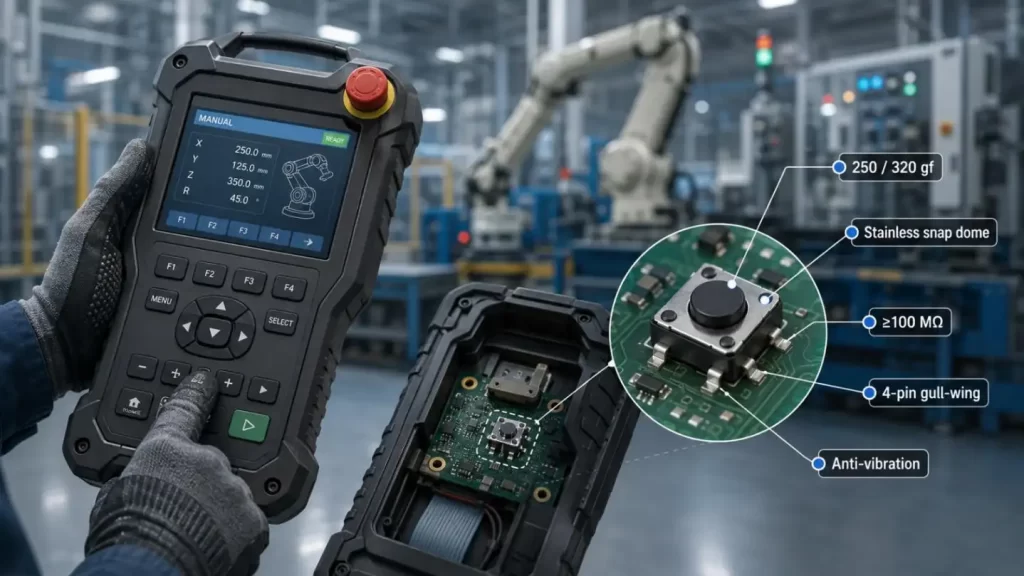
3. Industrial HMI & Handheld Programmers
Devices on the factory floor must have ruggedness and give no room for error for the user. A 4 Pin Tact Switch with more actuation force also reduces accidental presses.
• 250 gf or 320 gf operating force: Allows the operator to wear thick gloves with minimal risk of false triggering.
• Stainless steel snap dome: Delivers a distinct "click" that action is confirmed and is perfect for a noisy environment.
• ≥100 MΩ insulation resistance: Prevents leakage current in a factory setting with humidity and dust.
• Gull-wing leads + 4-pin design: Greater resistance to vibration and thermal cycling than 2-pin designs.
4. Medical Devices (Infusion Pumps & Patient Monitors)
The highest level of safety and hygiene. Medical equipment uses 4 Pin Tact Switch protected or sealed designs.
• High dielectric strength (250 VAC for 1 minute): Patient isolation is provided while ensuring medical safety is satisfied.
• Gold-plated contacts (optional): Guarantees low contact resistance at drive levels of 1mA (<100mΩ).
• Silicone rubber cap: Provides a smooth, easy-to-clean surface which is chemically resistant to liquid disinfectants while maintaining sanitary conditions.
• Long mechanical life (≥200k cycles at 250 gf): Reliable for high-usage hospital equipment.

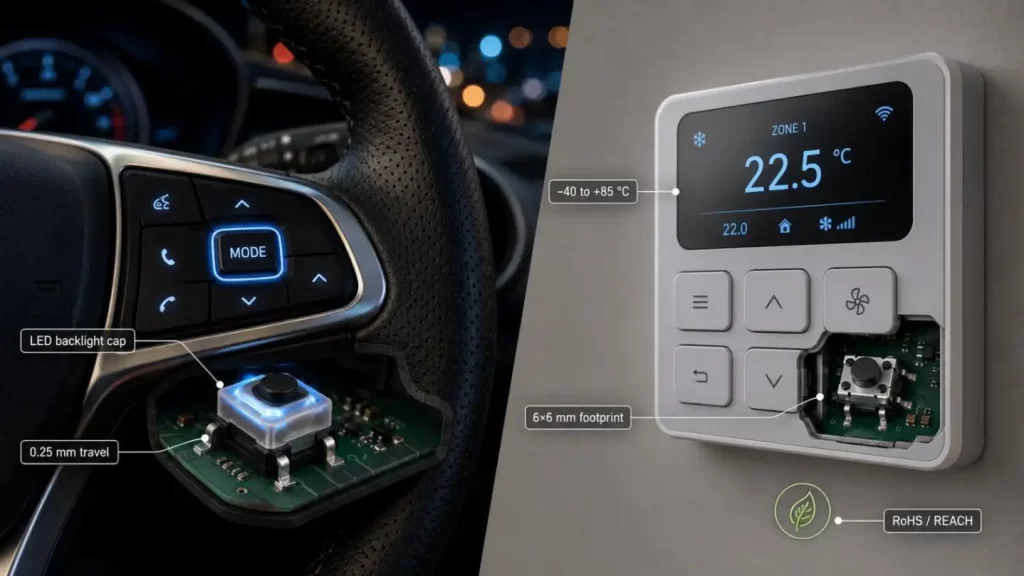
5. Automotive Aftermarket: Steering Wheel & Dash Controls
In-car switches face extreme temperatures and vibration. A 4 Pin Tact Switch with robust soldering and wide temperature range is essential.
• Operating temperature −40°C to +85°C: Withstands cabin heat and cold-soak conditions.
• 4-pin SMD mounting: Resists pad lift-off due to thermal expansion and mechanical shock.
• Actuation travel 0.25 ±0.1 mm: Short, crisp motion suits blind operation while driving.
• Optional translucent cap: Allows LED backlighting for night visibility without light bleed.
6. Smart Home Devices: Keypads & Zone Controllers
Modern smart panels need silent, low-profile switches with consistent feel. A 4 Pin Tact Switch meets aesthetics and reliability.
• Compact 6×6 mm footprint: Fits dense PCB layouts for wall-mounted touch panels and thermostats.
• Maximum bounce time ≤10 ms: Eliminates software glitches when scanning matrix keypads (debouncing still recommended).
• RoHS & REACH compliant: Satisfies global environmental regulations for consumer products.
• Reel packaging (1,000-4,000 pcs): Designed to integrate with high-speed pick-and-place, optimizes production value by reducing cost per unit.
7. Test & Measurement Instruments
Precision instruments cannot tolerate any electrical noise from switches. The 4 Pin Tact Switch with stable contact resistance is a good option.
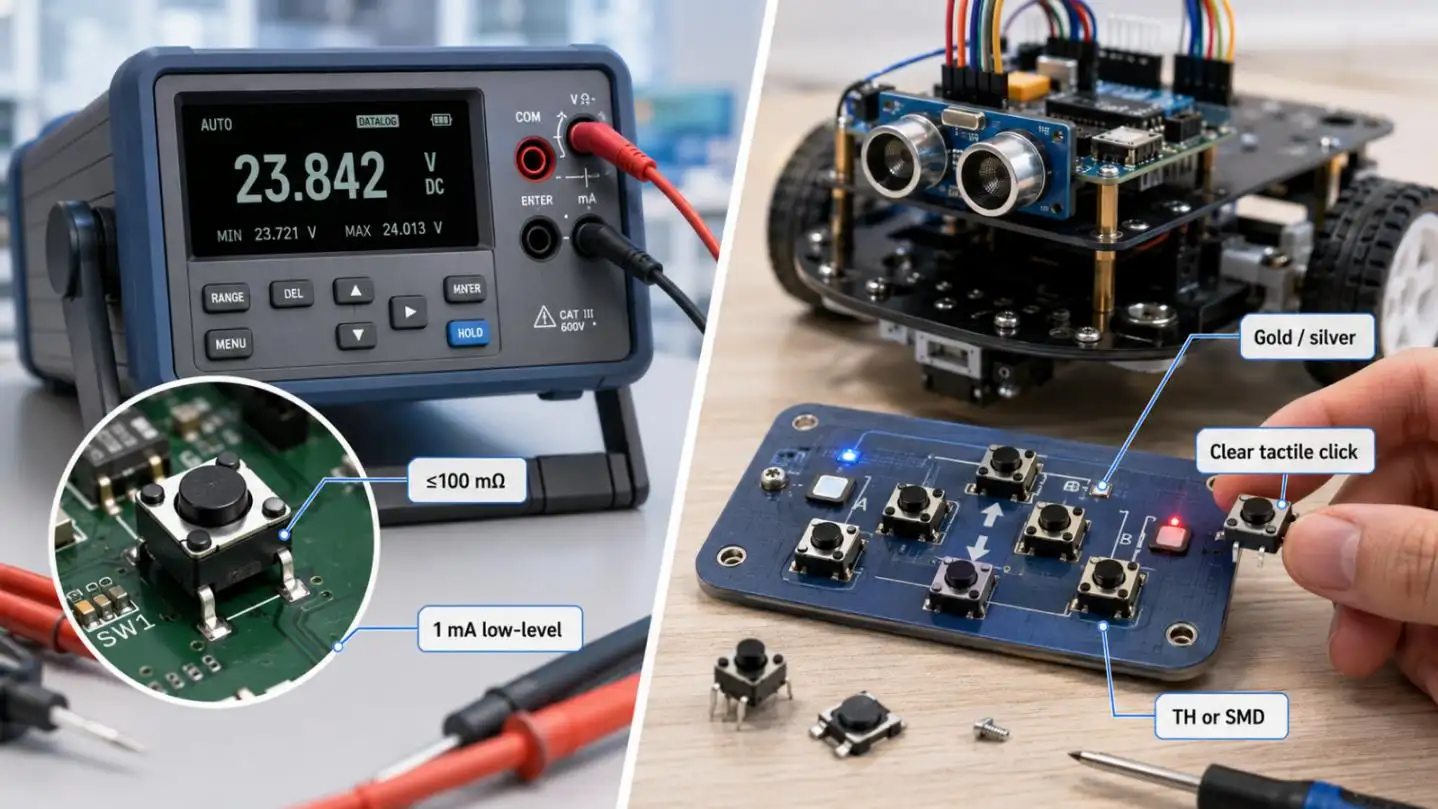
• Contact resistance ≤100 mΩ (initial): Enables reliable measurements for multimeter and calibration.
• Insulation resistance ≥100 MΩ @ 100 VDC: Eliminates crosstalk among the adjacent channels of a data logger.
• Requires a minimal current of 1 mA: Provides compatibility with low-voltage and sensitive analog circuits.
• Silver or gold plating options: Gold is preferred for ultra-low-level switching (<10 mA).
8. Robotics & Educational Kits
Hobbyist and educational robots need affordable, easy-to-solder switches. A 4 Pin Tact Switch with optional rubber cap is perfect for DIY keypads.
• 4-pin through-hole or SMD: Two redundant pins provide extra mounting strength for children's repeated pressing.
• 160 gf light touch: Comfortable for young users and rapid prototyping.
• Clear tactile "click": Gives immediate feedback when programming robot commands.
• Available with pickup cap: Simplifies manual assembly for small-batch makerspaces.
How to Select the Right 4 Pin Tact Switch: A Quick Checklist
Choosing a 4 Pin Tact Switch isn't just about pin count. Use these criteria:
• Force (gf): 160 gf for soft press (remotes), 250 gf for general use, 320 gf for gloved operation.
• Life cycles: 500k for low-stress apps; 100k-200k for heavy industrial.
• Sealing: Bare switch for clean indoor use; silicone cap for dust/splash resistance.
• Contact plating: Silver for cost-sensitive; gold for ultra-low-level or medical.
• Height: 4.3 mm / 5.0 mm / 7.0 mm to match enclosure design.
HANXIA's Design & Technical Advantages: HX TS6631A4P
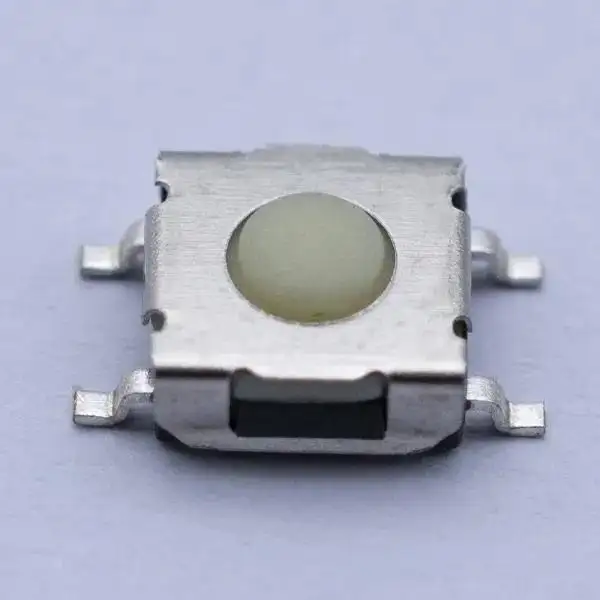
For engineers seeking a proven, high-reliability 4 Pin Tact Switch, HANXIA offers the HX TS6631A4P – a 6×6 mm SMD tactile push button with integrated silicone rubber cap.
Key technical advantages:
• Robust 4-pin SMD gull-wing terminals: eliminate tombstoning and provide superior anti-lift performance during wave or reflow soldering.
• Multiple force options (160/250/320 gf): Covers everything from wearables to industrial HMIs. Lifetime up to 500k cycles.
• Low bounce time ≤10 ms & contact resistance ≤100 mΩ: ensures clean digital signals without external debounce circuits.
• Wide temperature range −40°C to +85°C: field-proven for automotive, outdoor, and medical devices.
• Optional silicone rubber button cap: improves ergonomics, dust resistance, and allows translucent versions for LED backlighting.
• Compliant & ready: RoHS, REACH, halogen-free variants; available in tape & reel for automated assembly.
• Direct stock availability: samples shipped in 3-7 days; full production in 2-4 weeks.
Whether you design a medical pump, a smart thermostat, or an industrial keypad, HANXIA's HX TS6631A4P delivers the tactile, electrical, and mechanical consistency your product deserves.
CTA
Need a detailed datasheet, land pattern, or 3D model? Contact HANXIA for free quotes and engineering support.
FAQ
Q1: Are 4 Pin Tact Switches suitable for low power IoT devices?
Yes! Due to their low-level rating of 1mA at 5VDC, these switches are a great alternative compared with other switches for battery powered IoT nodes and wearables.
Q2. What is the life cycle for the HX TS6631A4P?
It varies with the operating force. For 160 gf, life cycle is up to 500,000. For 250 gf, 200,000–300,000, and for 320 gf, 100,000–200,000.
Q3. Is the silicone rubber button cap waterproof?
It does help with splash and dust protection. A sealed/washable version (available upon request) is necessary for full IP67.
Q4. Can I reflow solder the HX TS6631A4P?
Yes, it can be reflow soldered twice within the limits of Pb-free solder, 245–260°C for ≤10 seconds.
Q5. Which operating force do you recommend for an application with a gloved hand?
With thick gloves in industrial and outdoors environments, 250 gf or 320 gf is best to avoid an unintentional press.
