





The Complete Guide to 12V Push Button Switch: Types, Pin Configurations & Working Principle
The 12V Push Button Switch is perhaps one of the most common discrete components used in low-voltage electronic circuits. They are found in car dashboards, industrial control panels, and DIY Arduino projects, among many others. Their widespread use can be attributed to their utility in controlling the flow of an electric current. Knowing the different types, the internal wiring of a push button switch, and the principle of operation, can help you to select the right type of switch and avoid common failures in your circuit.
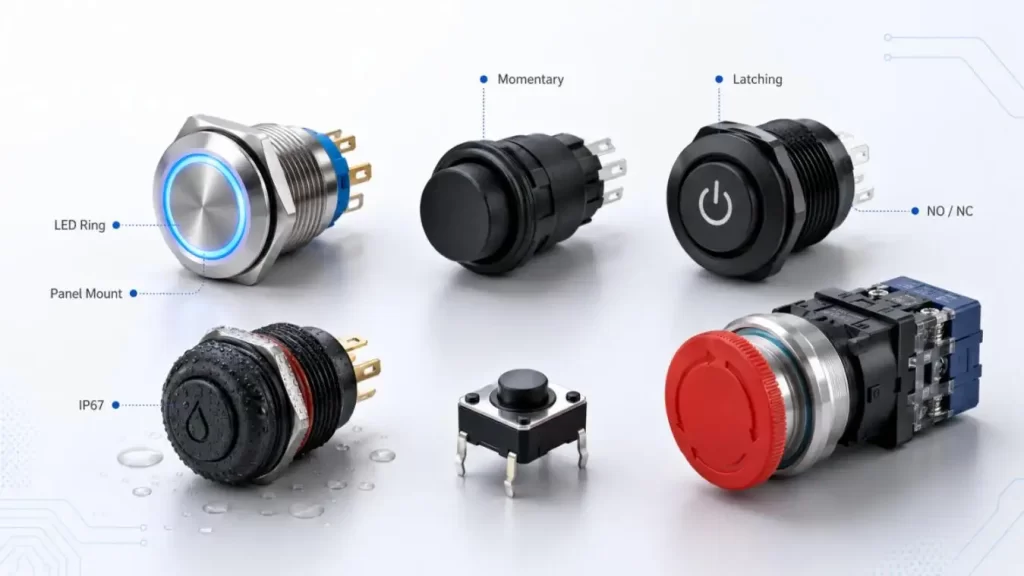
What is a 12V Push Button Switch?
A 12V Push Button Switch is a switch that can be used to connect and disconnect 12-volt DC circuits by means of a momentary mechanical action. Such a switch typically will return to the state it was in when the button is not pressed based on the internal mechanism.
They have three main characteristics:
• Basic characteristics: The switch can touch and allow current to pass completing the circuit or it can remain apart and completely separate the circuit.
• Voltage rating: The switches function correctly at 12V DC. Higher voltages may damage the insulation or cause an internal short circuit.
• Current rating: Due to the varying size and material of the contacts, this switch may carry anywhere between 0.5A and 10A.
A 12V Push Button Switch will have a voltage rating of 12V DC and a current rating of between 0.5A to 10A. The current rating will be based on contact size and material.
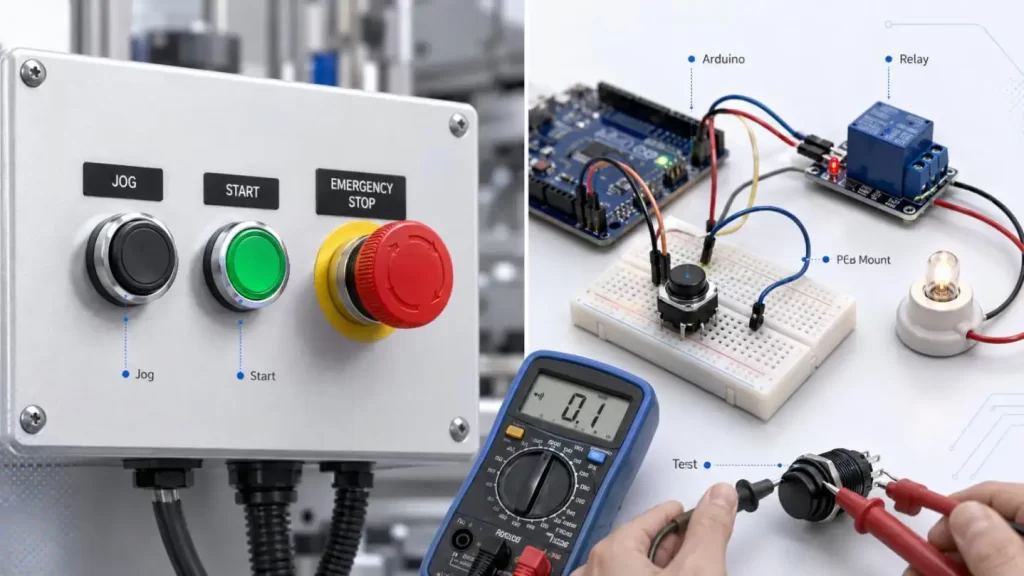
The Main Types of 12V Push Button Switches
Different types and sizes of push button switches will be required to perform different tasks. Below are some of the push button switches based on the action, contact form, and additional features.
1. Momentary vs. Latching (Self-Locking)
• Momentary (push-to-make): The circuit is closed only while you press the button; it springs back to off when released.
• Latching (push-on/push-off): The first press locks the button down and keeps the circuit closed; the second press releases it and opens the circuit.
2. Normally Open (NO) vs. Normally Closed (NC)
• Normally Open (NO): Rest position = open; pressing the switch closes the circuit. NO circuits are used for start buttons / horns.
• Normally Closed (NC): Rest position = closed; pressing the switch opens the circuit. Emergency stops / kill switches utilize NC circuits.
3. Illuminated vs. Non-illuminated
• Illuminated (LED): Circuit active = switch = illuminated (LED built in).
• Non-illuminated: No built-in indicator = panel labeling or external pilot lights.
4. Waterproof / Dustproof (IP Rated)
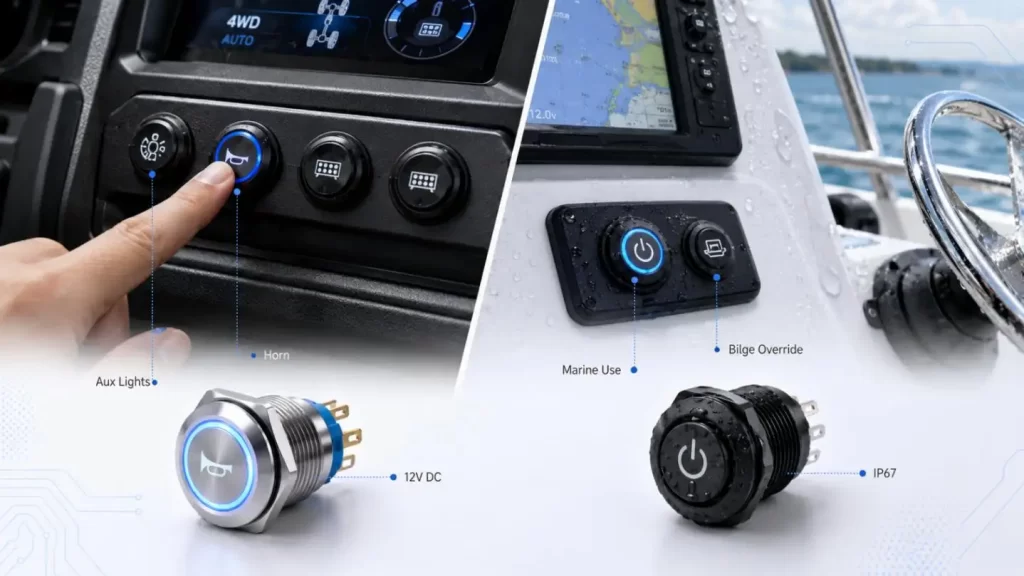
• IP65 / IP67: O-rings or sealed with epoxy resin make switches waterproof to water jets or temporarily submerged. Excellent for marine, outdoor, or automotive use.
Pin Configurations of a 12V Push Button Switch
Pin configurations of a 12V Push Button Switch = switch type. It is best to look at the switch datasheet, but commonly there are 2, 3, or 4 pins.
2-Pin (Simple NO Momentary)
•Pin 1: Connects to the positive (+) side of the 12V load.
• Pin 2: Connects to the negative (–) side or the load's other terminal.
• How to wire: One pin to battery positive, the other to the device (e.g., LED strip), then device negative back to battery negative.
3-Pin Configuration (Common for illuminated switches)
•Pin 1 (C – Common): The moving contact inside the switch.
•Pin 2 (NO – Normally Open): Open when unpressed, connects to common when pressed.
•Pin 3 (LED+ or GND): Separate terminal for the built-in LED's anode (or cathode) – often connected to 12V to light the button.
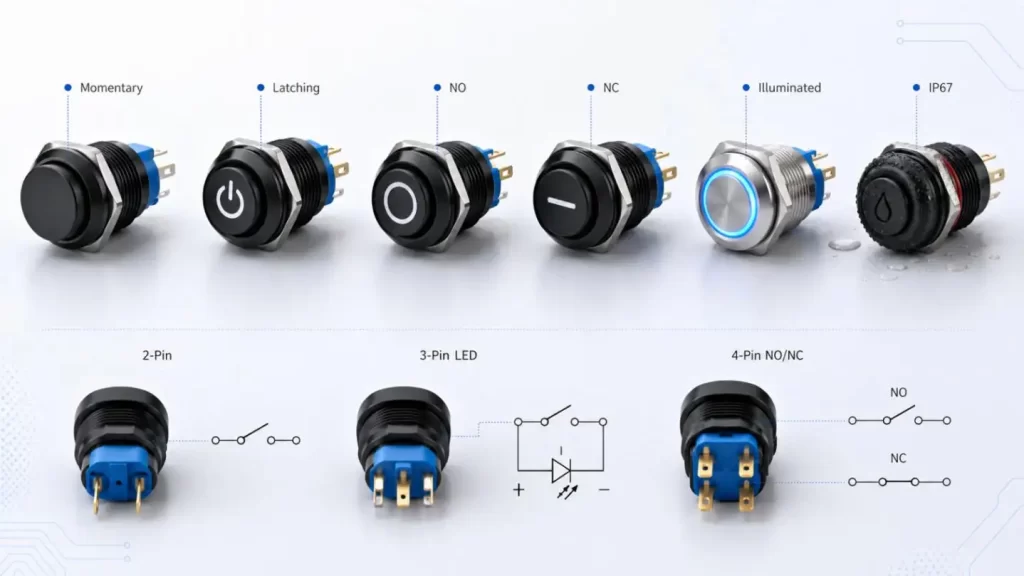
4-Pin Configuration (NO+NC with or without LED)
•Two pins for NO/NC function: One pair for NO (common + NO), another pair for NC (common + NC).
•Optional LED pins: Two extra pins (anode and cathode) for independent LED control.
•Typical use: Replacing both a start and a stop function in one button.
Working Principle – How Does a 12V Push Button Switch Operate?
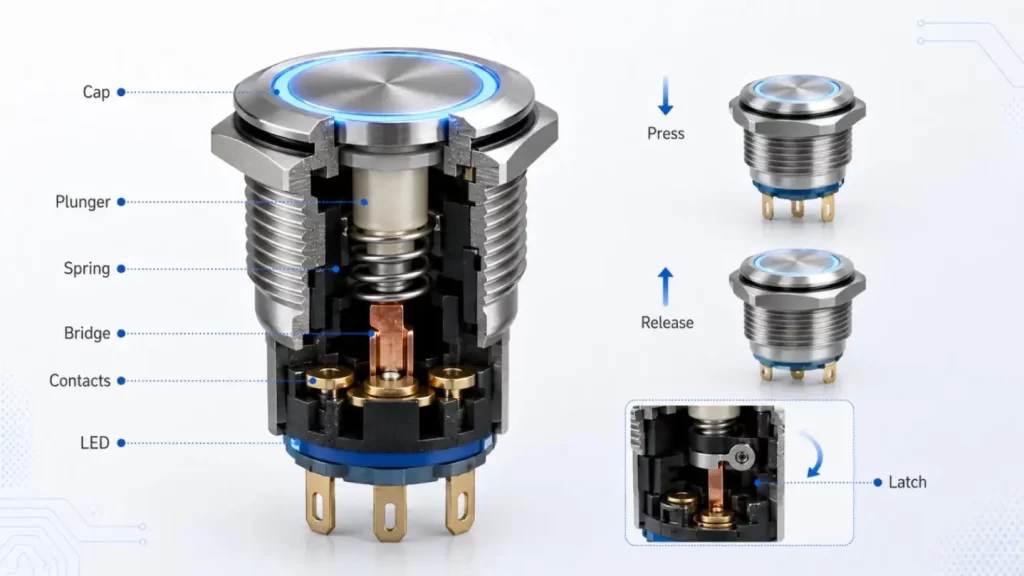
Inside the switch, a spring-loaded plunger moves a conductive bridge between fixed terminals. Pressing the button compresses the spring and forces the bridge to touch the contact pads.
•Press action (NO version): The bridge connects the two normally open terminals – current flows through the 12V circuit.
•Release action (NO version): Spring causes the bridge to push away – contacts separate and current ceases.
•Latching mechanism: A hook or cam holds the plunger down until it is pressed again.
Selecting the Right 12V Push Button Switch for Your Needs
Poor selection of a switch can result in overheating, contacts welding, and early switch failure, etc. Note the following:
•Load type (resistive vs inductive): Switches must be derated 50% or a relay must be used for inductive loads such as solenoids and motors which have back EMF.
•Switch current rating: Select the switch with a rating at least 1.5 times the load current. For example, use a 5A (or higher) switch for a 3A fan.
•Actuation force: Soft-touch (100–200 gf) for frequent use; heavy-duty (500 gf+) for anti-vibration environments.
•Mounting style: Panel mount (threaded bushing), PCB mount (through-hole pins), or surface mount (SMD).
•Environmental protection: IP54 for indoor splashes; IP67 for outdoor rain or washdown.
Common Applications of 12V Push Button Switches
•Automotive: Horn button, auxiliary LED light bar, window lift override, hidden kill switch.
•Marine: Bilge pump manual override, navigation light control – always use waterproof types.
•Industrial control: Safety interlocks, jog buttons, push buttons.
•DIY Electronics: Command input, interlocks, reset buttons, a programmable game controller, and Arduinos.
•Home appliances: Coffee machine brew button, electric standing desk height memory switch.
Wiring Tips for Reliable 12V Push Button Switch Circuits
•Use a relay for high-current loads: A 12V push button switch (rated 3A) can safely drive a 30A relay's coil, which then switches heavy loads like winches.
•Add a flyback diode: When switching motors or solenoids, place a 1N4007 diode across the load terminals (cathode to positive) to suppress voltage spikes.
•Solder and insulate: To guard against circuits shorting out, use heat shrink tubing to cover all terminals exposed to the metal chassis.
•Use a multimeter to test: Set the multimeter to continuity mode and check the NO/NC behavior with no 12V power connected.
Why Quality Matters – The Design and Technical Edge of HANXIA
After developing this understanding, the only remaining thing to consider is selecting the right manufacturer to ensure long-term functionality. With low-voltage switches in mind, HANXIA combines the experience of engineering skills with the potential of mass production.
HANXIA was established in 2014 and, with a background of over 12 years in the industry, is now one of the top Chinese manufacturers of tact switches. Their facility is 5,600 m2 and employs over 90 qualified staff.
•Technical partnership: HANXIA has built a quality standard by using high quality materials and by teaming up with Korean manufacturers. They focus on ways of making their products better and better.
•Sophisticated automation: Assembly of the product is now fully automated. This removed the manual assembly defects and improved the mechanical life and contact resistance.
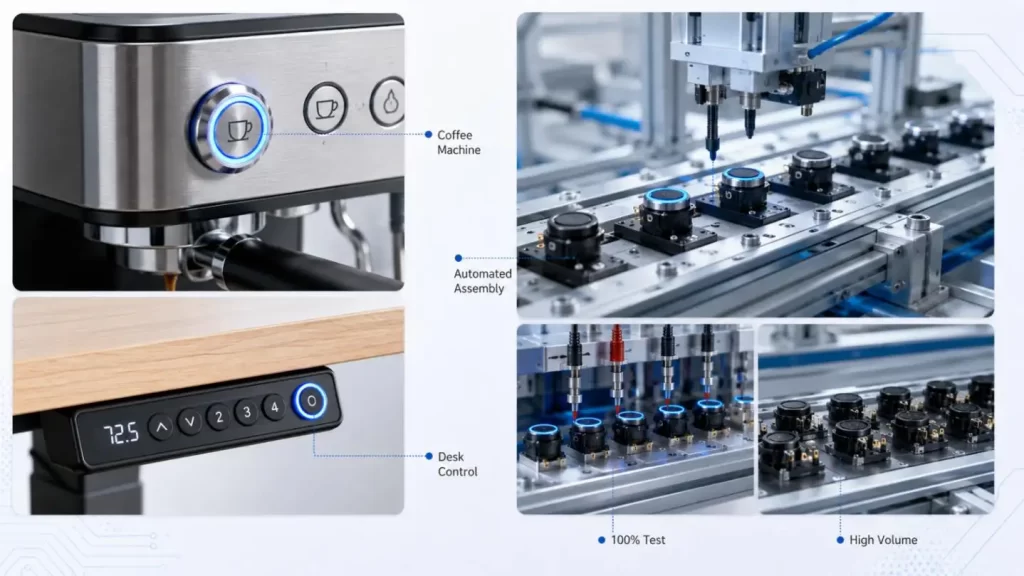
•Thorough Testing: We have automated inspections and functional testers that are built into our factory which guarantees quality on all our 12V Push Button Switches.
•Product Variety & Customizability: HANXIA is the best choice for variety, quality of products and best customer support. HANXIA is also capable of providing customers many advanced technical solutions and services.
•Enormous Capacity: HANXIA has 38 fully automated lines. We can manufacture more than 2 million standard and customized products every day.
•Quality Assurance: Our products have every certification and patent. Our products also have the international quality management system certification.
You can expect full compliance from all their push button switches whether you need a 12V Push Button Switch for a simple circuit or a waterproof latching switch for a large production run.
FAQs
Q1: What are the OEM/ODM options for your 12V Push Button Switches?
A: Yes, you can customize the actuation force, logos, wire harnesses, LEDs, and choose the IP rating, among many other options.
Q2: Are your products CE, ROHS, and REACH certified?
A: Our factory is ISO 9001 certified. We manufacture CE certified 12V Push Button Switches that comply with ROHS 2.0 and REACH.
Q3: What do you do to guarantee quality in your bulk production?
A: All production is fully automated. Each switch is tested to ensure functionality for quality beyond the possible manual inspection.
Q4: Would you be able to build a 12V Push Button Switch, for outside use, to a certain IP rating?
A: We can do custom designs using O-ring switches rated at either IP65, IP67, and if needed, IP68.
Q5: Do you supply a sample before the initial production run?
A: Yes, we supply free samples from stock, and custom samples at a reduced cost.
