





4 Major Technology Trends for Micro Push Button Switches (2026–2030)
From the gadgets we use daily to tools used in the medical field, industrial applications, and car components – micro push buttons are a key feature in manufacturing electrical components. 2026 will be the start of new ideas, innovations, and smart materials that are coming to micro push buttons. The article outlines 4 technology advancements that push buttons will adopt that focus on future connectivity and integration, and downsizing electrical components.
Trend 1: Smart Switches With Force Detection
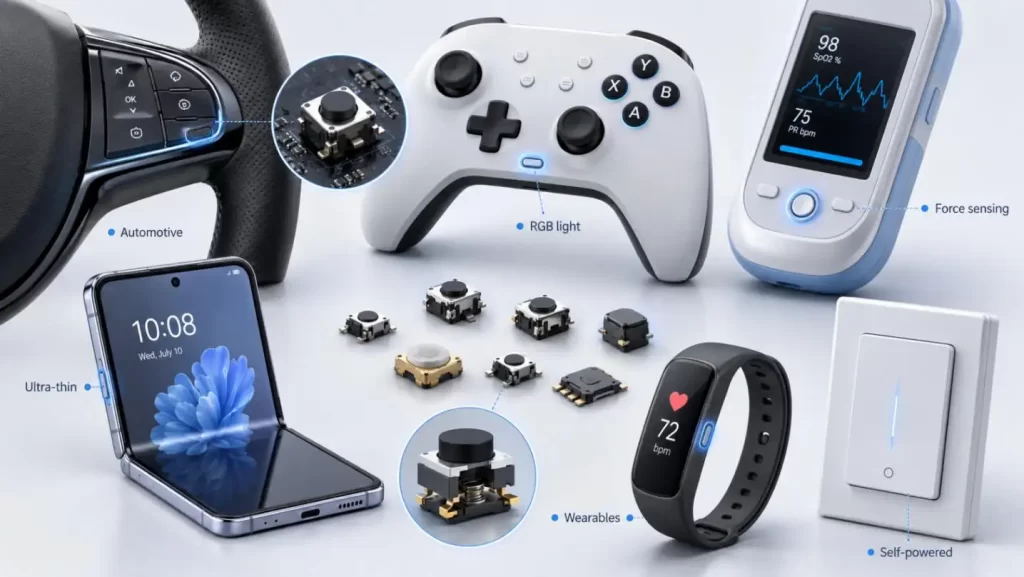
Micro push buttons traditionally only have two states – pressed or unpressed. The first of the emerging trends adds a third. Creating buttons that can detect the force of a press is done by adding force-sensing resistors (FSR) or capacitive strain gauges to the switch.
•They can be used to provide variable control: Micro push buttons can offer the same functionality for light presses, medium presses, and heavy presses. This can be used in automotive applications for different levels of acceleration (braking) or for different levels of scrolling.
•They replace less compact buttons: Because of their size, force-sensing micro push buttons can replace bulky, space-consuming analog sticks and can reduce the cost of the components and the printed circuit board.
•Integrating Haptic Feedback: A smart switch that uses an FSR along with a LRA would provide the user with confidence in a fully eyes-off operation. This is done by giving the user a different sensation of a click for each level of press.
•Lower power than capacitive touch: Unlike capacitive sensors which require continuous scanning, a force-sensing micro push button switch only wakes up the MCU when pressed, making it suitable for battery-powered IoT devices.
Expect force-sensing micro push button switches to be common in steering wheels, game controllers, and medical handheld devices by 2028.
Trend 2: Fully Integrated RGB-Illuminated Switches – Status at a Glance
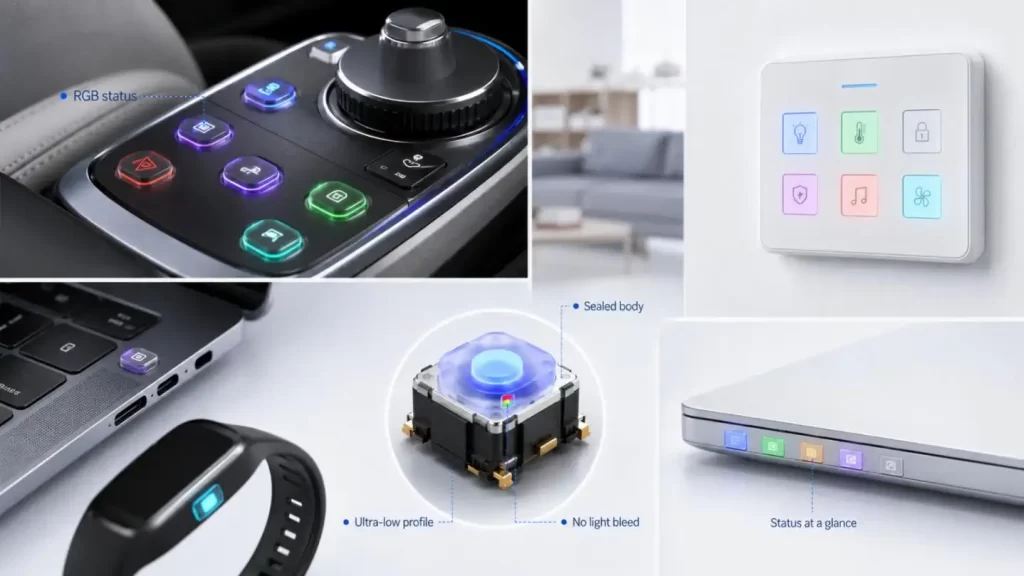
Indicator LEDs have traditionally been placed separately on PCBs, consuming extra space and requiring complex routing. The second trend integrates miniature LEDs – often side-firing or chip-scale RGB dies – directly inside the switch body.
•One component, multiple functions: A transparent or translucent actuator allows light to shine through the button cap, while the micro push button switch itself remains fully sealed. This eliminates the need for external light pipes or surface-mount LEDs.
•Dynamic color feedback: With built-in RGB control, the same switch can change color to indicate power state, error conditions, pairing mode, or user profiles – all without modifying the mechanical design.
•Ultra-low profile for portable devices: New side-emitting LED packages are as thin as 0.35 mm, enabling illuminated micro push button switches for slim laptops, smart home keypads, and wearable monitors.
•No light bleed interference: Advanced optical isolation inside the switch housing prevents stray light from affecting adjacent switches, a critical requirement for dense control panels.
From 2025 onward, illuminated micro push button switches will move from niche status to mainstream, especially in consumer electronics and car cabin controls.
Trend 3: Sub-0.3mm Ultra-Thin Switches for Foldables & Wearables
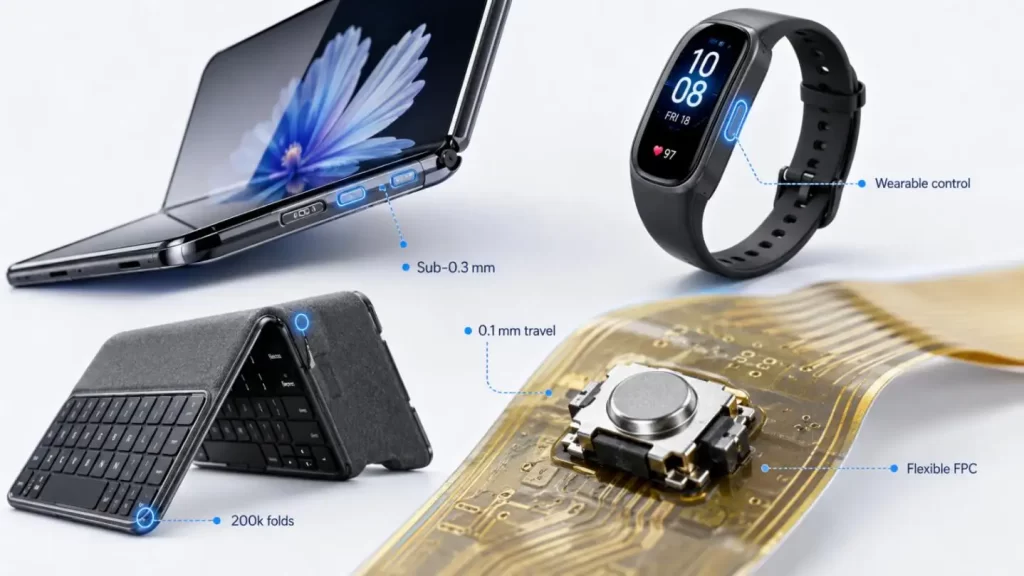
The push for thinner, foldable, and rollable displays has created an urgent need for micro push button switches that are almost invisible. The third trend delivers switches with total heights below 0.3 mm – thinner than a sheet of paper.
•Nano-travel with crisp feedback: Conventional switches require at least 0.2 mm of travel. New metal dome and cantilever spring designs achieve 0.1 mm travel while retaining a tactile click, thanks to high-yield stainless steel etching.
•Direct lamination on flexible substrates: These ultra-thin micro push button switches can be assembled directly onto flexible printed circuits (FPC) using anisotropic conductive film (ACF), enabling button placement on foldable hinge areas.
•Increased Resistance to Bending Cycles: Special polyimide reinforcement and strain-relief structures allow the switch to survive over 200,000 folding cycles with no contact resistance drift.
Beyond Just Phones: Envision smart watch bands with concealed controls, foldable keyboards and/or smart clothes with the micro push button switch built into the fabric layers.
By 2030, the thinnest micro push button switches will be measured in microns, opening up entirely new form factors that today's designers can only dream of.
Trend 4: Self-Powered & Zero-Standby Switches – No Battery, No Wiring
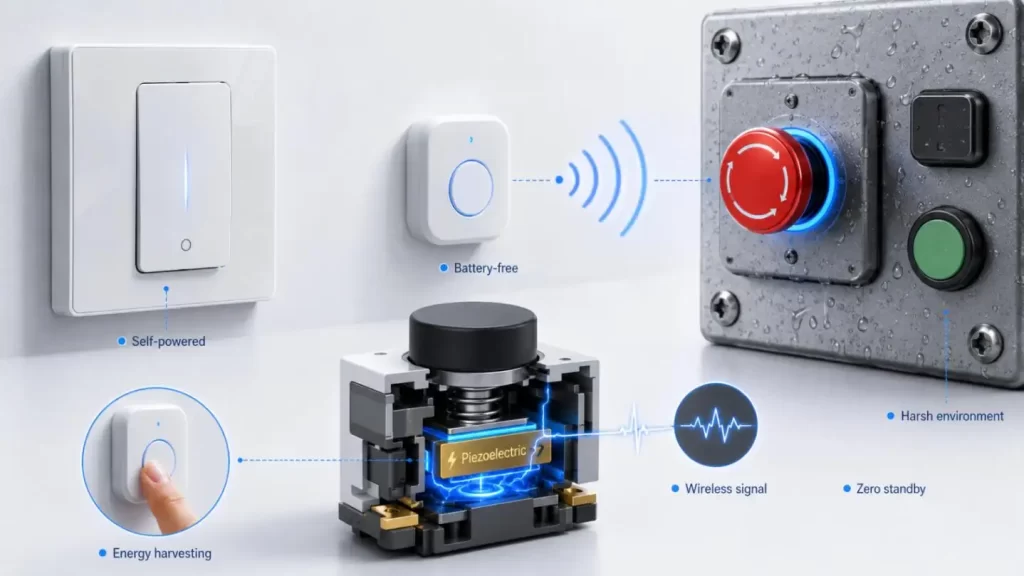
The fourth and most disruptive trend eliminates both external power and signal wires. Using piezoelectric or electromagnetic induction principles, a new class of micro push button switch generates its own electrical pulse when pressed.
•Piezoelectric energy harvesting: A bending piezoelectric element inside the switch produces a high-voltage (5–20 V), short-duration pulse – enough to wake a microcontroller or transmit an RF signal over 50 meters.
•Wireless and maintenance-free: These self-powered micro push button switches need no batteries (no replacement) and no wiring (lower installation cost). They are ideal for building automation, industrial emergency stops, and smart home retrofits.
•Ultra-low data rate communication: Paired with EnOcean or Zigbee Green Power, the switch can send a unique ID and a press/release event without consuming any network standby power.
•Reliability in harsh environments: With no electrical contacts to oxidize or wear out (piezoelectric models are contactless), these micro push button switches can exceed 10 million operations in dusty or humid conditions.
While currently more expensive than passive switches, economies of scale and energy-harvesting chip improvements will make self-powered micro push button switches cost-competitive by 2027.
Why Choose HANXIA for Next-Gen Micro Push Button Switches?
Facing shifting market demands requires a partner that can quickly adapt with flexible micro push button switches that do not compromise on quality. With the combination of the fully automated production systems and the precision engineering capability, HANXIA can meet the demands of the automotive, consumer and industrial markets.
1. Industry Experience
HANXIA is the first pioneer on electronic part manufacturing since 2014 and it has a decade of experience. Customers have trusted HANXIA, with more than 7,500 international clients in USA, Germany, South Korea, Taiwan, and Hong Kong.
2. Automated Manufacturing
•38 Fully Automated Production Lines: all of our equipment gives us the ability to produce micro push button switches with improved consistency and speed, as all manufacturing is fully automated.
•High Daily Output: We can meet the large volume orders and even the most challenging designs, such as those that incorporate thin and/or force-sensing designs, and do so on time. We produce 2 million switches every day.
•Smart Technology: Fully automated systems and automatic assemblies are among the technologies we use to minimize the risk of error and improve the accuracy of the products.
•Hassle Free Delivery: A 90 day return policy is a safe order of micro push button switches guarantee.
3. Quality Control
•Thorough Testing: Push button micro switches and the raw materials that we receive are tested for Push button micro switches and the raw materials that we receive are tested for quality control assurance. We perform a final inspection to test for tactility, insulation resistance, and operational life.
•100% Tested in Factory: Each switch is tested in our factory to be in compliance and to meet the quality assurance requirements for performance, durability, IP, and temperature cycling tests.
When you choose HANXIA, you select a qualified and trustworthy partner and an excellent service supplier. HANXIA produces ultra-thin switches used in foldables, self-powered switches used in smart buildings, and RGB illuminated switches for automotive HMIs, among others. With HANXIA, you can be confident that their versatile production capabilities can help you implement your designs.
FAQs
Q1: Will you provide samples for free prior to our placing a mass order?
- To support free evaluation samples, we will take on the cost for the first mass order. You will cover transport.
Q2: Will you provide the services related to custom designs? (Actuator height, force, IP rating, etc.)
- Yes, we will provide the service. As a part of our OEM/ODM, we will provide the services of integrated LEDs of different colors as well as a custom sealing, as well as a custom operating force, and a custom stem length.
Q3: What is your lead time?
- Our standard lead time is 15 – 20 working days. We have 38 automated lines for your urgent requirements.
Q4: Which certifications are held by your switches?
– Our micro push button switches are compliant with RoHS, REACH, and ISO 9001:2015. IP67 and automotive-grade (AEC-Q200) options available.
Q5: How do you ensure consistent tactile feel across millions of units?
– We use fully automated assembly lines (in partnership with Korean tech) with real-time force-displacement monitoring for every production batch.
