





The Micro Switch Push Button: Solving Industrial Reliability with Sealed Contact Technology
Micro Switch Push Button components are often the weakest link in industrial control systems—and the cost of that weakness can be staggering. A $5 switch failure can easily bring a $50,000 production line to a complete halt, and the downtime costs multiply from there. For procurement officers and maintenance managers, the challenge isn't just finding a switch that works—it's finding one that keeps working in the punishing conditions of modern manufacturing.
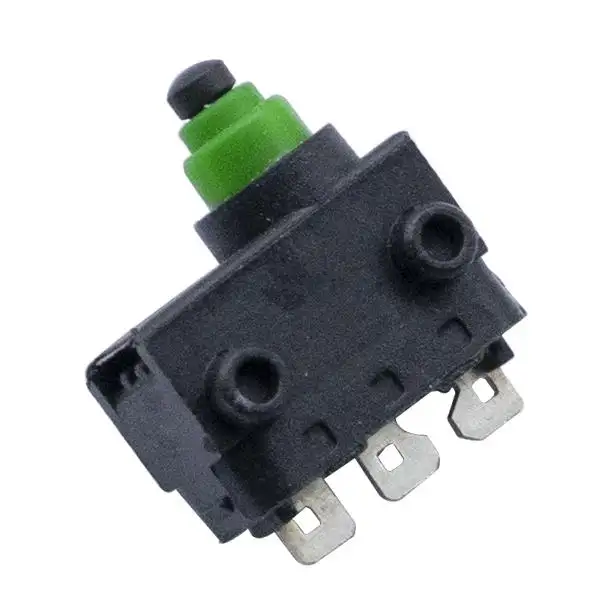
This article examines the most common failure modes of industrial push button switches and demonstrates how a single engineering upgrade—sealed contact technology with snap-action precision—addresses these challenges head-on.
The Economic Impact of Switch Failures in Industry
Issues of reliability in micro switches manifests in day to day operational costs of the business. As an example, micro switches within automated production lines of robotic arms, and emergency stop buttons are expected to operate with flawless precision for millions of cycles.
However, the average push button switch has an operational life of approximately 30,000 actuations before the switch begins to show signs of operational degradation. The reliability gap between expected and actual reliability is where the hidden costs are.
How Sealed Snap-Action Contacts Outperform Conventional Designs
The internal mechanisms of the better quality micro switch push button are where the most value is found. Unlike a conventional light switch where the user is in direct control of the speed of the switch contacts, micro switches are designed using snap action spring mechanisms, where the switch contact is designed to be stored as potential energy and released in an instant at a predetermined tipping point. This unique design gives rise to the following three features:
1. Contact snap open and closed in an instant – because the duration where the current is flowing is in the order of micro seconds, the contact suffers from virtually no erosion and as a result the electrical contacts will out live the mechanical
2. Contact Creep Prevention – Sparking and pitting of the switch contacts is eliminated because the switch is either in one of two states ON or OFF.
3. Possessing the defined contact opening and closing that is critical for the successful operation of safety interlocks and the detection of correct positioning.
These micro switches maintain reliability in applications where the International Protection (IP) sealing is rated at IP67 (dust-tight and temporarily Immersed in water) such as outdoor use, washdown use, and dusty environments.
Three Example Applications of ROI for Sealed Contacts
- Automated Manufacturing
Micro switches in robotic arms and conveyor systems detect limits and positions. Failure means part misalignment, loss of product, and unplanned downtime. Micro switches with gold-plated contacts and push button designs have contact resistance of ≤20mΩ, even after repeated use, and are less likely to trigger falsely, so movement can be controlled with greater precision.
- Food and beverage processing
Hygiene-critical environments have washdown areas with switches that are water and corrosion resistant. Sealed push buttons are made with stainless steel and have an IP67 rating. There are costs associated with food processing line stoppages, beyond the costs of replacing switches that are related to product spoilage and the costs of sanitation re-certification.
- Automotive and Heavy Equipment
From charging gun controls to door interlocks, automotive applications subject switches to temperature extremes (-40°C to 125°C), vibration, and moisture. Sealed micro switch push buttons with high-temperature PA66 housings have passed 12 months of actual vehicle testing without faults, winning bulk orders from major manufacturers.
Selecting the Right Micro Switch Push Button: A Procurement Checklist
For buyers evaluating suppliers, the datasheet contains the answers to long-term reliability questions. Before placing your next order, verify:
•IP Rating: IP65 provides dust-tight protection and water jet resistance; IP67 adds protection against temporary immersion
•Electrical Ratings: Match rated voltage and current to your system to prevent overheating and ensure safe operation
•Mechanical Life: Quality micro switches are rated for 1 million to 20 million cycles—far exceeding standard push buttons
•Contact Material: Gold-plated contacts for low-voltage/logic-level applications; silver for higher current loads
•Certifications: UL, VDE, CQC, ISO 13485 (medical), and IATF16949 (automotive) indicate rigorous quality control
Why Reliability Starts with the Right Specification
Most switch failures aren't due to the component being "bad"—they're due to the wrong switch being chosen for the job. Control engineers often overlook the subtle aspects of contact material, differential travel, or sealing attributes, and concentrate on measurements and price alone. The cost of omission, however, is painfully clear when a control panel is down and production is halted.
For purchasing managers trying to minimize the cost of unplanned downtimes and the cost of ownership, micro switch push buttons with sealed contact technology are a reliable answer. Buyers need to focus on sealed IP rated construction, snap action precision, and demonstrated cycle life to choose components that will endure the most demanding industrial environments, and sustain production lines.
