





SMT Tact Switch vs SMD Tactile Switch: Are They the Same?
If you've spent any time sourcing tactile switches, you've probably seen both labels — "SMT tact switch" on one supplier's datasheet and "SMD tactile switch" on another's. Same footprint, same function, different name. Before you place an order or update a BOM, you deserve a direct answer: yes, they are the same component, but there's one important nuance that affects how you specify and order correctly.
This article explains exactly why both terms exist, where the only real sub-difference lies, what specifications to verify before ordering, and how to avoid the common mistakes that cost engineers time and money.
What "SMT" and "SMD" Actually Mean on a Switch Label
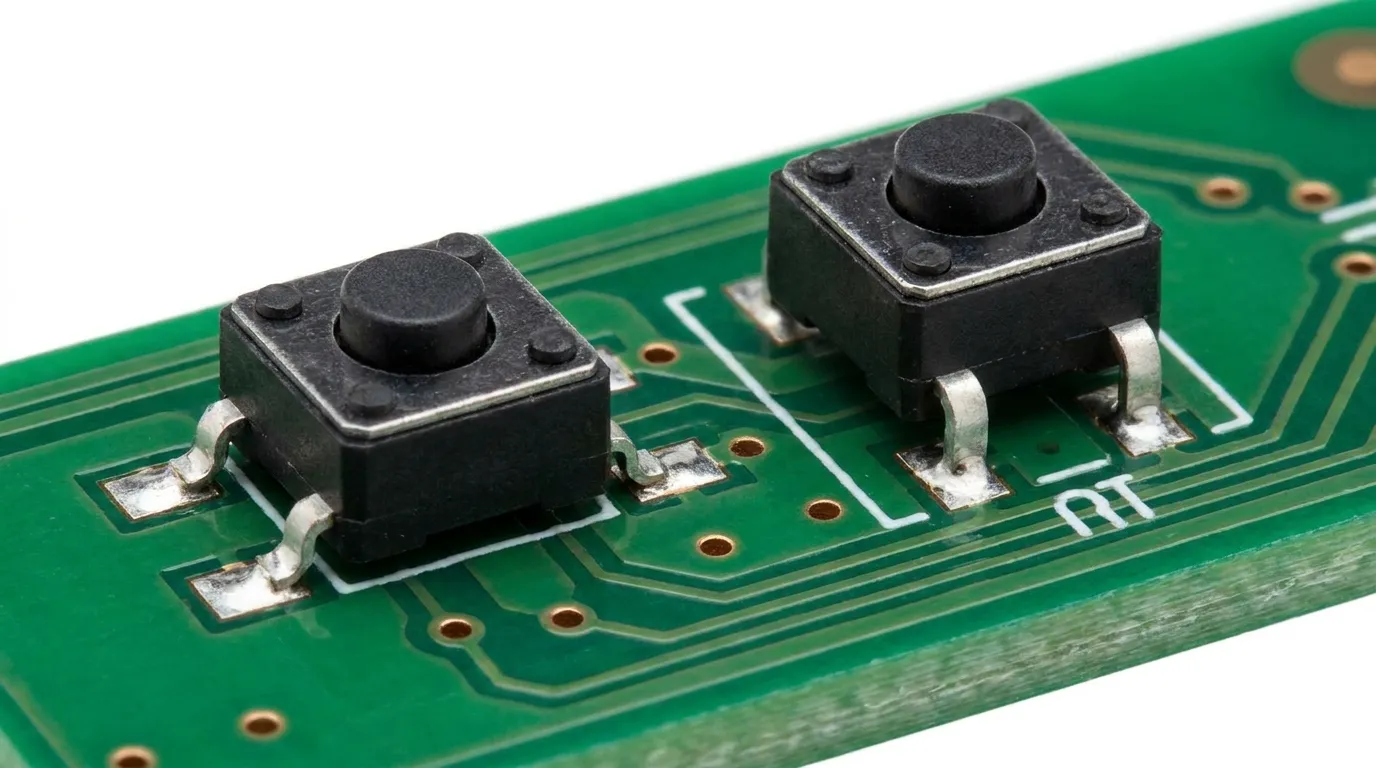
The confusion starts with two overlapping industry terms that describe the same reality from two different angles.
SMT — Surface Mount Technology refers to the manufacturing process: the automated method of placing and soldering components directly onto the surface of a PCB, using solder paste and reflow ovens rather than inserting leads through drilled holes. When a supplier labels a switch "SMT tact switch," they are communicating that this switch is designed for SMT assembly lines — compatible with pick-and-place machines and reflow soldering.
SMD — Surface Mount Device refers to the component itself: any electronic component built to be mounted on the surface of a PCB without through-hole leads. When a supplier labels a switch "SMD tactile switch," they are classifying it as a surface-mount component by category.
In simple terms: SMT is the process; SMD is the part. An "SMT tact switch" is an SMD component intended for use in SMT production. The labels describe the same object from two directions, which is why distributors list the entire category together as "SMD/SMT Tactile Switches" without distinguishing between them.
| Term | Full Name | What It Describes | Common Usage |
|---|---|---|---|
| SMT | Surface Mount Technology | The mounting process / assembly method | Manufacturer datasheets, Asian supplier catalogs |
| SMD | Surface Mount Device | The component type / component category | EU/US distributor listings, engineering BOMs |
| SMT/SMD | Both combined | The same tactile switch, described both ways | Distributor search filters, technical specifications |
Why Both Terms Appear in Product Catalogs
The naming inconsistency is a genuine industry-wide phenomenon, not a mistake by any one supplier. Manufacturers in Taiwan, China, and South Korea often prefer "SMT tact switch" on their product pages because it emphasizes production-line compatibility — the selling point their OEM customers care about most. European and American distributors tend to categorize by component type, so the same switch appears as "SMD tactile switch" or simply "surface mount tactile switch" in their catalog systems.
The result is that an engineer in Germany searching for "SMD tactile switch" and a procurement manager in Shenzhen sourcing "SMT tact switch" can be specifying the exact same part from the same factory floor. The label does not determine the product. The datasheet does.
For your SMD tactile switch specification and selection, what matters is not the label on the product title — it's the termination style, footprint dimensions, operating force, and cycle life listed in the technical parameters.
The One Real Sub-Difference: Termination Style
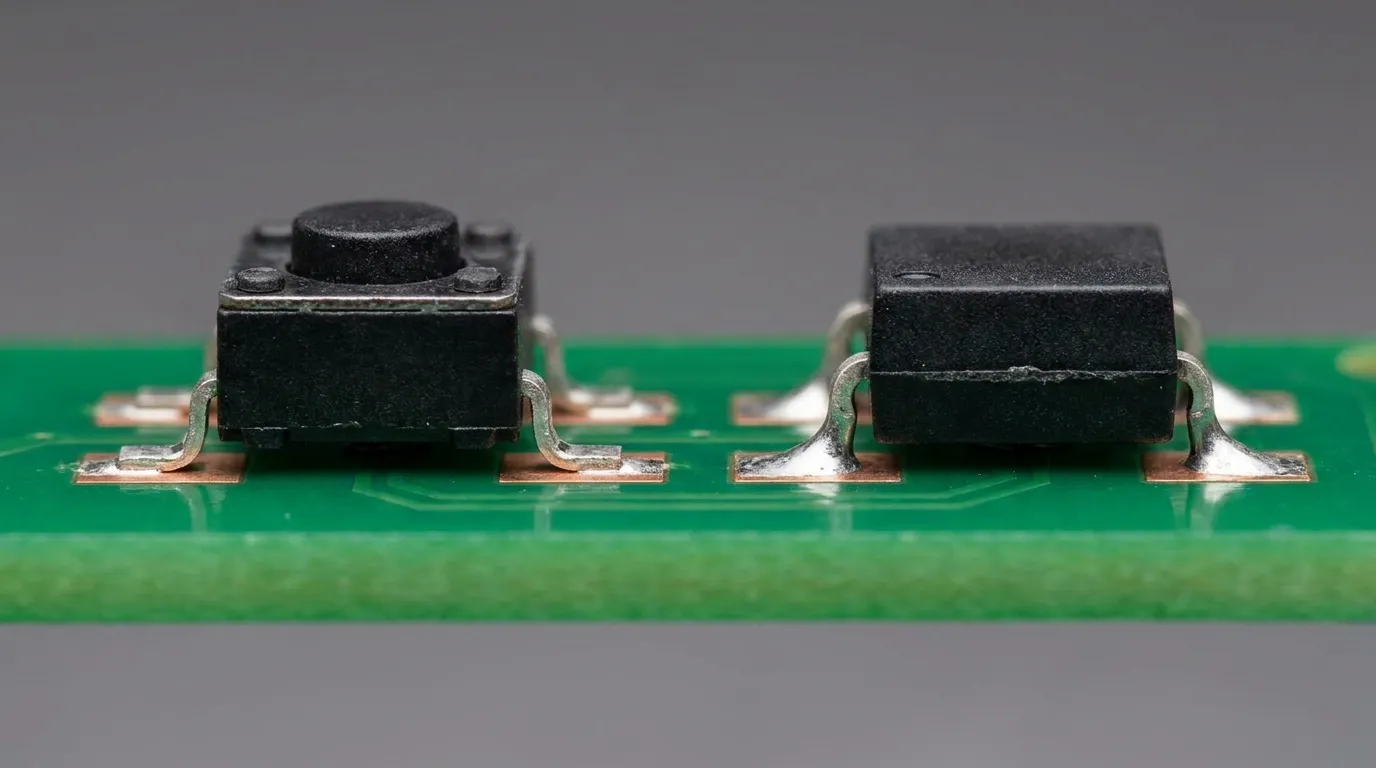
Once you accept that SMT tact switch and SMD tactile switch refer to the same component category, there is one genuine distinction to understand — lead termination style. Some suppliers use "SMT tact switch" specifically to denote gull-wing leads, while "SMD" may cover both gull-wing and J-lead variants. This is not universal, but it appears across enough product lines to be worth checking.
Gull Wing Termination
Gull-wing leads extend horizontally outward from the body of the switch, bending down and outward like a bird's wing. This is the most common termination style for SMD/SMT tact switches. Gull-wing leads sit flat on the PCB pad, making them easy to inspect visually after reflow soldering and straightforward to rework if needed. They are the standard choice for most automated PCB assembly applications.
J-Lead Termination
J-leads curve underneath the body of the switch, forming a "J" shape. This reduces the PCB footprint — the switch occupies less board real estate than its gull-wing equivalent — but makes post-solder inspection harder since the joint is partially hidden. J-lead SMD tact switches are used when board density is a priority and the design allows for the slightly more complex soldering process.
Both termination styles are fully compatible with reflow soldering and automated pick-and-place production. The choice between them is a PCB layout decision, not an assembly process decision.
| Termination Style | Lead Shape | Footprint | Inspection Ease | Best For |
|---|---|---|---|---|
| Gull Wing | Extends outward | Larger | Easy — joint visible | Most applications; standard automated assembly |
| J-Lead | Curls underneath | Smaller | Harder — joint partially hidden | High-density PCB layouts |
Key Specifications Shared by Both SMT and SMD Tact Switches
Regardless of which label appears on the product title, the following specifications define the performance of any surface mount tact switch. These are the numbers you should verify on every datasheet before ordering.
| Parameter | Typical Value | Why It Matters |
|---|---|---|
| Electrical Rating | DC 12V / 50mA | Defines maximum operating voltage and current for your circuit |
| Contact Resistance | ≤100mΩ | Lower resistance means more reliable signal transmission |
| Insulation Resistance | ≥100MΩ | Prevents leakage current between contacts |
| Operating Force | 100gf – 500gf | Determines tactile feel and how much force is needed to actuate |
| Cycle Life | 100,000 – 1,000,000 operations | Indicates durability; higher count required for frequent-use applications |
| Operating Temperature | –40°C to +85°C | Confirms suitability for your thermal environment |
| Contact Type | SPST-NO | Momentary, normally open — standard configuration for tact switches |
These parameters do not change based on whether the switch is called "SMT" or "SMD." When you see the same operating force range and the same footprint across two switches with different labels, they are specifying the same product class. Cross-reference these values directly rather than comparing product names.
Does the Label Matter When Ordering?
For the vast majority of orders, the answer is no — the label alone does not determine compatibility or interchangeability. What does matter is the technical specification behind that label.
Before placing any order, verify these five parameters on the datasheet:
- Termination style: Gull wing or J-lead — this determines your PCB footprint design
- Footprint dimensions: Common sizes include 3×6mm, 4×4mm, 6×6mm, and others — must match your PCB land pattern
- Actuation height: The total height of the switch plus actuator, which must fit within your enclosure clearance
- Operating force: Match to your UX requirement — lighter for frequent inputs, heavier to prevent accidental activation
- RoHS / Lead-free compliance: Verify if your production line or end market requires lead-free solder compatibility
If two switches from two suppliers — one labeled "SMT tact switch" and one labeled "SMD tactile switch" — share the same values across all five parameters, they are interchangeable. The title is a catalog convention. The spec sheet is the source of truth.
For a deeper guide on SMD tact switch selection, see our complete SMD tactile switch guide.
SMD/SMT Tact Switch vs. Through-Hole (DIP) Tact Switch
The more meaningful product distinction is not SMT vs. SMD — it's surface mount versus through-hole. Through-hole (DIP) tact switches have leads that pass through drilled holes in the PCB and are soldered on the reverse side, typically using wave soldering or hand soldering.
| Feature | SMD/SMT Tact Switch | Through-Hole (DIP) Tact Switch |
|---|---|---|
| Mounting Method | Surface mount; soldered on PCB surface | Inserted through PCB holes; soldered underneath |
| Assembly Process | Pick-and-place + reflow soldering | Wave soldering or hand soldering |
| Board Space | Smaller footprint; saves board real estate | Larger footprint; larger drill pattern required |
| Mechanical Strength | Lower pull-off resistance | Stronger mechanical anchoring to the board |
| Production Volume | Excellent for high-volume automated lines | Better suited for low-volume or hand-assembled products |
| Rework | Possible but requires SMD rework tools | Generally easier to rework with standard soldering iron |
For a full comparison of tact switch mounting types, actuation styles, and model selection across the complete range, see the tact switch overview and selection guide.
Common Applications for SMD/SMT Tact Switches
SMD tact switches are found in virtually every category of modern electronics where space efficiency and automated production are required. Their compact form factor and pick-and-place compatibility make them the default choice for high-volume PCB manufacturing.
Consumer electronics represent the largest application volume — smartphones, tablets, smartwatches, wireless earbuds, and remote controls all use SMD tact switches for reset buttons, mode selectors, and power functions. The low actuation force and small footprint are ideal for handheld devices where board space is at a premium.
Automotive electronics require SMD tact switches in dashboard controls, infotainment systems, and driver assistance interfaces. In this context, higher cycle life ratings and extended operating temperature ranges (–40°C to +85°C) are essential selection criteria.
Medical devices — diagnostic equipment, portable monitors, handheld analyzers — use SMD tact switches where reliability across high cycle counts is mandatory. For these applications, engineers should also confirm IP rating and contact material compatibility with cleaning agents.
Industrial control panels and IoT devices increasingly use SMD tact switches as PCB designs become more compact and automated assembly becomes the production standard. For high-vibration industrial environments, confirm the mechanical strength of the termination style and consider conformal coating requirements.
For application-specific tact switch selection by industry, see the tact switch application guide.
Common Mistakes to Avoid When Specifying SMT/SMD Tact Switches
Ordering by label alone. The single most common mistake is specifying "SMT tact switch" or "SMD tactile switch" on a purchase order without listing the footprint, termination style, and actuation height. Two switches with the same label from different suppliers can have different footprints. Always specify by technical parameters, not product name.
Ignoring actuation height. The overall height of the switch affects whether it fits inside your product enclosure. A 5mm tact switch and a 9mm tact switch may share the same PCB footprint but one will create mechanical interference with the housing. Confirm the full actuator height early in the design phase.
Mismatching operating force. Operating force is measured in grams-force (gf). For a button that users press hundreds of times per day, a 250gf force may cause fatigue. For a reset button that should resist accidental activation, a 500gf force is appropriate. Check this specification against your UX requirements, not just your electrical requirements.
Skipping RoHS compliance verification. If your product is sold in the EU or another regulated market, lead-free solder compatibility and RoHS compliance are non-negotiable. Not all tact switches from all suppliers carry explicit RoHS certification. Verify before committing to a supplier.
Assuming all SMD tact switches are the same. Cycle life ratings vary significantly — from 100,000 cycles on budget switches to 1,000,000 cycles on high-durability variants. For any switch in a frequently used user interface position, specify cycle life explicitly in your BOM and RFQ.
Frequently Asked Questions
Are SMT tact switches and SMD tactile switches the same thing?
Yes. "SMT" (Surface Mount Technology) describes the mounting process, while "SMD" (Surface Mount Device) describes the component type. Both terms are used to name the same product — a momentary tactile switch designed for surface mount PCB assembly. The label varies by supplier region and catalog convention; the component specification is identical.
What does "SMT" mean on a tact switch datasheet?
It indicates the switch is designed for automated SMT production lines — specifically, pick-and-place placement and reflow soldering. You can use this switch directly in a standard SMT assembly process without any manual through-hole insertion steps.
What is the difference between gull wing and J-lead SMD tact switches?
Gull-wing leads extend outward from the switch body for easier post-solder inspection and rework. J-leads curl underneath the body for a smaller PCB footprint but make visual inspection harder. Both are reflow-compatible. The choice depends on your PCB density requirements and inspection process.
Can I use an SMD tactile switch in an automated PCB assembly line?
Yes — SMD tactile switches are specifically designed for automated pick-and-place and reflow soldering production. Verify that the switch body is compatible with your pick-and-place nozzle size based on the switch's top-surface dimensions, and confirm your reflow profile matches the component's soldering temperature specifications.
Which specifications should I check when ordering an SMT tact switch?
Check five parameters: termination style (gull wing or J-lead), PCB footprint dimensions (e.g., 6×6mm), actuation height, operating force in grams-force, and electrical rating (typically DC 12V/50mA). Also confirm RoHS compliance if required by your target market.
Is "surface mount push button" the same as SMD tactile switch?
Yes. Surface mount push button, SMD tactile switch, SMT tact switch, and SMT push button switch are all industry terms for the same component category: a momentary contact switch designed for PCB surface mounting without through-hole leads.
Does the SMT or SMD label affect the price?
No. Pricing is determined by specifications — footprint size, actuation force, cycle life rating, contact material, and order volume. Two switches with different labels but identical specifications from comparable suppliers will be priced similarly. Never let the label be a price differentiator; compare actual specifications.
The Bottom Line
The SMT tact switch vs. SMD tactile switch question has a clear answer: they are the same component described with different terminology. SMT names the process; SMD names the part. When a supplier uses one label or the other, they are not describing a different product — they are using a different cataloging convention.
The distinction that actually matters to your PCB design is termination style — gull wing or J-lead — because that is what determines your land pattern and post-solder inspection approach. Beyond that, focus your specification work on the five parameters that define real-world performance: footprint dimensions, actuation height, operating force, electrical rating, and cycle life.
If you need to explore the full range of tact switch types — including through-hole variants, illuminated options, and waterproof models — the complete tact switch guide covers the full product family with selection guidance by application. For detailed SMD tact switch specifications and footprint options, the SMD tactile switch guide is the right next step.
Need to specify an SMT tact switch for your next PCB design? Use the five-parameter checklist above and contact us with your requirements — footprint, force, height, rating, and cycle life — for a fast, accurate product recommendation.
