





Choosing Tactile Switches for Industrial Devices
Mastering how to choose tactile switches for industrial devices requires prioritizing environmental sealing (IP ratings), mechanical actuation force (for gloved operation), and vibration resistance. Unlike consumer electronics, industrial switches must withstand harsh chemicals, extreme temperatures, and millions of cycles without signal failure.
I once audited a factory floor where a $500,000 CNC machine was sitting idle. The culprit wasn't the servo motor or the logic controller. It was a ten-cent tactile switch on the emergency stop panel that had corroded due to oil mist. That single failure cost the company thousands in lost production. This is the reality of industrial design: the smallest component often carries the highest risk.
When you leave the safe haven of a climate-controlled office and design for the factory floor, the oil rig, or the dashboard of an excavator, the rules change. You are no longer designing for "feel"; you are designing for survival.
What Defines an Industrial-Grade Tactile Switch?
An industrial-grade tactile switch is defined by its ability to maintain consistent electrical and mechanical performance under stress. Key metrics include high operating temperature ranges (-40°C to +85°C minimum), robust Ingress Protection (IP67+), and extended life cycles exceeding one million actuations.
In consumer electronics, a switch is "good enough" if it lasts 3 years. In industrial settings, we look for 10 to 20 years.
The Industrial Reliability Triangle
When selecting components, I use a three-point validation method:
- Physical Robustness: Can it take a hit? (Impact resistance).
- Environmental Shielding: Can it swim in oil? (Chemical resistance).
- Electrical Integrity: Will it oxidize? (Contact plating).
If you are starting from square one on your component list, review our broad guide on how to choose the right switch to establish your baseline electrical requirements before diving into industrial specifics.
How Does Environmental Sealing (IP Rating) Impact Reliability?
Environmental sealing, measured by IP ratings, prevents conductive debris and corrosive liquids from breaching the contact dome. For industrial environments, IP67 (dust-tight, immersion up to 1m) is the baseline, while environments with pressurized cleaning require IP69K to prevent seal rupture.
The most common failure I see in industrial Human Machine Interfaces (HMIs) is "switch bounce" caused by dust ingress.
- Dust (IP6X): In sawmills or textile factories, conductive dust can bridge contacts. A sealed membrane is non-negotiable.
- Liquids (IPX7/IPX8): It isn't just water. It is hydraulic fluid, cutting oil, and acidic cleaning agents.
- The Trap: A standard IP67 switch might stop water, but swell and fail when exposed to benzene or alcohol. You must verify the seal material compatibility.
For a deeper technical breakdown on sealing technologies, refer to our dedicated article on how to select waterproof tact switches.
Why Is Actuation Force Critical for Industrial Interfaces?
Actuation force determines if an operator can feel the "click" while wearing heavy safety gloves and prevents accidental activation by machine vibration. Industrial switches typically require high actuation forces (300gf to 500gf) to provide distinct haptic feedback through thick overlays or protective gear.
Imagine an operator wearing thick Kevlar gloves trying to press a 160gf (standard consumer) button. They won't feel it. They will press harder, likely crushing the switch internals.
The "Glove Test" Protocol
- Light Force (100-160gf): Unsuitable for industrial use. Too easy to trigger accidentally by tool vibration.
- Medium Force (260gf): Acceptable for light industrial (clean rooms, lab equipment).
- Heavy Force (300gf - 500gf): Mandatory for heavy machinery. The high resistance ensures the operator intends to press the button.
Key Data Point: High-force switches also tend to have a "snappier" return, which helps break through minor stickiness caused by surface grime. For more on tuning the "feel" of your device, read how to choose the right tact switch.
How Do You Handle Vibration and Shock?
Vibration and shock resistance are managed by selecting the correct mounting style and internal dome construction. Through-Hole (THT) switches offer superior mechanical anchorage compared to Surface Mount (SMT), preventing the switch from shearing off the PCB during high-frequency vibration.
Industrial machines shake. If you mount a standard SMT switch on a vibrating motor controller, the solder joints will eventually fatigue and crack.
Mechanical Anchoring Strategies
- Through-Hole (THT): The leads pass through the board, locking the switch in place. This is the preferred method for high-stress panels.
- SMT with Bosses: If you must use SMT for automated assembly, select a switch with "locating posts" (bosses) that fit into holes in the PCB to resist shear forces.
- Reinforced Solder Pads: Design your PCB with larger copper pads to increase the solder volume and grip.
If you are debating between assembly methods, our analysis on how to choose smt vs through hole dip switches provides a detailed comparison of mechanical durability that applies directly to tact switches as well.
What Materials Withstand Industrial Extremes?
Material selection dictates the switch's survival against heat and flammability. Industrial switches should utilize high-temperature thermoplastics like LCP (Liquid Crystal Polymer) or Nylon 9T for the housing, and stainless steel domes to maintain elasticity over millions of cycles unlike rubber counterparts.
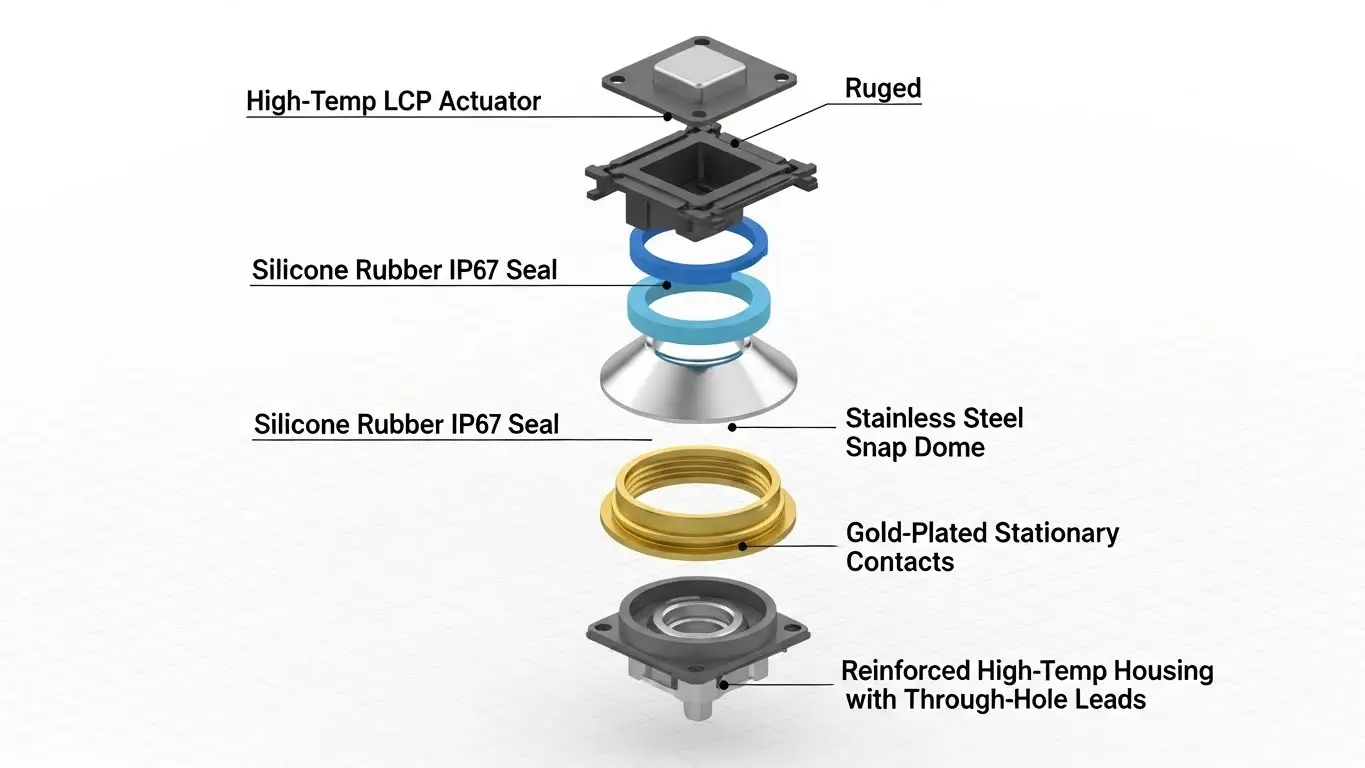
Plastic is not just plastic.
- Housing: Must be UL94V-0 rated (self-extinguishing). In the event of a control panel fire, you don't want your switches adding fuel.
- Contacts: Gold plating is essential for industrial logic circuits. Silver tarnishes. In a factory with sulfur or ozone in the air, silver contacts will fail open within months. Gold remains conductive indefinitely.
| Component | Standard Consumer Material | Industrial Grade Material | Benefit |
| Housing | Nylon 6/6 | LCP / PPA | Higher heat resistance, lower moisture absorption. |
| Dome | Carbon/Rubber | Stainless Steel (SUS) | Crisp tactile feel, >1M cycle life. |
| Plating | Silver (Ag) | Gold (Au) | Corrosion resistance in harsh air. |
Life Cycle: How Long Must It Last?
Industrial life cycle requirements often exceed 1 million to 10 million cycles to minimize costly downtime and maintenance. Long-life switches utilize specialized metal domes and wear-resistant actuator stems to ensure the millionth click feels exactly like the first.
In industry, the cost of the switch is irrelevant compared to the cost of the technician required to replace it.
- Standard Tact: 100,000 cycles.
- Industrial Tact: 1,000,000 to 10,000,000 cycles.
Pro Tip: Be wary of "soft" silicone actuators for ultra-long life. While they seal well, they can lose their tactile "snap" faster than hard stems.
PCB Design and Integration Checks
PCB integration for industrial switches requires careful attention to thermal management and physical spacing. You must allow for wider clearance to prevent arcing in high-humidity environments and ensure the switch location does not interfere with other high-profile components or enclosure reinforcements.
When laying out the board, consider the "Service Loop." Is the switch accessible? If a liquid spill occurs, does the board layout funnel liquid away from the switch or right into it?
If your industrial board also includes configuration switches, ensure you apply similar rugged design principles. See how to choose a DIP switch for PCB design for layout tips that translate well to robust tact switch placement.
Conclusion: The Cost of Reliability
Knowing how to choose tactile switches for industrial devices comes down to risk management. You are paying a premium for insurance against failure.
- Force: Go heavy (300gf+) for gloved use.
- Seal: IP67 is the minimum; check chemical compatibility.
- Contact: Gold is mandatory for harsh atmospheres.
- Mount: Through-hole is king for vibration.
By rigorously qualifying these four aspects, you build a machine that runs as smoothly on day 1,000 as it did on day 1.
FAQ
For industrial applications, an actuation force between 300gf and 500gf is recommended. This higher force prevents accidental actuation caused by machine vibration and ensures the operator can feel the tactile "click" even while wearing heavy safety gloves.
Industrial environments often contain corrosive gases (sulfur, ozone) and high humidity. Gold plating prevents oxidation and corrosion on the contact surfaces, ensuring reliable electrical connectivity for low-voltage logic circuits where silver contacts might fail.
Through-Hole (THT) switches are generally better for high-vibration environments. The metal leads passing through the PCB provide a stronger mechanical anchor compared to Surface Mount (SMT) pads, reducing the risk of the switch shearing off during operation.
At a minimum, IP67 is required to protect against dust ingress and temporary water immersion. For environments involving high-pressure washdowns (like food processing), an IP69K rating is necessary to prevent seal failure under pressure.
