





SMT vs Through-Hole DIP Switches: How to Choose
Knowing how to choose SMT vs through-hole DIP switches depends on your assembly process, board density, and mechanical stress requirements. Select Surface Mount (SMT) for automated high-volume production and compact PCBs, while Through-Hole (THT) remains superior for prototyping, manual assembly, and applications requiring high mechanical durability.
I still recall a project early in my career where we ignored mechanical stress. We chose a tiny SMT DIP switch for a field configuration panel. Within three months, technicians wearing heavy gloves sheared three switches right off the pads. We swapped to a Through-Hole version on the revision, and the failures dropped to zero. That lesson stuck: the "best" switch isn't always the newest technology; it's the one that survives the user.
Whether you are scaling a consumer IoT device or building a rugged industrial controller, the choice between Surface Mount Technology (SMT) and Through-Hole Technology (THT) defines your manufacturing yield and field reliability.
What Is the Core Difference Between SMT and Through-Hole DIP Switches?
The core difference lies in their mounting method and footprint. Through-hole switches have leads that pass through the PCB and are soldered on the opposite side, providing strong mechanical bonds. SMT switches sit directly on the PCB surface, utilizing reflow soldering for higher component density and faster automated assembly.
The Engineering Reality
While the electrical function—making and breaking circuits—is identical, the mechanical and thermal realities are worlds apart.
- Through-Hole (THT): These are the veterans of the industry. The leads act as anchors. When a user pushes a lever on a DIP switch, the force is distributed through the PCB layers.
- Surface Mount (SMT): These are the modern standard. They rely on the solder fillet's shear strength to hold them in place. They are designed for "Pick and Place" machines, not human hands.
If you are just starting to define your component list, it helps to understand the broader context of switch selection. I recommend reviewing our foundational guide on how to choose the right switch to align your electrical specs before locking in the mounting style.
How Does Manufacturing Volume Influence Your Choice?
Manufacturing volume is often the primary decision driver. High-volume production (10,000+ units) favors SMT switches because they are compatible with automated pick-and-place machines and reflow ovens, drastically reducing assembly time. Low-volume or hobbyist runs benefit from Through-Hole switches due to easier hand-soldering and prototyping capabilities.
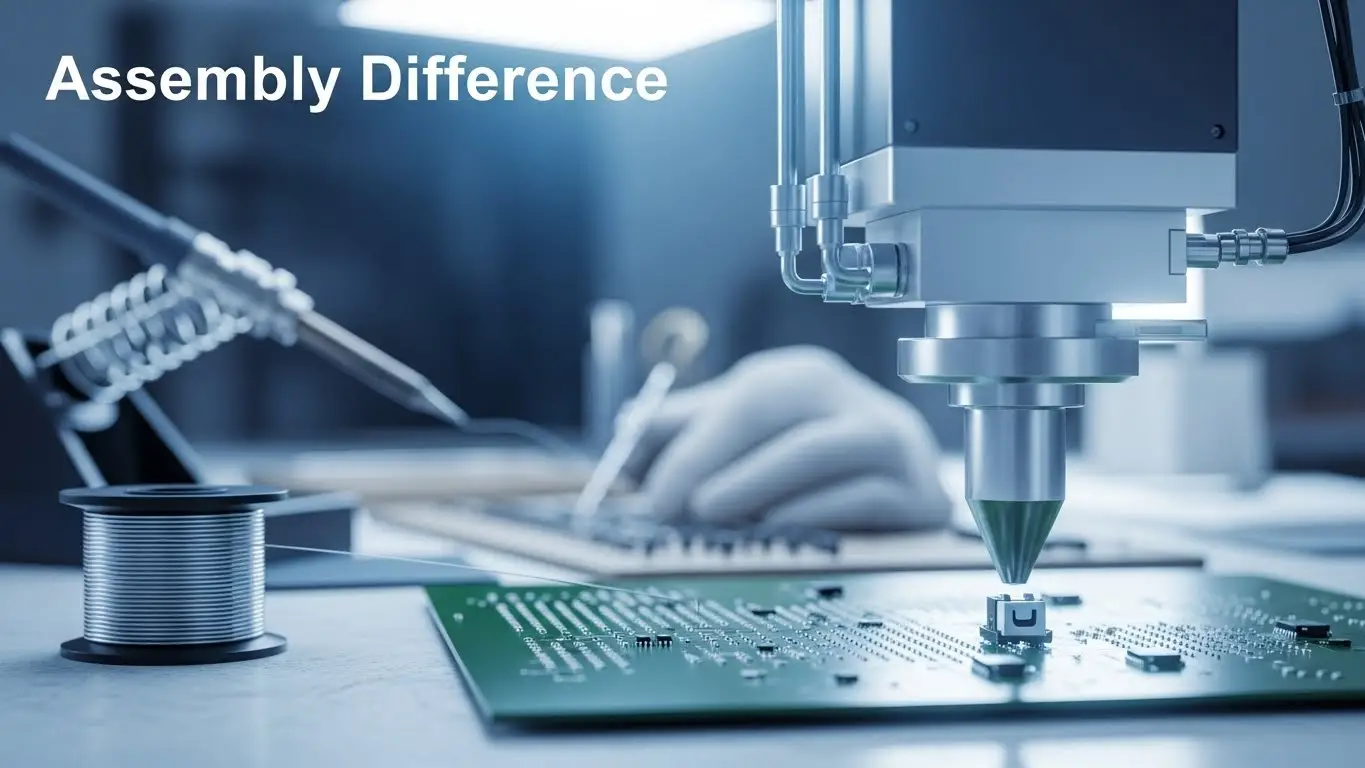
The Automation Equation
In my experience, once you cross the threshold of 5,000 units per run, THT becomes a bottleneck unless you have a dedicated wave solder line.
- SMT Efficiency: SMT DIP switches come on tape-and-reel. A machine places them at high speed, and they go through the oven with your resistors and ICs. There is no secondary manual step.
- THT Labor: Through-hole often requires a separate pass. If your board is mostly SMT, adding one THT switch might force you to use "Pin-in-Paste" reflow (tricky) or pay an operator to hand-solder it later.
Cost Insight: While an SMT switch might have a slightly higher unit price than a generic THT switch, the total installed cost is lower in mass production because you eliminate manual labor.
When Should You Prioritize Through-Hole (THT) DIP Switches?
Prioritize Through-Hole DIP switches for applications involving high mechanical stress, manual prototyping, or harsh vibration environments. The physical leads passing through the board provide superior anchorage, preventing the switch from detaching during aggressive actuation or if the device undergoes frequent reconfiguration by field technicians.
The "Heavy Hand" Factor
I usually spec THT for "Set and Forget" switches that might be accessed by non-engineers. If a technician uses a screwdriver to flip a DIP switch, they exert torque.
- Shear Strength: THT leads resist shear forces (sideways pushing) much better than surface solder pads.
- Thermal Mass: THT components can generally absorb more heat without damage during manual soldering repair.
Specific Use Cases for THT:
- Educational Kits: Students need components that fit into breadboards.
- Legacy Industrial Boards: replacements for 1990s era controllers.
- Heavy Vibration: The mechanical locking of the pins adds a layer of security against solder fatigue.
For more on laying out these specific components, check our detailed walkthrough on how to choose a DIP switch for PCB design.
Why Is SMT the Standard for High-Density Designs?
SMT is the standard for high-density designs because it eliminates the need for drilled holes, allowing routing on internal PCB layers directly beneath the switch. SMT switches also typically have a smaller physical footprint and lower profile, essential for compact devices like wearables, tablets, or densely packed control modules.
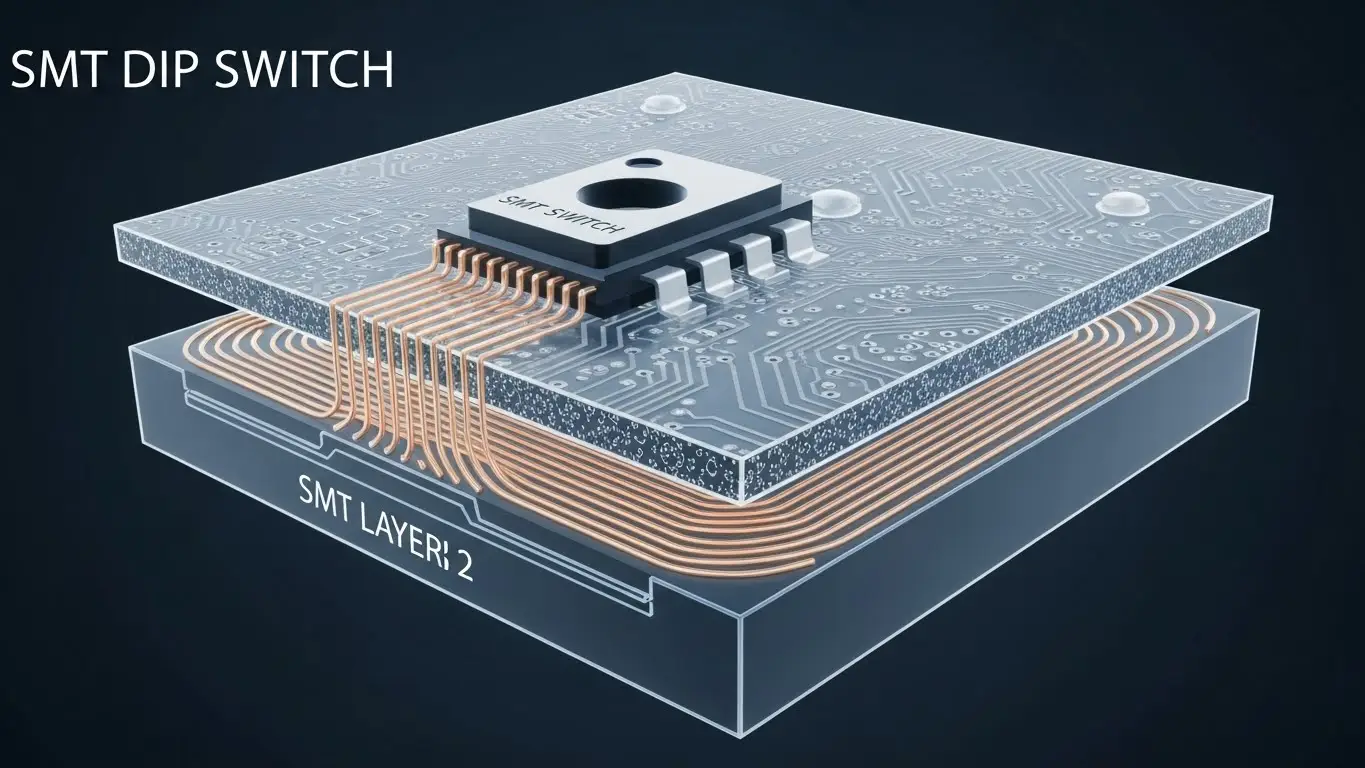
Reclaiming PCB Real Estate
In modern electronics, board space is expensive.
- No Holes: THT requires a hole through all layers. This blocks routing channels on every layer of the board. SMT only uses the top layer, leaving the layers below free for signal traces.
- Dual-Sided Assembly: You can place an SMT DIP switch on the top side and populate the bottom side directly underneath it with capacitors. THT pins would protrude and block this.
Tip: If you are designing a compact device that also requires distinct tactile inputs, you might face similar space constraints. See how this applies to other components in our guide on how to choose the right tact switch.
How Do Thermal Profiles Affect Component Selection?
Thermal profiles dictate component survival during assembly. SMT switches must withstand high reflow temperatures (up to 260°C) without plastic deformation, requiring high-temp materials like Nylon 9T or LCP. Through-hole switches are exposed to lower temperatures (wave solder or hand iron), allowing for a wider range of housing materials.
The Melting Point Risk
This is a critical failure mode. I have seen standard SMT DIP switches warp in a lead-free reflow oven because the profile was set for large BGAs.
- SMT Materials: Look for Polyphenylene Sulfide (PPS) or Liquid Crystal Polymer (LCP) housings.
- Sealing: SMT processing usually involves a wash. If the tape seal on the DIP switch fails during reflow, flux enters the contact area.
Validation Step: Always check the "Soldering Heat Resistance" in the datasheet.
- SMT: typically 260°C for 5-10 seconds.
- THT: typically 260°C for 5 seconds (wave) or 350°C for 3 seconds (hand solder).
If your environment involves liquids or potential washing after assembly, you must also consider sealing integrity. We cover this extensively in our article on how to select waterproof tact switches, and the same sealing logic applies to sealed DIP switches.
Comparative Analysis: SMT vs. THT Data Table
Use this table for a quick decision regarding your specific project constraints.
| Feature | SMT (Surface Mount) | THT (Through-Hole) |
| Assembly Method | Automated Reflow (Pick & Place) | Wave Solder or Hand Solder |
| PCB Density | High (No holes required) | Low (Requires drilled holes) |
| Mechanical Strength | Moderate (Relies on pads) | High (Anchored by leads) |
| Production Cost | Lower for High Volume | Lower for Low Volume |
| Prototyping | Difficult (Tweezers required) | Easy (Breadboard friendly) |
| Board Routing | Excellent (Frees inner layers) | Poor (Blocks all layers) |
| Vibration Resistance | Good (Low mass) | Excellent (Mechanical lock) |
Best Practices for PCB Layout and Design
When designing for SMT, maximize pad size for better adhesion and use thermal reliefs to prevent "tombstoning." For THT, ensure hole tolerance accommodates pin variations (typically +0.10mm) and use teardrops on pads to strengthen the trace connection against mechanical stress during switch actuation.
For SMT Layouts:
- Shear Tabs: If possible, design large ground pads on the side of the switch casing (if the switch body is metal) to solder it down for extra strength.
- Keep-Out Zones: Leave space around the switch for the "tape seal" removal tab. You don't want to bury the tab under a nearby capacitor.
For THT Layouts:
- Annular Rings: Make them as large as density allows. This gives the solder more surface area to grip, increasing mechanical strength.
- Clinching: If using automated THT insertion, ensure the leads can be clinched (bent) under the board to hold the switch before soldering.
Conclusion
The decision on how to choose SMT vs through-hole DIP switches is rarely about the switch itself—it is about the ecosystem of your product.
- Choose SMT if you are building >5,000 units, need to save space, and have a controlled reflow process.
- Choose Through-Hole if you are building <500 units, need extreme mechanical durability, or are designing for DIY kits.
By aligning your switch choice with your manufacturing reality, you ensure that your product is not just functional, but producible and durable.
FAQs (Schema Markup Ready):
n high-volume production, yes. While the SMT component cost is similar, SMT eliminates manual assembly steps, significantly lowering the total installed cost. For small batches, Through-Hole is often cheaper due to easier manual handling.
Yes, but it is difficult. You need a fine-tip soldering iron, magnification, and steady hands. For prototyping, Through-Hole is much easier to work with. If you must hand-solder SMT, ensure you do not overheat the plastic housing.
Through-Hole (THT) switches are mechanically stronger. The leads passing through the PCB act as anchors, making them more resistant to shear forces and aggressive operation compared to SMT switches, which rely solely on surface solder pads.
Yes. SMT switches do not require holes drilled through the board, allowing you to route signal traces on the internal layers directly beneath the switch. This is critical for high-density, multi-layer PCB designs.
Most SMT DIP switches are rated for lead-free reflow profiles with peak temperatures around 260°C. It is vital to use switches with high-temperature housing materials (like LCP or Nylon 9T) to prevent melting or warping during the proc
