


What is Tact Switch? Tactile Push Button Switches
A tact switch, or a tactile switch, is a small momentary electromechanical push button that is used to open or close an electrical circuit when it is pressed.
While a standard push button will move without giving any sensation of "click", a tact switch will give the user immediate sensory feedback that the button has been pushed and the contact made through the feeling of "click".
When designing a circuit, replacing a broken component or specifying parts for production, you probably have a few questions: What is the difference between a tact switch and a standard push button? What is the mechanism of its internal spring? What are the specifications (such as operating force, height of actuator or mounting style etc.) that are important for your project? The various types of switches and how to identify them, as well as how to choose the right switch for your build are explained below, step by step.
What is Tact Switch and How It Works?
A tact switch is a MW switch and is a momentary switch. That is, the switch will only be on (closing the circuit) as long as the pressure on the actuator is kept constant. Once the finger is removed, the internal mechanical tension forces the actuator back to its rest position, causing the electrical contact to open at once.
[ Actuator ]
│
┌─────┴─────┐
Logitech Metal Dome is a flexible dome that can be bent over on pressing to connect contacts (Tactile Click).
└─────┬─────┘
Two contacts are connected together (Circuit Completed)
The Core Components
- Actuator Component: Lever of the button or plunger key which receives the force of the user's finger is called the actuator component.
- Cover / Top Plate: Screens mechanical housing on inside and levels actuator.
- Core Mechanism Stainless Steel or Bronze Alloy (Metal Snap Dome / Spring Dome): In its default position, it holds the actuator, but collapses downwards when force is applied to create the tactile click.
- Base Contacts & Terminals: These are stationary metallic pins that are grounded into the bottom body and connected to your PCB right at the base.
The Momentary Operation Principle
A metal snap dome is directly pressed when the force is applied to the actuator, known as the Momentary Operation Principle. When the force exceeds a certain level, called the operating force, the dome will rapidly flex back inwards with a sudden drop in resistance. This unexpected breakdown creates a tactile "snapping" sensation as the dome touches the PCB contacts below it and completes the circuit.
When the pressure is released, the elastic metal dome will return to its shape, moving away from the contacts that are not moving, and closing the circuit once more.
Tact Switch vs. Standard Push Button Switch: Key Differences
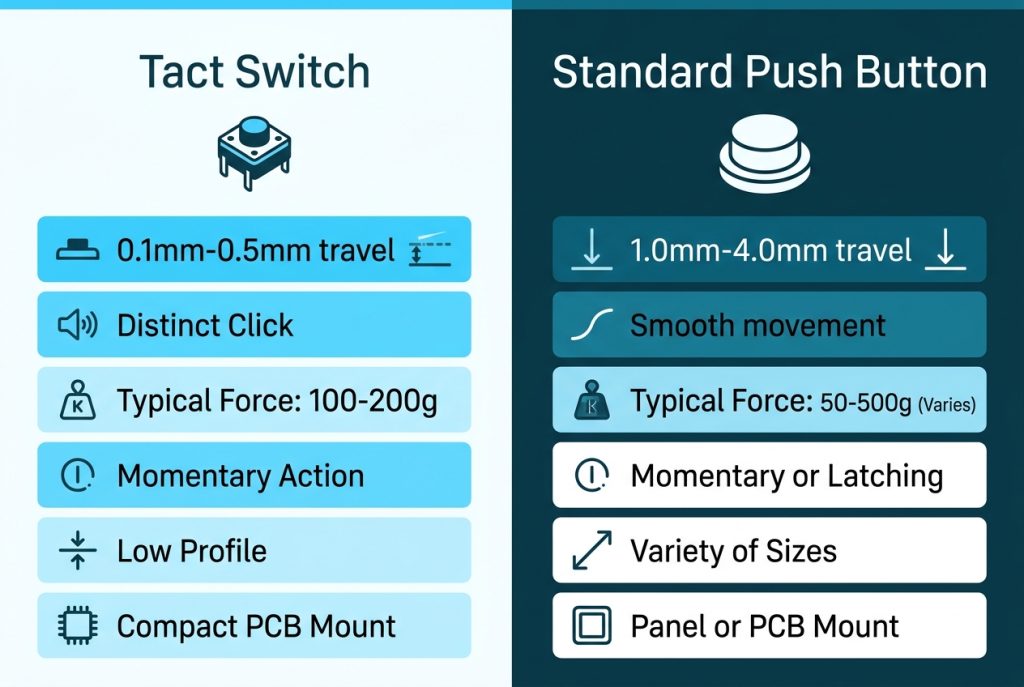
Although they both trigger electrical signals, they have vastly different mechanical, tactile and electrical characteristics.
| Feature | Tact Switch (Tactile Switch) | Standard Push Button Switch |
| User Feedback | Distinct physical "click" (tactile response) | Smooth movement with little to no tactile click |
| Circuit Type | Almost exclusively Momentary (NO - Normally Open) | Available as Latching (Push-ON / Push-OFF) or Momentary |
| Travel Distance | Very short (typically 0.1 mm to 0.5 mm) | Long travel distance (1.0 mm to 4.0+ mm) |
| Power Rating | Low voltage / low current (e.g., 12V DC, 50mA) | High range (from low signals up to 250V AC mains switching) |
| Physical Size | Ultra-compact (e.g., 3x3mm, 6x6mm, 12x12mm) | Medium to large panel-mount dimensions |
Main Types of Tactile Switches
Selecting the proper form factor depends on space constraints, mounting methods, and environmental protection requirements.
Surface Mount (SMD) vs. Through-Hole (THT)
- Surface Mount Devices (SMD / SMT): Designed for modern, automated PCB assembly. SMD tact switches use flat lead legs that solder onto surface pads, suitable for the devices such as remote control, smart phones, and wearable electronics, which are thin enough to only have a few millimeters.
- Through-Hole Technology (THT): It is a type of technology that makes use of metallic pins which are inserted into holes made in the PCB prior to soldering them to the opposite side. THT tact switches are designed to be stronger mechanically, and are therefore better for high duty-cycle industrial controls or prototyping boards.
Micro Tactile Switches for Compact Devices
Micro tactile switches can be used for applications where space is very limited, as small as 2.01.5mm with a low profile of less than 0.5mm. They are commonly employed in various applications such as wireless earbuds, smartwatches, and medical sensors.
Sealed & Waterproof Tact Switches
Standard open-body switches can be degraded over time in an outdoor electronic system, automotive interior or in an industrial machine that may be exposed to dust and moisture. Sealed tact switches have a built-in rubber stem and/or silicone membrane cover, which resist dust and are effective in water.
How to Choose the Right Tact Switch for Your Application
There are mechanical and electrical parameters to match to your device's physical layout and user experience requirements when choosing the right tact switch for your application. By testing the relevant specifications in advance, there will be no switching failures and consistent feedback from the users.
Key Specifications to Evaluate
┌─────────────────────────────────────────────────────────────┐
│ SELECTION METRICS │
├───────────────────┬───────────────────┬─────────────────────┤
│ Operating Force │ Travel Distance │ Operating Life │
│ (100g to 500g) │ (0.1mm - 0.5mm) │ (100k - 10M ops) │
└───────────────────┴───────────────────┴─────────────────────┘
- Operating Force (Actuation Force): Units measured in grams force (gf) or Newtons (N). Common ratings are from 100gf (light touch/easy to press) to 500gf (firm touch/prevents accidental triggering). The value for the remote controls used by consumers is usually between 160gf and 260gf.
- Travel Distance: Physical distance that actuator travels before making an electrical connection. Their travel distance is very small (usually 0.15mm to 0.3mm), which allows them to have a fast response time.
- Actuator Height & Shape: Height of the actuator from the top of the stem to the top of the PCB, and the shape of the actuator. For those attempting to mount behind a keycap, there are flat actuators as well as stem actuators; for the side enclosure wall that projects through, there are soft rubber or right angle actuators.
- Number of Press Cycles (Operating Life): The number of times a switch can be operated, from a mechanical fatigue or contact degradation point of view, before the internal metal dome fails. Standard tact switches can go as high as 100,000 to 1,000,000 operations; high-durability switches can reach up to 10,000,000 cycles.
- Electrical Voltage & Current Limits: Tact switches are capable of carrying low power control signals (usually 12VDC at 50mA). They are NOT intended for the direct control of mains power loads, they are used to switch loads through a digital input into microcontrollers, integrated circuits, or logic boards.
When ordering components for a new design, prototype or volume production, you can consider the detailed specifications and mechanical options on high-reliability tact switches, which can provide an optimum combination of footprint and force.
Common Applications of Tactile Switches
Tact switches are one of the most widely manufactured electromechanical components in the world, due to their small size and immediate tactile response.
- Consumer Electronics: Smartphones, Gaming Controller, television remote and audio headsets: Volume buttons, power keys, reset triggers.
- Home Appliances: Smart Thermostat, Coffee Maker, Washing Machine, and Microwave Oven with front panel user interface board.
- Automotive Control Panels: Steering wheel controls, dashboard climate controls, infotainment buttons and key fobs.
- Industrial & Medical Equipment: Diagnostic devices, handheld test meters, control interfaces, and patient monitoring devices where touching the device is necessary to confirm the operation for accuracy.
Frequently Asked Questions (FAQ)
What if there is an electrical bounce on a tact switch?
Contact bounce is the partial vibration of the internal metal dome off and on upon impact, resulting in very rapid contact openings and closings down to the microsecond range and settling.
The fast switching of these is interpreted by the microcontrollers as multiple key presses. Phantom inputs are reliably eliminated with either hardware filtering (RC circuits) or using software debouncing algorithms in your firmware.
Is it possible to use a tact switch as a latching switch?
No, a tact switch is definitely a momentary part. It would only form the electrical circuit when it is depressed. In order to get ON/OFF latching with a tact switch, it needs to be combined with a flip-flop circuit or programmed with a microcontroller pin to change the output state with each momentary pulse.
Why isn't my tact switch clicking anymore or making contact?
Three common causes of loss of tactile feel or failure to bridge contacts are mechanical dome fatigue (due to exceeding rated contact actuation forces), flux damage to the solder at contact assembly, and contamination from flux, dust, or moisture entering the housing through an unsealed section.
Summary & Next Steps
A tact switch is a small, reliable way of conveying momentary control signals, and offers instant tactile feedback to the user. It has a metal snap dome that connects low voltage contacts internally under pressure and snaps back immediately after it is released.
Next Steps for Your Project:
- PCB clearance measurements, SMD vs Through-Hole mounting options, and deciding if it requires a right-angle or sealed body (IP67).
- Choose the feel of the operation (for general electronics it is 160gf, while for automotive or rugged application it is 260gf+).
- Debounce in firmware: Incorporate debouncing code (10ms to 20ms delay) into production firmware.
