





Mini Slide Switch Contact Materials and Electrical Performance
A Mini Slide Switch is widely used for power control, mode selection, signal routing, and function configuration in compact electronic devices. Although its housing is small, the internal contacts must provide stable conductivity within limited mechanical space.
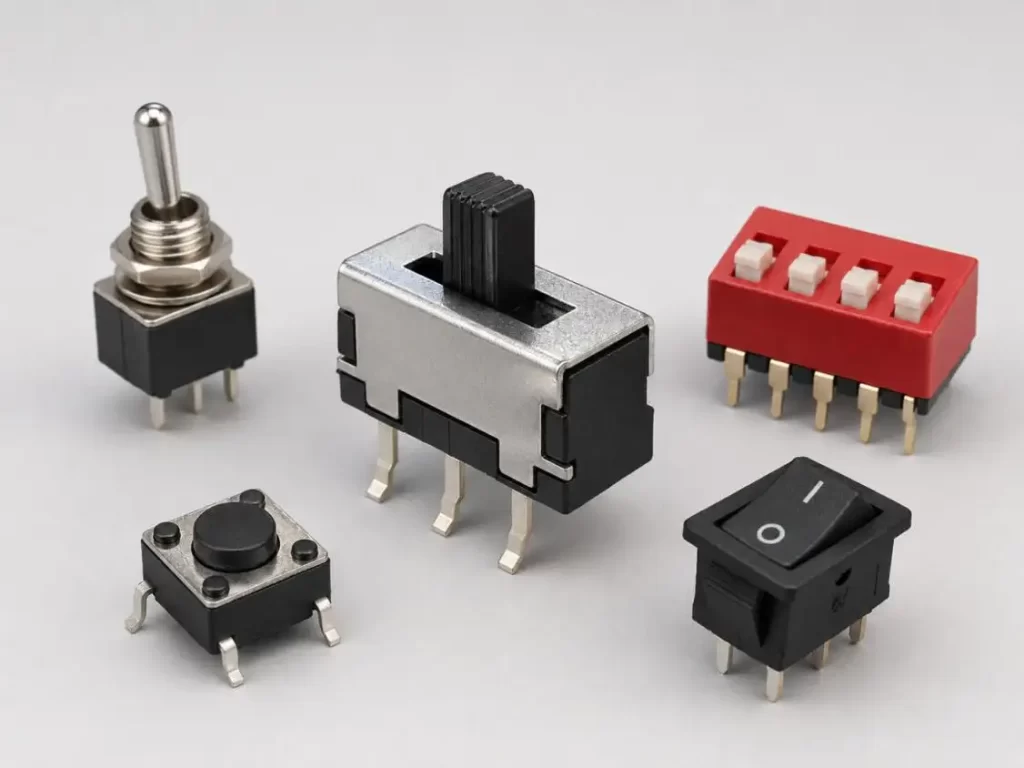
Selecting the wrong contact material can increase contact resistance, cause intermittent signals, generate excessive heat, or shorten electrical life. Buyers should therefore evaluate a Mini Slide Switch by more than dimensions and price. Contact material, surface plating, circuit load, terminal design, switching frequency, and operating environment must be considered as one system.
How a Mini Slide Switch Works
Moving the actuator drives an internal movable contact across fixed terminals. Contact behavior when opening, closing, or redirecting an electrical path depends on the circuit configuration.
Typical configurations are:
•SPST: Allows a circuit to be controlled in an ON-OFF manner.
•SPDT: Connects one of the outputs to the common terminal.
•DPDT: Provides the control to operate two separate circuits at the same time.
•Three-position design: can provide the functions of ON-OFF-ON among others.
The following have an impact on the electrical stability of a Mini Slide Switch:
•Contact material and plating choice.
•Contact area effectiveness.
•Contact force.
•Terminal shape.
•Travel distance of the actuator.
•Design of the internal spring.
•Tolerances in the housing and assembly.
Reliability of design is dependent on the consistency of these factors.
Typical Contact Materials of Mini Slide Switches
Varieties of contact materials produce different combinations of electrical characteristics, resistance to corrosion, resistance to wear, and cost.
| Material or Plating | Main Characteristics | Typical Application | Key Consideration |
| Copper alloy | Good conductivity and formability | Consumer electronics | Unprotected surfaces may oxidize |
| Silver plating | High conductivity and suitable for moderate loads | Power control and small appliances | May tarnish in sulfur-containing environments |
| Gold plating | Stable contact resistance and oxidation resistance | Sensors and low-level signal circuits | Higher cost and limited suitability for heavy arcing |
| Tin-plated terminal | Good solderability | PCB through-hole connections | Usually not the main switching surface |
| Composite plating | Balances conductivity, wear, and cost | Custom Mini Slide Switch projects | Must be specified for the actual load |
The terminal material may differ from the internal switching surface. When reviewing a gold-plated Mini Slide Switch, buyers should confirm:
•Plating location
•Plating thickness
•Base material
•Underplating structure
•Intended voltage and current range
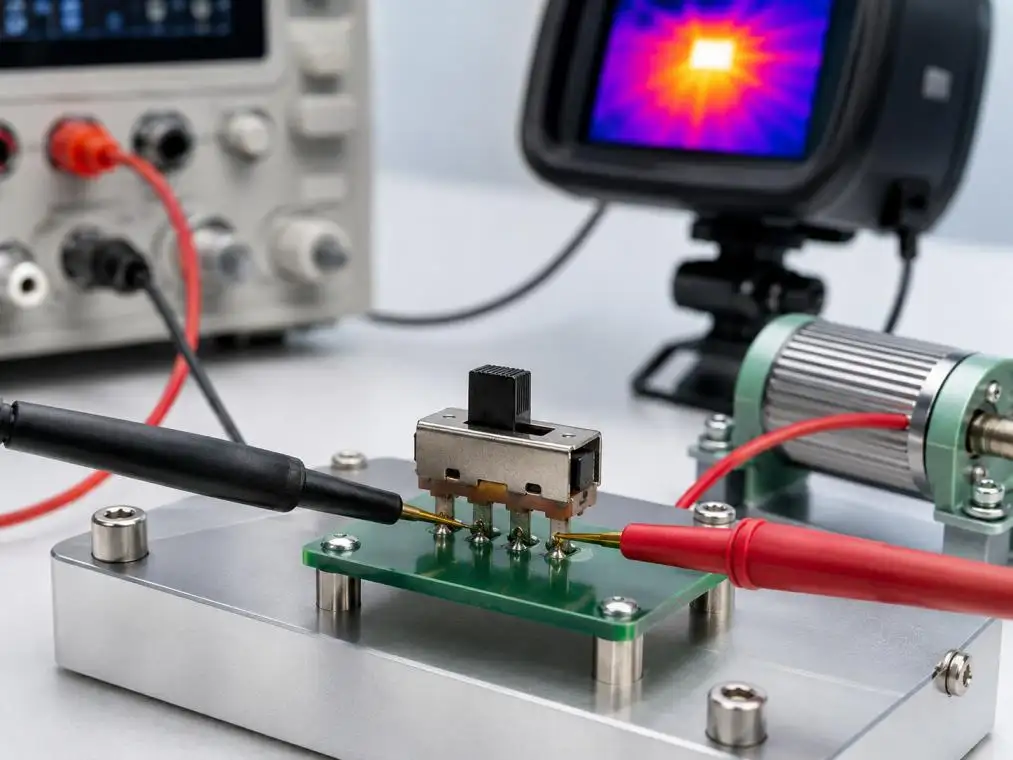
How Contact Materials Affect Electrical Performance
Contact Resistance
Contact resistance influences:
•Signal integrity
•Voltage drop
•Local temperature rise
•Long-term continuity
•Low-level circuit stability
For sensors, instruments, and signal boards, even a small increase in resistance may create intermittent performance. A low initial resistance value is useful, but resistance stability after repeated operation is equally important.
Current-Carrying Capacity
A Mini Slide Switch intended for higher current generally requires:
•Larger effective contact area
•Stable contact pressure
•Suitable conductive alloys
•Adequate terminal thickness
•Controlled temperature rise
•Sufficient resistance to electrical arcing
Rated current should never be evaluated separately from load type and switch construction.
Oxidation and Environmental Resistance
Humidity, dust, sulfur compounds, temperature cycling, and chemical exposure may alter the contact surface. Gold plating is often suitable for weak signals because it resists oxidation. For contact applications involving moderate power loads, silver-based contacts exhibit superior conductivity but are sensitive to environmental conditions and thus require added protection.
Mechanical Life vs Electrical Life
Mechanical life measures the number of operations without electrical load. Electrical life measures operations under specified voltage, current, and load conditions.
Contact wear may be accelerated by:
•Electrical arcing
•High inrush current
•Insufficient contact pressure
•Frequent switching
•Contaminated environments
A high mechanical-life rating does not automatically guarantee equivalent loaded performance.
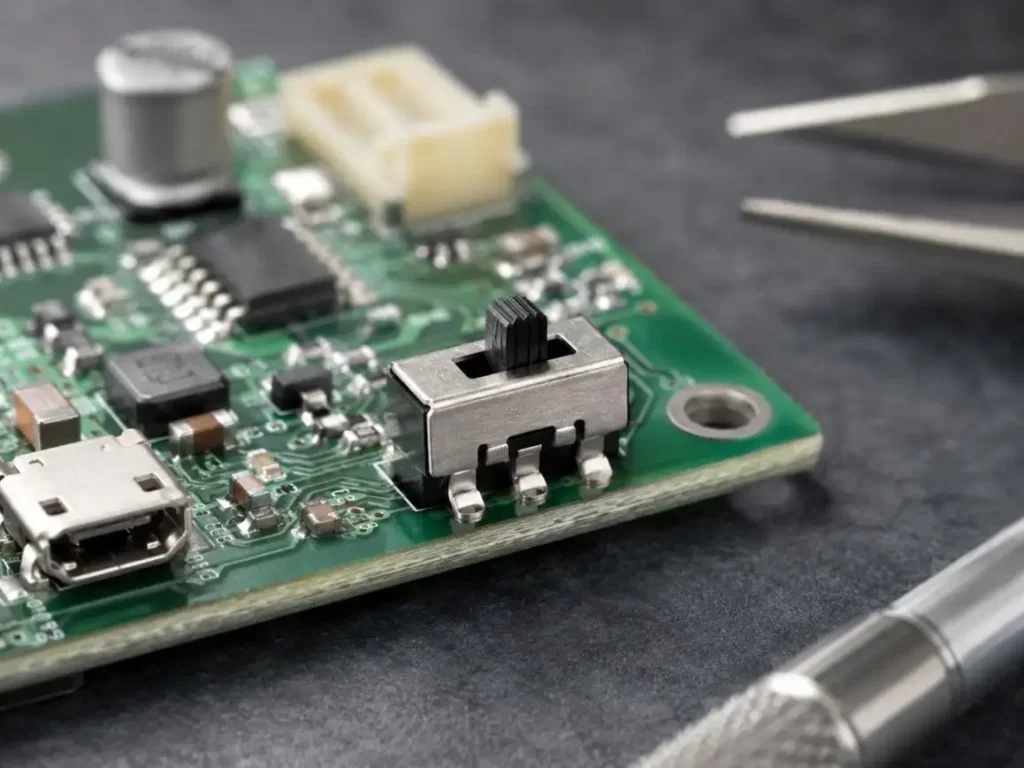
Understanding Mini Slide Switch Electrical Ratings
| Parameter | Procurement Meaning |
| Rated voltage | Permitted working voltage under defined conditions |
| Rated current | Current capacity under a specified load |
| Contact resistance | Resistance across closed contacts |
| Insulation resistance | Resistance between electrically isolated parts |
| Dielectric strength | Ability to withstand test voltage without breakdown |
| Electrical life | Loaded switching cycles under stated conditions |
The same Mini Slide Switch may have different ratings for AC and DC circuits. Resistive, inductive, capacitive, lamp, and motor loads also create different stresses.
For example, a motor may draw an inrush current much higher than its normal operating current. Final selection should therefore be verified using the manufacturer's data sheet and application-specific testing.
Low-Level Signal vs Small Power Switching
| Comparison | Low-Level Signal Circuit | Small Power Circuit |
| Main concern | Stable low contact resistance | Current capacity and heat |
| Typical contact choice | Gold or stable composite plating | Silver plating or conductive alloy |
| Common application | Sensors, instruments, signal boards | Toys, appliances, battery products |
| Main risk | Oxidation and intermittent signals | Arcing, wear, and temperature rise |
| Recommended test | Continuity and signal stability | Loaded life and temperature-rise testing |
There is no universally best contact material. The appropriate Mini Slide Switch contact material depends on the actual circuit and operating environment.
Mini Slide Switch vs Other Compact Switches
Horizontal comparison helps determine whether a Mini Slide Switch is the correct switch format.
| Switch Type | Main Advantage | Typical Limitation |
| Mini Slide Switch | Compact, maintained state, visible position | Requires actuator travel space |
| Mini Toggle Switch | Clear operation and strong tactile feedback | Usually occupies more space |
| DIP Switch | Suitable for multi-position circuit settings | Not designed for frequent operation |
| Tact Switch | Very compact and easy to integrate | Usually provides momentary operation |
| Rocker Switch | Easy to identify and operate | Requires a larger panel opening |
A Mini Slide Switch is generally suitable for compact devices requiring maintained switching and moderate operating frequency.
How to Compare Mini Slide Switch Specifications
After selecting the switch type, compare products vertically according to:
•SPST, SPDT, or DPDT circuit
•Two-position or three-position design
•ON-OFF, ON-ON, or ON-OFF-ON logic
•Through-hole, surface-mount, or wire terminals
•Horizontal or vertical actuator
•Actuator length and operating travel
•Contact material and plating
•Rated voltage and current
•Operating force
• PCB mounting dimensions
• Mechanical and electrical life
The objective is not to select the highest rating. It is to match the Mini Slide Switch to the PCB layout, circuit load, operating method, and expected service life.
Testing and Quality Control
The following inspections are applicable to Mini Slide Switches:
• Contact and insulation resistance
• Dielectric strength
• Terminal continuity
• Electrical and mechanical life
• Temperature rise
• Solderability
• Actuator travel
• Dimensional and visual
It is necessary to use the same materials, plating, tooling, and assembly as the production process to create equivalent samples. A batch inspection should verify consistency across the batch and should not be based on a single approved sample.

Common Errors in Selection
❌ Comparison of rated currents: The type of load and the test conditions are often ignored.
❌ Assuming superiority of gold plating: Wear, current, and plating costs must also be considered.
❌ Contact resistance: This may cause an unstable signal when operating at low levels.
❌ Selection based on dimensions: A mechanical fit does not ensure an electrical fit.
❌ General-purpose certificates: Acceptance of these certificates is often on the assumption that the component is covered by the certificate.
❌ Skipping production-equivalent samples: Prototype and mass-production performance may differ.
How Hanxia Supports Mini Slide Switch Development
Hanxia can develop a Mini Slide Switch around the required PCB space, housing dimensions, circuit logic, terminal arrangement, contact plating, actuator direction, operating travel, and electrical ratings.
Founded in 2014, Hanxia operates an approximately 5,600-square-meter facility with more than 90 employees and multiple automated production lines. Project support may include:
✅ Structural and contact-system design
✅ Tooling development
✅ Sample production and installation confirmation
✅ Automated assembly
✅ Functional and dimensional testing
Hanxia's quality management system is ISO 9001 certified. CE, REACH, and RoHS 2.0 documentation may be available for relevant products, but the applicable scope should be confirmed for the selected Mini Slide Switch.
Final Thoughts
Select a Mini Slide Switch that fits your application and matches contact material, plating, switching logic, terminals, and electrical rating. Compare different switch types and options in Mini Slide Switches side-by-side to narrow your specifications.
Provide your PCB layout, load profile, dimensions of the actuator, switching logic, the environment in which you will operate the switch, and the expected life to Hanxia. We will analyze your contact structure and make samples for the installation and electrical test equivalent to production.
FAQs
Q1. What is a Mini Slide Switch?
A Mini Slide Switch is a small device that uses electromechanical technology to make or break a connection or to divert an electrical path via a sliding motion. This device is great for control over the power, selection of the operating mode, or for even routing signals.
Q2. What contact materials are there in a Mini Slide Switch?
Several Mini Slide Switches are manufactured using copper alloys, silver contacts, gold contacts, or plated contacts of different materials. Selection of the contact material depends on the voltage, current, type of load, and the environment in which the switch would be operating.
Q3. Are gold-plated contacts always an advantage?
Not always. Gold-plated contacts are often an advantage when dealing with low-level signals since they are non-oxidizing and they maintain low contact resistance. In this instance, silver contacts could be a better choice when dealing with low to moderate current switching.
Q4. What is contact resistance in a Mini Slide Switch?
Contact resistance refers to the resistance that was measured across the contacts when they were closed. High contact resistance adversely affects the voltage, signal becomes unstable, there is localized heating, and the overall performance of the switch is degraded.
Q5. What is the difference between mechanical life and electrical life?
Mechanical life is concerned with the life of the switch without an electrical load, while electrical life is the opposite of mechanical life and is concerned with operating life under defined conditions of voltage and current flow. In general, life of a switch is more relevant to electrical life.
