





Micro Float Switch: Ultra-Compact Design For Dense PCB Mounting
Introduction
A Micro Float Switch is often the difference between reliable liquid level detection and unexpected system failure. As electronic appliances evolve, devices get smaller and denser, and circuits get smaller. Engineers and procurement managers have the same problems trying to find Micro Float switches that fit within the fighting compact housing and the switching performance limitations.
Optimizations in form and strict quality control have awarded HANXIA with Micro Float Switch models that can function in space-constrained assemblies. It can even fit in medical analyzers and industrial control panels manufacturing. It subsequently dispenses answers to micro float switch selection for dense PCB mounting, to improve integration and outline the resources that HANXIA allocates to meet the requirements posed by the engineers in the year 2026.
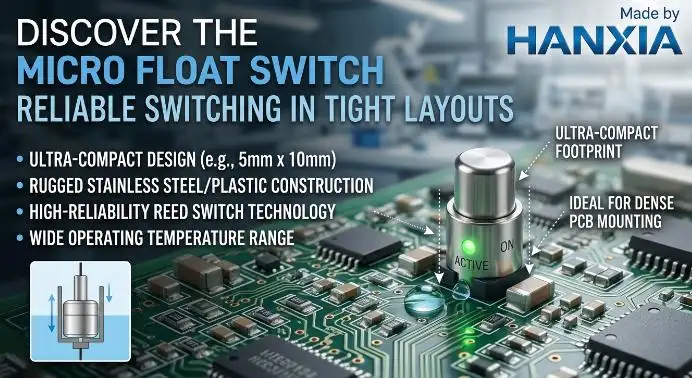
Why PCB Density Creates Demand for a Smaller Micro Float Switch
Modern PCBs pack more functionality into less board space
Competing for every denomination of space are capacitors, connectors, microcontrollers, and shielding cans.
In such an environment, it doesn't take a lot of liquid level indicators to become a layout bottleneck.
A Micro Float Switch designed for high-density PCBs must offer:
• Small housing footprint: allows placement near edge connectors or between tall components
• Low profile height: fits inside enclosures with limited vertical clearance
• Through-hole or compact terminal options: simplifies soldering and inspection.
When a Micro Float Switch ignores these constraints, design teams face difficult trade-offs: enlarge the enclosure, move components farther apart, or choose less reliable sensing methods. None of these options benefit the final product's cost or reliability.
Key Features of a PCB-Friendly Micro Float Switch
Not every Micro Float Switch suits dense board mounting. Based on real production requirements, buyers should look for the following physical and electrical characteristics.
• Mounting style compatibility: Vertical versus horizontal mounting preference that aligns with available PCB space is without crowding.
• Predictable switching mechanics: The reliable actuation point and negligible hysteresis prevent false switch triggers in space limited designs.
• Low power requirements: External drivers are obviated due to microcontroller I/O (or low side sensing) directly driving the switch.
• Material longevity: The thermoplastic or stainless steel housings remain structurally robust during the reflow soldering process.
• Prominent markings and indicators: Assembly mistakes during manual or robot assembly are less likely.
Micro Float Series switches are designed with the above from the beginning, not as optional extras.
This is important when moving from prototyping to mass manufacturing.
Integrating Micro Float Series Switches - Common Challenges
Micro Float Series switches often integrate easily into most PCB layouts. However, our customers often report the following common issues.
Mechanical interference when placing capacitors or inductors nearby.
Unusual spacing between switch pins makes manual soldering difficult and often results in soldering the switch to the incorrect pads.
Unstable output caused by inductive coupling due to nearby power traces.
Micro Float Series switches are designed to minimize these risks.
HANXIA achieves this by consistently molding switch bodies and controlling spacing between sensing reeds.
This results in design flexibility, fewer revisions and shorter validation.
This also results in design robustness and fewer field failures.
HANXIA's Quality Assurance Process
HANXIA does not use generic components when designing Micro Float Series switches.
As a manufacturer, every Micro Float Switch is subject to the same in-process electrical and visual inspections.
Important benefits for high-density applications:
• Slightly larger than industry standard length and diameter tolerances: Eliminates nasty surprises associated with mechanical interlocking on tight boards.
• Well matched specific gravity of the float: guarantees the same liquid level switching even when the Micro Float Switches are operated in tight quarters.
• Traceable production lots: allows engineers to correlate performance with specific build parameters when debugging rare issues.
HANXIA's factory standards align with what OEM buyers expect: repeatability, documentation, and support for custom cable or terminal configurations.
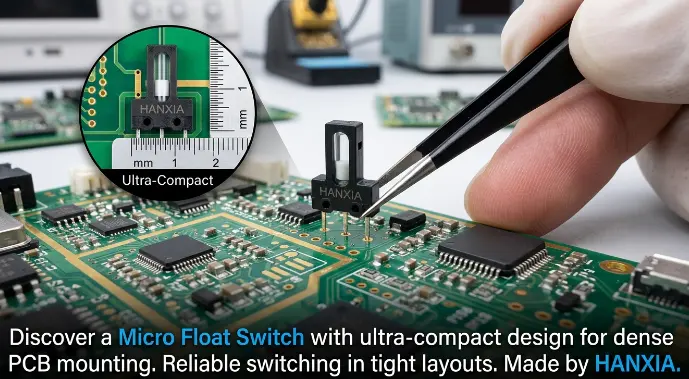
2026 Trends in Compact Liquid Level Sensing
The move toward denser PCBs did not start recently, but it accelerates each year. Looking at 2026 design and purchasing trends, several factors push more applications toward ultra-compact Micro Float Switch adoption.
• Miniaturization of home appliances: coffee machines and humidifiers now fit level detection into smaller water tanks.
• Portable medical devices: require components that survive portable use while fitting on multi-layer PCBs.
• Industrial IoT sensors: combine wireless communication, processing, and liquid detection in a single small enclosure.
In each case, a Micro Float Switch that saves board area delivers direct value: smaller final products, lower material costs, and easier assembly. HANXIA's product line stays current with these trends by offering multiple mounting configurations and output logic options.
How to Specify the Right Micro Float Switch
When evaluating samples, compare these measurable parameters rather than relying on marketing claims.
• Maximum Size: Check the dimensions of the tallest elements.
• Operating temperature: Check with the final designed environment range and NOT with the solder temperature.
• Inrush current: Refer to the Micro Float Switch's contact rating for solenoids or pump inrush current with direct load switching.
• Cable exit: For exiting the cable, choose top, side, or bottom. This keeps routing easy in tight spaces.
All of this information is provided on our data sheets, unique to HANXIA, and allows engineers to rapidly and confidently make the right choice.
Conclusion
Floating Micro Switch selection is often based on price and a catalog image but will often result in difficult integration for compact PCB design. The better approach is to prioritize physical footprint, switching stability, and manufacturing consistency—exactly where HANXIA focuses.
Whether you are developing next-generation laboratory equipment or upgrading a compact industrial controller, a correctly specified Micro Float Switch reduces layout compromises and improves long-term reliability.
Visit www.hx-switch.eu to explore HANXIA's Micro Float Switch lineup, request samples, or discuss custom configurations for your 2026 project timeline.
FAQ
Q: What is the minimum PCB space required for a Micro Float Switch?
A: It depends on the model, but HANXIA's ultra-compact designs typically occupy less than 10mm in diameter and 25mm in height, and will fit between components with a standard pitch.
Q: Can a Micro Float Switch be mounted vertically and horizontally on the same PCB?
A: Yes, each model is vertical/horizontal, so you choose the orientation to simplify your liquid channel and enclosure design.
Q: Does a smaller Micro Float Switch mean lower reliability or shorter life?
A: No. It is possible for a Micro Float Switch to achieve millions of cycles under a load with a properly chosen reed switch and appropriate seal.
Q: Is it difficult to solder a Micro Float Switch on a dense PCB?
A: Definitely not as long as the pitch and leads are designed properly. HANXIA adopts standard through-hole designs to ensure compatibility.
Q: Does HANXIA have the capability of altering the cable length or the terminal type as it pertains to PCB mounting?
A: Certainly. Custom cables, pre-stripped wires, or right-angle terminal design are available with volume purchases.
Q: How do I test if a Micro Float Switch fits my PCB layout?
A: Probably best if you contact HANXIA for a sample and run a mechanical fit test on your actual printable layout for your PCB gerber.
