





Low Profile Tact Switch Guide for Thin Electronic Devices
When your PCB-to-housing clearance is measured in fractions of a millimeter, the tact switch you choose can determine whether your product fits together cleanly — or goes back to the drawing board. In slim consumer electronics, wearables, and portable medical devices, standard tact switches are simply too tall. A low profile tact switch solves that problem directly by delivering reliable tactile feedback within a drastically reduced height envelope.
This guide explains what low profile tact switches are, how their specifications translate to real design constraints, how to choose the right variant for your device, and how to avoid the integration mistakes that cause problems at assembly. If you are designing a thin electronic device and need to specify a tact switch correctly, this is the guide for you.
What Is a Low Profile Tact Switch?
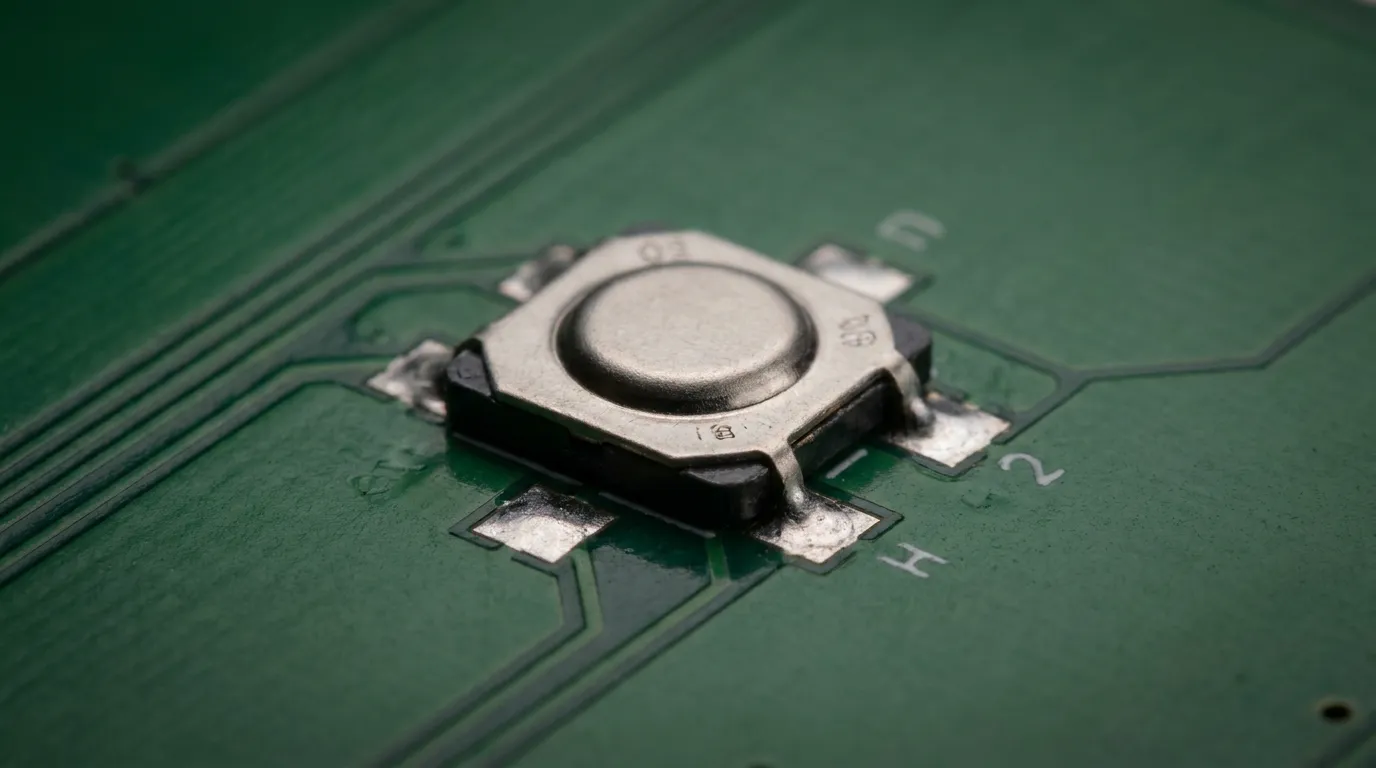
A low profile tact switch is a miniature momentary push-button switch designed with a reduced overall height — typically 2.5mm or below including the actuator — making it suitable for space-constrained PCB layouts where a standard-height tact switch would not physically fit.
In simple terms, it performs the same function as any tact switch: pressing the actuator completes a circuit momentarily, producing a click or tactile feedback to confirm the input. The difference is that every dimension has been engineered downward. The body is shorter, the footprint is smaller, and the actuator travel is tighter — all without sacrificing the reliable snap-action contact that makes tactile switches useful in the first place.
The term "low profile" specifically refers to the overall height from the PCB surface to the top of the actuator cap. Ultra-low profile variants reach as little as 0.55mm to 0.65mm in total actuator height, while standard low profile variants typically fall between 1.5mm and 2.5mm. For context, a conventional through-hole tact switch in a standard package often measures 5mm or more in overall height — three to five times taller than its low profile equivalent.
For a broader understanding of tact switch types, working principles, and category options, see our complete tact switch guide.
How Low Profile Tact Switches Work
The operating mechanism inside a low profile tact switch is the same dome-contact principle used in larger tactile switches, but re-engineered into a much thinner package. When you press the actuator, it compresses a stainless steel or metal alloy dome located inside the switch body. At the actuation point, the dome snaps inward, completing the electrical contact between the terminals and generating the characteristic tactile click. Releasing the button allows the dome to spring back, breaking the circuit.
What changes in a low profile design is the stroke length — the distance the actuator travels before the dome snaps. Ultra-thin device designs require extremely short travel: 0.1mm to 0.2mm is typical for the slimmest variants, which gives fast response and crisp tactile feedback even with minimal physical movement. This short stroke means there is very little mechanical travel before actuation occurs, which is appropriate for applications where users interact with buttons through thin enclosures or flush-mounted surfaces.
The contact mechanism is usually a 4-pin layout for stability on the PCB, with the electrical path running through the dome when pressed. Some variants add a ground pin for enhanced ESD protection, which is important in sensitive electronics. The entire assembly — body, dome, actuator, and terminals — is engineered to sit as close to the PCB surface as possible, which is how these switches achieve their defining low height characteristic.
Key Specifications to Understand Before Selecting
Choosing the wrong specification is the most common and most costly mistake in tact switch selection. Here are the four specification dimensions that matter most when selecting a low profile tact switch for a thin device application.
Profile Height and Body Dimensions
The overall height is the most critical specification — it determines whether your switch physically fits inside your enclosure. Low profile tact switches are generally categorized as follows:
| Category | Overall Height | Typical Application |
|---|---|---|
| Ultra-low profile | 0.55mm – 0.65mm | Hearing aids, earbuds, wearable patches |
| Low profile | 1.0mm – 2.0mm | Smartwatches, fitness bands, slim phones |
| Standard low profile | 2.0mm – 2.5mm | Tablets, thin laptops, compact IoT devices |
| Standard (non-low profile) | 3.5mm – 5.0mm+ | General electronics, industrial panels |
Beyond overall height, check the body footprint dimensions (typically 3mm × 2mm for miniature SMT variants up to 6mm × 6mm for larger low profile types) and the actuator diameter. Smaller footprints allow higher component density on the PCB, which matters in slim device layouts where every square millimeter of board space is accounted for.
Actuation Force and Operating Life
Actuation force — measured in Newtons (N) or gram-force (gf) — determines how much pressure a user must apply to trigger the switch. For low profile tact switches, the available range is typically 1.3N (approx. 130gf) to 5N (approx. 500gf), with most thin-device applications falling in the 1.57N–2.55N range.
The right force depends on the use context. Hearing aids, earbuds, and wearable health patches benefit from lighter actuation forces (1.3N–1.6N) because users often press with a fingertip or light touch. Smartwatch side buttons and device power buttons typically use 2.0N–2.5N for a confident press feel without accidental activation. Devices where unintended button presses would cause a problem — such as portable medical monitors — may specify higher forces approaching 3N–5N for deliberate resistance.
Operating life (cycle rating) is equally important. Quality low profile tact switches are rated for 100,000 to 500,000 operating cycles. A smartwatch power button pressed ten times daily will accumulate roughly 3,650 presses per year — meaning a 100,000-cycle switch would theoretically last over 27 years in that specific scenario. For high-interaction applications like gaming peripherals or frequently accessed controls, specify the highest available cycle rating.
Sealing and Environmental Protection
Not all low profile tact switches are sealed. Unsealed variants are fine for enclosed devices where the PCB is protected from moisture and contamination. However, for wearables, outdoor devices, and medical equipment where exposure to sweat, humidity, or cleaning fluids is expected, choose a sealed variant.
IP67-rated low profile tact switches are available even in ultra-thin packages, using rubber plunger seal construction to protect the contact cavity from dust and water ingress. Sealed variants are slightly more complex to manufacture and may have a marginally higher profile compared to their unsealed equivalents, so verify that the sealed version's dimensions still fit within your height budget. The performance tradeoff is worth it for any device that will contact skin or moisture regularly.
RoHS Compliance and Soldering Compatibility
All low profile tact switches for modern consumer and medical electronics should be RoHS compliant, meaning they are manufactured without restricted hazardous substances. Additionally, verify that the switch is rated for the soldering method you are using. SMT low profile tact switches are designed for reflow oven soldering and must be rated to withstand peak temperatures typically in the 250°C–260°C range for short durations. This is a data sheet specification — confirm it before sending your board to assembly.
SMT vs. Through-Hole: Which Mounting Method Fits Thin Devices?
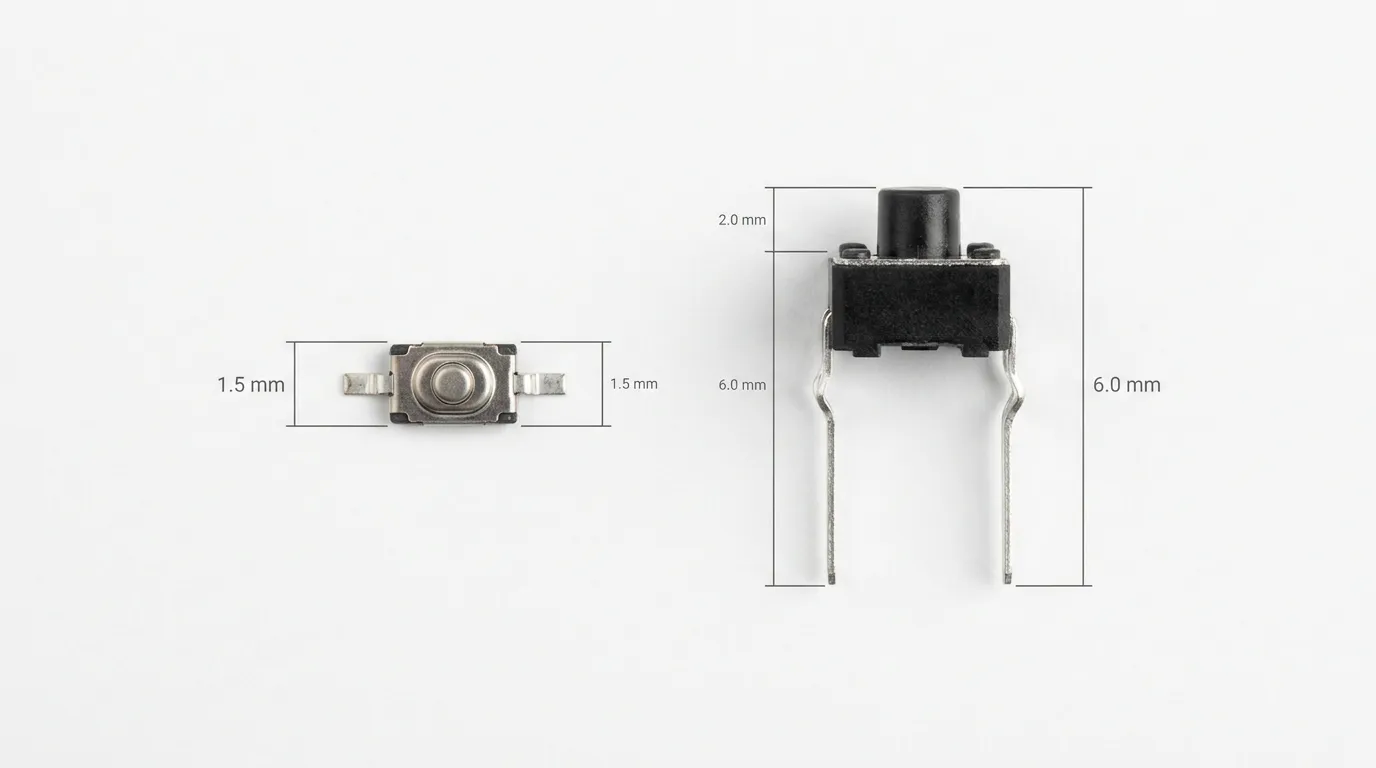
For the vast majority of thin electronic device applications, Surface Mount Technology (SMT) is the correct mounting choice. Through-hole (THT) tact switches require drilled holes through the PCB, which reduces board structural integrity in thin PCBs, consumes vertical space on both sides of the board, and is incompatible with automated reflow assembly processes. SMT switches sit directly on the PCB surface with solder pads, enabling flat mounting, automated pick-and-place assembly, and a much lower combined component height.
| Feature | SMT Low Profile Tact Switch | Through-Hole Tact Switch |
|---|---|---|
| Overall height | 0.55mm – 2.5mm | Typically 3.5mm – 6.0mm+ |
| PCB drilling required | No | Yes |
| Automated assembly compatible | Yes (reflow) | Limited (wave solder) |
| Component density | High | Lower |
| Best for thin devices | Yes | Not recommended |
| Repairability | More difficult | Easier manually |
| IP sealing availability | Available | Limited in slim variants |
The one scenario where through-hole still applies to thin-device contexts is when mechanical strength is the primary concern — THT soldered pins provide stronger mechanical anchoring under direct push forces. For most consumer thin electronics, however, SMT is the engineering default and the right choice for integrating a low profile tact switch.
If your enclosure design requires the button actuator to face horizontally rather than straight up — for example, a side button on a smartwatch or the edge trigger on a compact remote — consider reviewing our right angle tact switch guide as an alternative orientation option.
Where Low Profile Tact Switches Are Used in Thin Electronics

Low profile tact switches appear in virtually every product category where slim form factor and user interaction intersect. Understanding where they are used helps you validate your own design choice before specifying components.
Smartphones and tablets use low profile SMT tact switches for volume buttons, power buttons, SIM tray ejector triggers, and sometimes touchpad feedback mechanisms. The switch must fit within the slim side frame of the device, making 1.5mm–2.0mm overall height the typical range for these applications.
Smartwatches and fitness bands represent the most demanding application category for low profile tact switches. Devices like fitness trackers and health monitoring wristbands use switches with profiles between 1.0mm and 2.0mm for side-button controls, with sealing essential due to sweat and water exposure. Applications include hearing aids, earbuds, mobile phones, fitness and healthcare wristbands, and smart glasses — all of which demand micro-miniature switch dimensions.
Wearable medical devices — including portable ECG patches, glucose monitors, and wearable drug delivery systems — require ultra-low profile switches where the total device thickness is a clinical and regulatory constraint. Sealed variants rated for skin contact environments are standard in this category.
Wireless earbuds and hearables use the smallest available variants, sometimes below 1mm in actuator height, to fit the miniature housing geometries of modern earbud shells. High cycle ratings are important here because users interact with control surfaces frequently throughout the day.
Ultra-thin laptops and tablets use low profile tact switches for keyboard feedback mechanisms, trackpad click registers, and power switch assemblies. In laptop keyboards, SMT low profile switches allow SMD LEDs to be placed directly underneath the switch body for backlighting — a configuration only possible because of the reduced switch height.
Compact IoT devices and smart home sensors use low profile tact switches for pairing buttons, reset controls, and user input on small enclosures where a standard switch would make the housing visibly larger than necessary.
How to Select the Right Low Profile Tact Switch for Your Device
Selecting a low profile tact switch is not about choosing the thinnest switch available — it is about matching specifications to your specific design constraints. Follow these five steps to specify correctly.
Step 1: Define Your Height Budget
Measure the internal PCB-to-housing clearance at the switch location. Subtract a minimum clearance tolerance (typically 0.1mm–0.2mm to account for manufacturing variation and housing flex). The result is your maximum allowable overall switch height. Any low profile variant with an overall height at or below this number is geometrically eligible.
Step 2: Determine the Required Actuation Force
Consider who will press this button, how often, and in what conditions. Light, frequent interactions (wearables, earbuds) call for 1.3N–1.6N. Confident, infrequent buttons (power, mode) typically work well at 2.0N–2.5N. Buttons that must resist accidental presses in active environments (medical devices, sports equipment) should use 3N or above.
Step 3: Choose SMT Mounting
Unless you have a specific mechanical reason to use through-hole (which is rare in thin device design), specify SMT. It keeps overall height lower, supports automated assembly, and is compatible with the reflow soldering standard used in modern electronics manufacturing.
Step 4: Assess Sealing Requirements
Will the switch be exposed to moisture, sweat, cleaning agents, or dust? If yes, specify a sealed variant with IP67 or equivalent rating. Confirm that the sealed variant's dimensions still meet your height budget — sealed switches may add 0.1mm–0.3mm to the overall height in some designs.
Step 5: Confirm RoHS and Reflow Temperature Rating
Verify that the switch is RoHS compliant and that its maximum reflow temperature rating exceeds the peak temperature of your soldering process. A switch that cannot survive your assembly process is a reliability risk regardless of how well it matches your other specifications.
PCB Integration and Soldering Best Practices
Even a correctly specified low profile tact switch will fail at assembly if it is integrated incorrectly. These practices reduce the risk of rework, solder joint failures, and mechanical misalignment.
Pad layout precision matters. SMT tact switches have tight terminal pad footprints — especially ultra-miniature variants. Use the manufacturer's recommended pad dimensions exactly. Undersized pads reduce solder joint strength; oversized pads can cause solder bridges between adjacent terminals.
Ensure flush seating before reflow. Ultra-low profile SMT switches must sit completely flat on the PCB surface before soldering. Even a slight tilt — caused by uneven paste deposition or PCB warping — will result in uneven solder joints. At the scale of a 0.55mm profile switch, a 0.1mm tilt is a significant percentage of the total component height.
Control your reflow temperature profile. Low profile switches with ultra-thin plastic bodies are sensitive to thermal stress. Follow the manufacturer's recommended reflow profile: a gradual preheat, controlled ramp to peak temperature (typically 250°C–260°C for lead-free), and a controlled cool-down. Do not exceed the rated peak temperature. Thermal shock from an overly rapid profile can warp the switch body or degrade the dome contact inside.
Account for stroke depth in your enclosure design. The actuator travel of an ultra-low profile switch is very short — often 0.1mm–0.2mm. Your enclosure button cap must transfer user force accurately to the actuator without bottoming out on the PCB or the switch body before the dome actuates. Model this clearance during enclosure design, not after the first prototype arrives.
Clean carefully if using flux. Unsealed low profile tact switches are sensitive to flux residue, which can migrate into the contact area and increase contact resistance over time. Use no-clean flux where possible, or ensure thorough cleaning using methods that do not force liquid into unsealed switch bodies.
Low Profile vs. Standard Tact Switch: Direct Comparison
| Specification | Low Profile Tact Switch | Standard Tact Switch |
|---|---|---|
| Overall height | 0.55mm – 2.5mm | 3.5mm – 6.0mm+ |
| Footprint (typical) | 3mm × 2mm to 6mm × 6mm | 6mm × 6mm to 12mm × 12mm |
| Mounting type | SMT (primary) | Through-hole (primary) |
| Stroke length | 0.1mm – 0.3mm | 0.25mm – 0.5mm+ |
| Automated assembly | Yes | Limited |
| Sealing availability | Yes (IP67 in select variants) | Yes |
| Typical applications | Wearables, slim phones, medical | Panels, remotes, general electronics |
| Actuation force range | 1.3N – 5N | 1.5N – 7N+ |
| Operating life | 100k – 500k cycles | 100k – 1M cycles |
The main difference is that low profile tact switches are engineered specifically for height-constrained, surface-mount PCB designs, while standard tact switches prioritize mechanical robustness and versatility in thicker assemblies. Neither is universally better — the correct choice depends entirely on your device's physical constraints and assembly requirements.
For a full comparison of tact switch types including panel mount, right angle, and illuminated variants, see our complete tact switch guide.
Common Mistakes to Avoid
Selecting based on profile height alone. Engineers sometimes choose the thinnest available switch without checking actuation force, cycle life, or sealing — and then discover the switch feels wrong to users or fails prematurely in the field. Height is just one axis of the specification.
Ignoring the sealed vs. unsealed distinction. A wearable device that contacts skin will be exposed to sweat every time it is worn. An unsealed switch in that position will accumulate moisture in the contact cavity over weeks of use, leading to intermittent contact failures or corrosion. Always verify sealing requirements before finalizing the component.
Using the wrong reflow temperature profile. The thin bodies of ultra-low profile tact switches are less thermally tolerant than larger standard components. Running a reflow profile calibrated for larger components can warp or crack ultra-thin switch housings. Request and follow the manufacturer's specific reflow recommendations.
Not accounting for actuator height in enclosure clearance modeling. The listed "overall height" of a tact switch includes the actuator at rest. Your enclosure button cap must press the actuator down by the stroke distance before contact is made — meaning the cap must travel below the switch's at-rest top surface. If your enclosure design allows zero clearance below the button cap, the switch will never actuate. This is a surprisingly common prototyping error.
Mismatching actuation force to the user interaction. A 5N actuation force on a hearing aid control button will frustrate users with limited finger strength. A 1.3N force on a smartwatch sports mode button will trigger unintentionally during workouts. Force specification should reflect the actual human interaction context, not just what is available from the supplier.
Skipping the footprint verification step. Two low profile tact switches with identical body dimensions may have different pad layouts depending on the variant (2-pin vs. 4-pin, ground terminal vs. no ground). Never assume footprint compatibility between variants — verify the land pattern drawing for every component before committing it to your PCB layout.
Related Guides
If your thin device design requires the tact switch actuator to face horizontally — for example, a side control on a fitness tracker or a lateral input on a compact remote — the actuator orientation changes your component selection entirely. Our right angle tact switch guide covers how right angle variants work, where they fit in thin device side-wall designs, and how to select and integrate them correctly.
For a complete overview of all tact switch types, applications, and buying considerations across the full product category, visit our tact switch guide. It covers the full landscape of tactile switch options, from standard through-hole types to sealed SMT miniature variants — useful when you are making initial component category decisions before narrowing to a specific subtype.
Frequently Asked Questions
What is the minimum available height for a low profile tact switch?
Ultra-low profile tact switch variants are available with overall heights (including the actuator) as low as 0.55mm to 0.65mm. These ultra-thin variants are typically designed for hearing aids, wireless earbuds, and wearable sensor patches where the total device thickness is under 5mm.
What is the difference between a low profile tact switch and a standard tact switch?
A standard tact switch typically measures 3.5mm to 6mm or more in overall height and is commonly through-hole mounted. A low profile tact switch is specifically designed with an overall height of 2.5mm or below and is primarily surface-mount, making it suitable for thin PCB assemblies where a standard switch would not fit.
Are low profile tact switches suitable for reflow soldering?
Yes — SMT low profile tact switches are designed for reflow oven soldering. However, you must verify that the specific switch you have selected is rated for your process's peak reflow temperature, typically 250°C–260°C for lead-free processes. Always check the manufacturer's recommended reflow profile before assembly.
What is the typical operating life of a low profile tact switch?
Most quality low profile tact switches are rated for 100,000 to 500,000 operating cycles. The appropriate rating depends on how frequently the button will be used. A daily-use wearable fitness tracker button might accumulate 10,000 to 20,000 presses per year, making a 200,000-cycle rating appropriate for a 10-year product life expectancy.
How do I calculate the right profile height for my device?
Measure the internal clearance between your PCB surface and the inner face of your housing or button cap at the switch location. Subtract a 0.1mm–0.2mm mechanical tolerance. The resulting figure is your maximum allowable overall switch height. Select any low profile tact switch with an overall height equal to or less than this calculated maximum.
Choosing the Right Low Profile Tact Switch
A low profile tact switch is a precision mechanical component, and selecting the right one requires more than finding the shortest option in a catalog. Your height budget sets the outer boundary. From there, actuation force must match the real interaction pattern of your users. Sealing requirements must reflect your device's exposure environment. And your PCB integration process must be executed to the same precision that the component itself demands.
The devices these switches enable — smartwatches, hearing aids, fitness trackers, medical wearables, and ultra-thin laptops — set a high bar for both product quality and component reliability. Specifying the right low profile tact switch at the design stage is one of the decisions that determines whether those products meet that bar.
If you are ready to explore low profile tact switch options or need guidance on selecting the right specification for your device, contact the HX Switch team for technical support and product recommendations.
