





How a Tact Switch Works: Internal Mechanism & Physics
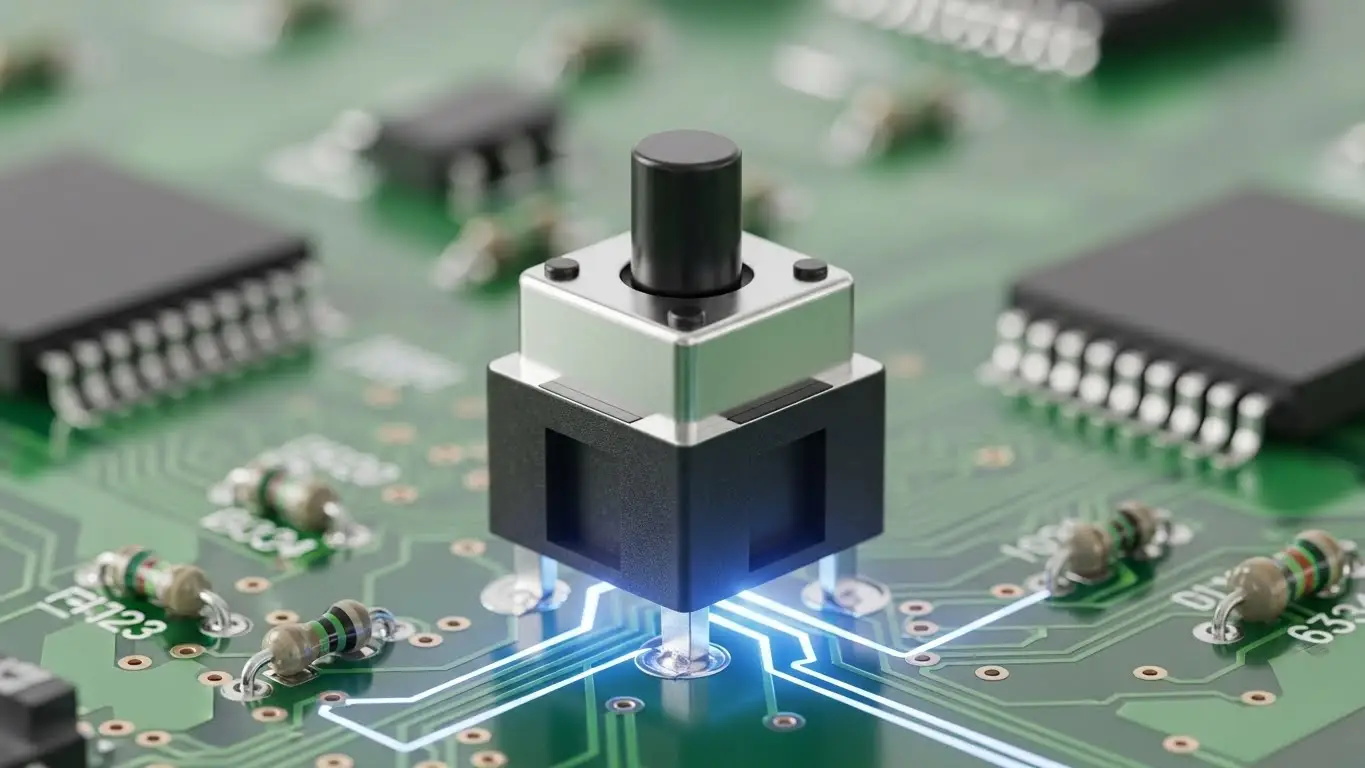
At its simplest, a tact switch (tactile switch) is a momentary push-button that connects two electrical points only while pressed. But the magic lies in the feedback. Unlike a squishy rubber button, a tact switch provides a crisp, snappy "click" that physically confirms the connection has been made.
This guide takes you inside the metal and plastic housing to explain exactly how that snap happens and how the electrical circuit is completed.
(New to this component? Start with our overview on What is a Tact Switch for a broader introduction.)
Anatomy of a Tact Switch: The 4 Key Layers
To understand the mechanism, you must first visualize the stack-up. A standard tact switch is built like a sandwich, consisting of four primary components working in unison.
1. The Cover & Plunger (The User Interface)
The top layer is the cover (usually metal) and the plunger (plastic).
- The Plunger: This is the button you actually press. Its shape dictates the "travel distance"—usually between 0.25mm and 0.50mm.
- The Mechanism: The plunger transmits force from your finger directly to the center of the dome beneath it.
2. The Contact Dome (The "Heart")
This is the most critical component. It is a convex, arched disc usually made of phosphor bronze or stainless steel.
- Role: It acts as both the spring (returning the button up) and the moving electrical contact.
- The "Snap": The dome is designed to buckle under specific pressure, creating the signature tactile feel.
3. The Base (The Housing)
Molded from heat-resistant resin/plastic, the base holds the terminals in place and insulates the switch from the circuit board (PCB).
4. The Contacts (The Circuit)
Embedded in the base are two fixed metal contact points (pins).
- Material: These are often silver-plated (for conductivity) or gold-plated (for corrosion resistance).
- State: In a standard switch, these contacts are separated by air (Normally Open).
The Physics of the "Click": How Actuation Happens
When you press a tact switch, a specific sequence of mechanical and electrical events occurs in milliseconds.
Step 1: The Pressure Build-Up
As you apply force to the plunger, the metal dome begins to flex. It resists your finger, creating "actuation force."
Step 2: The Buckling Point (Hysteresis)
Once the force exceeds the dome's threshold (e.g., 160gf), the dome suddenly collapses or "inverts."
- Why it clicks: This collapse isn't linear. It’s an instant release of resistance. This sudden drop in resistance is called the tactile ratio or click ratio. Your brain registers this sudden "give" as a physical confirmation.
Step 3: Circuit Completion
The center of the inverted dome hits the fixed contacts in the base. This bridges the gap between the two pins, allowing electricity to flow. The circuit is now closed (ON).
Step 4: The Return
When you release the button, the metal dome uses its elastic memory to snap back to its original convex shape. It pushes the plunger up and disconnects the circuit (OFF).
Note: For a comparison of how this mechanism differs from other board-mounted switches, see our guide onTact vs. DIP Switch Fundamentals.
The Invisible Phenomenon: Contact Bounce
One detail most guides miss is Contact Bounce.
When the metal dome hits the fixed contacts, it doesn't just stick perfectly instantly. Because it is metal hitting metal with elastic force, it actually "bounces" microscopically.
- The Result: For a few microseconds, the electrical signal flickers On-Off-On-Off before stabilizing.
- The Fix: Good circuit design uses "debouncing" (either via software code or a capacitor) to ignore these initial jitters and register a single, clean press.
Common Mechanism Variations
While the basic mechanism remains the same, the internal construction varies for specific environments:
Sealed Tact Switches (IP Rated)
In these versions, a thin silicone rubber membrane is placed under the plunger but over the metal dome.
- Function: It allows the plunger to push the dome while preventing dust, water, or soldering flux from entering the contact area, which could cause connection failure.
Illuminated Tact Switches
The mechanism here is modified to accommodate an LED. Usually, the plunger is made of transparent or hollow material to let light pass through from an LED mounted in the center or side of the base.
Frequently Asked Questions
The sound is caused by the metal dome snapping from a convex shape to a flat/concave shape. This acoustic release of energy occurs simultaneously with the physical tactile feedback. Silent tact switches use rubber domes instead of metal to dampen this sound.
The two most common failure modes are fatigue (the metal dome loses its elasticity after millions of cycles) and oxidation (the silver plating on the contacts tarnishes, increasing resistance until the switch no longer conducts electricity reliably).
Travel distance is how far the button must be pressed to actuate. For tact switches, this is very short—typically 0.25mm to 0.5mm—allowing for rapid, repeated inputs.
The vast majority are Normally Open (NO), meaning electricity does not flow until pressed. However, specialized Normally Closed (NC) versions exist where pressing the button breaks the circuit, though these are rare in standard consumer electronics.
Key Takeaways
- The Dome is Key: The internal metal dome provides both the electrical connection and the physical spring-back action.
- It's Momentary: Current only flows while the user actively applies force; release breaks the circuit.
- Hysteresis creates the feel: The "click" is a physical phenomenon caused by the non-linear collapse of the dome.
- Bounce happens: All mechanical switches experience "contact bounce" that must be managed by the device's electronics.
