





Ditch the Old Controls: How a Dual Rocker Switch Panel Enhances Your System
Why a Dual Rocker Switch Panel Upgrade Pays Back
Dual Rocker Switch Panel upgrades are one of the fastest ways to modernize a control surface without redesigning the entire system—and the business case is stronger than many teams expect. Unplanned downtime is expensive: one major industry survey estimates the world’s 500 biggest companies lose about 11% of revenues to unplanned downtime (about $1.4 trillion), and cites $2.3 million per hour in automotive at the high end.
At the plant level, a separate survey-driven industry report highlights that an hour of unplanned downtime “hovers around $25,000,” and can exceed $500,000 in larger organizations.
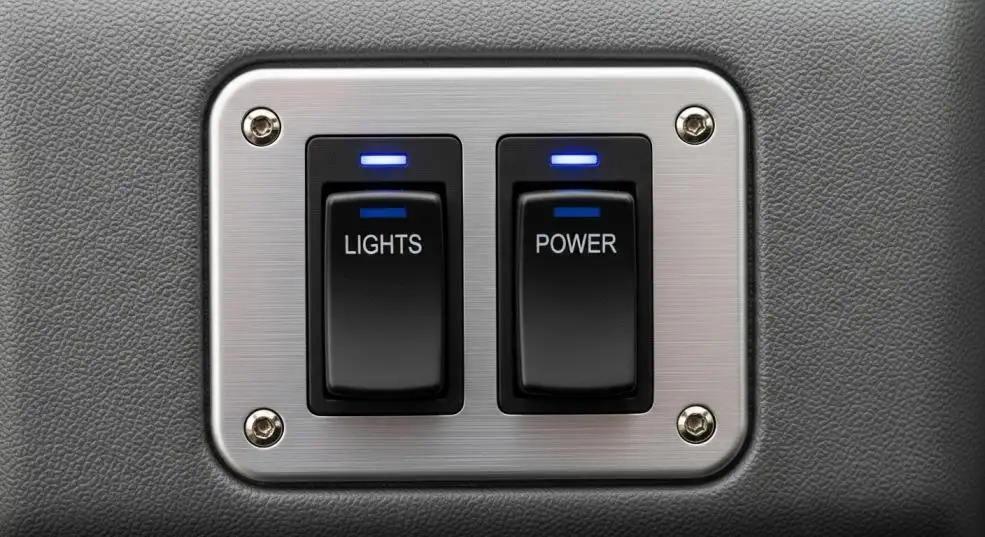
A Dual Rocker Switch Panel is a small component choice that supports big outcomes: faster operation, clearer status, fewer wiring mistakes, and better sealing opportunities where water/dust are real-life threats. HANXIA’s own field feedback mirrors this: teams move from loose individual switches to a compact panel to reduce weak points and simplify wiring and the user interface.
✓ More control density in less space
✓ A cleaner, more readable interface—especially under time pressure
✓ Fewer cutouts and cable runs, which supports better long-term durability
✓ Easier standardization for OEM builds and maintenance teams
Why Old Single-Switch Controls Can Hold Your System Back
Most “old controls” are not bad because a single switch is inherently wrong. They fail because the control approach scales poorly: every new function adds another hole, another label, another termination point, and another chance for inconsistency. HANXIA often sees this pattern in vehicles, marine equipment, and industrial cabinets where dust, spray, vibration, and temperature swings are normal—not exceptional.
As the number of discrete switches grows, systems typically face three predictable costs:
- Interface cost: users must scan more labels and remember more “rules.”
- Installation cost: more point-to-point wiring increases time and rework risk.
- Reliability cost: more physical openings and exposed terminations create more pathways for slow ingress and corrosion-driven faults over time.
A Dual Rocker Switch Panel is a pragmatic response to scaling pressure: consolidate control points into one panelized interface, standardize the mounting approach, and make “what’s on” visible at a glance.
| Attribute | Old Single-Switch Controls | Dual Rocker Switch Panel |
| Panel Space | Many separate cutouts; layout drifts over revisions | Two functions consolidated into one defined footprint |
| Wiring Effort | More point-to-point runs; higher rework risk | Shorter, cleaner routing; easier harness logic |
| Status Visibility | Often unclear without extra indicators | Supports integrated illumination/indication conceptually |
| Sealing Strategy | Multiple openings create multiple leak paths | Fewer openings; sealing can be designed as a system |
| Troubleshooting | “Which switch/which wire?” slows diagnosis | Clearer grouping speeds isolation and repair |
How a Dual Rocker Switch Panel Improves Human Operation
Good controls are not only electrical. They are also human. The best manufacturing and product teams treat the control interface as part of reliability engineering—because confusion and hesitation create operational errors, service calls, and poor user confidence. Research on human-centered design emphasizes that improving usability can reduce stress and safety risk while supporting productivity.
In practical terms, a Dual Rocker Switch Panel helps operators do three things faster:
✓ Locate the right control (grouping and consistent geometry)
✓ Actuate with confidence (repeatable click/force and predictable behavior)
✓ Verify status (visual indicators and unambiguous ON/OFF state)
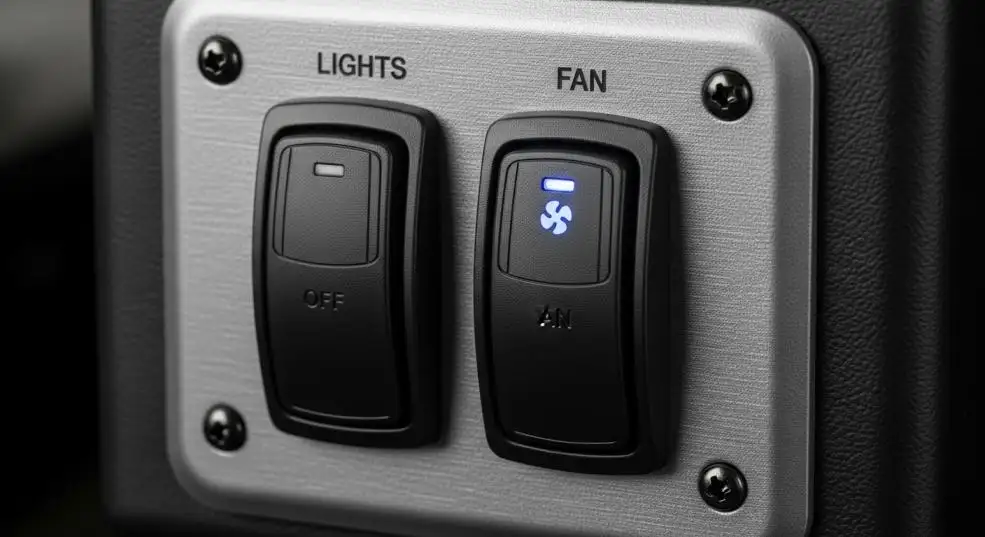
HANXIA’s panel-focused design thinking follows the same logic: consolidate multiple functions into a compact interface and reduce the number of separate cutouts. That makes the panel easier to read at a glance and supports better sealing.
For glove-friendly use, actuation force matters. HANXIA’s dual-function rocker/push control approach references an operating force around 250 ± 50 g, specifically noting usability even with work gloves in demanding environments.
Dual Rocker Switch Panel Reliability: Sealing, Cycles, and Real Environments
Reliability claims should translate into testable requirements. Two reality checks matter most: ingress protection (dust/water) and service life under load (electrical wear).
Ingress protection is commonly communicated using IP ratings defined by the International Electrotechnical Commission standard IEC 60529. IP codes separate protection against solids (first digit) and water (second digit).
HANXIA’s marine-focused guidance also highlights how buyers typically interpret common targets: IP65 for dust + water jets, IP66 for stronger jet exposure, and IP67 for temporary immersion (often described as up to 1 m for up to 30 minutes, depending on test conditions).
A critical insight: IP ratings describe the enclosure, not your final wiring method. A sealed switch can still fail if the wiring side is left exposed to moisture and salt air.
On service life, mechanical life can be high, but electrical life depends heavily on load type. For example, one sealed rocker switch listing shows IP66, a defined panel cutout, and 100,000 mechanical cycles, while electrical life is far lower (6,000 cycles) under rated conditions—an important reason many modern designs use low-current switching to control relays or modules.
For harsh corrosion exposure, many buyers specify salt mist testing. One widely used test method is ASTM B117 from ASTM International; industry guidance describes it as a continuous neutral salt fog test at 35°C using a 5% NaCl solution.
HANXIA also notes common salt mist checkpoints (such as 96, 240, 500, or 1,000 hours) depending on risk level and expected service environment.
HANXIA Dual Rocker Switch Panel: What We Offer and What to Specify
When customers say “Dual Rocker Switch Panel,” they often mean one of two architectures:
- Direct-load switching (the panel switch carries the load current), or
- Signal-level control (the panel switch triggers relays/modules that carry load current).
Below is a practical spec checklist for your HANXIA Dual Rocker Switch Panel project—clearly separating published vs. assumed values:
✓ Control rating: DC 12 V, 50 mA (signal-level)
✓ Electrical integrity: contact resistance ≤100 mΩ; insulation >100 MΩ
✓ Actuation force: ~250 ± 50 g
✓ Typical industry assumptions to benchmark (assumed): for direct-load rocker switches used in similar environments, IP66-class sealing and defined panel cutouts are common; in one example class, IP66 and a ~36.6 mm × 21.2 mm rectangular cutout are listed, with 100,000 mechanical cycles.
CTA: If you are planning a control refresh, message HANXIA with your environment (indoor/outdoor/marine), your load strategy (direct-load vs relay control), and your target sealing level—we will share a recommended Dual Rocker Switch Panel configuration, wiring concept, and sampling path that fits your system.
Next Steps: When to Upgrade and How to Choose a Dual Rocker Switch Panel
A Dual Rocker Switch Panel upgrade is most valuable when you have repeated operator actions, expanding feature sets, or real environmental exposure. Consider upgrading when you see:
✓ More functions being “patched in” with extra toggles and labels
✓ Rework hotspots: loose terminals, inconsistent harness routing, mislabeling
✓ Water/dust exposure, wash-down routines, or salt air risk
✓ Downtime sensitivity where even small faults create outsized cost
Finally, choose with a “system lens,” not a single-part lens. IP ratings, for example, are meaningful only when the full assembly—including wiring side protection—is designed consistently.
And if you want long service life, consider separating human interface switching from high-current switching where appropriate.
CTA: Ready to ditch the patchwork of old controls? Contact HANXIA for a Dual Rocker Switch Panel evaluation sample, a wiring recommendation (direct-load vs relay control), and a spec template you can drop into your OEM documentation.
