





What An Automatic Light Control Switch Does, And Why HANXIA Does It Better For 2026
For any commercial building manager or procurement officer in 2026, an Automatic Light Control Switch is no longer a luxury item. It is a standard component of energy-efficient construction and retrofitting. That said, switches differ in reliability, compatibility, and long-term value.
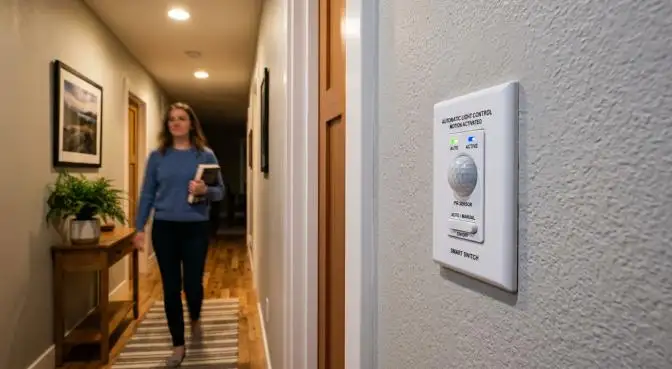
This article details the operation of the Automatic Light Control Switch, what to consider when bulk purchasing, and why HANXIA provides a solution that is both feasible and modern for commercial projects due to its focus on specialization and technology.
Understanding Automatic Light Control Switches
An Automatic Light Control Switch is a control unit that turns lights on or off when certain external factors are met, including, but not limited to, the presence/absence of light, scheduling, or motion. Such switches are different from light switches, in the sense that they are operated without user intervention. It does its job silently and continuously.
In practice, these switches are installed in:
•Office corridors and meeting rooms
•Hotel lobbies and guest bathrooms
•Hospital hallways and exam rooms
•Public stairwells and warehouse aisles
•The goal is simple: light only when needed, save energy when not.
The Logic Behind Technology Can Help Make Informed Purchases
PIR and Ultrasonic Sensors:
•Passive Infrared (PIR): detects and is triggered by body heat. Ideal for areas with a clear line of direct sight:
•Ultrasonic: It gauges and activates with wave motions. Can work through thin walls and wide gaps.
Near 2026, switches are incorporating both technologies. This is beneficial for dual-technology switches, The lights remain on with both motion and heat while light is off with only one. This is ideal for workplaces with HVAC vents where one technology switches would keep lights on when they should not be.
Why 2026 Buyers Are Updating Their Specifications
Energy codes across Europe and Asia are tightening. Buildings are expected to reduce standby power and improve efficiency reporting. An Automatic Light Control Switch directly supports both requirements.
But not all switches are future-proof. Some older relay models show issues such as:
-Using outdated relays and components with a 30,000 cycle lifespan
-Not working with current LED drivers
-Needing a complete rewiring of existing junction boxes
For those in charge of procurement, replacing a switch should not require a wall to be reconstructed. This is where design clarity comes into play.
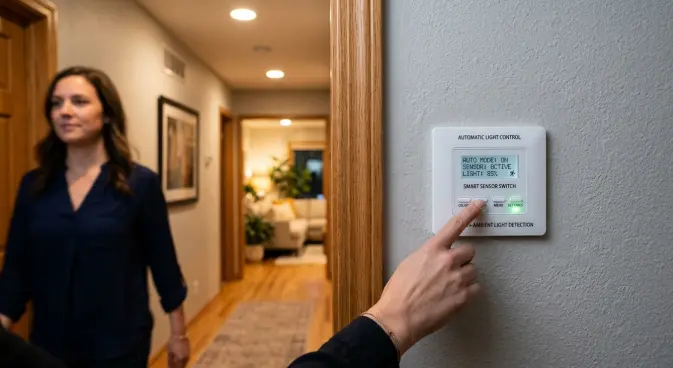
How Can One Trust an Automatic Light Control Switch
There are a few basics to consider when sorting through suppliers:
•Load Handling: No flickering is to be expected when the switch handles LED, fluorescent, and resistive loads.
•Standby Power: The less, the better. In many cases, the switches use power, whilst in standby.
•Detection Range: Measured in meters. Do not let marketing determine range. Size is a more appropriate determinant.
•Adjustable Hold Time: An adjustable range of 10 sec to 30 min is what should be expected.
•Manual override option: Useful for cleaning or maintenance schedules.
A well-designed Automatic Light Control Switch gives the installer flexibility without complexity.
HANXIA's Manufacturing Approach: Designed for Real Buildings
HANXIA, operating from www.hx-switch.eu, builds Automatic Light Control Switch products with a clear engineering philosophy: reduce failure points, simplify installation, and match 2026 infrastructure needs.
Our switches are manufactured using industrial-grade components, not general-purpose electronics. Key practical advantages include:
•100,000-cycle relays: Designed for high-frequency commercial use environments.
•Wide voltage range (110V–240V AC): One product can target all markets.
•60mm box size standard for EU: Nothing to change.
•Lux and time: Rotary switches preferred.
•For CE and RoHS: European and international projects.
Don't worry, these are not just marketing features. They are measurable specifications that matter to facility managers and electrical contractors.
How HANXIA Stays Current With 2026 Trends
The lighting control industry is moving toward decentralized intelligence. Large central panels are being replaced by standalone smart devices. An Automatic Light Control Switch today must be able to operate independently but also connect when needed.
HANXIA addresses this trend by offering:
•Optional KNX-ready variants for building management system (BMS) integration
•Zigbee 3.0 compatibility for wireless expansion
•Modular faceplate designs that match modern interior aesthetics
This means a buyer can install a basic HANXIA Automatic Light Control Switch today and later integrate it into a full smart building network—without replacing hardware.
Common Myths About Automatic Light Control Switches
Let us clarify a few frequent misunderstandings:
• Myth 1: They increase installation time. Reality: A good Automatic Light Control Switch replaces a standard switch directly. Wiring is identical.
• Myth 2: Temperatures between -20°C and +50°C shouldn't be a problem for industrial-rated switches. Truth is, poorly designed switches lose effectiveness with extreme temperature variance.
• Myth 3: Users are confused. Reality: Most manual models have user control buttons.
HANXIA focuses on balancing. Automation will be offered when useful. Manual mode will be added when necessary.
Suggestions for Buying for Procurement Teams
That is the process you could use if you wanted to buy an Automatic Light Control Switch for a 2026 project:
•Get a sample unit to test with your desired brand of LED.
•Get your desired lighting circuit and check the ratings to make sure you are below the circuit ratings.
•Look at lead times for bigger orders to make sure you are meeting deadlines. (HANXIA has a 2-6 day work week lead time).
The support and warranty can be confirmed at the time of sale.
HANXIA provides the technical support and the direct support of the specifiers. As a manufacturer, not a sales team member, we maintain quality at the most useful level throughout our component sourcing to the final assembly testing.
Conclusion
An Automatic Light Control Switch is a straightforward device with a significant impact on energy bills and operational convenience. But the specific design, component quality, and installation ease vary widely between suppliers.
HANXIA focuses on building Automatic Light Control Switch products that meet the actual conditions of commercial buildings in 2026: mixed loads, tight budgets, and non-negotiable reliability. For a technical catalog or a sample request, visit www.hx-switch.eu.
FAQ: Automatic Light Control Switch
Q: Will Automatic Light Control Switches work with LED lights?
Most switches are designed to work with LED lights. They are designed for LED, fluorescent and resistive loads and ensure that there will be no flicker nor damage.
Q: Do Automatic Light Control Switches still work during power outages?
This varies based on the model. Most switches rely on AC power to run. HANXIA models offer a battery-backup option that would supply power to critical areas during outages.
Q: What is the life expectancy of a Automatic Light Control Switch?
It depends on the specifications. Some lower-end switches will be rated for a maximum of 30,000 light cycles. Other switches, like the HANXIA, will go for ten years, rated for 100,000 cycles.
Q: Do Automatic Light Control Switches have a manual override?
Yes. HANXIA models include a manual push-button. This allows the user to turn the switch on or off. After the user manual override, the switch automation will take over within a designated time.
Q: Do I need to change the wiring to install an Automatic Light Control Switch?
There are no modifications to the wiring that are needed for HANXIA models. The installation of a standard ATLS unit is the same as a regular wall switch and just as easy. No junction-box modifications are required.
