





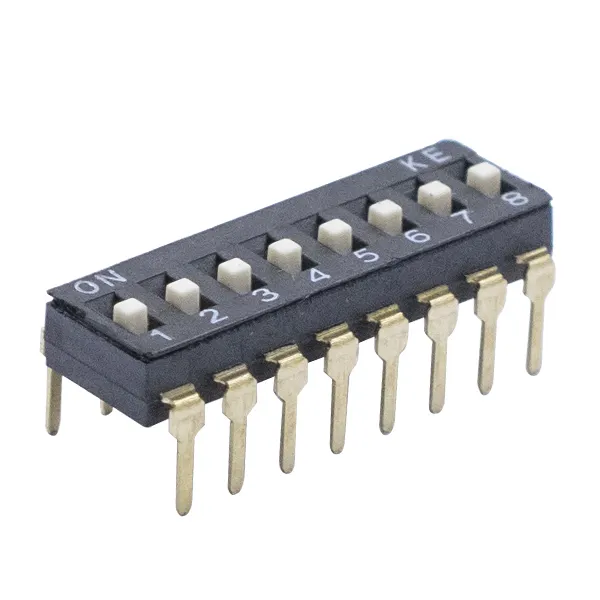
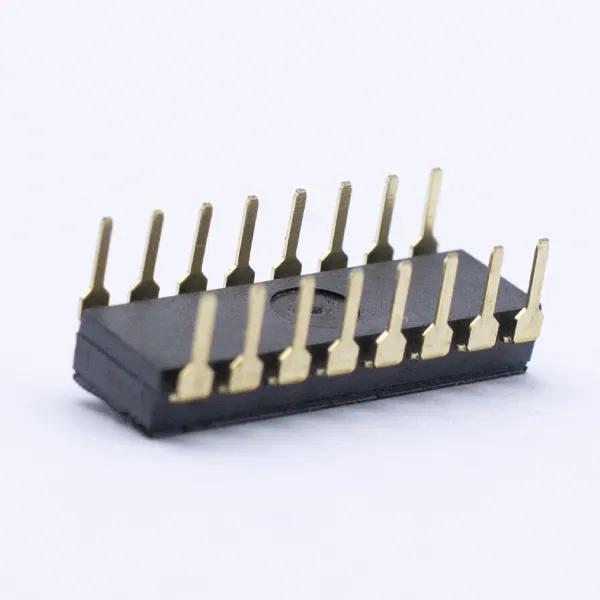
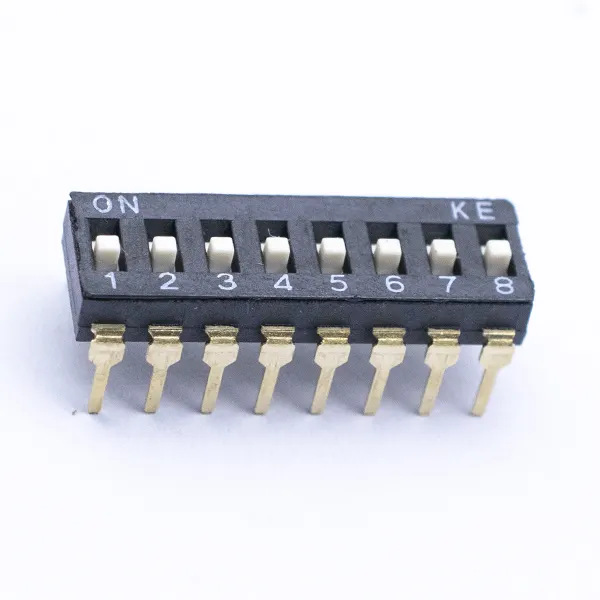


Product Description
This 8-position DIP switch provides a simple, nonvolatile way to configure lighting equipment without software access. Each pole offers a crisp ON/OFF action with clear legends, enabling binary address setting (e.g., DMX 1–255), DALI grouping, emergency mode selection, output current steps, CCT profiles, and test or commissioning functions. Gold-over-nickel contacts deliver consistent low-level switching for microcontroller inputs, while sealed “washable” constructions prevent flux and cleaning fluid ingress during assembly. Available in top-actuated slide or side-actuated “piano” styles, the compact housing fits dense LED driver and fixture PCBs. Choose through-hole 2.54 mm pitch for robust mounting or gull-wing SMD for automated reflow in high-volume luminaires.
Key features:
- 8 independent positions with positive detent; clear ON marking and orientation
- 2.54 mm (0.1") pitch; through-hole (DIP) and SMD gull-wing terminations
- Sealed, washable options (tape/epoxy top seal) for reflow and aqueous cleaning
- Gold-plated contacts for reliable low-level logic; anti-sulfur finishes available
- Slide (top-actuated) and piano (side-actuated) styles; low-profile bodies
- UL94V-0 flame-retardant housings; RoHS/REACH compliant
- Standard red/black actuators; white legends for high contrast
- Packaging for automation: tape-and-reel (SMD), tube or bulk (THT)
Typical specifications (verify per selected datasheet):
- Positions: 8; actuation type: momentary toggle per pole (maintained ON/OFF)
- Contact rating: up to 25 mA at 24 VDC (resistive); logic-level switching recommended
- Max voltage (non-switching): 50 VDC
- Contact resistance: ≤100 mΩ initial
- Insulation resistance: ≥100 MΩ at 100 VDC
- Dielectric withstand: 500 VAC, 1 minute
- Mechanical life: 2,000–10,000 toggles per pole (style dependent)
- Bounce time: ≤10 ms typical
- Operating temperature: −40 to +85 °C
- Soldering: reflow compatible (SMD); wave or hand solder (THT)
Applications:
- LED drivers and power supplies (address, current set, dimming curve)
- Luminaires: panels, downlights, floods, wall packs (scene/group selection)
- Stage and architectural lighting: DMX node address and mode setup
- Emergency and egress lighting: test/maintenance modes, charger limits
- Signage, controllers, gateways, and occupancy/daylight sensor hubs
- Building automation modules for simple field commissioning
Customization options:
- Actuation style: slide (top) or piano (side); low-profile heights
- Legends: ON + 1–8, binary weights (1/2/4/8/16/32/64/128), or custom icons
- Sealing level: tape or epoxy top seal; dust caps; conformal-coat compatible
- Contact finish: standard gold-over-nickel; anti-sulfur variants for harsh atmospheres
- Terminations: SMD gull-wing, THT straight or right-angle pins; pin length options
- Color and marking: actuator/body colors and high-contrast printing
- Pitch variants: standard 2.54 mm; half-pitch 1.27 mm on request
- Extended temperature range and higher cycle life versions
Design notes:
- Use appropriate pull-ups/pull-downs to limit current per pole (typically ≤1 mA).
- For DMX addressing, assign binary weights to positions to support 1–255; reserve extra bits for mode flags if needed.
- Debounce in firmware; sample after a brief delay or majority-vote in high-vibration environments.
- Align silkscreen “ON” arrow with actuator orientation; provide access holes in enclosures for commissioning.
- Specify washable types if boards undergo reflow and aqueous cleaning; avoid solvents that can fade legends.
