


How to Choose the Right Waterproof Micro Switches for Industrial Applications
Selecting the right industrial micro switch involves more than simply considering the type of machinery in which it will be installed. Different industrial environments expose switches to different operating conditions. For instance, a switch installed inside a dry electrical control cabinet faces very different challenges from one positioned near a machine tool or in a food processing facility where regular wash-down procedures take place.
In demanding environments, switches may encounter cutting fluids, oil, dust, moisture, and high-pressure hot water. Using the same switch model across every application can create unnecessary expenses through excessive protection or lead to premature product failure and potential safety risks.
When choosing a waterproof micro switch, manufacturers should look beyond its IP67 rating. Although an IP rating indicates the level of protection against dust and water, electrical and mechanical characteristics are equally important. The contacts must withstand the electrical load, while the operating mechanism must function reliably under actual working conditions.
A systematic selection process helps manufacturers identify the right product based on environmental exposure, electrical requirements, mechanical performance, and long-term reliability.
What Makes a Micro Switch Waterproof?
A waterproof micro switch works on the same basic principle as a conventional micro switch. Both use a snap-action mechanism that quickly opens or closes electrical contacts when the actuator reaches a specific operating point.
The main difference is the protective sealing structure. A waterproof design incorporates additional sealing features to prevent water, dust, and other contaminants from entering the internal contact chamber.
However, protection must not interfere with the movement of the actuator. The sealing arrangement needs to keep contaminants away from sensitive internal components while allowing the switch to operate smoothly.
This combination of environmental protection and mechanical functionality makes waterproof micro switches suitable for industrial applications where exposure to moisture and contaminants is a concern.
Waterproof Micro Switch
Four Sealing Paths for Micro Switches
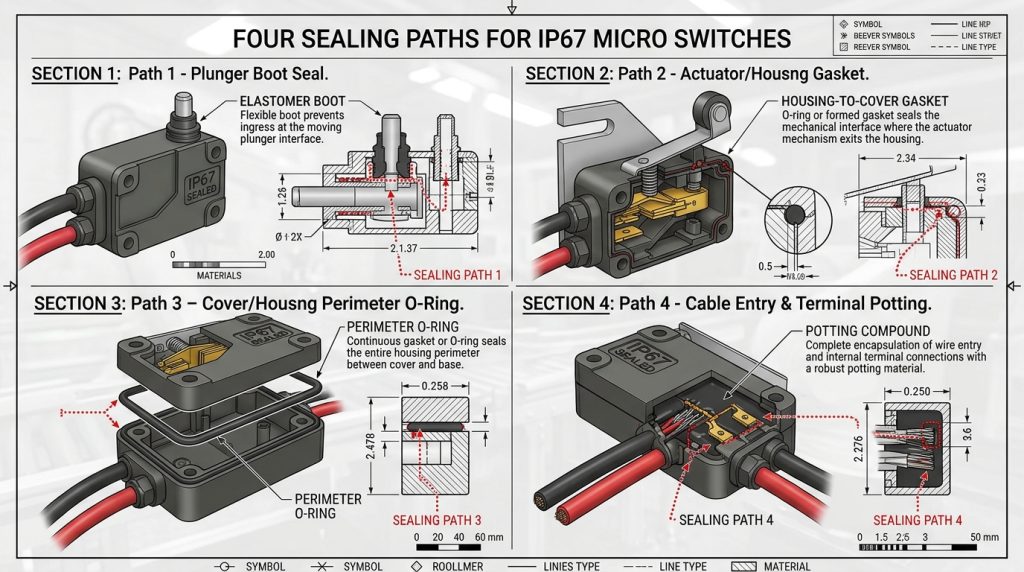
The protective performance of a waterproof micro switch depends on four major sealing areas: housing joints, actuator movement points, terminal openings, and cable entry points.
Each location requires proper protection. Even if the main housing is completely sealed, an unprotected terminal connection or cable opening can allow contaminants to enter the switch.
The four important sealing paths include:
- Housing seams: The joints connecting different housing sections must prevent water and dust from entering the enclosure.
- Moving actuator components: These areas require effective sealing without restricting the normal movement of the actuator.
- Terminal exit points: Electrical connection areas should remain protected against moisture and environmental contamination.
- Cable entry points: Cable openings need suitable sealing to prevent water from entering through the wiring connection.
A reliable industrial micro switch should maintain consistent protection across all four areas. Checking these points helps manufacturers evaluate the actual sealing quality rather than relying only on the product's advertised IP rating.
How to Read IP Codes for Waterproof Micro Switches
IP ratings, or Ingress Protection ratings, describe how effectively an electrical enclosure prevents solid particles and water from entering its internal components.
The first digit represents protection against solid objects and dust, while the second digit indicates resistance to water exposure.
Understanding these ratings helps manufacturers select appropriate waterproof micro switches for different industrial operating environments.
| IP Rating | Dust Protection | Water Resistance | Test Conditions | Permissible Applications | Limitations |
| IP54 | Level 5: Restricts most dust without affecting operation | Level 4: Protects against water splashes from any direction | Water splashing from all directions | Indoor cabinets and surfaces occasionally exposed to splashes | Not intended for rinsing, immersion, or prolonged dust accumulation |
| IP65 | Level 6: Completely dustproof | Level 5: Protects against water jets from any direction | Low-pressure water jets from all directions | Outdoor installations, cleaning areas, and dusty environments | Not suitable for brief immersion or close-range high-pressure water jets |
| IP67 | Level 6: Completely dustproof | Level 7: Protects against temporary water immersion | Immersion at a depth of 1 metre for 30 minutes | Floor-mounted equipment and applications with occasional water accumulation | Not intended for long-term immersion, high-temperature steam, or cleaning agents |
| IP68 | Level 6: Completely dustproof | Level 8: Protects against continuous immersion under agreed conditions | Depth and duration agreed upon between manufacturer and user | Underwater equipment and applications involving prolonged immersion | Conditions beyond the agreed depth or duration are not covered |
An IP40 micro switch is also identified in the source material as dustproof. Although it does not provide waterproof protection, it prevents the entry of solid foreign objects measuring approximately 1 mm or larger.
This makes it suitable for certain general-purpose electrical equipment operating in dry indoor environments where protection against larger solid objects is required.
Electrical Selection of Waterproof Micro Switches
Selecting an appropriate waterproof micro switch requires careful evaluation of its electrical characteristics. The requirements of a low-current signal circuit are different from those of a power circuit.
Manufacturers should consider the connected load, switching frequency, inrush current, and contact material before finalizing their selection.
Signal Circuits vs. Power Circuits
Signal circuits are commonly found in PLC digital inputs, position feedback systems, and safety interlock monitoring applications. These circuits generally operate at very low current levels.
One important concern in these applications is contact oxidation. Silver contacts can develop a sulfide film under low-current conditions, increasing electrical resistance and potentially causing inconsistent signal transmission.
Gold-plated contacts are generally recommended for these applications because of their chemical stability and suitability for low-level signals.
Power circuits require a different evaluation. Their selection depends on steady-state current, inrush current, and switching frequency.
For example, contactor coils and solenoid valves are inductive loads. When their electrical supply is disconnected, they can generate back-electromotive force (back-EMF), which may produce an electrical arc across the contacts.
Heating elements also require attention because their resistance can be particularly low during a cold start. This can result in inrush currents several times higher than their normal operating current.
These electrical characteristics should be evaluated before selecting a micro switch. Depending only on the current rating printed on the product may not provide sufficient information about its suitability for the application.
Inrush Current and Contact Material
Contact material has a significant influence on the electrical loads an industrial micro switch can handle.
Silver alloys provide relatively low contact resistance and good resistance to electrical arcing. These properties make them suitable for power-switching applications.
Gold plating offers excellent chemical stability, making it appropriate for low-level signal circuits. However, gold-plated contacts are not designed to withstand high electrical currents because an electric arc can damage or burn through the plating layer.
Therefore, the contact material should always match the electrical requirements of the connected equipment.
Manufacturers should evaluate both the expected operating current and potential inrush conditions when choosing between silver alloy and gold-plated contacts.
Fail-Safe Contact Logic for Micro Switches
Safety interlock circuits should follow a fail-safe, or fail-to-stop, operating principle. This approach ensures that equipment enters a safe, non-operational condition when a fault occurs.
Potential failures include broken wires, disconnected terminals, contact erosion, and sealing problems that cause the switching mechanism to become stuck.
When these problems occur, the circuit should open so that the connected equipment stops operating.
For safety guards and emergency stop applications, manufacturers may also consider a DPDT micro switch or a redundant switching arrangement.
A redundant design can combine a micro switch with an additional sensor to reduce the possibility of a single point of failure affecting the entire safety system.
Mechanical Selection of Waterproof Micro Switches
Electrical compatibility is only one part of selecting a suitable waterproof micro switch. Its mechanical characteristics must also match the movement and operating conditions of the equipment.
Important considerations include operating force, differential travel, actuator design, and terminal configuration.
Operating Force and Differential Travel
The operating force of a micro switch should correspond to the output force available from the mechanical system.
If the required operating force is too high, the cam and lever may experience accelerated wear. This can shorten the service life of the equipment.
On the other hand, an operating force that is too low may allow machine vibration to trigger the switch unintentionally, resulting in unwanted switching activity.
Differential travel is another important specification. It describes the distance between the point at which the switch activates and the point at which it resets.
If differential travel is too small, even minor mechanical rebound may cause the contacts to repeatedly open and close. This can produce incorrect signals for the PLC.
Excessive differential travel creates a different problem. The switch may take longer to reset and could remain engaged even after the mechanical component has moved away. This can create a blind spot in the equipment's safety logic.
For reliable operation, both operating force and differential travel should be matched to the movement characteristics of the machine.
Actuator and Terminal Options
The actuator should be selected according to the movement pattern and mechanical arrangement of the equipment.
Common options include:
- Plunger-style micro switch: Suitable for direct linear pushing and pressing movements.
- Roller-lever micro switch: A practical choice for oscillating movements and applications involving cams.
- Long-lever micro switch: Useful in space-constrained installations where the actuation point needs to be positioned in a more accessible location.
- Bent-lever micro switch: Suitable for mechanical arrangements involving angled contact.
Terminal selection should also reflect the production process and maintenance requirements.
The main options include:
- PCB-solderable terminals: Suitable for automated assembly and PCB manufacturing processes.
- Quick-connect terminals: Allow technicians to replace switches more quickly during field maintenance.
- Integrated pre-wired cable assemblies: Particularly useful in humid environments because they can provide more reliable connections than standard terminals covered with heat-shrink tubing.
Choosing suitable actuator and terminal configurations helps manufacturers achieve reliable installation and consistent equipment operation.
Materials and Environmental Tolerance of Waterproof Micro Switches
The long-term performance of a waterproof micro switch depends on how well its materials withstand environmental conditions.
Temperature fluctuations, chemical exposure, vibration, and mechanical shock can gradually affect sealing components and internal mechanisms.
Manufacturers should evaluate these factors before choosing a switch for demanding industrial environments.
Temperature and Chemicals
Temperature variations can significantly influence the durability of rubber sealing materials.
High temperatures accelerate rubber aging and may cause permanent compression set. In contrast, low temperatures can make sealing materials harder and reduce their elasticity.
Both conditions may weaken the sealing structure and eventually compromise environmental protection.
Chemical exposure creates additional challenges. Substances such as extreme-pressure additives in cutting fluids and alkaline cleaning agents can cause rubber components to swell, leach, or develop cracks.
For this reason, manufacturers should review the chemical compatibility information for the specific sealing material used in the selected micro switch.
Choosing materials that can withstand the actual chemicals and operating temperatures helps maintain long-term sealing performance.
Vibration, Shock, and Long-Term Consistency
Continuous vibration can gradually affect the mechanical and electrical stability of an industrial micro switch.
It may loosen mounting screws, shift the original installation position, and cause fretting wear between electrical contacts. This wear can generate debris and contribute to spring fatigue.
As the spring becomes fatigued, its operating force may decrease, potentially affecting switching consistency.
Before finalizing a product selection, manufacturers should request batch-level information from the micro switch manufacturer. This should include the distribution of operating forces and operating points across production batches.
Products that meet average specifications but show significant variation between individual units may create problems during production.
Such inconsistencies can result in intermittent failure to actuate, which is often difficult to identify and troubleshoot.
Checking production consistency is therefore an important part of evaluating the long-term reliability of industrial micro switches.
Selection Guide for Waterproof Micro Switches in Typical Industrial Scenarios
Different industrial environments require different levels of protection. A switch suitable for a dry production area may not perform reliably in a location exposed to oil, water, cleaning chemicals, or continuous vibration.
The following table provides a preliminary selection guide for common industrial applications.
Final product selection should also account for operating temperature, cleaning methods, installation direction, and the actual exposure conditions.
| Typical Industrial Scenarios | Types of Liquids and Contaminants | Recommended Protection Level | Key Selection Criteria |
| Machine Tool Coolant Area | Cutting fluid splashes, oil contamination, and metal chips | At least IP65; IP67 for heavy oil contamination | Downward-facing actuator and sealed cable exit |
| Outdoor Electrical Cabinets and Barrier Gates | Rainwater, standing water, and condensation caused by temperature fluctuations | IP67 | Downward-facing actuator and sealed cable exit |
| Vehicle Washing and High-Pressure Rinsing Equipment | High-pressure water jets and cleaning foam | IP67 with structural shielding | Evaluate the angle at which water jets may strike the switch |
| Packaging and Assembly Lines | Paper dust, particulate matter, and continuous vibration | IP65 | Dust protection, vibration resistance, and actuation-point stability |
This comparison helps manufacturers identify an initial protection level for each application before evaluating detailed electrical and mechanical specifications.
A final decision should always be based on the actual installation conditions rather than the general application category alone.
FAQ
Q1: Does a Higher IP Rating Always Mean a Higher Current Rating?
No. An IP rating and an electrical current rating describe two completely different product characteristics.
The IP rating measures protection against dust and water, while the current rating indicates the electrical load a switch can handle.
If an application requires both waterproof protection and high-current switching capability, the selected product must satisfy both requirements independently.
Manufacturers should confirm these specifications with their suppliers before purchasing.
Q2: What Are the Most Common Mistakes When Selecting a Waterproof Micro Switch?
One common mistake is focusing exclusively on the current rating while ignoring how the operating environment may affect electrical contacts.
Another is assuming that a waterproof micro switch automatically supports higher electrical loads.
Manufacturers may also concentrate on the switch housing while overlooking terminal connections and cable entry points.
These factors can compromise the reliability of the entire installation, even when the selected product has an appropriate IP rating.
Q3: Can a Waterproof Micro Switch Be Used Directly in a Motor or Heater Circuit?
Not necessarily. A waterproof rating does not automatically mean that a micro switch can handle the electrical requirements of a motor or heater circuit.
If the contact specifications are unsuitable for the connected load, rapid contact erosion or electrical welding may occur. In some cases, the contacts may stick together and prevent normal switching.
The load characteristics, inrush current, and contact material should therefore be checked before installation.
Q4: How Can Manufacturers Verify That a Supplier's Claimed IP Rating Is Reliable?
Manufacturers should request the relevant IP test report and carefully review the testing information.
The report should explain the condition of the test samples, the sequence of testing procedures, and whether temperature cycling was completed before immersion testing.
Information about batch sampling inspections can also help manufacturers evaluate whether the supplier maintains consistent product quality.
These checks provide a better understanding of the actual protection performance than relying on an IP rating printed in a product catalogue.
Q5: What Other Factors Are Important in Low-Temperature, Salt-Spray, or Chemical Environments?
Several environmental and material characteristics should be considered when selecting a micro switch for these conditions.
For low-temperature applications, manufacturers should check the low-temperature embrittlement point and compression set of the sealing materials.
In salt-spray environments, the testing duration for the housing and electrical terminals should be evaluated.
For chemical applications, the sealing materials must be compatible with the specific substances present in the operating environment.
These considerations help determine whether the selected micro switch can maintain its protective performance under demanding conditions.
Conclusion
Choosing the right waterproof micro switch for industrial equipment requires a systematic evaluation of its operating environment and technical specifications.
Important factors include the type of liquid exposure, required ingress protection level, electrical load, contact material, operating force, differential travel, environmental resistance, and sealing quality of the cable entry points.
Relying entirely on previous experience or selecting a switch based only on its IP rating can result in unexpected failures, particularly when equipment moves into mass production.
A more reliable selection process follows these steps:
Application Environment → IP Rating → Electrical and Contact Specifications → Mechanical and Installation Requirements → Material and Service-Life Considerations → Micro Switch Manufacturer Verification
Manufacturers should document the results for every installation location in a consolidated selection table.
By evaluating environmental protection, electrical compatibility, mechanical performance, and production consistency together, industrial users can choose micro switches that provide dependable operation and long-term reliability in demanding workshop environments.
