





How Touch Switch Button Ensures Safe Daily Operation
How does a Touch Switch Button keep daily operation safe and steady? It starts with clean signals and a reliable press. No chatter. No surprise triggers. Heat and vibration try to break that promise every day. So do voltage spikes and cramped PCB layouts. Yet the right materials and design can hold the line. Users feel the difference in one tap. Brands see it in fewer failures. What makes this simple part so resilient - and where do most designs go wrong? Stay with us. The next sections reveal the quiet engineering choices that protect safety, cycle after cycle.

Why A Touch Switch Button Matters
From the factory floor to the end user's kitchen, safety starts with predictability. Our engineering teams focus on the two fundamentals that make a Touch Switch Button dependable: low contact resistance and high insulation. By keeping contact resistance at ≤100 mΩ, the signal path stays clean and crisp, reducing heat at the interface and lowering the chance of micro-arcing. Pair that with ≥100 MΩ insulation resistance and you get a switch that resists leakage and noise - even when the surrounding circuitry becomes crowded or a device is exposed to humidity and temperature swings. The result is simple: taps register when they should, and only when they should.
Voltage endurance adds another layer of protection. Each unit is validated to withstand AC 250V (50 Hz) for one minute, a margin that helps devices sail through compliance tests and shrug off real-world transients. Temperature stability rounds out the safety envelope. With a working range of -25°C to +70°C, performance remains steady in cool garages, warm kitchens, server closets, and compact sealed housings. For control logic and indicator tasks, the rated load of DC 12V 50 mA strikes a practical balance between responsiveness and longevity.
Reliability is more than a specification - it is a promise of consistent feel over time. We qualify for up to 100,000 cycles, which gives design teams room to target multi-year product duty cycles with confidence. Users sense that durability immediately: every press feels familiar, with no chatter, drag, or dead spots. Brands benefit too, with fewer field failures and a smoother ownership experience.
✅ Built For Feel, Tuned For Usability
Tactility influences how customers perceive quality. Our 250 ± 50 g operating force delivers a firm, assured press that avoids fatigue and still works beautifully behind decorative fascias, printed overlays, or thin glass. That repeatable feel, press after press, helps reinforce a product's premium character while keeping the interface approachable for all users.
Materials And Mechanics That Last
Great switching behavior comes from materials that cooperate under stress. Hanxia selects each element for electrical performance, structural stability, and heat resistance - then verifies the full stack under real application conditions.
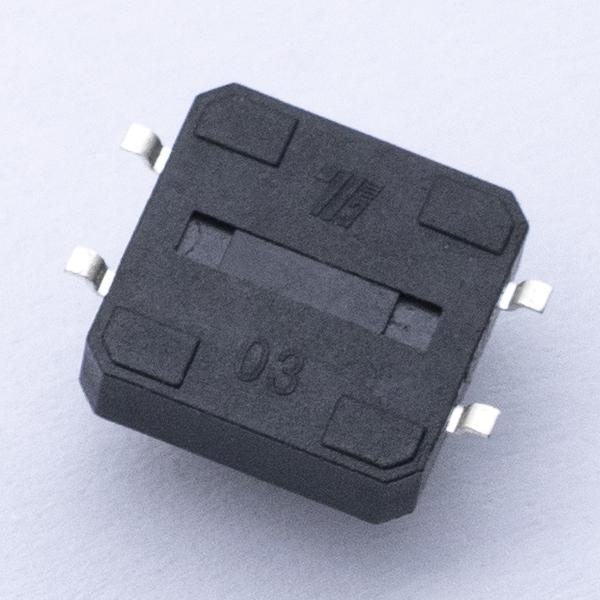
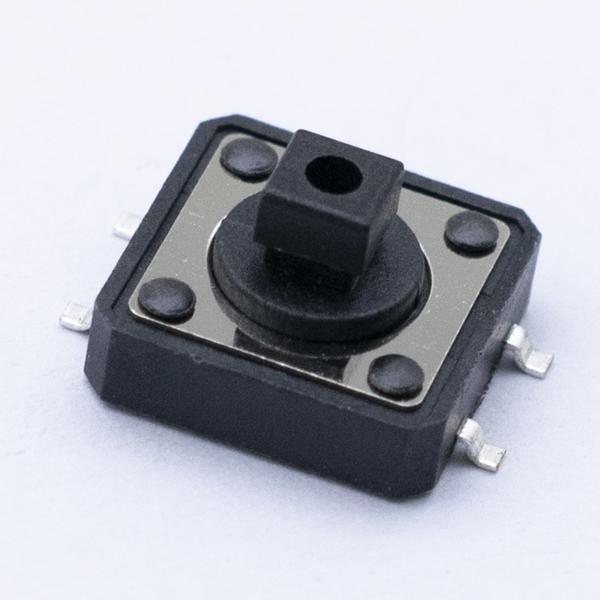
- Efficient Conduction Path: A H62Y brass insert (Ag) pairs with a stainless-steel reed (Ag) to ensure low-loss conduction and stable contact over time.
- Heat-Resistant Structure: A PPA base (black) and PPA button (yellow) provide strength, thermal stability, and dimensional accuracy through repeated heating and cooling.
- Robust Protection: A cold-rolled steel cover (Cu/Sn) safeguards the mechanism and supports consistent contact pressure, even under vibration.
- Proven Endurance: AC 250V for 1 minute withstand testing builds headroom for mixed-signal assemblies and transient events.
- Signal Integrity: ≤100 mΩ contact resistance preserves crisp digital edges, while ≥100 MΩ insulation helps block leakage currents and crosstalk.
- Environmental Readiness: -25°C to +70°C operating range supports refrigerators, HVAC controls, range hoods, and other temperature-variable environments.
✅ Key Electrical & Mechanical Data (Quick View)
- Rated Load: DC 12V 50 mA
- Operating Force: 250 ± 50 g
- Service Life: Up to 100,000 cycles
Together, these choices help the Touch Switch Button maintain a stable actuation curve over its service life. The low-resistance path reduces I²R heating at the contact, high insulation keeps adjacent nets quiet on dense PCBs, and PPA resists creep and warping that can alter travel or force over time. It's a materials-first approach to reliability.
✅ Integration Notes For Design Teams
Getting the most from a Touch Switch Button starts with a few practical layout habits:
- Use a firm, consistent overlay to preserve the tactile signature; soft laminates can blunt feedback.
- Keep traces short and reference to a solid ground near the switch node to limit EMI pickup.
- Validate perceived force with the final stack-up; overlay thickness and adhesive choice can subtly change the feel.
Include these checks in your DV and PV builds and you'll reduce late-stage surprises while protecting the switch's designed-in tactility.
Real Applications, Real Pain Points
Whether you are designing a smart oven control panel or an industrial HMI, the pain points tend to rhyme: inconsistent actuation, thermal drift, premature wear, and the occasional compliance headache. Our Touch Switch Button tackles those issues with a clean electrical profile, comfortable force, and a structure built for heat and vibration.
✅ Typical Application Areas
- Automotive interior controls and auxiliary modules
- Household appliances - cooktops, purifiers, washers, dryers, refrigerators
- Communication equipment and docking/base units
- Industrial control panels and HMIs in variable airflow cabinets
- Consumer electronics and smart home dashboards
- Safety and alarm interfaces that demand stable triggering
In home appliances, tight signal stability and AC 250V withstand margin help during dielectric and surge testing. In industrial panels, the -25°C to +70°C operating window supports cabinets with fluctuating cooling. For consumer devices, the 100,000-cycle lifetime and tuned 250 ± 50 g force create a premium, repeatable press that users notice on day one - and still appreciate years later.
Why Teams Choose Hanxia
Choosing a switch is easy; choosing one you can trust at scale is harder. Hanxia supports engineers from concept through mass production with application guidance, stack-up advice, and validation tips tailored to the specific enclosure, overlay, and PCB constraints of your design. Our manufacturing lines are tuned for consistent metallurgy, plating, and molding so the first batch behaves like the last - critical when you're qualifying a Touch Switch Button for a multi-year platform.
What You'll Gain With Hanxia
- Faster compliance passes thanks to proven insulation and voltage withstand
- Fewer warranty claims due to stable force curve and durable contacts
- A better user impression driven by clean, confident tactility
Call To Action
If you're ready to improve user experience and reduce failure risk, talk to Hanxia about integrating a Touch Switch Button into your next appliance, control panel, or smart device. Our engineering team can review your stack-up, recommend tolerance windows, and help you validate performance under heat, vibration, and electrical stress. Contact Hanxia today - let's turn precise presses into lasting product trust.
