





Avoid Signal Loss with Precision Right Angle SMT Slide Switch Design
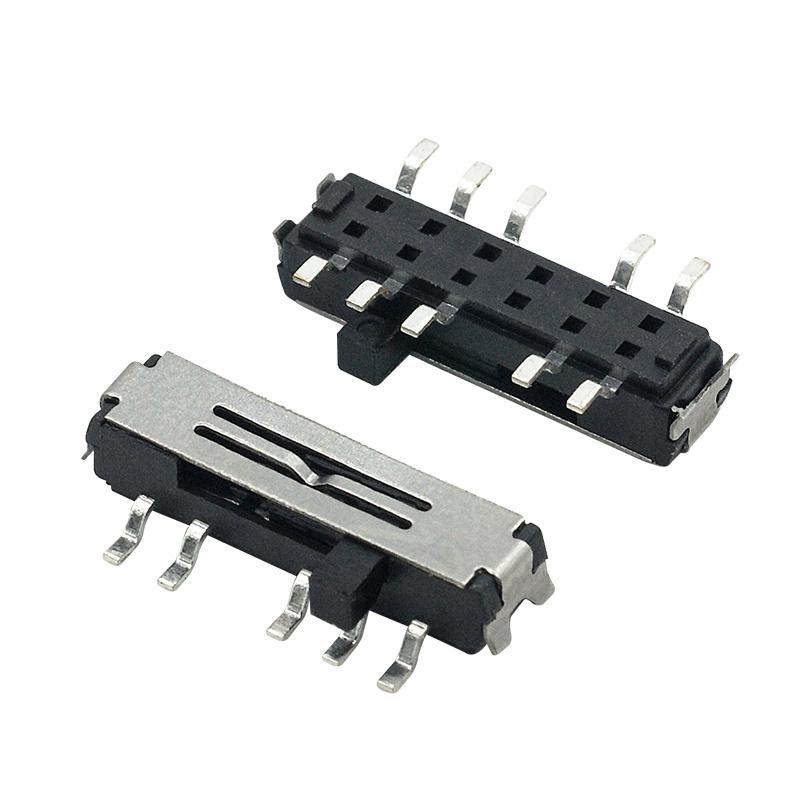
A Right Angle SMT Slide Switch is a compact, surface-mount switch with its actuator at 90° to the PCB edge for side operation. It provides precise on/off or mode selection in space-constrained devices and supports automated assembly. Right Angle SMT Slide Switch design looks simple, yet it decides whether your signal stays clean. In tight enclosures and fast boards, tiny mistakes grow loud. Parasitics creep in. Contacts drift. Returns fracture. Your scope shows ghosts. Your QA sees sporadic fails. We've watched teams chase noise for weeks. The fix was not a shield can or a thicker trace. It was a smarter interface choice and cleaner integration. This guide shows where the loss really starts - and how a precise Right Angle SMT Slide Switch turns it off. The trick is subtle. Miss it, and the noise wins.

The Real Reason Signals Go Missing
Signal loss in small electronics is seldom caused by a single dramatic fault. It's an accumulation of small penalties: parasitic inductance at a pad, a broken ground reference under a trace, the extra stub from an ill-placed component, or a contact interface that drifts as the product ages. When you place a user interface on the same tiny board as RF, high-speed digital, and sensitive analog, these penalties add up quickly.
A Right Angle SMT Slide Switch helps not because it is "just a switch," but because its geometry and mounting style cut down variability. The short mechanical throw reduces bounce duration. Stable contact geometry lowers resistance drift. Surface-mount assembly improves joint consistency across large builds. Instead of fighting misalignment or hand-solder variability, you start with a predictable interface that behaves the same at prototype and mass production.
- Pain Points We See On Real Programs
• Rework caused by slight misplacement on dense edges
• Intermittent glitches from rising contact resistance over time
• Space clashes between the mechanical actuator and RF keep-outs
• Through-hole bottlenecks that slow otherwise SMT-optimized lines
The lesson: reliability starts with form factor. A compact, edge-friendly Right Angle SMT Slide Switch lets you keep the UI your customers want without taxing yield, EMI margins, or schedules.
Hanxia's Right Angle SMT Slide Switch
Our camera-focused Right Angle SMT Slide Switch was designed for clean control over power and modes, but the same attributes translate across remote controls, IoT nodes, handheld medical tools, and other space-constrained products. The right-angle orientation aligns the actuator with the enclosure wall, so mechanical integration becomes straightforward and sensitive circuitry can stay clear of openings and seams.
In camera systems - whether compact digital models, action cams, or professional DSLRs - positive tactile feedback matters. So does low variability from unit to unit. Hanxia's precise actuation profile delivers crisp transitions with minimal bounce, helping prevent false edges on logic inputs and glitches on power rails.
- Rated value: DC 12 V, 50 mA - ideal for logic-level power and control lines
- Contact resistance: ≤100 mΩ - supports low-loss, stable connections
- Insulation resistance: >100 MΩ - protects high-impedance nodes from leakage
- Operating force: 250 ± 50 g - deliberate feel that helps avoid accidental toggles
These numbers are not abstract. Low contact resistance reduces the chance of droop on small rails or reference nodes. High insulation resistance keeps leakage from nudging sensitive comparators. A well-defined operating force shrinks bounce windows and creates consistent user feedback - key for professional gear where timing matters.
✅ Where It Excels
- Camera Power Control: Reliable on/off and power mode selection for action cams, digital cameras, and camcorders.
- Settings & Mode Switching: Clean transitions between photo/video, or integration into zoom assemblies where accuracy is essential.
- Professional Photography Equipment: Tactile certainty and electrical stability under frequent use.
- Compact Accessories & Wearables: Small footprint, low power, and robust feel inside crowded enclosures.
✅ Why teams pick Hanxia:
- Long-lasting reliability for extended duty cycles
- Precise, repeatable actuation that supports clean edges
- Compact profile that preserves precious PCB and enclosure space
- Low power characteristics suited to battery devices
- Compatibility with automated SMT lines and diverse applications
Call To Action: Want to cut noise, reduce rework, and lock in a cleaner signal path? Contact Hanxia for samples and DFM guidance on integrating a Right Angle SMT Slide Switch from prototype to high-volume production.
Design Practices That Protect Signal Integrity
You don't need a radical redesign to avoid signal loss. You need consistent, disciplined integration. These practices help a Right Angle SMT Slide Switch enhance - rather than threaten - your signal budget.
Layout And Routing
Place the switch near the board edge to shorten mechanical travel and keep its pads away from high-speed lanes and RF keep-outs. Maintain a continuous ground under sensitive traces; avoid slots, long necks, and fragmented returns. If the switch connects to a logic input, consider a small series resistor or a compact RC for debouncing - particularly if the MCU lacks built-in filtering. Keep stubs short to limit parasitic inductance and ringing.
Footprint And Assembly
Follow the recommended SMT land pattern and ensure proper solder mask clearance. Toe and heel fillets provide mechanical retention and reduce micromotion that can trigger intermittent contacts over time. In panelized builds, review pick-and-place keep-outs to prevent actuator stress. During reflow, respect the material stack so you preserve tactile feel and avoid subtle deformation that only shows up in field use.
Power And Return Paths
Treat the switch node like any other interface. If it selects rails or modes, place ceramic decoupling close to the load. Stitch ground vias near the switch pads to confine fields and provide a tight return. When signals must cross noisy regions, guide the return intentionally; you're not just routing traces - you're routing the loop.
Verification Without Drama
Validation should prove that your assumptions hold under real conditions, not just on a benchtop at room temperature.
- Oscilloscope The Node: Observe bounce duration and settling during actuation.
- Measure Across Environment: Track contact resistance at temperature and humidity extremes.
- Check Haptics: Confirm the 250 ± 50 g operating force aligns with the product's industrial design and user expectations.
- Build A Short Checklist: A lightweight APQP-style review catches land-pattern drift, paste choice, and reflow windows before they cost time.
When teams approach switch integration this way, they ship sooner. They also ship with fewer returns attributed to "mysterious intermittent behavior," a phrase that usually masks small mechanical inconsistencies and marginal return paths.
Bottom Line
A Right Angle SMT Slide Switch can either inject uncertainty - or remove it. Hanxia's precision actuation, compact geometry, and SMT-friendly construction reduce variability at the exact point where electrical and mechanical design meet. You gain cleaner transitions, tighter returns, and more room for the circuits that differentiate your product. Ready to design out signal loss? Reach out to Hanxia for engineering samples, layout recommendations, and integration support tailored to your enclosure, PCB stack-up, and manufacturing flow.
