







Product Description
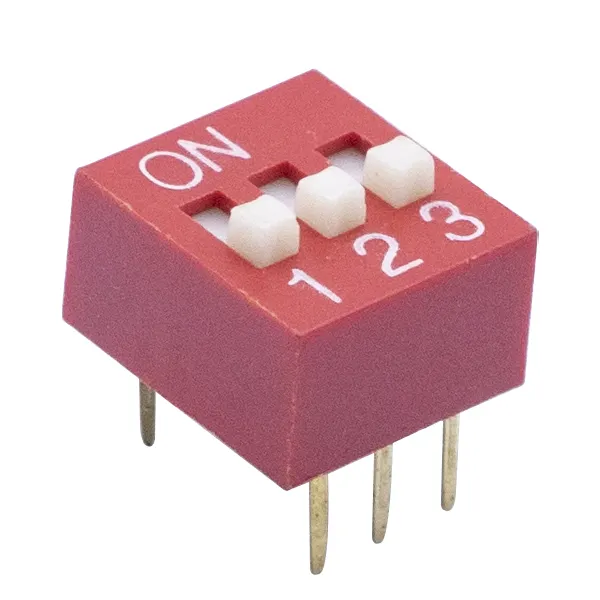
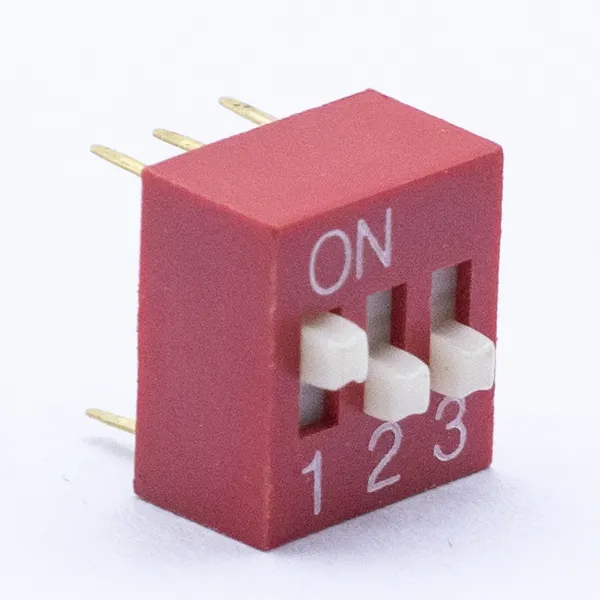
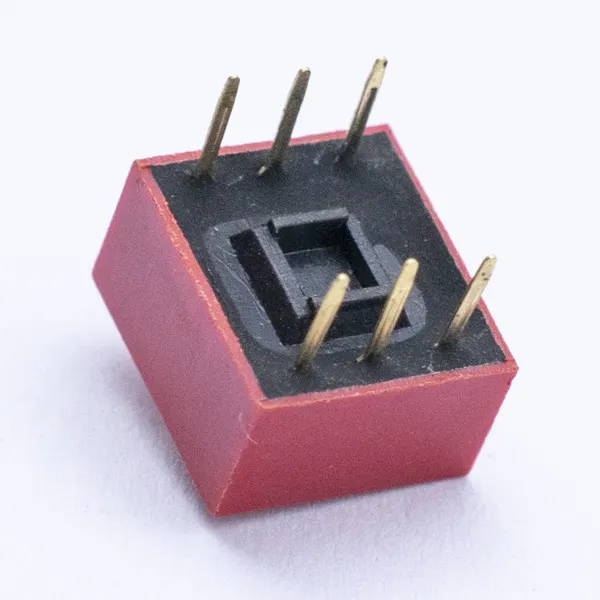
This 3-position SMD DIP switch offers a simple, nonvolatile way to set product behavior in compact consumer devices. Each pole provides a crisp ON/OFF selection for mode flags, regional compliance settings, pairing/test routines, boot options, or SKU differentiation—without relying on firmware menus or external tools. Low-profile housings and gull‑wing terminals fit space‑constrained boards, while sealed (“washable”) constructions block flux and cleaning solutions during automated assembly. Gold‑over‑nickel contacts ensure stable, low‑level switching to MCU GPIOs and logic circuits, and high‑contrast ON indicators reduce commissioning errors. Available in standard 2.54 mm pitch and micro 1.27 mm pitch to optimize layout in wearables, smart home modules, and handhelds.
Key features:
- 3 independent ON/OFF positions with tactile detent
- SMD gull‑wing terminals; 2.54 mm or 1.27 mm pitch options
- Sealed, washable versions (tape/epoxy top seal) for reflow and aqueous cleaning
- Gold‑plated contacts for reliable low‑level logic switching
- Ultra‑low profile bodies; recessed actuators to prevent accidental toggling
- Clear ON marking and polarity notch for assembly orientation
- UL94V‑0 housings; RoHS/REACH compliant
- Automation‑friendly packaging: tape‑and‑reel
Typical specifications (verify per selected datasheet):
- Positions: 3 poles; maintained ON/OFF per pole
- Contact rating: up to 25 mA at 24 VDC (resistive); logic‑level use recommended
- Max non‑switching voltage: 50 VDC
- Contact resistance: ≤100 mΩ initial
- Insulation resistance: ≥100 MΩ at 100 VDC
- Dielectric withstand: 500 VAC, 1 minute
- Mechanical life: 2,000–10,000 toggles per pole (style dependent)
- Bounce time: ≤10 ms typical
- Operating temperature: −40 to +85 °C
- Height: typically 2.5–4.0 mm (low‑profile variants)
- Soldering: reflow compatible per J‑STD‑020; MSL 1 typical
Applications:
- Smart speakers, soundbars, set‑top boxes, and streaming dongles (region/mode flags)
- Wearables and trackers (debug, boot, and feature enable)
- Smart home sensors, hubs, thermostats, and alarms (pairing/test functions)
- Portable gadgets and accessories (SKU configuration, current/LED profile selection)
- Small appliances and consumer robotics (service modes, safety limits)
- Toys and educational kits (mode selection and address setting)
Customization options:
- Pitch: 2.54 mm standard or 1.27 mm micro; custom land patterns
- Actuation style: top‑slide or side “piano”; recessed or raised lever
- Sealing level: tape or epoxy top seal; optional dust cap
- Contact finish: standard gold‑over‑nickel; anti‑sulfur variants
- Colors/markings: actuator/body colors; custom legends and icons
- Pin geometry: gull‑wing dimensions, coplanarity grade, and pin strength
- Extended temperature/life cycle versions and conformal‑coat compatible designs
Design notes:
- Use high‑value pull‑ups/pull‑downs to limit current (typically ≤1 mA per pole).
- Debounce in firmware; sample after a brief delay or on device boot.
- Provide silkscreen “ON” arrow and orientation notch alignment to avoid assembly errors.
- Keep a conformal‑coat keep‑out or use sealed versions to prevent actuation issues post‑coating.
- Place away from user‑accessible surfaces unless intended; ensure tool access through enclosures.
- For reflow, follow manufacturer profiles; verify coplanarity and land pattern to minimize tombstoning.
