





Low-Profile vs Standard Tactile Switches: The Definitive Comparison for Precision, Portability, and Performance
Choosing between low-profile vs standard tactile switches is a foundational decision in design. It dictates the entire user experience. A low-profile tactile switch is inherently shorter, creating a more compact product with a shorter key travel. In contrast, a standard tactile switch is taller, offering a more traditional, pronounced keystroke and greater customizability. Your final choice will be the central factor in the device's ergonomics, aesthetics, and overall performance.
What is the Core Difference Between Low-Profile and Standard Tactile Switches?
The core difference lies in the physical height and the resulting key travel distance. Low-profile switches are designed to be significantly thinner, often reducing the overall height by 30% to 40% compared to standard switches. This reduced height shortens the actuation and total travel distances. The result is a faster, shallower keystroke suitable for thin, portable, and ergonomic designs.
The distinction is more than just size. It is a fundamental trade-off between compactness and portability (low-profile) versus pronounced tactile feedback and customization (standard). Having used both extensively in industrial controllers and custom keyboards, I can affirm that the feel is dramatically different. Standard switches provide that satisfying, deep thock, while low-profile ones offer a snappy, quick response that is excellent for speed.
Key Technical Comparison: Low-Profile vs. Standard
This table highlights the most critical engineering and user experience differences. It offers a quick-glance view for engineers and product managers.
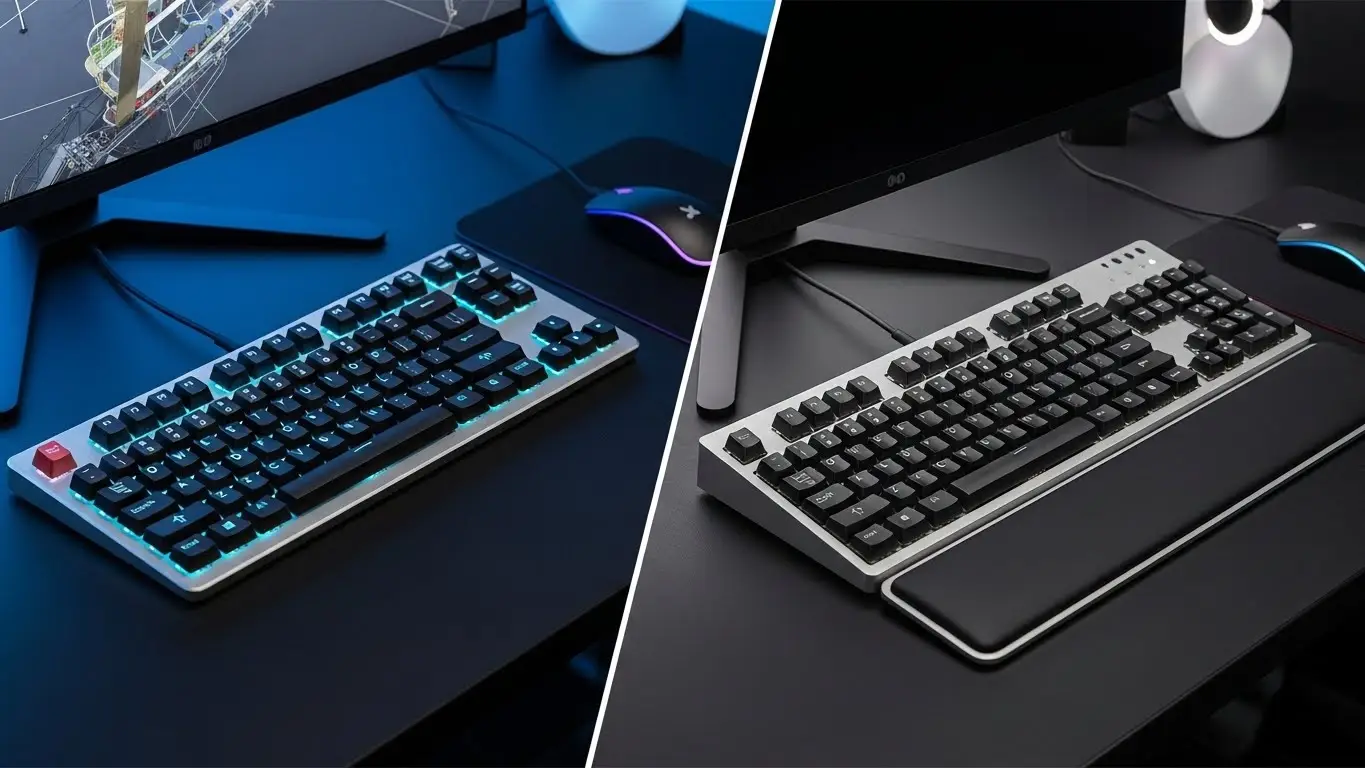
| Feature | Low-Profile Tactile Switches | Standard Tactile Switches |
| Switch Height | Shorter (e.g., 12.2 mm to 14.5 mm) | Taller (e.g., 17.9 mm to 18.5 mm) |
| Total Travel | Shorter (Typically 2.5 mm – 3.2 mm) | Longer (Typically 3.5 mm – 4.0 mm) |
| Actuation Point (Pre-Travel) | Shorter (Typically 1.2 mm – 1.7 mm) | Longer (Typically 2.0 mm) |
| Tactile Feedback | Crisper, faster response, less pronounced bump | More substantial, pronounced, and deeper bump |
| Ergonomics | Inherently more ergonomic due to flatter design, less wrist extension required | May require a wrist rest for comfort during long sessions |
| Portability | Excellent; ideal for compact, lightweight, and travel-friendly devices | Poor; bulkier and heavier, requiring more space |
| Customization | Limited selection of keycaps and switch variants | Vast selection of keycaps (e.g., Cherry, OEM profiles) and switch types |
Why is Actuator Travel Distance the Most Important Metric?
Actuator travel distance is the most important metric because it directly dictates the speed and feel of the switch. Travel distance is the physical space the plunger moves. A shorter travel distance means a keypress registers faster. This is crucial for rapid input applications like gaming or speed-typing.
The total distance is comprised of the pre-travel (actuation point) and the subsequent travel. Low-profile switches often actuate at just $1.2\text{ mm}$ to $1.7\text{ mm}$ of pre-travel. Standard switches generally actuate at $2.0\text{ mm}$ (Source: [Placeholder for Technical Data Sheet/Industry Standard]). For a user, a shorter throw translates to less finger fatigue over extended periods. It creates a snappier, more immediate typing sensation.
How Do Low-Profile Switches Affect Ergonomics and Wrist Health?
Low-profile switches significantly improve ergonomics by facilitating a more neutral wrist position. Since the switch is shorter, the entire keyboard or device interface can be flatter and closer to the desk surface. This reduced overall height minimizes the degree to which a user must extend their wrists upwards.
A flatter wrist angle reduces strain. Standard switches often force the wrist into an unnatural upward position, increasing the risk of Repetitive Strain Injuries (RSI). I often recommend low-profile boards to users who experience wrist discomfort with traditional setups. This aligns with modern ergonomic design principles that favor a minimal angle between the hand and forearm.
Where Are Low-Profile Tactile Switches Most Commonly Used?
Low-profile tactile switches are most commonly used in applications prioritizing minimal form factor and portability. This includes laptops, ultra-slim mechanical keyboards, specialized compact keypads, and many modern Point-of-Sale (POS) systems.
Their compact size makes them ideal for any device where space is at a premium. They are prevalent in the ergonomic mechanical keyboard community for custom split and compact designs. These switches are a must-have for devices designed to be taken on the go, as they offer the mechanical feel without the bulk. You can explore how compactness affects other switch types in our comparison of Tact Switches vs Micro Switches.
Where Are Standard Tactile Switches the Optimal Choice?
Standard tactile switches are the optimal choice for applications where robustness, maximum feedback, and customization are critical. This includes high-end gaming keyboards, industrial control panels, medical diagnostic equipment, and desktop keyboards.
The taller housing allows for larger internal components, often translating to a more reliable, durable mechanism with a higher operating life—often rated for 50 million keystrokes or more. The deep travel provides definitive feedback, which is essential for high-precision, deliberate inputs. Their design is also the standard for industrial applications requiring enhanced sealing against contaminants. For more on protection levels, see our guide on Sealed vs Waterproof Tact Switches.
Do Low-Profile Switches Offer the Same Noise Profile as Standard Switches?
No, low-profile switches generally do not offer the same noise profile as standard switches. The shorter travel distance and different internal housing structure typically result in a crisper, sharper sound profile, sometimes described as clackier. Standard tactile switches, with their greater travel and larger housing, often produce a deeper, more resonant thock sound, especially when paired with high-quality keycaps and a well-damped keyboard case.
| Noise Characteristic | Low-Profile Tactile | Standard Tactile |
| Sound Quality | Sharper, higher pitch, immediate | Deeper, lower pitch, more resonant |
| Volume Potential | Can be quieter overall due to less momentum, but the clack is more immediate | Can be louder if not properly built, but better potential for thock with mods |
| Acoustic Environment | Preferred for shared offices where a quick, subtle response is needed | Preferred for home/private use where a satisfying, audible feedback is desired |
What is the Impact of Switch Profile on Keycap Customization?
The switch profile has a profound impact on keycap customization because low-profile keycaps are unique and non-interchangeable with standard keycaps. Standard tactile switches, particularly those using the ubiquitous MX-style stem (a cross-shaped connector), have a universal keycap mounting system. This grants the user access to thousands of keycap sets in various profiles (Cherry, OEM, SA, etc.).
Low-profile switches use a proprietary or limited cross-stem design. This significantly restricts the available keycap options, often limiting the user to only the keycaps provided by the manufacturer. If customization is a major priority, standard switches are the unequivocal winner.
How Do Actuation Force and Force Curve Compare?
The actuation force, or the peak force needed to register a press, can be similar, but the force curve feels dramatically different. While both types of switches can be manufactured with a similar operating force (e.g., $50\text{ gf}$), the low-profile switch reaches its actuation point and the bottom of the travel much faster.
The tactile bump—the key feature of a tactile switch—is compressed into a much shorter path in a low-profile design. This makes the bump feel less drawn-out and more immediate or snappy. The standard switch, having a longer distance, allows for a more gradual, drawn-out, and pronounced tactile event. For an in-depth look at this feedback mechanism, check out our guide on Illuminated vs Standard Tact Switches.
Which Switch Profile is More Durable and Why?
The standard tactile switch profile is generally considered more durable due to its larger internal components and more robust housing. The greater physical size allows for stronger springs and thicker plastic walls. While low-profile switches are certainly engineered for millions of cycles (often rated for $50\text{ million}$), the larger components of a standard switch provide an inherent structural advantage against heavy use and off-center presses.
I have seen industrial standard switches withstand significant physical abuse on production lines. The larger standard footprint also tends to offer more stability on the Printed Circuit Board (PCB). This makes them less susceptible to damage during assembly or from hard use.
Which Switch Type is Better for High-Performance Gaming?
For high-performance, competitive gaming, the low-profile tactile switch often provides a distinct edge because of its faster actuation point. The minimal key travel means a shorter response time between thought and action. A difference of even $0.5\text{ mm}$ in travel can translate into faster in-game reactions.
However, the "better" switch is subjective:
- Low-Profile: Best for speed, rapid-fire actions, and minimizing finger travel for complex combinations.
- Standard: Best for users who rely on the distinct tactile bump to avoid misclicks during critical, deliberate inputs.
How Does the Cost of Low-Profile vs. Standard Switches Compare?
The cost per unit for low-profile tactile switches is often slightly higher than for standard switches. This increased cost is driven by the more complex engineering required to miniaturize the switch mechanism while maintaining reliability and a desirable tactile feel. Standard switches benefit from decades of design optimization and mass production, making their manufacturing more cost-effective. However, the final product price difference may be marginal depending on the volume ordered.
Conclusion: Making the Right Switch Choice
Choosing between a low-profile vs standard tactile switch boils down to a single question: What is the primary function and form factor of your device?
- Choose Low-Profile if: Portability, maximum ergonomics, and a sleek, modern aesthetic are your top priorities. You accept limited customization for a fast, snappy typing experience.
- Choose Standard if: Unmatched tactile feedback, ultimate durability, and extensive customization are non-negotiable. You prefer a deeper, more robust keystroke and can accommodate a slightly bulkier form factor.
My expert recommendation is to use a switch tester if possible. Experience is the truest metric in this debate. The one that feels right under your fingers is the one that minimizes fatigue and maximizes your productivity.
Frequently Asked Questions (FAQ)
The "tactile bump" is a slight, palpable resistance in the keypress that signals the user that the key has been actuated, or registered. In standard switches, this bump is generally more pronounced and spread over a longer distance, creating a satisfying, deliberate feel. In low-profile switches, the bump is compressed into a much shorter key travel, making it feel snappier and faster, but often less distinct.
No, you cannot use low-profile switches in a standard keyboard PCB, as they are not cross-compatible. Standard switches typically use through-hole or different surface-mount technology (SMT) with a taller pin layout. Low-profile switches are designed to sit closer to the PCB surface and have a different pin configuration, meaning they require a PCB specifically engineered for their reduced height.
Low-profile tactile switches can be better for quiet environments, but it depends on the specific model. They generally produce less overall noise than clicky-type standard switches. However, some silent standard tactile switches use dampeners to minimize the bottom-out noise, making them the quietest option overall. The low-profile's shorter travel can sometimes result in a sharp, audible 'clack' on bottom-out.
No, the lifespan is not significantly shorter in terms of cycle count. Most quality low-profile tactile switches are rated for a durability of 50 million keystrokes, which is the same as many standard switches. The potential difference lies in resistance to physical damage, where the more robust structure of a standard switch offers a slight advantage against high-force, repeated impacts.
