





Engineering Reliability: The Best Tactile Switches for Medical Electronics
In medical electronics design, a switch is never just a switch—it is a critical interface between a healthcare professional and patient safety. Whether it is the actuation button on a surgical ablation tool or the mode selector on a home dialysis machine, the component must meet stringent regulatory standards (IEC 60601) and survive aggressive sterilization protocols.
Selecting the best tactile switches for medical electronics requires balancing three competing priorities: hermetic sealing against fluids, precise haptic feedback to prevent dosage errors, and long-term electromechanical reliability. This guide analyzes the technical specifications required to specify switches for mission-critical medical devices.
1. The Critical Factor: Haptic Feedback and "Snap Ratio"
In a consumer remote control, a "mushy" button is an annoyance. In a medical device, it is a liability. "Haptics" refers to the tactile sensation transmitted to the user’s finger.
For medical applications, the Snap Ratio (the relationship between actuation force and return force) is the defining metric.
- High Snap Ratio (>50%): Provides a sharp, crisp "click."
- Best for: Surgical instruments and emergency stop buttons. The surgeon needs absolute physical confirmation that the switch has actuated without looking away from the patient.
- Soft/Silent Actuation:
- Best for: Bedside patient monitors and ultrasound machines. In these environments, loud clicks can contribute to "alarm fatigue" or disturb resting patients.
Engineering Tip: For handheld medical devices, look for a "Pre-Travel" specification. This ensures the switch doesn't trigger with accidental light brushes, which is vital forIoT and wearable medical devices.
2. Ingress Protection: IP67 vs. Chemical Resistance
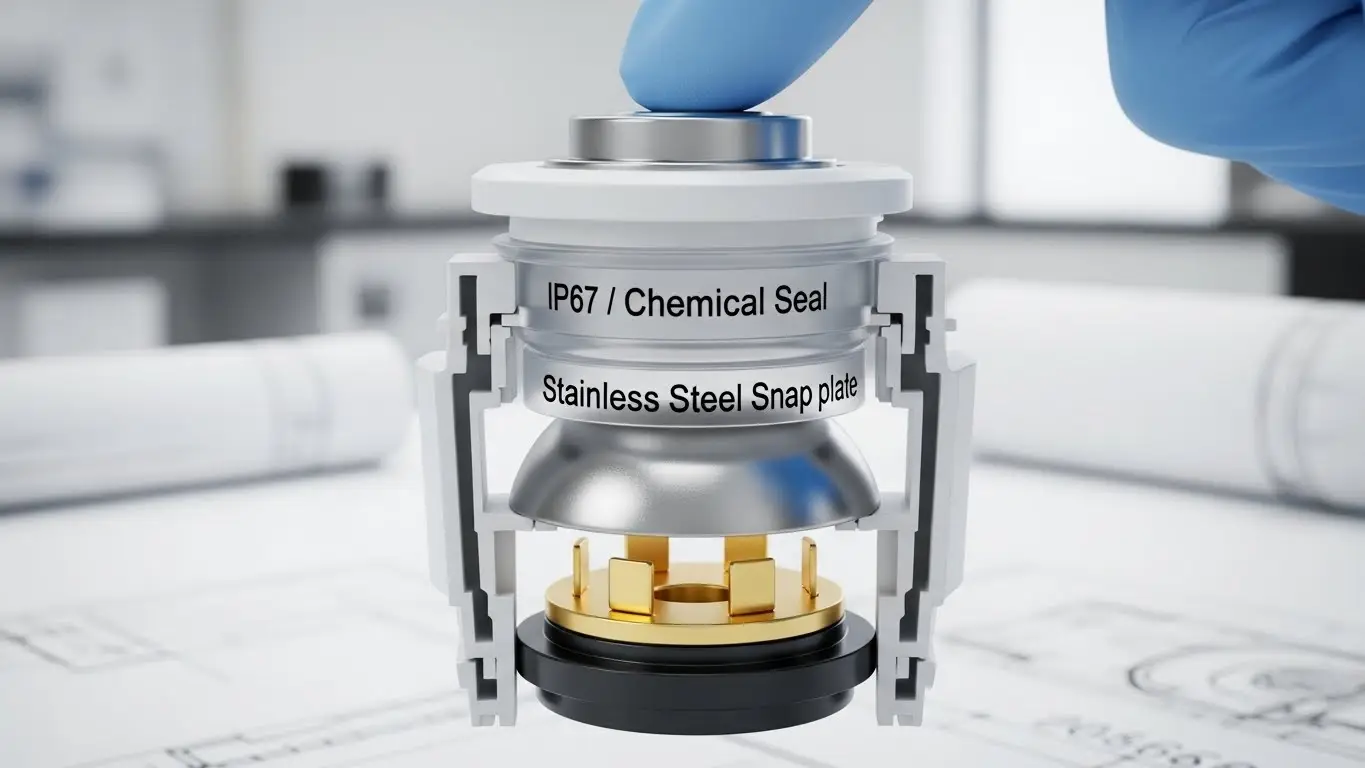
Most engineers know to specify IP67 ratings (dust-tight and temporary immersion) for medical environments. However, water resistance does not equal chemical resistance.
Hospital equipment is frequently wiped down with aggressive sterilization agents, including Isopropyl Alcohol, Bleach (Sodium Hypochlorite), and Quaternary Ammonium compounds.
- The Trap: Standard silicone actuators can swell or degrade when exposed to these chemicals over time.
- The Solution: Select Sealed Tactile Switches using chemically resistant materials like PBT (Polybutylene Terephthalate) or high-grade Nylon for the housing.
- Deep Dive: Learn more about protecting outdoor and harsh-environment electronics in our guide to waterproof tact switches.
3. Matching the Switch to the Application
Different medical environments demand drastically different switch architectures.
A. Surgical & Critical Care (High Reliability)
Devices: Electrosurgical pencils, Defibrillators, Ventilators.
- Requirement: High Actuation Force (300gf - 500gf).
- Why: Prevents accidental activation. A high force curve ensures the action is intentional.
- Contact Material: Gold plating is non-negotiable here. It prevents oxidation and ensures reliable low-current switching (dry circuit) even after months of inactivity.
B. Home Health & Wearables (Compact & Efficient)
Devices: Glucose monitors, Insulin pumps, Portable ECG.
- Requirement: Low Profile (SMT) & High Cycle Life.
- Why: These devices are used multiple times daily. A switch rated for 100,000 cycles is insufficient; look for 1 million+ cycle life.
- Connectivity: These devices often interface with communication modules. Ensure your switch layout minimizes EMI (Electromagnetic Interference) near sensitive communication module switches.
C. Diagnostic & Laboratory Automation
Devices: Blood analyzers, Centrifuges, MRI consoles.
- Requirement: DIP Switches for Configuration.
- Why: Behind the panel, technicians often need to set calibration codes or device IDs during installation.
- Recommendation: Use DIP switches with raised actuators for easy field serviceability, or recessed ones to prevent tampering.
4. Integration with Hospital Infrastructure
Modern medical devices are rarely standalone; they are nodes in a "Smart Hospital" network.
- Data Transfer: High-speed data logging often runs alongside manual inputs. While the tactile switch handles the user input, the device's backend often relies on robust networking. (See our guide on Industrial Ethernet Switches).
- Shielding: Tactile switches for medical use should offer grounding options (ESD protection) to prevent static discharge from the user's finger from damaging sensitive internal microprocessors.
Frequently Asked Questions
"Medical Grade" generally implies the switch component supports compliance with IEC 60601-1 standards. This includes specific requirements for dielectric strength (insulation), flammability ratings (UL 94 V-0), and reliability testing (MTBF).
Gold contacts are highly recommended. Medical signals are often low voltage/low current ("dry circuits"). Silver contacts can tarnish (sulfurate) over time, creating resistance that causes signal failure. Gold remains stable and conductive indefinitely.
Switch bounce (signal fluctuation upon press) can cause a device to register a double-press. In medical dosing, this is dangerous. High-quality medical switches have low bounce times (<5ms), but this should also be mitigated via software debouncing or hardware RC filters.
No. Most standard switches cannot survive the high heat and pressure of an autoclave. Devices meant for autoclaving usually require the switch to be sealed within a fully hermetic enclosure, or use specialized high-temperature piezo or capacitive switches instead of standard mechanical tactile ones.
Key Takeaways
- Haptics Save Lives: Use high-force, high-snap ratio switches for surgical tools to confirm actuation blindly.
- Beyond Waterproof: Ensure switch materials are resistant to hospital-grade cleaning chemicals, not just water.
- Gold Standard: Always specify gold-plated contacts for low-power medical circuits to prevent failure from oxidation.
- Cycle Life Matters: For daily-use home health devices, prioritize switches rated for >1 million actuations.
Conclusion
The best tactile switch for a medical device is one that the user never has to think about. It functions consistently, resists the harsh hospital environment, and provides the exact feedback needed for the procedure. By prioritizing sealed designs, appropriate actuation forces, and premium contact materials, engineers can build devices that stand up to the rigorous demands of modern healthcare.
