





Best Tact Switches for IoT Devices
Selecting the best tact switches for IoT devices is a critical design decision that directly impacts user experience and product longevity. Whether you are building a wearable fitness tracker or a remote industrial sensor, the button is the primary physical interface. If that switch fails, your "smart" device becomes useless.
In my experience prototyping hardware, I have seen robust firmware defeated by a cheap, non-sealed switch that corroded after one month outdoors. The ideal switch for the Internet of Things (IoT) must balance an ultra-compact footprint with distinct haptic feedback and extreme durability. Let’s explore the specific components that ensure your device stays connected and responsive.
What Are the Key Criteria for IoT Switch Selection?
The most critical criteria for IoT switches are miniature size (footprint), high cycle life, ingress protection (IP rating), and distinct haptic feedback. Designers must prioritize Surface Mount Devices (SMD) to save PCB space and select actuation forces that match the device's intended use case, such as 160gf for consumer wearables or 260gf for industrial interfaces.
Balancing Size and Durability
In the IoT world, PCB real estate is the most expensive asset. A standard 6x6mm tact switch is often too large for a smart ring or a wrist-worn monitor. You are likely looking for 3x3mm or even 2x4mm side-actuated switches.
However, going smaller often means sacrificing the "click" feeling. I once worked on a smart home hub where we chose the smallest possible switch. Users hated it because they couldn't feel if they had actually pressed the reset button. We had to redesign the board to accommodate a slightly larger switch with a higher "click ratio" (the snap feeling).
Key Performance Indicators (KPIs) for IoT Switches:
- Life Cycle: Minimum 100,000 cycles for setup buttons; 500,000+ for main interface buttons.
- Travel: Short travel (0.15mm - 0.25mm) is preferred for compact devices.
- Current Rating: Low power (50mA @ 12VDC) is standard, fitting battery constraints.
Why Is IP Rating Essential for Outdoor IoT Sensors?
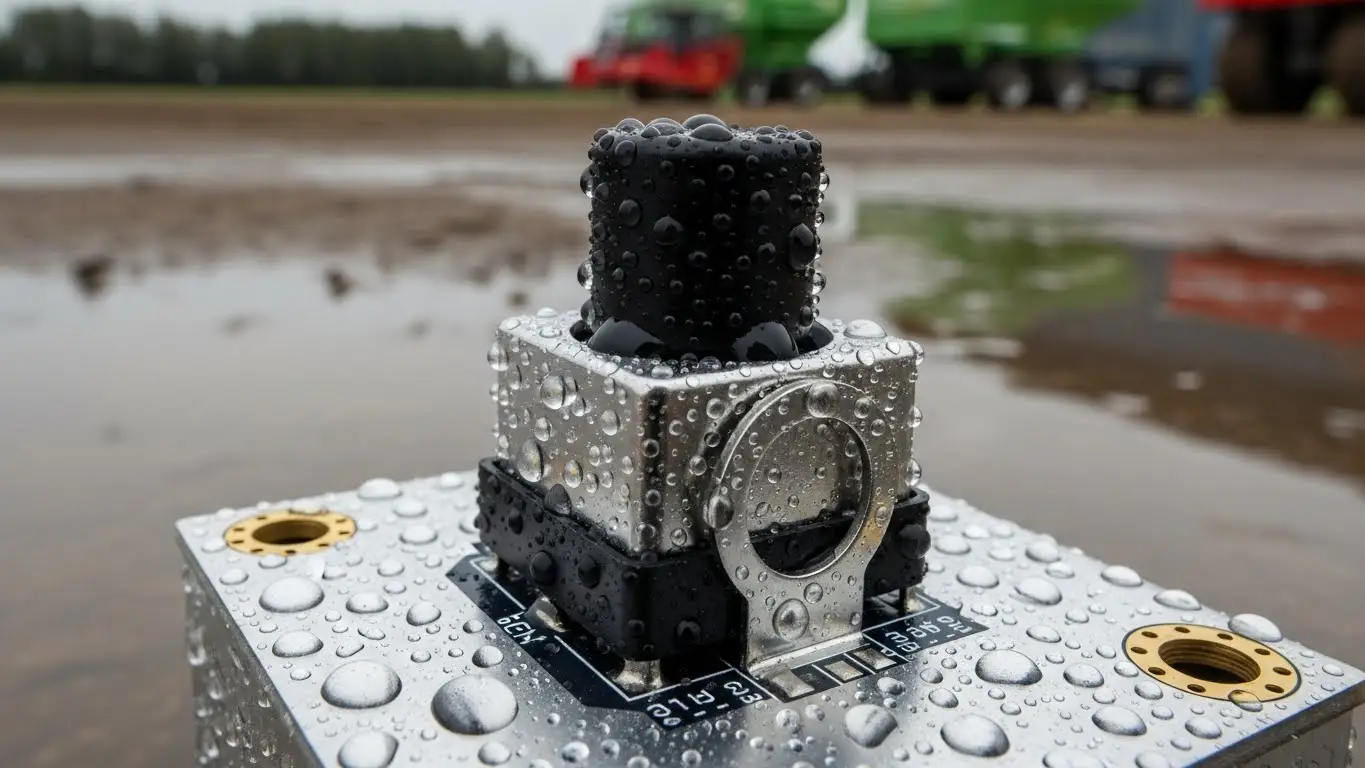
An IP67 or IP68 rating is essential because outdoor IoT sensors are exposed to humidity, dust, and temperature fluctuations that can corrode internal contacts. A sealed tact switch prevents moisture ingress, ensuring the device functions correctly in agricultural monitoring, smart city infrastructure, or marine tracking applications.
The Cost of Corrosion
"It's just a reset button inside a case; does it need to be waterproof?" Yes. Humidity condenses inside enclosures.
I recall investigating a batch of failed smart water meters. The enclosure was rated IP68, but the internal air volume expanded and contracted with temperature, drawing moist air in through the cable glands. The non-sealed tact switches on the PCB oxidized, causing phantom signals that drained the batteries.
Recommended Ratings:
- IP54: Acceptable for indoor smart home devices (thermostats).
- IP67: Mandatory for wearables (sweat resistance) and outdoor sensors.
- IP68: Required for devices liable to be submerged.
Ultra-Miniature vs. Low-Profile: Which Fits Your PCB?
Ultra-miniature switches minimize the X-Y surface area, while low-profile switches minimize the Z-axis height. For wearables like smartwatches, low-profile switches (under 0.5mm height) are critical to keeping the device slim, whereas ultra-miniature footprints are better for high-density sensor boards where component crowding is an issue.
Managing the Z-Axis
Thickness matters. In a smart card or a slim key fob, you literally cannot use a standard switch.
- Thin-Film Switches: These offer extreme thinness but often lack a sharp tactile feel.
- Dome Arrays: Using a peel-and-stick metal dome directly on the PCB pads is the ultimate space-saver, often used in remote controls and credit-card-sized trackers.
If you are designing a sleek consumer product, specify a "low-profile SMD tact switch" early in the BOM (Bill of Materials). If you wait until the enclosure is designed, you may find yourself with no vertical clearance for a tactile component.
How Does Actuation Force Impact User Experience?
Actuation force determines the "heaviness" of the press; 160gf is the industry standard for general use, while 100gf is soft and 260gf is firm. For IoT devices that are handheld or worn, a crisp 160gf-240gf force provides reassurance that the input was registered, reducing user frustration and accidental double-presses.
The "Mushy" Button Problem
A switch with low actuation force (e.g., 70gf) combined with a rubber keypad can feel "mushy." Users will press harder, thinking the device didn't register the input, which damages the switch over time.
- Wearables: Use higher force (200gf+). It prevents accidental activation when the user bends their wrist.
- Wall-Mounted Hubs: Use medium force (160gf). It feels high-quality without requiring too much pressure on a mounted device.
How Do Switches Connect to the Broader IoT Ecosystem?
Tact switches serve as the local physical interface (reset/pairing), while the data transmission often relies on gateways connected via Industrial Ethernet. While the tact switch initiates the action (like "pairing mode"), the reliable transport of that data to the cloud often passes through a robust wired network backbone.
From Button Press to Cloud Data
It is important to view the tact switch as the start of a chain. You press the button -> The MCU wakes up -> The radio transmits data -> The gateway receives it.
In industrial IoT (IIoT), that gateway is often plugged into a rugged network switch. If you are designing the infrastructure that supports these sensor networks, understanding the backbone is just as important as the edge device. You can learn about the networking side in our Industrial Ethernet Switch Guide, which explains how data from thousands of small IoT sensors is aggregated and processed safely.
Comparison of Top Switch Types for IoT
The best switch type depends on mounting; Top-Actuated SMD is best for flat buttons, while Side-Actuated is ideal for edge-mounted reset or power buttons. Selecting the correct orientation simplifies the mechanical design of your enclosure and buttons (caps).
Selection Matrix
| Switch Type | Best For | Pros | Cons |
| Top-Actuated SMD | Smart Home Panels | Easy SMT assembly, stable | Adds height to device |
| Side-Actuated | Wearables, Tablets | User access from side | Requires PCB edge placement |
| Illuminated Tact | Status Indicators | Visual feedback + Input | Higher power drain |
| Sealed (IP67) | Outdoor Sensors | Corrosion resistance | Slightly higher cost |
What About Power Consumption and Leakage?
While tact switches are passive mechanical components, "leakage current" can occur in poorly isolated circuits or damaged switches, draining IoT batteries. High-quality switches with high insulation resistance (typically >100MΩ) are vital for battery-powered devices intended to sleep for years between button presses.
The Silent Battery Killer
In "Always On" low-power modes, the microcontroller waits for an interrupt signal from the switch. If moisture creates a micro-short (dendrite growth) across the switch pads, it creates a constant leakage path.
- Design Tip: Always use a high-value pull-up resistor (1MΩ or internal MCU pull-up) to minimize current flow during the active state.
- Component Choice: Specification sheets list "Insulation Resistance." Never ignore this line item for coin-cell powered devices.
Conclusion: Making the Right Choice
Selecting the best tact switches for IoT devices is not just about finding a part that fits the pads. It is about ensuring the mechanical integrity of the user interface.
- Prioritize Sealing: If it goes outside or on a wrist, get IP67.
- Check the Force: 160gf is safe; 240gf is premium.
- Watch the Height: Don't let a tall switch ruin your slim enclosure design.
By focusing on these metrics, you ensure your IoT product feels professional and functions reliably in the real world.
Frequently Asked Questions (FAQ)
For most IoT devices, a standard tact switch should be rated for at least 100,000 cycles. However, for primary buttons on consumer electronics (like a main function button), it is best to look for switches rated for 500,000 to 1,000,000 cycles to ensure longevity.
It is difficult. Standard 6x6mm switches are usually too large and tall for slim wearables like fitness trackers. You should look for "ultra-miniature" or "low-profile" SMD switches, often measuring 3x3mm or smaller, to fit within the compact enclosure.
Not all, but it is highly recommended. Even indoor devices are subject to humidity and spills. Using an IP67-rated sealed switch costs marginally more but significantly reduces field failures due to corrosion and dust ingress.
Actuation force is the pressure required to "click" the switch (e.g., 160gf). Return force is the strength of the spring pushing the button back up. A good ratio between these two ensures the button feels "snappy" and doesn't get stuck down.
If you use sealed (washable) tact switches, you can use standard aqueous PCB cleaning processes. If you use non-sealed switches, you must be very careful, as washing can flush flux residue inside the switch, ruining the contact. Always check the datasheet for "washability."
